What increases your social status?
Being a trusted group member is #1. This is what people value in their community.
Other factors include intelligence, university prestige, leadership, knowledge, creativity, honesty, public speaking, income, humor and kindness.
Stealing, stupidity, STDs, and uncleanliness are the biggest ways to reduce your social status.
I have been thinking about the famous chart showing how experts keep projecting linear growth in solar installations, year after year, and always get it wrong when growth is still exponential.
I think the same thing is happening with the discourse on product strategy around AI.
12 Things Everyone Should Know About Sex Differences
2. On average, men place more weight than women on a long-term mate’s looks (first graph below), whereas women place more weight than men on a mate’s wealth and status (second graph).
https://t.co/Awk2mzm4k7
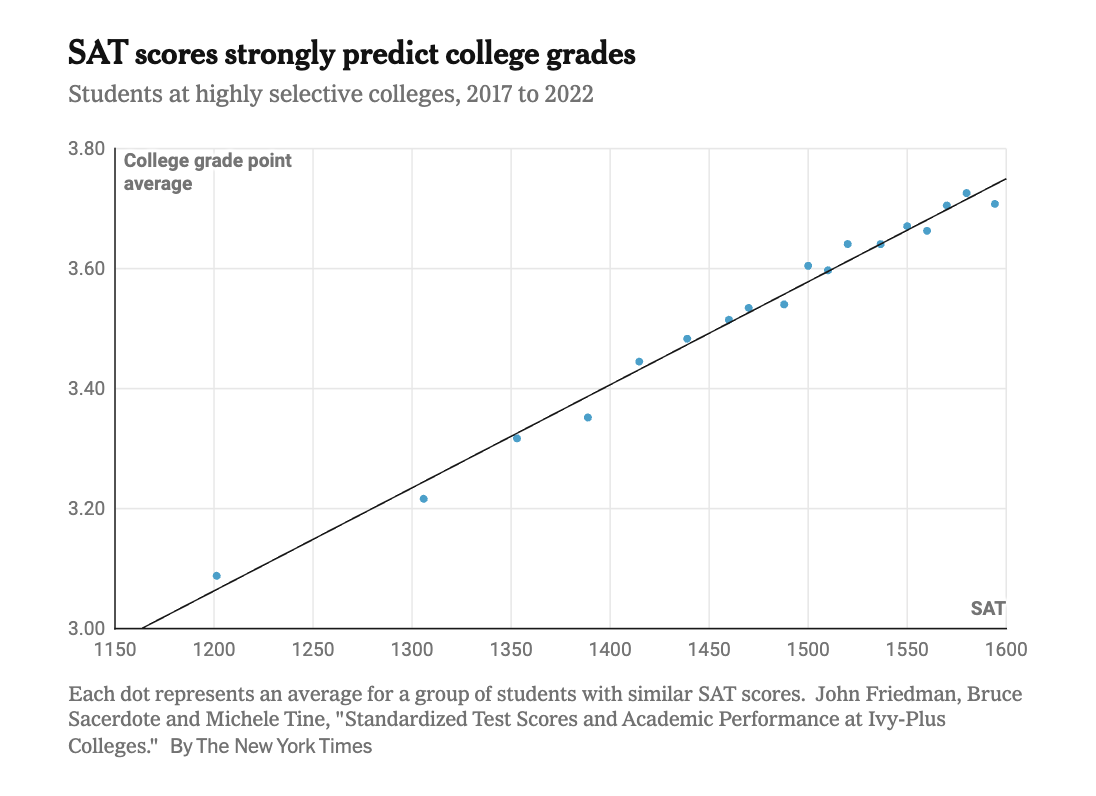
Removing standardized tests has been a disaster for many top colleges.
Seven years ago, the University of California system appointed an 18-member committee to study the use of standardized tests in its undergraduate admissions. The committee included professors from all 10 campuses and a range of disciplines. They spent a year studying the issue and published a 225-page report full of evidence and recommendations.
The committee concluded that scores on the SAT and ACT, the main standardized tests for college admissions, did a better job measuring student readiness for college than high school grades. High test scores were particularly good at finding talented students from low-income families and underrepresented minority groups. For these reasons, the committee recommended the system continue to require applicants to submit SAT or ACT scores.
The university’s leaders disregarded the report.
A few months after its release, early in the Covid-19 pandemic, the system’s Board of Regents voted to stop using the tests in undergraduate admissions. Initially, the university planned to make the submission of SAT and ACT scores optional, as many other colleges did during the pandemic. Almost immediately, though, the University of California began refusing to accept SAT or ACT scores, even from students who wanted to submit them. The policy was known as “test blind.” University leaders wrongly claimed that it would make admissions fairer and more equitable.
The results have been terrible. At the University of California, San Diego, a faculty group last year reported “a steep decline in the academic preparation” among entering students. Last fall, for example, nearly 12 percent of first-year U.C.S.D. undergraduates were not qualified to take pre-calculus, a low-level class, up from only 0.5 percent in 2020. “The key problem is that many of the students coming in do not know algebra,” said Mina Aganagic, a Berkeley physics professor. More than half of entering Berkeley students who took a math placement test incorrectly answered basic questions (such as solving for x in x²> 4). https://t.co/ZvdsWBU1sY
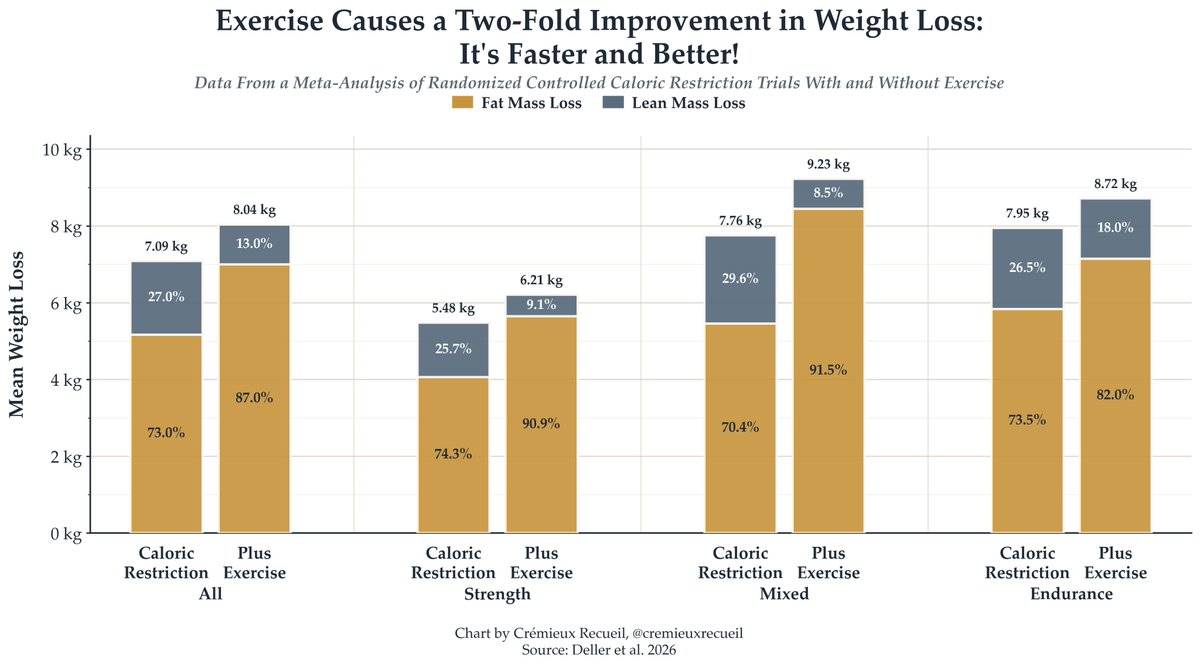
We now have meta-analytic confirmation:
Adding exercise on top of caloric restriction leads to more weight loss.
It also leads to better weight loss, with less of the weight lost as lean mass, and more of it lost as fat mass.
No child is born able to read. The brain ships with no reading region at all. It builds one, and the construction runs on the exact effort AI removes.
Learning to read physically repurposes a patch of visual cortex. A spot in the left fusiform gyrus starts out tuned to objects and faces. Through months of effortful decoding, a 6-year-old converts it into the visual word form area, the region every literate adult uses to recognize words on sight. Stanislas Dehaene mapped it and called it neuronal recycling. Pre-literate kids show no special response to letters there. It shows up only as they struggle to read.
The struggle is the build signal. When a child strains to sound out a word or hold a sum in working memory, focus chemicals like acetylcholine and norepinephrine flag that circuit as worth keeping. Effort is how the nervous system marks which synapses to strengthen. Low effort, no marker.
Errors carry the same signal. The brain learns from the gap between what it predicted and what turned out true. Each wrong guess followed by a correction releases the dopamine that drives the rewire. Fluent, instant output produces almost none of it.
The wiring locks in later, during deep sleep, when the circuits tagged that day get consolidated. Only the ones that fired hard enough to get tagged. A child who never strained tagged nothing to keep.
Hand that child a model that returns the sentence or the answer on demand, and the strain, the errors, and the prediction gap vanish at once. The worksheet looks finished. The cortex that should have rewired underneath it never fired.
The window is the urgent part. The tissue reading recycles is where childhood plasticity peaks, and ages 6 to 13 are when that repurposing is cheapest. Miss the reps then and the same wiring costs far more to build later, if it builds at all.
Norway is the country that already ran the opposite experiment. In 2016 they gave a tablet to every 5-year-old, went all in on screens in class, and watched the results for a decade. Now they're pulling AI out for ages 6 to 13 and funding paper books again. A government reading its own data ahead of the curve.
The biology is identical in every country. Norway just moved on it first. Watch how fast others follow.
"Overall, across the world, there’s reason to believe that happiness has increased for obvious reasons: people are living longer, they’re less poor, they’re better educated, and so on. That would suggest, though not prove, that there has not been a decline in meaningfulness. It’s still possible, but just anecdotally, there have been complaints that life is meaningless as far back as you can go.
You know: Ecclesiastes—“Vanity of vanities, all is vanity.” Henry David Thoreau, in 1854: “The mass of men lead lives of quiet desperation.” Now, how a guy living in a cabin on a pond could know this is unclear, but that was the perception. T.S. Eliot: “We are the hollow men, we are the stuffed men,” in the 1920s.
Starting in the 1950s, there was a great fear of alienation. That was the big issue, and part of the counterculture was the idea that suburban middle-class life was meaningless, empty, plastic, and artificial. The Pursuit of Loneliness, a 1970 bestseller by Philip Slater. Jimmy Carter’s “malaise” speech in the late 1970s.
So it’s a constant complaint. The fact that people say it doesn’t necessarily mean it’s true."
@HumanProgress
“It’s ironic that, in an age where we rightly celebrate differences and diversity, we often get outraged when anyone points them out. Not exactly tolerance of diversity!”
An excerpt from my recent op-ed in The Independent.
https://t.co/pz3QA3Eq76
A man's ability to throw projectiles overhead leaves telltale traces on his face.
Humans have a remarkable and unique capacity to throw projectile weapons. The ability to throw overhand with power and accuracy, to wound and kill from afar, is a derived adaptation within the genus Homo that undoubtedly had a profound effect on the success of our ancestor, by offering advantages in fighting and hunting. As a result, the capacity to quickly infer this trait in others could have also been adaptive for the purposes of assessing coalitional partners, rivals and potential mates.
The current research investigates whether people can accurately infer the overhand throwing ability of others based on facial appearance.
We demonstrated that face-based inferences of overhand throwing ability are accurate, predicting an analogue of ancestral projectile weaponry, the javelin, among male track and field athletes. Moreover, we found that javelin throwers have distinctive facial shapes, which may be driving these perceptions. Facial morphometric analyses showed that javelin throwers could be distinguished from the other track and field athletes by more prominent brows, a narrower interorbital distance, a broader mid-face and a more elongated chin.
Finally, we replicate these effects and demonstrate that face-based inferences of overhand throwing ability can be decoupled from perceptions of physical strength and formidability. Overall, the ratings from male and female participants were highly similar across all three studies, which is consistent with the view that face-based inferences of overhand throwing could have been adaptive both in terms of assessing potential rivals and coalitional partners (male–male competition) as well as identifying mating partners that can provide, protect and provision (female choice).
New preprint: There is only one correct analysis. https://t.co/BBrwVm6elC
We take a critical look at recent proposals for multiverse or many analyst procedures, and strongly argue that epistemic uncertainty should be reduced, not “embraced”. >
This is a great post by @FranckRamus.
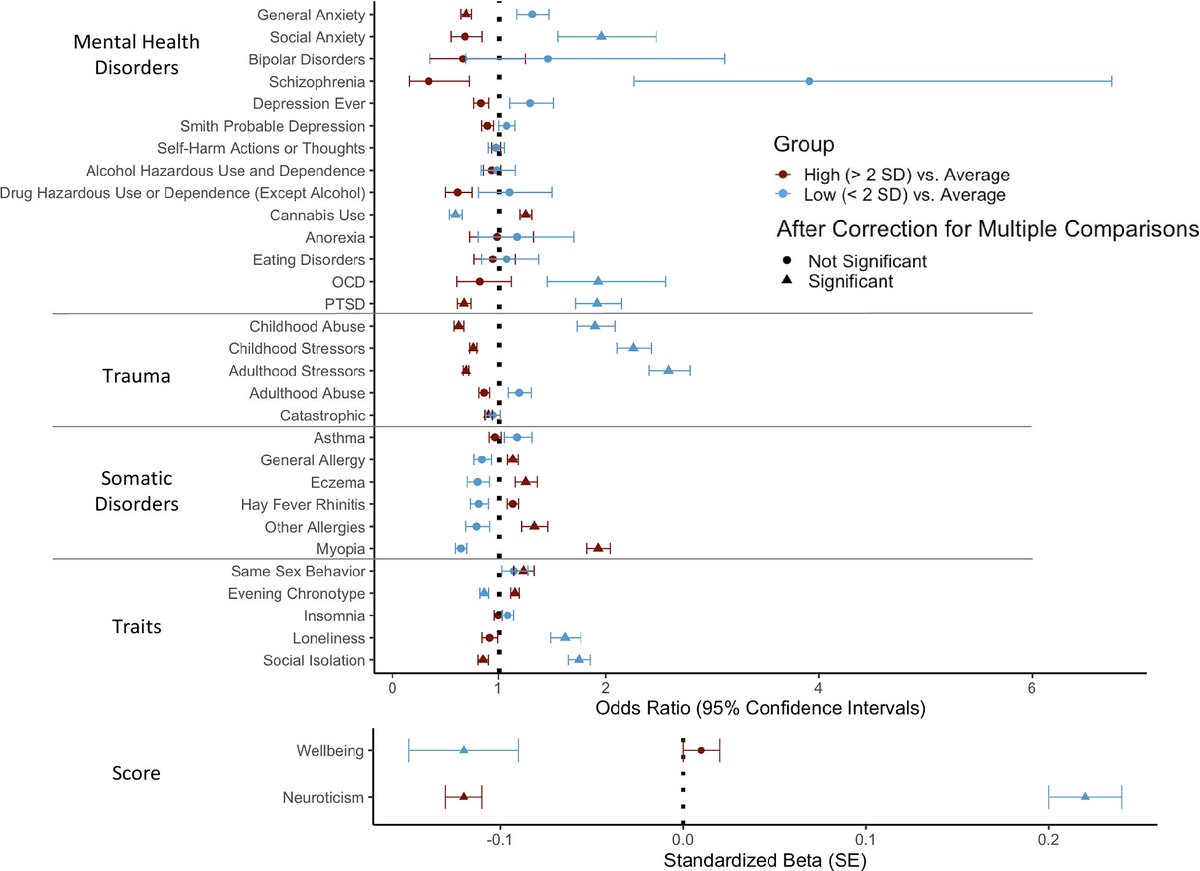
He shows that, contrary to a popular myth, high IQ children do not suffer elevated rates of academic, cognitive, or psychological impairment.
Just take a look at this result from his paper with @Cognitive_Camz
https://t.co/MD2xMObe39
Children who score higher in intelligence tests tend to be diagnosed with ADHD later than those with lower scores. This is presumably because smarter children are better at masking their symptoms. https://t.co/G4poptRuMK
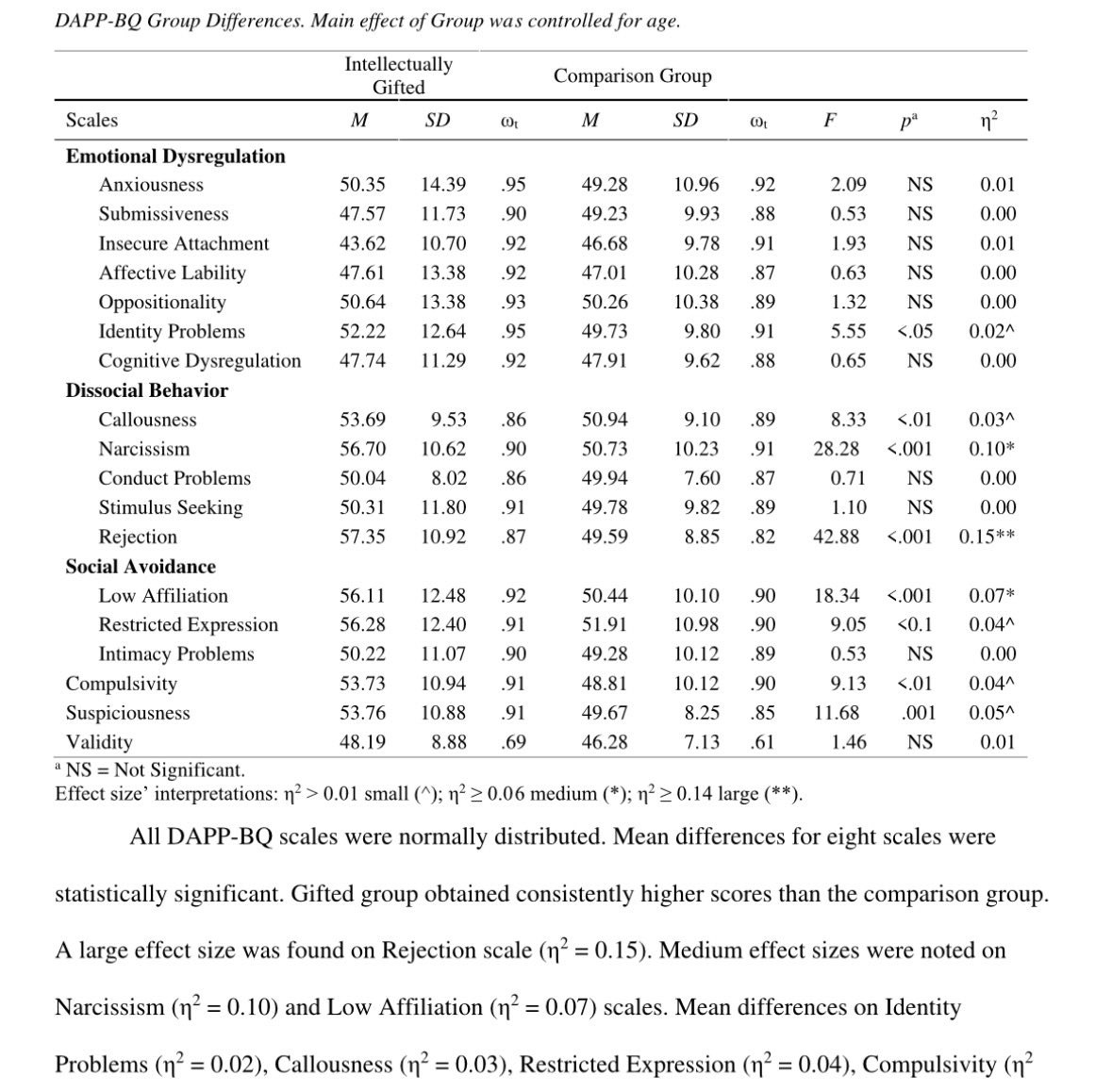
75 gifted adults with IQ scores above 130 (WAIS-IV or Mensa) showed these patterns compared to average-intelligence:
• Noticeably less interested in other people’s feelings and more dominant in how they handle relationships.
• Higher scores on narcissism (medium effect; the scale includes grandiose elements).
• Stronger preference for emotional distance and keeping others at arm’s length rather than seeking closeness.
• Elevated emotional guardedness and restricted expression of feelings.
• More rigidity and compulsivity in habits and thinking.
• Heightened suspicion toward others.
• More identity-related struggles
• Increased callousness — disregard for others’ feelings/well-being and reduced empathy/remorse.
Gifted women scored higher overall on these traits than gifted men in the sample.
“… high Intelligence Quotient (IQ) may represent a potential risk factor for the development of affective dysregulation, depression, bipolar disorder, attentional and hyperactivity deficits, autism spectrum disorders, and immune disorders (Karpinski, Kinase Kolb, Tetreault, & Borowski, 2017).”
However — “The present paper aims at overcoming these limitations, examining personality vulnerabilities of intellectually gifted adults. Livesley's dimensional model was used specifically for its capability to assess subclinical symptoms which traditionally do not fulfill criteria for psychopathological diagnosis.”
Yet another study shows a 24% reduced risk of dementia after the Shingles vaccine. This one in over 500,000 participants with a recent skilled nursing facility stay, adding to 4 huge natural experiments in 4 countries (US, Canada, Wales, and Australia)
https://t.co/TmYqwTB7IT @AnnalsofIM
Researchers show that Claude Code is 98% not AI.
Anthropic never gave us the architecture for Claude Code. There were no docs. Just a tool that every developer is currently obsessing over.
Until it leaked recently.
A research team pulled the source code, analyzed all 500,000 lines, and found something ridiculous.
Only 1.6% of the codebase actually interacts with the AI model.
The core of Claude Code is literally just a simple while-loop. It asks the model what to do, runs a tool, and repeats.
So what is the other 98.4%?
It is hardcore, traditional software engineering.
The researchers found a massive, complex infrastructure designed entirely to babysit the AI and keep it from hallucinating or destroying your computer:
- A 7-mode permission system acting as a security bouncer.
- A 5-layer context compaction pipeline so the AI doesn't forget its goal.
- A subagent delegation mechanism with strict worktree isolation.
- Four different extensibility hooks to manage external tools safely.
Every startup right now is trying to build a better AI model to get better results.
Anthropic did the exact opposite.
They took an existing model and built a fortress of deterministic software around it.
They realized that the AI doesn't need to be smarter. It needs to be managed.
Recent research suggests that genes associated with educational attainment are being selected against, whereas genes associated with depression, asthma, and earlier first birth are being favored. (US data.)
https://t.co/e6iKLpqxka