🧵 How does a pathogen know it has entered its host?
🎉 Our paper is published in Nature Communications!
We found a co-evolved peptide–GPCR system that helps the corn pathogen Ustilago maydis detect host entry and promote infection.
🔗 Read: https://t.co/H1dzJsYpot
Thrilled to finally see BoltzGen, our new state-of-the-art all-atom binder design model, coming out fully open-source after a very extensive experimental validation with many top academic and industry labs! 🧬
The diversity of the experiments is unprecedented, spanning binder modalities from nanobodies to disulfide-bonded peptides and including targets ranging from disordered proteins to small molecules. These experiments demonstrate state-of-the-art performance, for example, a 67% success rate at designing nanomolar nanobody binders against several novel targets with only 15 or fewer designs. 🚀
Incredible work from an amazing team led by @HannesStaerk! 🤗
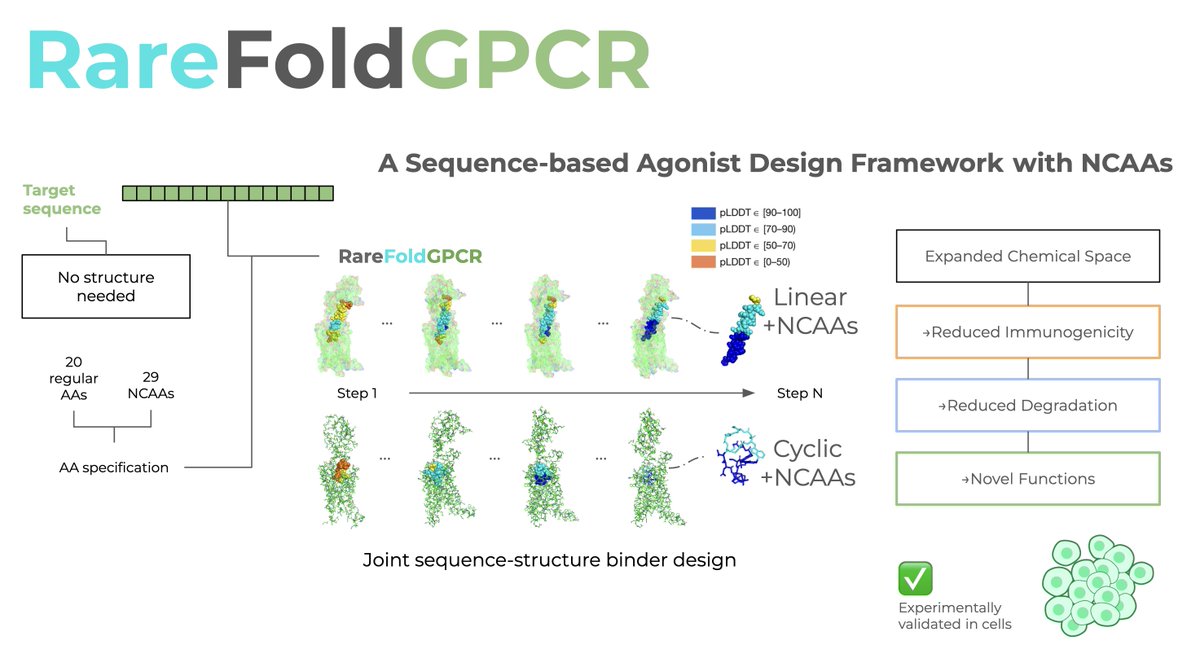
The future of drug design is in AI. Let me introduce our new work, RareFoldGPCR: Agonist Design Beyond Natural Amino Acids.
Paper: https://t.co/Xd5UMDI4IF
Code: https://t.co/N4JuxIl6o5
Happy to introduce AlphaGenome, @GoogleDeepMind's new AI model for genomics.
AlphaGenome offers a comprehensive view of the human non-coding genome by predicting the impact of DNA variations. It will deepen our understanding of disease biology and open new avenues of research.
Molecular biology research is a game that you can’t win without strict rules 🎲. Here are my 6 rules and reflections as I leave this lab:
Rule #1: Everything gets a code! Tubes aren’t the place for descriptions (1/6) 🧵
Introducing ATOMICA 💫
A model to universally represent molecular interactions (for proteins, nucleic acids, small molecules, and ions) at an all-atom scale 🧵
Our paper “Blocking IF3N delays bacterial translation initiation” is out on #biorxiv
Awesome work from @ana_sancas and @Ka_li44 in collaboration with friends from @WilsonLab2 and @akonevega labs!
https://t.co/IE1OD4fIvi
Maravillas de la naturaleza! estructuras a alta resolución de ribosomas en iniciación y unidos a 3 antibióticos!
Gracias @ProcienciaPeru por financiarnos, @WilsonLab2 y @UniCamerino por la exquisita colaboración!
Impresionante contribución de @anasanc!
https://t.co/VCd6Ya5gsd
We trained a genomic language model on all observed evolution, which we are calling Evo 2.
The model achieves an unprecedented breadth in capabilities, enabling prediction and design tasks from molecular to genome scale and across all three domains of life.
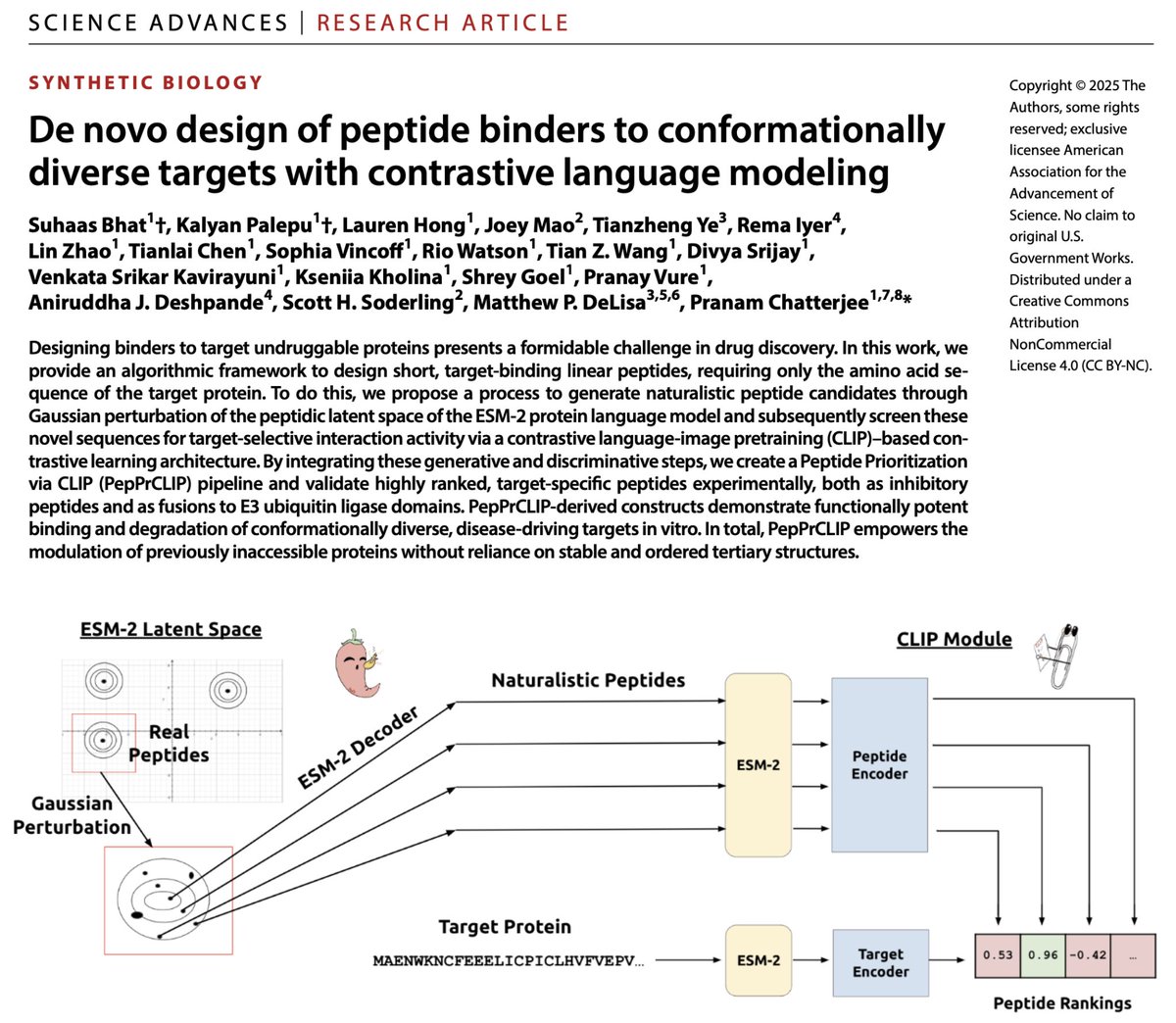
I'm usually not too emotional about paper acceptances, but this one justifies it. 🥹 It doesn't feel real, but PepPrCLIP is now published at @ScienceAdvances! Let me tell you its story. 📕
📜: https://t.co/x0nlBSJ8cJ
💻: https://t.co/uQftSZGdgb
PepPrCLIP (🌶️📎) began as Cut&CLIP, before I even came to @DukeU in 2022, where my first @Harvard undergrad mentee @kalyanmpalepu (now at @DEShawResearch ) would cut ✂️peptides from interacting partner proteins, and throw them thru a trained peptide-protein CLIP 📎 model to predict which ones were specific to the target (cool use of DALL E 2's architecture, right?). We had good initial experimental results, but they weren't robust enough for publication. 🤔
While the team tried to get our CLIP model better for experimental testing, my amazing other @Harvard undergrad @garykbrixi came up with a really unique way of cutting peptides from the ESM-2-predicted binding sites of partners (our SaLT&PepPr model🧂). We changed the focus to SnP (get it, SnP ✂️?), and spent over a year through numerous good/bad review processes, and FINALLY got it out last October in @CommsBio: https://t.co/DavIss1CXP 🥳
@bhat_suhaas, a @Harvard undergrad, later a Rhodes Scholar (so proud of you!! 🥹🫵), and @kalyanmpalepu's roommate, who stuck with me as I transitioned to @DukeU, kept working on it with Kalyan, and not only trained a beautiful CLIP model on peptides and proteins with ESM-2 embeddings (goodbye ESM-1b and MSA transformer!), but also devised an incredibly clever way of generating new peptides via Gaussian perturbation of peptide embeddings for screening with CLIP, creating PepPrCLIP! ���️📎 The experimental validations were beautiful, and it became our first de novo peptide model in the lab! 👩🔬
We went into submission at another top journal, and worked hard to iron out IP issues, but at the end of the day, it was just too difficult to convince structure-focused reviewers how this was better than RFDiffusion 😑, even though we showed strong data showing PepPrCLIP-generated peptides allowed us to extend to conformationally disordered targets that RFDiffusion/structure-based methods could not access (we even did better on structured targets than RFDiffusion in vitro!). Frustrating. 😒
Still, we had incredible data! As you can see in our manuscript, PepPrCLIP-generated peptides can serve as inhibitory peptides to enzymes (i.e. biotin ligases, like UltraID) as well as degraders to transcription factors (β-catenin) and EVEN heavily-disordered fusion oncoproteins (SS18-SSX1)! 🧫 We showed extensive binding, inhibition, and degradation data in endogenous cellular settings and have now extended PepPrCLIP to more undruggable targets! And after over 2 years since our first submission, @ScienceAdvances, who published my first first-author paper back in graduate school, decided to accept it! 🌟 Full circle. ⭕️ Incredible. 😭
To the most important part: I am forever, forever grateful to @bhat_suhaas and @kalyanmpalepu's incredible dedication to this work, even after I moved to @DukeU and even after they graduated from @Harvard. 🫂 I love you guys. 🫶 And I couldn't be more thankful to our incredible collaborators @SoderlingLab @DeLisaGroup and @anideshpandelab (as well as the amazing experimentalists in my lab) who believed in our algorithm and did the painstaking experiments to prove it out. 🙏 Just an INCREDIBLE team-wide effort to get this over the finish line. I am just so lucky and so grateful -- I don't deserve such an amazing collaborators. 🥲
Finally, with the generous support of my company @UbiquiTxINC, we have made the code FREELY AVAILABLE to academics after signing a non-commercial license! I can guarantee you that PepPrCLIP peptides will work for your target! 😉
Feel free to read our paper and provide your thoughts! 💡We just got multiple other big paper acceptances and will be sharing those shortly as they come online! 🪇
We're thrilled to present ESM3 in @ScienceMagazine. ESM3 is a generative language model that reasons over the three fundamental properties of proteins: sequence, structure, and function. Today we're making ESM3 available free to researchers worldwide via the public beta of an API for biological intelligence.
Trained with over a trillion teraflops of compute, this is the first time a model of this scale has been trained for biology, pushing the frontier of AI for biological discovery and engineering.
ESM3 learns to represent the immense complexity of protein biology, learning from billions of natural proteins. From this training it developed the capability to design proteins, responding to complex prompts combining atomic level details and high level instructions to generate new proteins.
ESM3 can explore protein space far beyond natural evolution. We prompted ESM3 to generate a fluorescent protein at a far distance from any known fluorescent proteins, searching an unknown region of protein space, to discover a new fluorescent protein.
We estimate this is equivalent to simulating five hundred million years of evolution.
We release our protein chatGPT, Evola! 🌟 https://t.co/xHrp0Oo3IS
Evola comes in two versions: 10B & 80B. The 80B model has a 1.3B Saprot encoder & a 70B LLaMA3 decoder.
Trained on 546 protein question-text pairs with an 150 billion word tokens! 💡🔬
https://t.co/wYBpVKpwkU
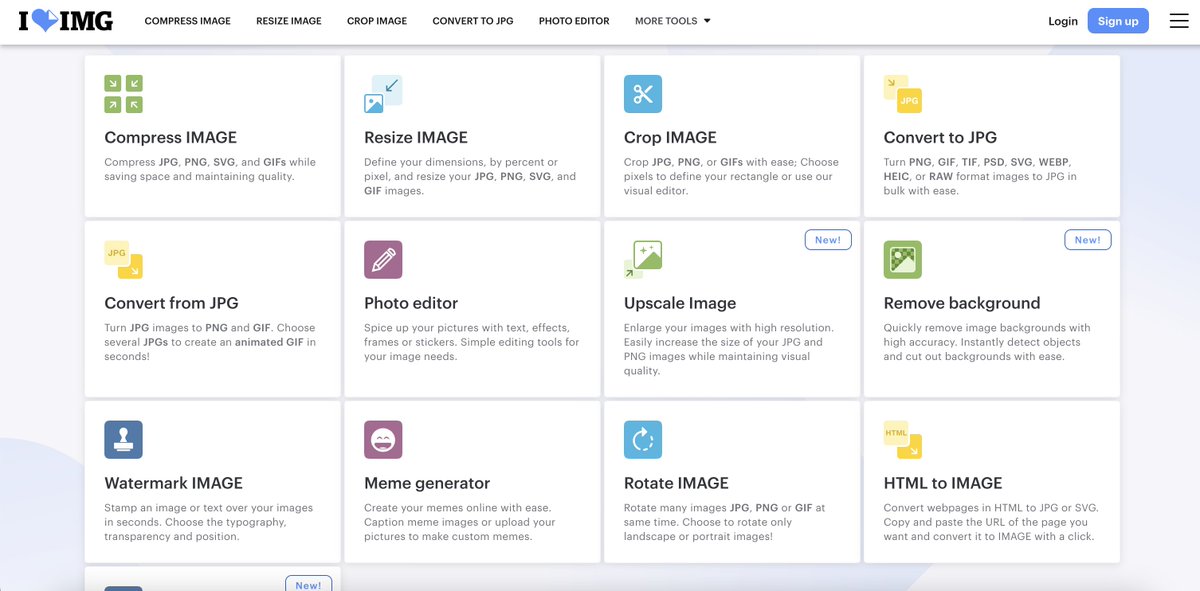
Como si no hubieran hecho ya un bien invaluable a la humanidad, la gente de iLovePDF creó iLoveIMG que te permite hacer todo tipo de cosas con imágenes.
Sacaron hace poco una herramienta para hacer upscale de imágenes con IA. Le mandás algo blureado y te lo mejora.
🐐
He tenido reglas dolorosas desde la primera, con 13 años. Siempre me han dicho que es normal, que tenía quistes, me mandaban pastillas anticonceptivas para mitigar los efectos...Hasta que hace 4 años decidimos intentar ser padres y dejé las anticonceptivas. Y ahí empezó todo.
📢Real-time context-aware protein search is here! We are thrilled to release Gaia, a gLM2-powered search tool for microbial protein sequence annotation and exploration. Give it a try and let us know what you think! https://t.co/4dfwrfXxYh #BioML