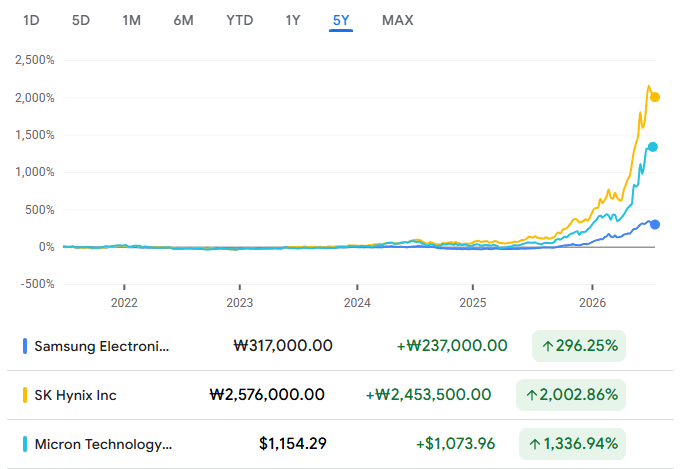
@pandawatch88 Either way that means the US gets lesser memory allocation.
Incentivising memory makers to sell to others at full price vs selling to US at a discount means US will get lesser of AI's most strategic component.
Losing the most important technological race just for a discount.
@oguzerkan Low IQ take.
Samsung's business that are negatively affected by memory is basically negligable in terms of overall figure percentage, even if you discount its mobile phone business as a zero it doesn't make a dent.
@MarcosMillaYT It's actually Samsung.
1. Its baseline is much higher than the other 2. P/B ratio also much lower.
2. Diversified business including world's 2nd best logic fab (free optionality).
3. Cheapest valuation in terms of forward P/E.
@rubicon59 People talking about "effiency improvements" of memory like it isn't happening to compute.
Efficiency improvements has been happening on compute and memory since its invention, yet their demand has never been higher.
@brandonjcarl Don't think you understand all of these points are bullish.
Companies don't enter or expand capacity if the outlook is poor.
And these companies have far more industry visibility than almost anyone else, especially you.
A good chunk of inference for the most successful AI agent, Claude Code, is done on Trainium, while Claude training is done on TPUs. Just a year ago, it would have been unimaginable that TPUs and Trainium could grow this rapidly, while the CUDA moat slowly eroded. 3/4🧵
@MikeFritzell@joinyellowbrick CUDA is software moat. Memory is complex manufacturing moat.
No prizes for guessing which is the stronger and sustainable moat in the AI era.