Robots and autonomous machines need to know exactly where they are. For many outdoor applications, ordinary GPS isn’t precise enough.
GNSS reference stations provide data that compatible positioning systems use to calculate centimeter-level positions.
onocoy brings these stations together in one open marketplace.
Here’s how it works:
Station operators contribute data and earn solana:onoyC1ZjHNtT2tShqvVSg5WEcQDbu5zht6sdU9Nwjrc. High-quality infrastructure can serve more customers beyond its owner’s own projects.
onocoy validates the contributed data. Connecting stations is one part of the job. Checking the data they supply is another.
Businesses access that data on demand. Applications range from surveying and precision agriculture to drones, robotics and autonomous vehicles.
The marketplace is hardware-agnostic, connecting compatible stations across manufacturers.
That’s the idea behind onocoy: turn fragmented positioning infrastructure into a shared resource for the machines that need it.
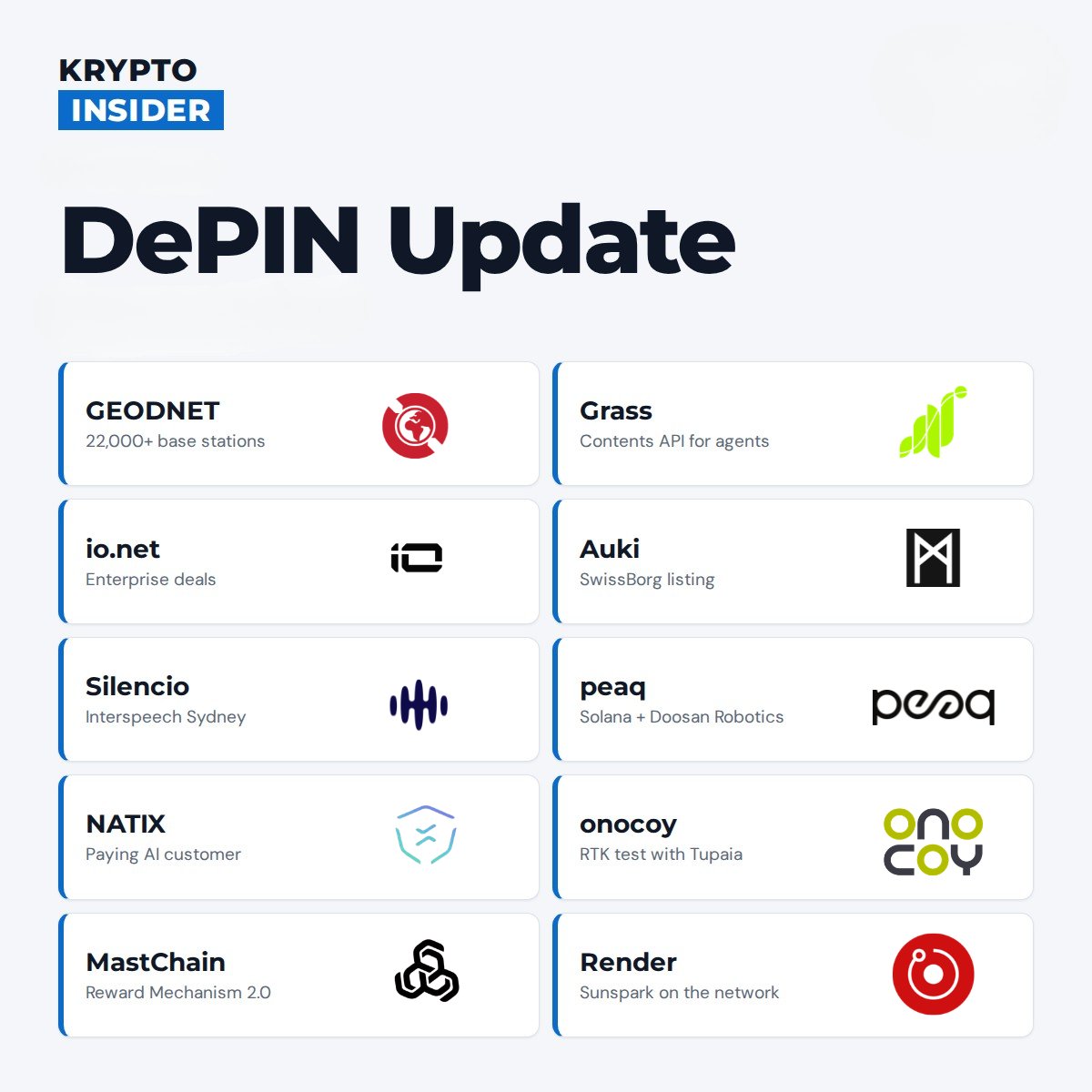
A lot of meaningful progress in DePIN lately and I think the space has matured.
Here are some updates I’ve been watching with interest:
▪️ @GEODNET hit ATH weekly burns of ~$240K and a burn rate above 100% and was presented as the “Rails for Physical AI” at TOKEN2049 Singapore. It now has 22,000+ base stations in 175 countries
▪️@grass reported $14.5M revenue in H1 2026 and launched its Contents API for agents. In its own benchmark it retrieved 98% of hard-domain pages vs 71% for the next best provider
▪️ The @Auki team announced it will be at the Hong Kong Electronics Fair with @MechKenna and a live demo at NACS in Las Vegas with Bruegmann and @bracketbot . The token was also recently listed on @swissborg
▪️ @silencioNetwork was Full-Day Sponsor of Indigenous Voices Day at Interspeech Sydney and reports plenty of leads from the big AI labs
▪️ @peaq is live on Solana, announced a partnership with Doosan Robotics and launched Economics 2.0 on mainnet with machine bonding
▪️ @NATIXNetwork announced a paying AI customer: a lab working on general world models bought 3,000 hours of driving data in a six-figure deal. The network has collected 198K+ hours of multi-camera footage from 28 countries
▪️ @ionet is one of the top revenue generating DePINs by annualized revenue and the team says multiple large enterprise deals just closed
▪️ @onocoyRTK 's network stayed within 10-15 cm accuracy for most of a joint drive test with Tupaia. According to its latest community update, the project is working with some major companies and has grown ~15% month over month on average over the last 12 months
▪️ @MastChain_DePIN , a maritime AIS data network, announced Reward Mechanism 2.0: stations are ranked per hex by valid AIS data and the 500-message daily minimum is gone
▪️ @rendernetwork rendered 1.33M frames in August, up 23% month over month. The animated short Sunspark was rendered on the network and has 45+ festival selections, 11 of them at Oscar-qualifying festivals
Exciting to see so many teams delivering and I’m curious which of these will keep the momentum going.
Buying a GNSS miner? Start with the site, not the price tag.
The receiver is only part of the setup. Signal coverage, antenna placement, stable mounting, power and connectivity determine how useful your station’s data will be.
Hardware-agnostic means choice. It doesn’t mean every setup delivers the same result.
Our new guide compares receiver options from @Quectel_IoT, @ublox, Bynav, Unicore and @Septentrio, plus the station products built around them.
Before spending on hardware, check whether your location fills a coverage gap.
“How to Choose a GNSS Base Station: Receivers Compared” is now on the onocoy blog.
🔗 https://t.co/VdXPNdPTTL
What does onocoy’s infrastructure actually enable? 🛰️
Tupaia develops cloud-based GNSS positioning technology. In its latest benchmark, it combined onocoy reference data with cloud processing to test three off-the-shelf receivers from two vendors.
The results:
📍 Sub-centimeter horizontal accuracy in controlled static tests
🚗 10–15 cm accuracy or better during most of the drive test
onocoy delivers the reference data. Tupaia handles the positioning calculations in the cloud, helping bring precise positioning to more devices.
Read all about it:
https://t.co/GUqCYj3ewl
Applications are open! Apply to receive 1 of 5 free Sixents G20 stations 🛰️
The Sixents G20 is a GNSS reference station built for onocoy.
Now, we are opening up a forms to apply to receive 1 of 5 free Sixents G20 Stations! Selected applicants receive the hardware for free, install it at the submitted location, and connect it to the network after setup.
The important part is the location. Reference stations need clear sky view, reliable internet, stable power, and a mounting point that can stay fixed. Without that, even good hardware can't produce useful correction data.
We are looking for rooftops, masts, farms, marinas, company sites, and existing GNSS locations that can add practical coverage to the network. This is worldwide and not only in specific areas. If your location adds value, this is interesting for us and our clients!
Selected stations can contribute correction data to onocoy after successful validation.
Links in the first comment 👇
PS: Deadline is September 30th 2026
One of the biggest opportunity zone in liquid markets right now is still businesses that chose a token as their ownership structure and are therefore mispriced.
My best example is always solana:7JA5eZdCzztSfQbJvS8aVVxMFfd81Rs9VvwnocV1mKHu.
It is NOT a crypto business, the same way Amazon isn't in the equity business. They are crushing it in their industry, though. You just have to approach it differently and step out of CT bubble and learn a new field if you want to invest in them.
Differnet markets but similar ownership projects like @grass, @silencioNetwork, @OVRtheReality, @NATIXNetwork or @onocoyRTK are heavily overlooked right now.
You can see it in the price action: the ones performing best are those who found pmf, maybe moats and good sales pipelines.
An underappreciated skill is knowing how to talk to investors and doing the best job of educating their investor base (people who invested in SoV assets and DeFi). IMO, @GEODNET did this by far the best: they never cared about narrative and delivered on fundamentals, while choosing @Blockworks early as their partner to present their business. @mikeahorton is doing what a public market CEO would do, since those investing long-term need assurances and ways to constantly underwrite the business. Focus on longterm investors and ignore traders.
The wind is changing, and more founders are starting to see that this is part of their business. Not everyone is operating on their or @grass 's level when it comes to investor relations right now, but its memetic. Those who weren't as transparent but have good fundamentals will feel the difference which will start change.
You can't just bid "DePIN" and expect to hit it big, but it definitely feels like seeing early DeFi in liquid markets, even though there's obviously not as much beta to the underlying SoV.
Valuations have hit levels similar to 2019 DeFi coins.
Your job is not to buy the category but find generational winners.
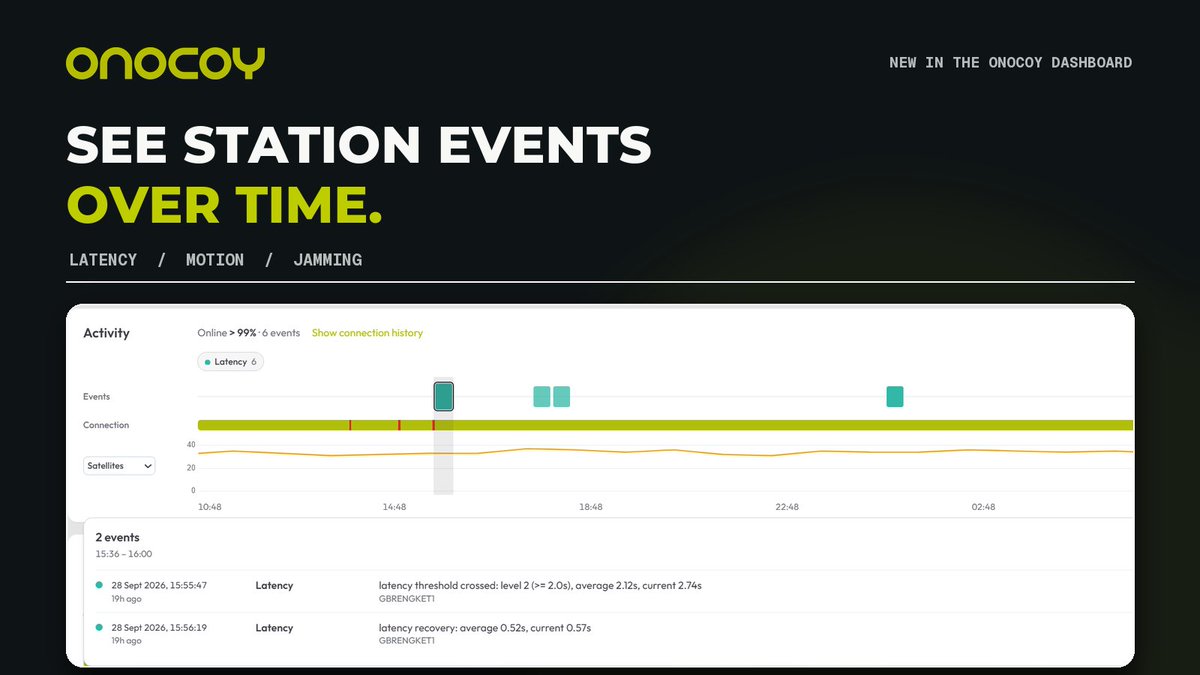
Station issues are easier to investigate when you can see when they happened.
New in the onocoy dashboard:
→ Events timeline for latency, motion, jamming and more
→ Live antenna position and velocity
→ Clock drift and bias
→ Code and phase RMS
More context for every station.
3 Days left to apply for a free Sixents G20! 👀
We are looking for real deployment sites: rooftops, masts, farms, marinas, company buildings, existing GNSS locations.
Apply until 30.09., 23:59pm CET:
https://t.co/DSmfdH9KcJ
Randomly came across one of my first DePIN posts/threads today.
Back then this space was completely unknown, nothing like the attention it gets now.
Natix and peaq are still building and making real progress. Nothing came of Bloxmove though, even though the idea itself was solid imho.
The space has matured a lot since then. A few projects are already pulling ahead, they've got actual adoption, real revenue, a token model that makes sense and they communicate well with their community.
DePIN projects I’m following with interest 👇
@GEODNET@Auki@GlowFND@silencioNetwork@akashnet@FliteGrid@peaq@NATIXNetwork@onocoyRTK
Another major GNSS hardware partner is joining onocoy.
Tarrius by @Quectel_IoT is integrating the TR07B directly with the network, allowing station operators to contribute correction data and earn $ONO rewards.
Every new hardware integration creates more potential deployments, more coverage and more correction data for buyers.
The onocoy hardware ecosystem keeps growing.
Another major GNSS hardware partner is joining onocoy.
Tarrius by @Quectel_IoT is integrating the TR07B directly with the network, allowing station operators to contribute correction data and earn $ONO rewards.
Every new hardware integration creates more potential deployments, more coverage and more correction data for buyers.
The onocoy hardware ecosystem keeps growing.