What looks as if it is going to swallow the great Pillars of Creation?
The Eagle Nebula (M16) is not a bird, a plane, or Superman. M16 is actually a combination of several celestial objects.
NGC 6611 is the young star cluster that appears to peak out beneath the Eagle’s “wings”. The ultraviolet light from these stars ionizes the surrounding gas, creating the emission nebula IC 4703. The Stellar Spire is seen reaching towards the Pillars of Creation from the left.
Both are structures of cold gas and dust that are optimal for star formation. Some astronomers previously thought the Pillars of Creation had been evaporated away by a supernova. Because M16 is 6,000 light years away, we would not be able to see the Pillars’ destruction for thousands more years.
However, there is no conclusive evidence of the theorized supernova, so the Pillars of Creation will likely continue to create stars for millions of years.
Image Credit & Copyright: Emmanuel Delgadillo
Text: Keighley Rockcliffe (NASA GSFC, UMBC CSST, CRESST II)
アメリカ、キットピーク国立天文台で撮影された画像。中央に流星が映っているほか、オリオン座や付近の星雲、シリウスをはじめとしたおおいぬ座の星々などが映っています。
6月3日公開のNOIRLab(アメリカ光学・赤外天文学研究所)の「Images of the Week」
https://t.co/Y2PR27KkBm
Image Credit: KPNO/NOIRLab/NSF/AURA/P. Horálek (Institute of Physics in Opava)
Here is a single raw photo captured just a few minutes ago, showing a star like ours as it dies.
In the center of the outwardly- expanding gas shell, you can see what remains: a white dwarf, the star's core.
This will be a true-color photo with much more detail when I finish.
The scientific value, and limits, of the Anthropic Principle
Just from the fact that we exist, there's much we can rightfully conclude about the Universe.
That's the core of the Anthropic Principle: powerful to use, but all too easy to abuse.
https://t.co/ymYUiLNwP3
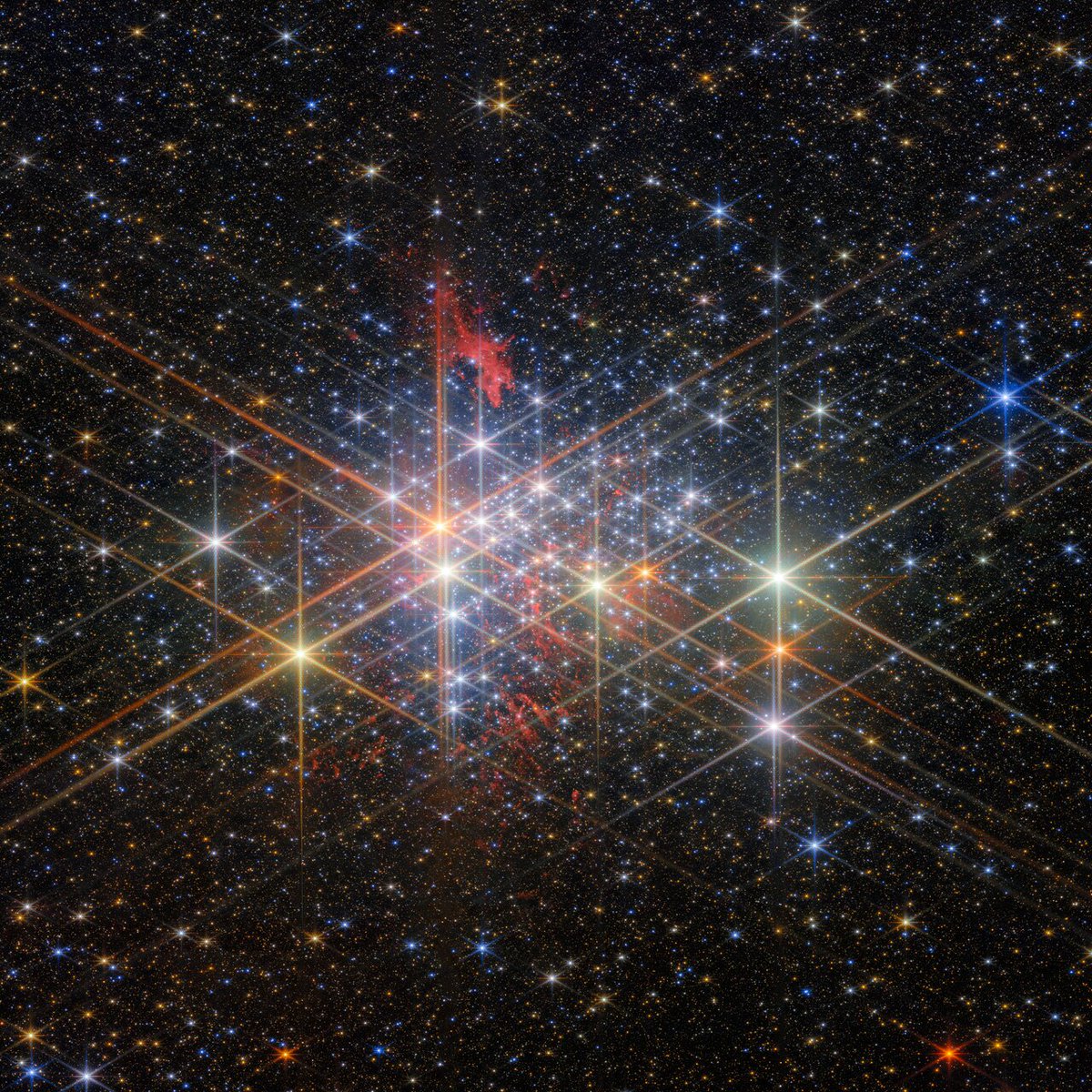
ジェイムズ・ウェッブ宇宙望遠鏡がNIRCam(近赤外線カメラ)で撮影した散開星団ウェスタールンド1。ウェスタールンド1は、「超星団」と呼ばれるタイプの巨大な星団です。星団の年齢は350万〜500万歳と推定されています。大質量星が数多く含まれており、なかには太陽の100万倍の明るさで輝く星や、土星軌道に相当する太陽の2000倍の大きさの星もあります。
詳しくはリプライのリンク先記事をご覧ください。
Image Credit: ESA/Webb, NASA & CSA, M. Zamani (ESA/Webb), M. G. Guarcello (INAF-OAPA) and the EWOCS team
New data from @NASAWebb shows that supermassive black holes can grow to their current size without a much larger host galaxy to feed them.
This helps to explain why some black holes in the early universe got so big so quickly. https://t.co/9l3SjnKHqZ
All personnel are accounted for and safe. It’s too early to know the root cause but we’re already working to find it. Very rough day, but we’ll rebuild whatever needs rebuilding and get back to flying. It’s worth it.
Here's our video of the explosion at Launch Complex 36. It happened about 9 pm ET (0100 UTC) as Blue Origin was beginning a static fire test of its New Glenn rocket.
Watch live views: https://t.co/tm2wZQmAVD
Massive setback today. Hopefully they can jump through the cause, repairs and upgrades ASAP but this is going to cause a pretty big chunk of downtime for NG missions. The lunar lander isn't going to be flying for quite some time yet. 😢
SpaceX has almost finished writing V1.0 of an in-house AI training stack in C that exact-maps to 220k GB300s with 800G NICs, making heavy use of pipeline parallelism and getting as close to bare metal as possible.
The potential speed improvement vs JAX for large training runs is over an order of magnitude.
Using observations from the JWST, researchers have identified cloudy “mornings” and clear “evenings” on a distant gas giant exoplanet.
The findings in Science suggest that the planet’s atmospheric aerosols are dominated by condensation-driven clouds that form, circulate, and evaporate as they move through extreme temperature contrasts across the planet.
Learn more: https://t.co/uygynvBne4
The large-scale structure of the universe looks like a gigantic web, known as the "cosmic web." It consists of long filaments of galaxies and clusters around vast, nearly empty voids. These structures are a result of fluctuations in the density of matter in the early universe, magnified by the expansion of the universe.