The Market Is Rigged - Just Not the Way You Think
Most people think markets are unfair because of insiders or manipulation. That’s not the real problem.
Every trade you make, someone faster is on the other side. They've already won before you hit confirm. You're just paying for it - on every trade, whether you know it or not.
1. The hidden problem of CLOBs
Most exchanges run on a Central Limit Order Book (CLOB): real-time matching, tick-by-tick updates, first-in-first-out. Simple. Efficient. But structurally biased.
Orders are processed sequentially, so the fastest participant always gets priority. Traders with superior infrastructure or proprietary data access can react first and pick-off stale quotes before the rest of the market adjusts. LPs know this and to protect themselves, they widen spreads and quote more cautiously, pricing in the constant risk of adverse selection. As a result, the end user gets a worse price.
The faster you are, the more you extract. Everyone else pays for it.
2. Frequent Batch Auctions on pod
Frequent Batch Auctions (FBAs) eliminate this arms race
Instead of matching orders continuously, FBA's group orders into very short, discrete time windows (50 -200ms) and clear them at a single uniform price. Because everyone in the batch trades on the same price , speed advantages disappear. The batch window is the speed bump itself - except instead artificially slowing down fast participants, it makes speed structurally irrelevant.
A retail trader and a co - located HFT participate on equal terms, removing the constant race for microsecond execution.
This single structural change has meaningful downstream effects:
- Adverse selection disappears
- Spreads tighten
- Price discovery improves
- Manipulation becomes structurally impossible
- Batches are transparent and verifiable
3. What this means in practise
On @poddotnetwork the structural tax of wider spreads, thinner books and adverse selection is removed at the protocol level.
LPs quote tighter because they carry less risk. Traders execute better because the liquidity they access is genuine, stable, and priced fairly. The market functions the way it should.
This isn't just a marginal improvement. FBA's represent a fundamental rethinking of what a fair market looks like - shifting the competitive edge away from latency and toward what should always have mattered: pricing accuracy, capital efficiency, and execution quality for everyone.
People think pod is fast because it’s consensus-less.
Yes - but that’s only part of the story.
Consensus-less makes high performance possible.
The engineering is what actually unlocks it.
To fully utilize pod’s consensusless design, the entire stack had to be built around it:
1. Actor-based concurrency to avoid locks
2. Batching across the pipeline to amortize expensive operations
3. Append-only logs instead of databases in the hot path
4. A hand-tuned UDP networking stack to keep packets moving
Every piece removes a specific bottleneck.
When validators don’t need to wait for global ordering, the system stops being coordination-bound.
But you only realize the benefit if the execution pipeline, storage, and networking are designed for it.
Performance isn’t something you bolt on at the end. It has to be designed all the way down - from the protocol to how packets leave the kernel.
The L2 Block Building space is accelerating (again)! Check out our latest L2 demo day w/ Flashbots, @base, @worldnetwork, and @poddotnetwork where we show lower block times, improved tooling, a modular block building library, p2p flashblocks, and a new censorship resistance gadget!
🎂 Happy Birthday to us — pod turns 1 today!
Year One: built a consensusless, blockless, super-fast L1.
Year Two: onboard the next billion users to Web3.
LFG!
interesting finding by the flashbots team.
"spam" txs are taking all our throughput gains!
the article outlines two parts to the solution: the first can be solved by TEE, while the second necessitates @poddotnetwork!
to solve the spam problem, we need:
1. open but restricted access to the real-time state and transaction flow = programmable privacy using TEE
2. efficient markets for tx inclusion and ordering = fast auctions on pod
finding the MEV
searchers spam the network trying to find potential MEV opportunities on the L2. With open but restricted access to the state and tx flow, searchers can identify MEV opportunities without simulating trades on-chain. this can be done using TEEs, where searchers can run a specific program in a restricted fashion without leaking private data - aka programmable privacy.
explicit bidding
once a searcher successfully identifies MEV opportunities, they need to get their transaction included. Without additional infrastructure, they would spam the network with increasingly higher tips—leading back to the same problem. this requires an efficient off-chain market where searchers can explicitly compete for inclusion and ordering. the most straightforward solution is a fast auction system where the highest bidder gets their transaction included. this is where pod comes in—pod can be leveraged to build sub-second auctions with strong censorship resistance.
the combination of programmable privacy through TEE and explicit bidding on pod will enable L2s to reach their true throughput potential.
shitpost[dot]wtf just went full onchain.
The world’s most chaotic meme feed now stores media on Walrus 🐋
⚡️ Fast txs via @poddotnetwork
🧊 Permanent storage via Walrus
🪞 Fully decentralized, remixable memes
Long live the memechain. Use the codes in the reply to join 👇
A showcase of true Web3 UX!
shitpost[dot]wtf 2.0 combines:
• Sub-second txs on pod’s devnet
• Decentralized media on @WalrusProtocol
• Fully on-chain profiles with avatars + handles
No blocks. No lag. No compromise. A lot of fun!Join the fun now → use code: PODshill
Never thought I'd get to shitpost memes for a living!...
shitpost[dot]wtf is here—build on @poddotnetwork's devnet, with media stored on @WalrusProtocol.
Try it out → use code: PODshill
Just dropped shitpost[dot]wtf v2.
It's a fully decentralized meme social network built on @poddotnetwork's devnet — now with @WalrusProtocol baked in.
That means fast txs, zero wallet friction, and immortal memes thanks to Walrus.
Finally, it's Web3 that feels like Web2 🧵1/5
Check out pod’s devnet in the wild—shitpost[dot]wtf version 2.0 just shipped:
✅ 200ms confirmation
✅ Media hosted on @WalrusProtocol
✅ Profile photos & handles live
It's the most fun you'll have on-chain without a line of code!
Start shitposting now → use code: PODyap
📣Excited to announce:
Shitpost[dot]wtf has integrated @WalrusProtocol for decentralized storage!
Every meme, PFP, and leaderboard moment is now permanent, censorship-resistant, and user-owned.
Web3 social just got a major upgrade.
Try it now! Use Code: PODyap 👉 shitpost[dot]wtf
Ready for the next drop? 👀
Shitpost[dot]wtf 2.0 is about to change the meme game (again).
Handles, PFPs, real-time leaderboards. Plus a new integration to make your memes immortal. 🔥
Web3 decentralization, Web2 feel. Stay tuned!
1/n: After a brutal schedule, I could finally take a breath and write. I am super excited --first for defending my PhD and finishing with the thesis, and also, for finding an extremely interesting role for my next step, as Scientist at @poddotnetwork! Here is why I can't wait:
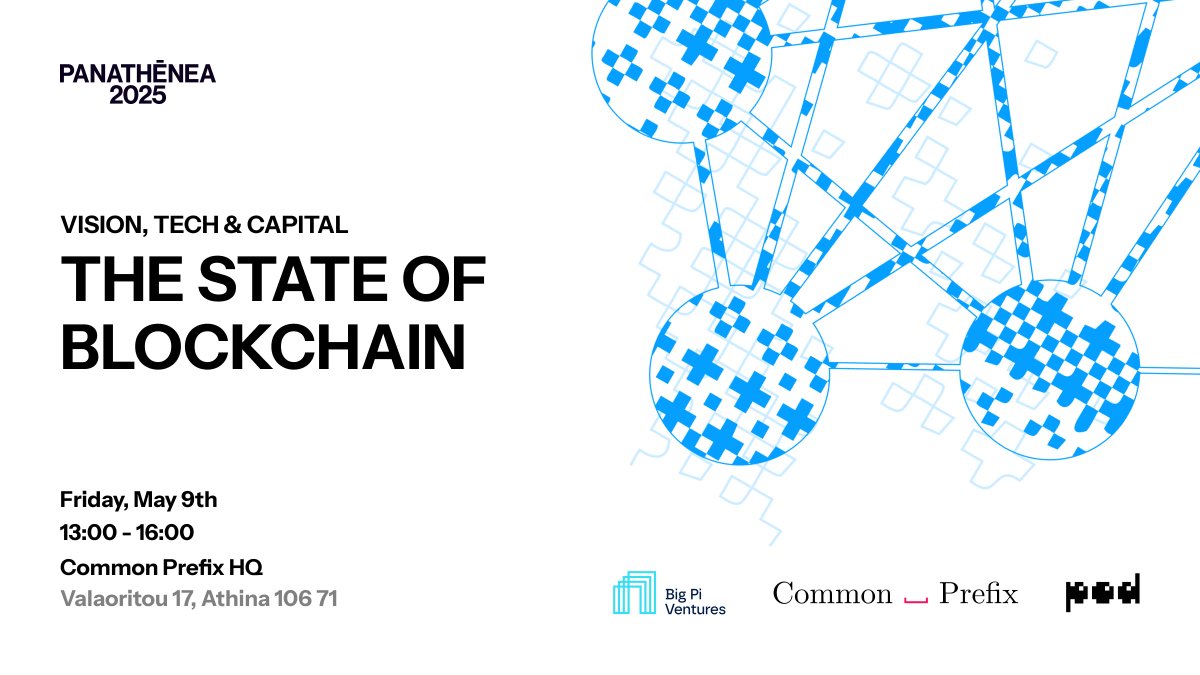
🗓️Happening Friday, May 9, 13:00 in Athens. 🔥
The State of Blockchains: Vision, Tech and Capital
Featuring @sagrawal@dionyziz and many more.
With @bigpivc and @CommonPrefix.
See you there!
https://t.co/CncKtpoBaJ
📅 We're hosting a fun meetup on May 9 as part of @PanatheneaFest. If you're in Athens and you're a crypto nerd, come join @poddotnetwork@CommonPrefix and @bigpivc to talk about the state of blockchain. 👇
🧠 What's the best path to building a decentralized Internet?
@sagrawal is going live with @RosuGrigore & @ma2bd to chat about alternative Web3 infra 🤯
April 24 | 10am CT
mod: @UBAmain. Not your average panel
@linera_io@pisquared
👉https://t.co/OefQdgrXc2