Only one chance in this lifetime…
Like watching sunset at the beach from the most foreign seat in the cosmos, I couldn’t resist a cell phone video of Earthset. You can hear the shutter on the Nikon as @Astro_Christina is hammering away on 3-shot brackets and capturing those exceptional Earthset photos through the 400mm lens. @AstroVicGlover was in window 3 watching with @Astro_Jeremy next to him.
I could barely see the Moon through the docking hatch window but the iPhone was the perfect size to catch the view…this is uncropped, uncut with 8x zoom which is quite comparable to the view of the human eye. Enjoy.
☄️ #3I/ATLAS comet update!
On 3 October, our ExoMars Trace Gas Orbiter (TGO) turned its eyes towards interstellar comet 3I/ATLAS as it passed close to Mars.
Together with Mars Express, ExoMars TGO had the closest view of the comet of all of our spacecraft. It looked towards the interstellar interloper from just 30 million km away during its closest approach to the Red Planet.
Read more: https://t.co/XGPNDmBfxD
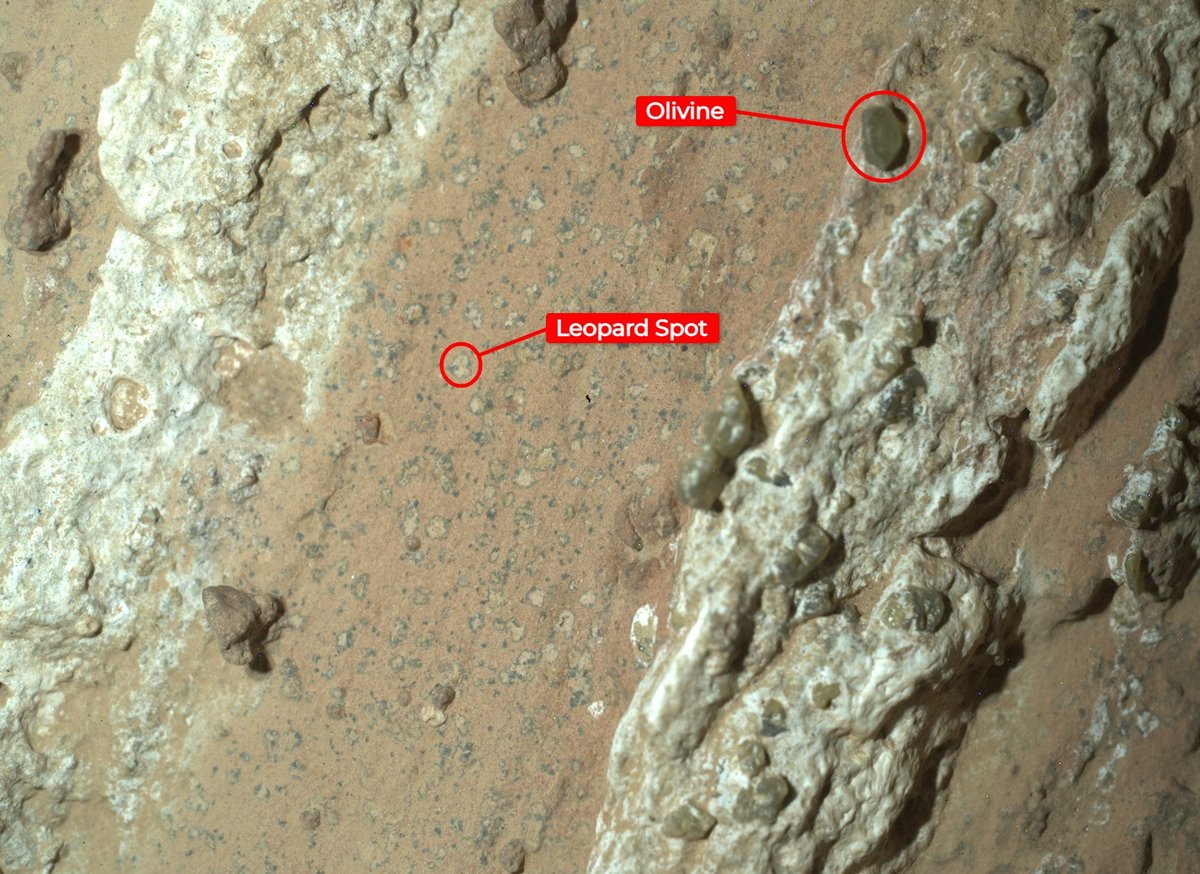
After a year of scientific scrutiny, a rock sample collected by the Perseverance rover has been confirmed to contain a potential biosignature. The sample is the best candidate so far to provide evidence of ancient microbial life on Mars. https://t.co/0BAO1dhMG8
Remember the “leopard spots” rock Perseverance sampled last year?
After a year of scientific scrutiny, the rock remains the mission's best candidate for containing signs of ancient microbial life processes. More on this peer-reviewed finding: https://t.co/p1a0N3o4ZL
New Horizons is so far away that the nearest stars have shifted markedly from where we see them on Earth. With NH-based positions for two stars alone we can figure out where the spacecraft is. This technique would be used on interstellar voyages. https://t.co/roJ1ExMXn9
Wishing upon a... moon?
That bright "star" is actually Mars' moon Deimos. In the hours before dawn, I snapped this long-exposure image with my left Navcam and caught Deimos as well as two stars from the constellation Leo in the sky.
It's definitely a mood, as they say.
Happy to announce a new paper (the last chapter of my thesis)!
We infer a 100-200 C temperature anomaly in the Moon's nearside mantle. This anomaly suggests that geologic activity which formed the mare 3-4 billion years ago is still active today.
https://t.co/4xopelmzgA
Wow! I’ve never seen anything like this 😱
This CCTV footage captures the powerful M7.7 earthquake that struck Myanmar in March. You can clearly see the dramatic shift in the ground.
Absolutely surreal.
NASA’s #DragonflyMission, which will send a rotorcraft to explore Saturn's moon Titan, has passed its Critical Design Review, meaning its mission plans have been approved and the team can now turn its attention to the construction of the spacecraft itself
https://t.co/c93NXZqlZy
Hello from the rim of Jezero Crater 👋
I’ve hit my fastest science-collection tempo yet, sampling three rocks since January and analyzing dozens more. One might even be 3.9 billion years old!
So, what’s next? More exploration at Witch Hazel Hill. https://t.co/Vd1VVvftLn
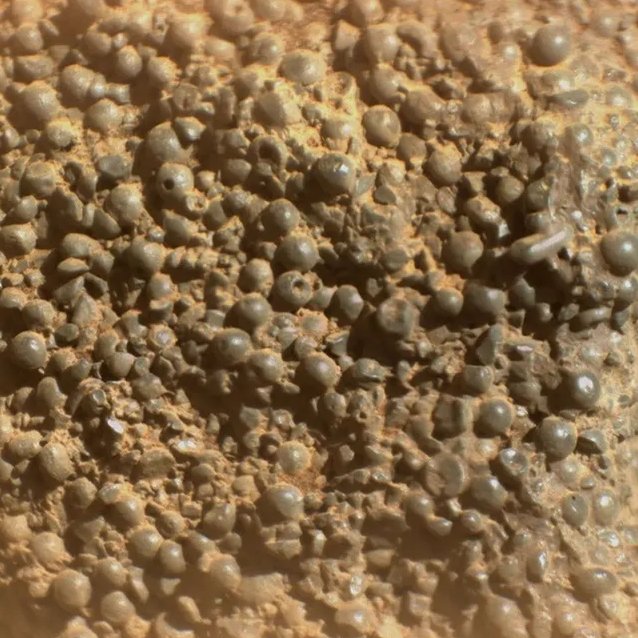
#PPOD: Shocking Spherules
This image from @NASAPersevere, a fusion-processed SuperCam Remote Micro-Imager (RMI) mosaic, shows part of the “St. Pauls Bay” target acquired from the lower Witch Hazel Hill area of the Jezero crater rim. The image reveals hundreds of strange, spherical-shaped objects comprising the rock. Perseverance acquired this image on March 11, 2025.
Credit: NASA/JPL-Caltech/LANL/CNES/IRAP
#planetaryscience
BREAKING 🚨: NASA's Perseverance rover has found a bizarre rock with hundreds of little dark gray spheres
Scientists are still investigating but believe it could've been formed by groundwater or volcanic activity
Mesmerised by these photos. Often we remark on how lucky we are to experience total solar eclipses on Earth. But now we see that the Moon's counterpart is just as spectacular and strange.
Blue Ghost turns red! Our lander downlinked more imagery from the Moon captured around 2:30 am CDT during the totality of the solar eclipse last night. These images - rapidly captured by our top deck camera with different exposure settings - were stitched together in a quick clip. The red hue is the result of sunlight refracting through the Earth's atmosphere as the sun is blocked by our planet, casting a shadow on the lunar surface. The glowing ring of the eclipse is again seen on Blue Ghost’s solar panel. #BGM1
Blue Ghost turns red! Our lander downlinked more imagery from the Moon captured around 2:30 am CDT during the totality of the solar eclipse last night. These images - rapidly captured by our top deck camera with different exposure settings - were stitched together in a quick clip. The red hue is the result of sunlight refracting through the Earth's atmosphere as the sun is blocked by our planet, casting a shadow on the lunar surface. The glowing ring of the eclipse is again seen on Blue Ghost’s solar panel. #BGM1
#BlueGhost got her first diamond ring! Captured at our landing site in the Moon’s Mare Crisium around 3:30 am CDT, the photo shows the sun about to emerge from totality behind Earth. Hope to have more shots to share soon! #BGM1