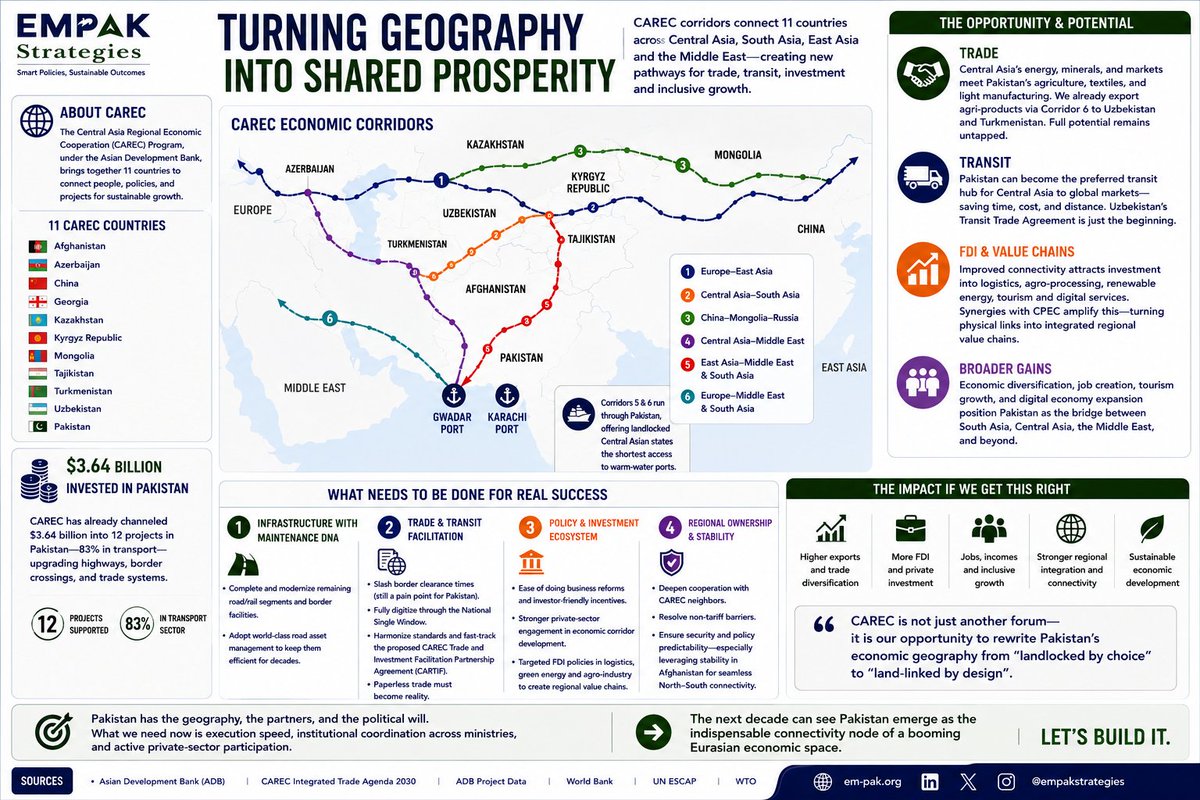
CAREC’s economic corridors already run through Pakistan — connecting Central Asia, South Asia, China, and the Middle East through one of the world’s most strategic geographies.
Since joining the CAREC Program in 2010, Pakistan has become part of a regional connectivity network linking 11 countries through trade, transport, energy, and economic cooperation. As of December 2025, CAREC has supported $3.64 billion across 12 projects in Pakistan — most focused on transport and connectivity infrastructure.
But modern connectivity is no longer only about roads. The real opportunity lies in trade facilitation, logistics efficiency, digital systems, industrial integration, and regional value chains.
If Pakistan improves border efficiency, logistics, policy coordination, and regional integration, it can evolve from a transit route into a regional economic hub connecting Eurasia, Central Asia, South Asia, and the Middle East.
Geography creates opportunity. Connectivity determines whether countries capture it.
#CAREC #Pakistan #RegionalConnectivity #Trade #CentralAsia #CPEC #Logistics #EconomicCorridors #FDI #EMPAK
@PIDEpk At the end of the day, it’s the decision of @GovtofPakistan who to appoint for running the Maritime Division & the administration of port authorities, & to set targets / KPIs. The buck stops there.
#WTOMC14 concluded this week, highlighting new approaches to key WTO issues, with strong engagement despite a challenging global context.
The work now moves forward in Geneva.
March 1776: Adam Smith published The Wealth of Nations — a blueprint for how nations achieve prosperity.
His core insight was simple:
Nations grow rich not by hoarding wealth, but by creating it — through productivity, specialization and trade.
Over the next 250 years, countries that embraced competition, openness and strong institutions prospered.
Those that relied on protection and privilege did not.
But Smith also warned:
Markets fail when monopolies dominate, elites capture the state, and rules serve insiders.
That warning is now global — and deeply relevant.
Pakistan is a textbook case of ignoring Adam Smith.
For decades, we have chosen: • Protection over competition
• Subsidies over productivity
• Privilege over performance
The result?
A low-productivity, rent-seeking economy trapped in recurring crises.
The lesson from 250 years of global experience is brutally clear:
You cannot build prosperity by protecting inefficiency.
You cannot create wealth by redistributing stagnation.
Adam Smith gave the world a roadmap.
The nations that followed it prospered.
Pakistan must now decide whether to finally do the same.
As far as I recall, the #export related industry was exempted from lockdown even during #Covid days. I remember Secretary Commerce Mr. Sualeh Farooqi heading a committee which would convey the names of such units to relevant local authorities, so they could operate smoothly !
There’s been a lot of uninformed debate around exports, particularly textiles.
The global textile market exceeds US$ 1 trillion, in which Pakistan exports have a 2% share each year, while both Vietnam & Bangladesh have twice as much.
The rational strategy is not to pivot away from an industry that provides Pakistan with US$20 billion each year— it is to upgrade and scale.
While making our textile industry competitive would improve our share, we do need to change a few things around textiles as well …
1. Convert export of yarn & grey fabric into value added exports (garments / bedwear etc);
2. Accelerate ESG compliance of our textile units to improve our share in the EU & similar regulated markets;
3. In the made up category, move from low-end, unbranded items to better quality / branded products.
@AhmadJalal_1@shahzadsaleem@SohaibTweets The fundamental question to be asked is, “whether the Govt intervention would act as a lever for growth, or a lever for control?”
Anything that increases control must be avoided, while those which increase private sector growth must be championed.
Never ever think you are the only one facing hardships. It is in the design of things that each one of us shall be tested. All we need to do is to remain firm in our faith and Love 🧡
“And We shall surely try you with something of fear and of hunger, and loss of goods and lives and harvesting. But give glad tidings unto the steadfast, who say when a blow befalleth them :
Verily we are for Allah, and verily unto Him are we returning.
On these are the blessings from their Lord and mercy; and these are the rightly guided “.
@81ShahbazRana Alarm bells should also ring in the concerned quarters due to the disenchantment of highly talented professionals & the corporate sector, with the taxation situation & growth prospects of the country …
@ZulfiqarAhmed69 Anyone who thinks that Digitalisation is a magic wand which can cure all ills & transform organisations is seriously mistaken. It has to be used along with several other tools & mechanisms to be effective.
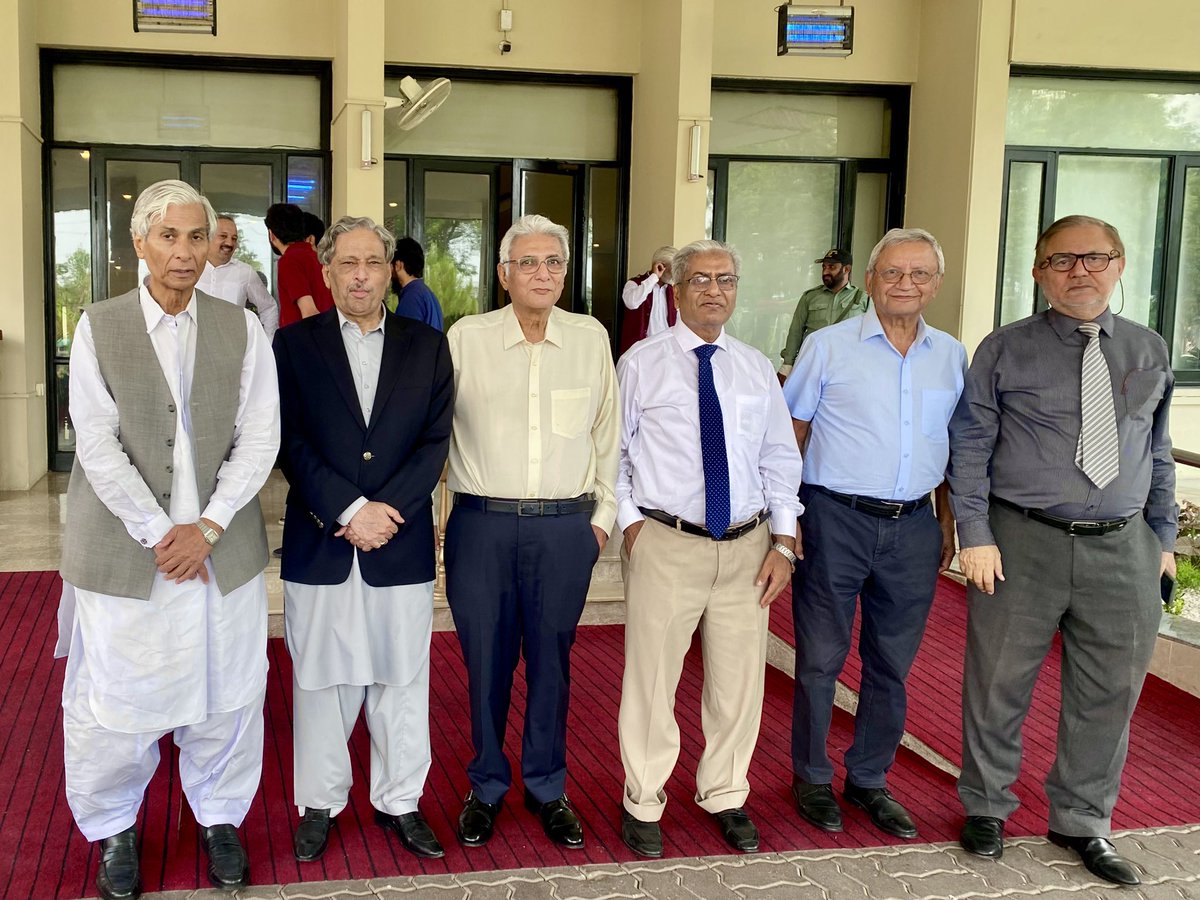
Always a pleasure to reconnect with my senior colleagues from @Pak_Customs 💕
Listening to @drahmadmanzoor about the ongoing Tariff Rationalisation, of which he’s the main architect, was a real delight !!
Thank you Nazim Saleem sb to hosting us today 🙏🙏🙏
Over-regulation is stifling Pakistan's economy and people's livelihoods. The cost is just too high for the "sludge" it creates.
In this episode of SIA Conversations, @nadeemhaque and @mukarram_ansari build a case for a productive regulatory framework.
https://t.co/PEH4LEArhb
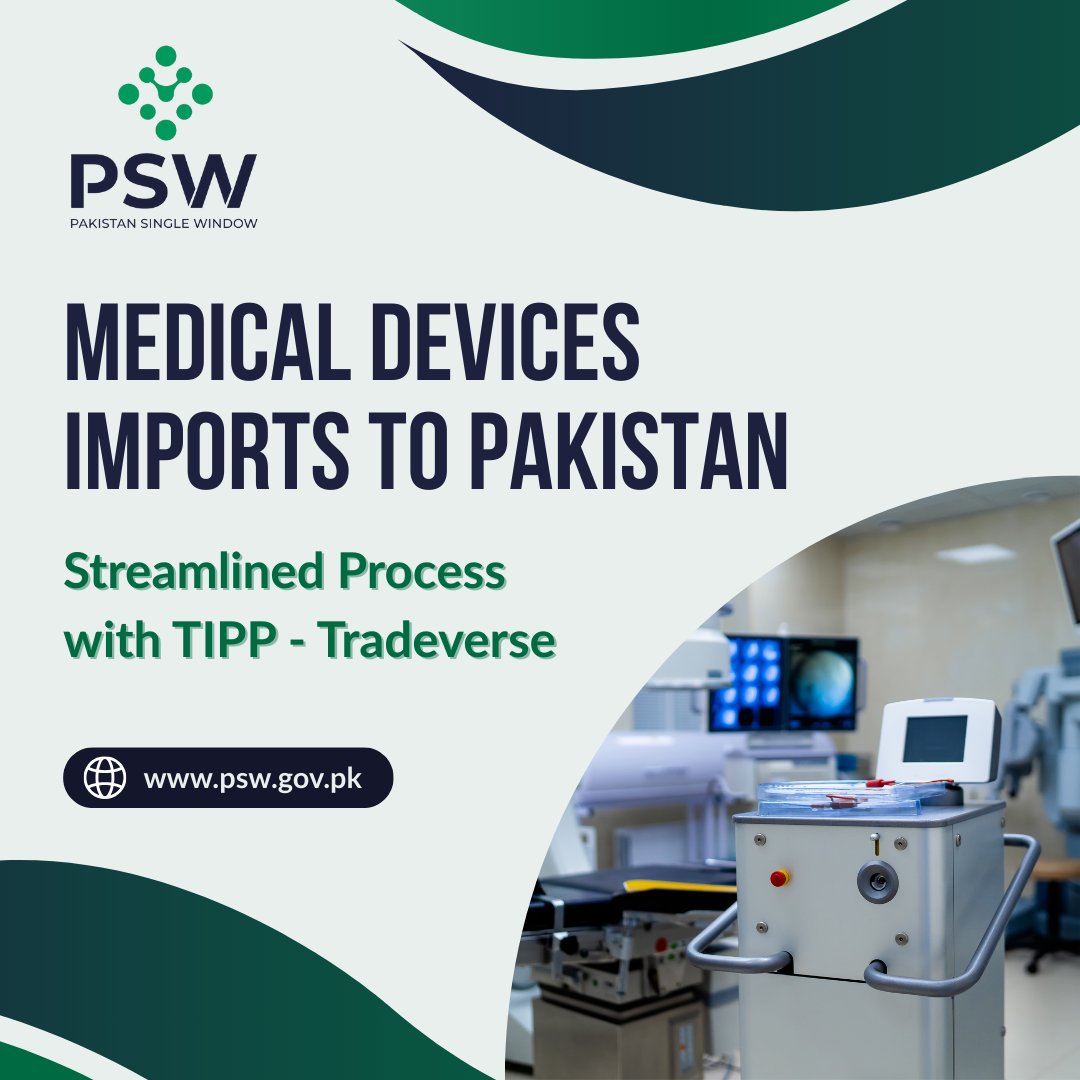
Importing medical devices into Pakistan is now easier with #PSW and #TIPP. From securing NTN and registering with DRAP to filing a single digital declaration, traders can manage all steps online—enhancing transparency, reducing delays, and simplifying compliance.
Value-added textile exports have shown remarkable resilience and growth, recording a 15% increase in 9MFY25, despite facing the most challenging period with record-high financial and energy costs.
Thankfully, the pressure is now easing. As energy and financing costs begin to normalize, Pakistan’s textile sector is regaining traction and investor confidence.
Global buyers are turning to Pakistan for apparel, home textiles, and finished fabrics, owing to our reliable, complete, integrated, and compliant supply chain.
The potential for further growth is significant. The private sector must ignore propaganda, focus on enhancing productivity, adopt lean operations, and drive innovation & new product development.
We also urge the federal and provincial governments to continue prioritising exports and to permanently resolve issues like taxation anomalies, delayed refunds, and regulatory bottlenecks.
The Government of Pakistan (GoP) must honour its past commitments and support the private sector by providing an enabling policy environment, ease of doing business, and institutional stability.
The government is also working on rationalising import duties on raw materials and intermediate goods—this is critical to support value addition, manufacturing growth, and job creation.
Together, we must work to achieve the ultimate goal of taking Pakistan’s textile exports to $35 billion in the next few years—this is both realistic and achievable with the right support and direction.
Let’s stay focused, act responsibly, and strengthen the partnership between industry and state. The future lies in productivity, innovation, and consistency—for a more prosperous Pakistan.
@PakPMO@jam_kamal@AliPervaiz450@IhsaanaKhan@DrMusadikMalik@81ShahbazRana@mubarakzebdawn@AajKamranKhan@TextilePtea
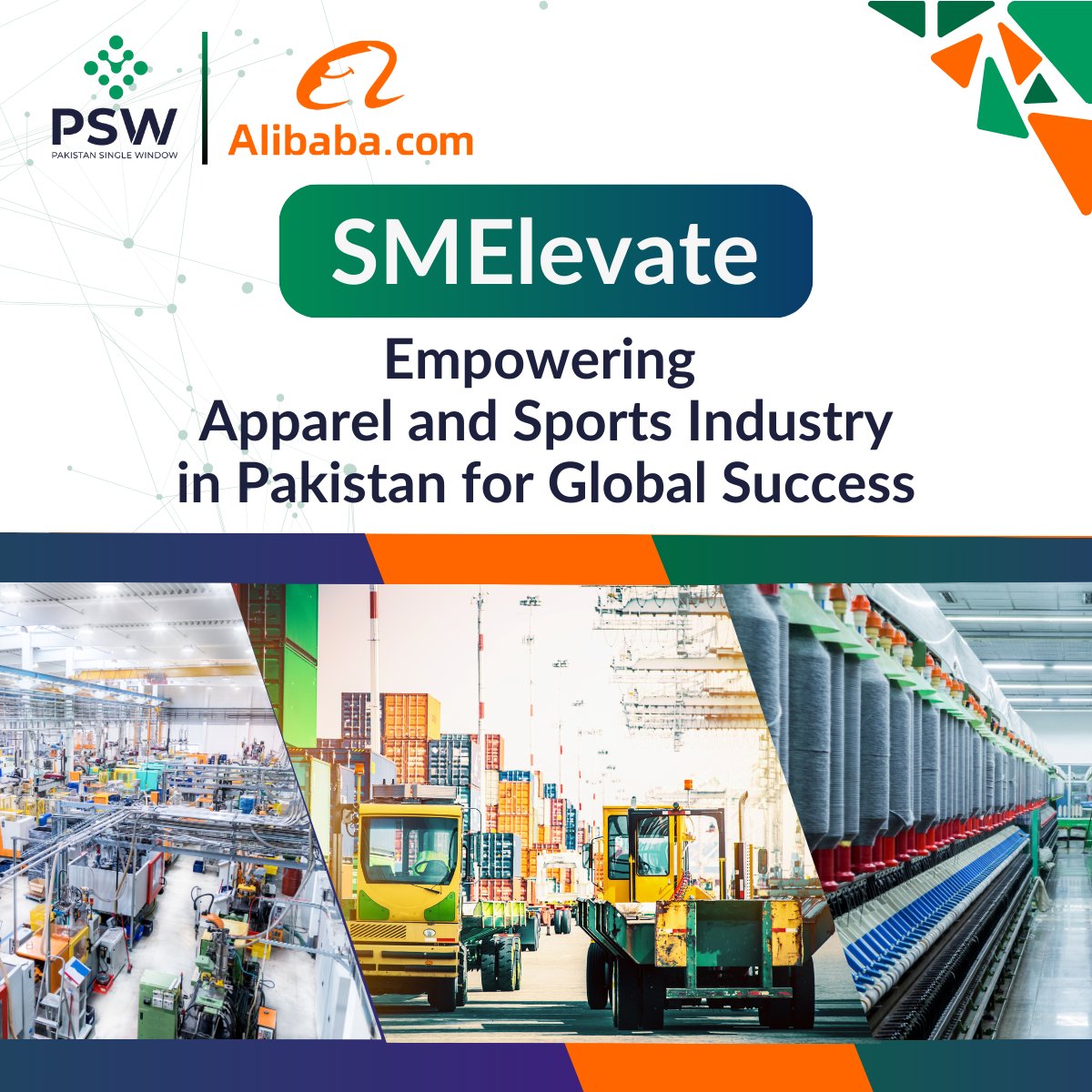
#PSW & @AlibabaGroup are empowering SMEs in Pakistan through #SMElevate. Tailored for apparel and Sports Sectors in #Sialkot, the session covers trade procedures, legal aspects, and export solutions to help businesses scale globally.
To register: https://t.co/ihi2bKlDdz