Really awesome stuff from @coeff_giving
- identified a problem no one was owning (Strep A)
- recruiting someone awesome to own the problem (@Kat_a_Collins)
- syndicated capital from a bunch of donors to give them the resources to succeed
Today, @coeff_giving is launching the Strep A Vaccine Fund, a multi-donor initiative to accelerate vaccine development against one of the world's most neglected infectious diseases relative to its scale.
Strep A kills ~639,000 people a year. There is no vaccine. I think that can change 🧵
We're hiring a Senior Livelihoods Researcher at GiveWell! Work with me on building out a research & grantmaking agenda spanning cash transfers, economic inclusion, education -- or any program with a promising track record of improving the living standards of the global poor... 🧵
I'm joining the OpenAI Foundation to lead the Life Sciences & Curing Diseases program.
We're starting with three areas of grantmaking:
* AI for Alzheimer's
* Public Data for Health
* Accelerating Progress on High-Mortality and High-Burden Diseases
Time to get to work!
When @tylercowen called @JoeStudwell's How Asia Works "perhaps my favorite economics book of the year" back in 2013, he wasn't alone: it became one of the most influential treatments of industrial policy ever written. Now Studwell has turned his attention to Africa with How Africa Works. Tyler calls it excellent, extremely well-researched, and essential reading, but how does Studwell's optimism about the continent hold up under scrutiny?
0:00:00 – Is population density key to development?
0:06:14 – Will there ever be an African Denmark?
0:13:03 – Africa’s manufacturing future
0:23:05 – Public vs private infrastructure
0:28:09 - Educational progress
0:34:02 - Public health progress
0:37:33 - Foreign investment and special economic zones
0:42:05 - Permanency of African borders
0:46:07 - How Asia’s working
0:52:18 - The success of industrial policy
Watch the full episode here or at the links:
https://t.co/iFFnOzB9zJ
Rux has a rare combination of pragmatism and skepticism/intense desire for truth. I am so excited for her to "GM" clinical trials abundance (H/T @nanransohoff)!
One year ago, my Clinical Trial Abundance work was kickstarted through the actions of @Parthion, with a policy workshop in DC.
Excited to partner again with @RenPhilanthropy to continue this work & grateful to @coeff_giving for the support.
Over a year ago, I made several criticisms of a viral article that claimed that microplastics had now accumulated to roughly 7g of our brains. For example I pointed out they gave very little detail on how they checked for contamination.
How has the study held up?
Not very well!
New blog post:
There should be ‘general managers’ for more of the world’s important problems
There’s a surprisingly big category of problems that are ‘orphaned.’ By ‘orphaned’ I mean: you can’t point to a specific person or organization who thinks it’s their responsibility to deliver the outcome in its entirety. Lots of people talk about the problem, and often many work on slices of it. But if you asked: ‘is there a hyper-competent person waking up every day feeling accountable for making sure this gets solved?’—the answer is very often, ‘no.’
These problems exist across domains and at a variety of ‘altitudes.’ Indeed, some are perhaps better described as ‘things we want to be true’ rather than ‘problems.’ In any event, a few examples that have been on my mind recently:
(1) Can we prevent infection from all respiratory pathogens (including the common cold)?
(2) Can we make every new building in SF both serve its function and be beautiful?
(3) Can we permanently fix the American west’s water problem?
(4) Can we halve X risk?
(5) Can we eliminate single-use plastic globally without making convenience trade-offs?
(6) Can we make childcare costs so low that they’re a non-factor in deciding whether to have kids?
In my opinion, there should be ‘general managers’—GMs—for problems like these. These are founder-types who feel personally responsible for delivering a specific outcome (vs field-building generally); hyper-competent leaders who will pull whatever levers necessary to achieve the defined outcome. Most companies wouldn’t let an important initiative go unmanned or without a ‘directly responsible individual’ — why are we OK not having GMs for even more wide-reaching problems?
(Link to full post in reply)
1/ As we close out 2025, our first full year of operation, we’re proud to reflect on a year of significant progress and growth.
Here’s a look at what kept us busy 👇
Request for product: Doing my end of year giving and there does not appear to be a way to support my favorite micro-grants programs like @slatestarcodex's ACX grants. Can someone create a catalog of micro-grants programs with an easy no-fee way to donate?
New episode w @AdamMarblestone on what the brain's secret sauce is: how do we learn so much from so little?
Also, the answer to Ilya’s question: how does the genome encode desires for high level concepts that are only seen during lifetime?
Turns out, they’re deeply connected questions.
Timestamps
0:00:00 – The brain’s secret sauce is the reward functions, not the architecture
0:22:20 – What the genome actually encodes
0:42:42 – What kind of RL is the brain doing?
0:50:31 – Is biological hardware a limitation or an advantage?
1:03:59 – Why we need to map the human brain
1:23:28 – What value will automating math have?
1:38:18 – Architecture of the brain
Look up Dwarkesh Podcast on YouTube, Apple Podcasts, Spotify, etc. Enjoy!
Surrogate endpoints could dramatically speed up clinical trials, but the system is backwards: new, better endpoints face steep barriers, while old, weak ones persist due to precedent. In a new @IFP series, I explore how this came to be.
https://t.co/cx3AbNYwSu
The series will run over the coming months & this piece is the starting point.
Speed matters in drug development. Each extra year a clinical trial runs can cost hundreds of millions of dollars.
One way to shorten trials is through surrogate endpoints. Instead of waiting years for outcomes like survival, regulators can rely on earlier biological signals — such as biomarkers or imaging measures — that reliably predict real patient benefit. When they work, surrogate endpoints dramatically reduce the time and cost needed to generate evidence. They also incentivize investment in R&D in the disease areas they are applied to.
Shorter, cheaper trials make it possible to run more studies, test more ideas, and learn faster from failure — all of the key ingredients of clinical trial abundance. Systems like this are more likely to identify what actually works, sustain private investment, and deliver effective therapies to patients sooner.
But the story is not so simple. Within biomedicine, surrogate endpoints inspire both optimism and deep skepticism. Longevity researchers see them as a path to approval for aging interventions, while many oncologists — where surrogates dominate approvals— warn that overreliance on surrogates can mislead.
Both perspectives are correct.
Surrogate endpoints sit in a worst-of-both-worlds equilibrium. Old, weak endpoints persist largely by precedent, rarely revisited or audited. New, potentially better ones face years of uncertainty, fragmented evidence requirements, and opaque regulatory processes.
The FDA’s Biomarker Qualification Program, created via the 21st Century Cures Act, was meant to create a usable path for validating surrogate endpoints and reusing them across trials. In practice, it moves extremely slowly.
A case in point is SABRE, an effort to qualify bone mineral density (BMD) as a surrogate endpoint for osteoporosis trials. Osteoporosis trials routinely cost over $1 billion, which has long discouraged investment in the field — exactly the kind of setting where a good surrogate endpoint should matter most.
BMD benefitted from a unique advantage: as an established diagnostic tool in osteoporosis, it had decades of interventional data behind it.
Despite this, SABRE took more than 12 years; the @US_FDA decided to qualify BMD as an endpoint on 19 December 2025. The lesson is not about BMD itself, but about how hard and lengthy the process of qualification is, even in unusually favorable cases.
At the same time, we spend vast amounts of money discovering biomarkers. Genomics, proteomics, imaging, and multi-omics studies generate thousands of statistically significant signals every year. As a biologist, I often wondered: what actually happens to all of these biomarkers?
The answer is that almost none of them are ever validated in the way regulators require. The work needed to turn a biomarker into a usable surrogate endpoint — assembling interventional evidence, linking changes in the marker to changes in patient outcomes, and doing so across trials — is slow, expensive, and poorly incentivized in both academia and industry.
The result is a system that relies on surprisingly weak evidence. A 2024 systematic review found that 22 of 37 surrogate markers used in non-oncologic chronic disease trials had no published meta-analysis linking treatment effects on the surrogate to patient outcomes. Of the 15 that did, only three showed consistently strong associations.
This series will run over the coming months and examine how we ended up here: why surrogate validation is so rare, why weak endpoints persist by precedent, and what it would take to build a system that produces endpoints we can actually rely on.
Announcing: the winner of our $10K Meme Prize!
After reviewing almost 400 entries, we are thrilled to share that the winner of our Meme Prize is “Voices from 2099” by @JellyfishDAO! Their short video makes us see the present day through the eyes of a future society that has solved aging. Congratulations!
@mattyglesias I care about global poverty in meaningful part because of Rawls's original position, so I was surprised when I read his writing on international relations! https://t.co/jFsLW5jUIv
Huge kudos to @calebwatney and many others involved behind-the-scenes! Given (a) the huge social returns to R&D spending and (b) the huge amount the U.S. government spends on it (~$150B), improving U.S. science policy is among the most important things one could work on.
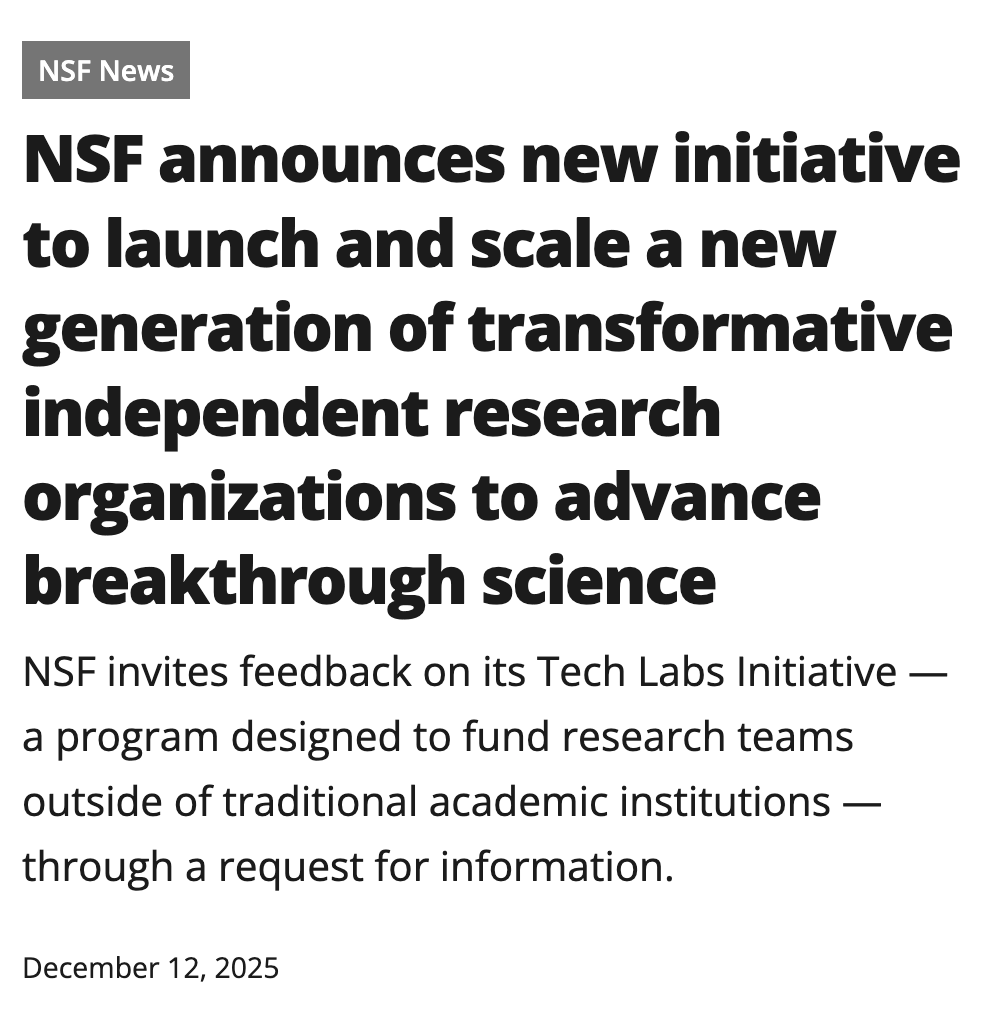
NSF is launching one of the most ambitious experiments in federal science funding in 75 years.
The program is called Tech Labs, and the goal is to invest ~$1 billion to seed new institutions of science and technology for the 21st century.
Instead of funding projects, the NSF will fund teams. I’m in the @WSJ today with a piece on why this matters (gift link): https://t.co/xteQ3NgWVC
Here’s the basic case:
1) Most federal science funding takes the form of small, incremental, project-based grants to individual scientists at universities.
2) The typical NSF grant is ~$250k/year to a professor with a couple of grad students and modest equipment over a few years. This is a perfectly reasonable way to fund some science, but it's not the only way.
3) A healthy portfolio needs more than one instrument. Project-based grants are like bonds: low-risk, steady, safe. But no one trying to maximize long-run returns would put 70% of their portfolio in bonds.
4) Yet that's basically what our civilian science funding portfolio looks like. Around 3/4ths of NSF and NIH grant funding is project-based.
5) Tech Labs is NSF's attempt to diversify that portfolio. The Tech Labs program is aiming for:
- $10-50 million/year awards per team
- 5+ year commitments
- Measuring impact through advancement up the Tech Readiness Level scale rather than papers published
- Up to ~$1 billion for the program
- Supporting research orgs outside traditional university structures
6) Scientific production looks very different than it did when the NSF launched 75 years ago. The lone genius at the chalkboard can only do so much. Frontier science + tech today is increasingly team-based, interdisciplinary, and infrastructure-intensive.
7) The team behind AlphaFold just won the Nobel Prize in Chemistry. It came from DeepMind, an AI lab with sustained institutional funding and full-time research teams. It would be near-impossible to fund this kind of work on a 3-year academic grant.
8) Same pattern at the @arcinstitute (8-year appointments, cross-cutting technical support teams) and @HHMIJanelia (massive infrastructure investments to map the complete fly brain). Ambitious science increasingly needs core institutional support, not a series of project grants stapled together.
9) Similarly, Focused Research Organizations (@Convergent_FROs) have showcased a new model supporting teams with concrete missions and predefined milestones to unlock new funding.
10) There’s a whole ecosystem of philanthropically-supported centers doing amazing research, like the Institute for Protein Design, the Allen Institute, the Flatiron Institute, the Whitehead Institute, the Wyss Institute, the Broad — the list goes on.
11) But philanthropy can’t reshape American science alone. The federal government spends close to $200 billion each year on research and development, an order of magnitude more than even the largest foundations.
12) If we want to change how science gets done at scale, federal funding has to evolve. And the NSF and NIH don’t have dedicated funding mechanisms to support or seed these sorts of organizations.
13) Earlier this year, I started working on a related framework called “X-Labs” that built on all this exciting institutional experimentation that’s been happening within the private and philanthropic sectors. It’s time for the federal government to step into the arena: https://t.co/0iVLobqQeA
14) Traditional university grants are still important for training the next generation of scientists and for certain kinds of curiosity-driven work. But after 75 years of putting nearly everything into one model, we should try something different.
15) And key program details are still being developed! You can reply to the Request for Information with suggestions or feedback on how to design this program here: https://t.co/R6MNo0ZfN1
16) Science is supposed to be about experimentation. Science funding should be too.