#GLAND#GlandPharma
Nomura maintains a Buy rating on Gland Pharma with an increased target price of ₹3,750 (up from ₹3,330), driven by a strategic pivot toward contract development and manufacturing organization (CDMO) and biologics models.
✅Target Price: ₹3,750 per share
✅Rating: Buy
✅Valuation: Trading at ~30.6x one-year forward P/E
✅Growth Outlook: Expected ~20% revenue CAGR over FY26–30
My base case now :
We slowly try to form the bottom in the range @ 22400-22850 and then some recovery .
Bull case will be only activated , if crude breaks below $ 92 or some policy action from GOI , which is impossible to predict .
Why FII Selling Is hurting India's Economy ??
1. Stock prices drop first:
FIIs sell Indian shares, causing stock markets to fall, but that is only step one , High-end consumers get impacted , less spending .
2. The Rupee loses value:
FIIs convert Rupees into US Dollars to take cash home, making the Dollar stronger and the Rupee weaker.
3. Petrol and diesel get expensive:
India imports around 85 % of its crude oil in Dollars, so a weaker Rupee instantly increases fuel costs.
4. Daily grocery bills go up:
Higher transport costs drive up prices for food, vegetables, and daily household items.
5. Loan EMIs become costlier:
Money leaving the country forces interest rates up on home, car, and personal loans.
6. Companies slow down hiring:
Rising input costs make businesses cautious, delaying new projects and job openings.
7. Government budgets get squeezed:
More public money goes toward managing debt and costly imports instead of roads, schools, and hospitals.
These are just first / 2nd order impact of FII outflows.
It's never just about stock prices.
Don’t wish to write 3rd/4th order impact & scare people around me .
I hope some solution will be found in coming months .
Let’s hope for the best 💚
This quarter’s results should give us much more clarity on how markets are reacting to inflation. The key question is whether the sharp rise in crude oil prices was passed on to the end consumer, and if it was, how did demand hold up? Did higher prices lead to demand destruction? On the other hand, if companies absorbed the higher costs instead, we could see a meaningful dent in margins across sectors. FIIs aren’t willing to take that risk right now; they are simply selling and discounting the uncertainty around how these factors will play out in the future.
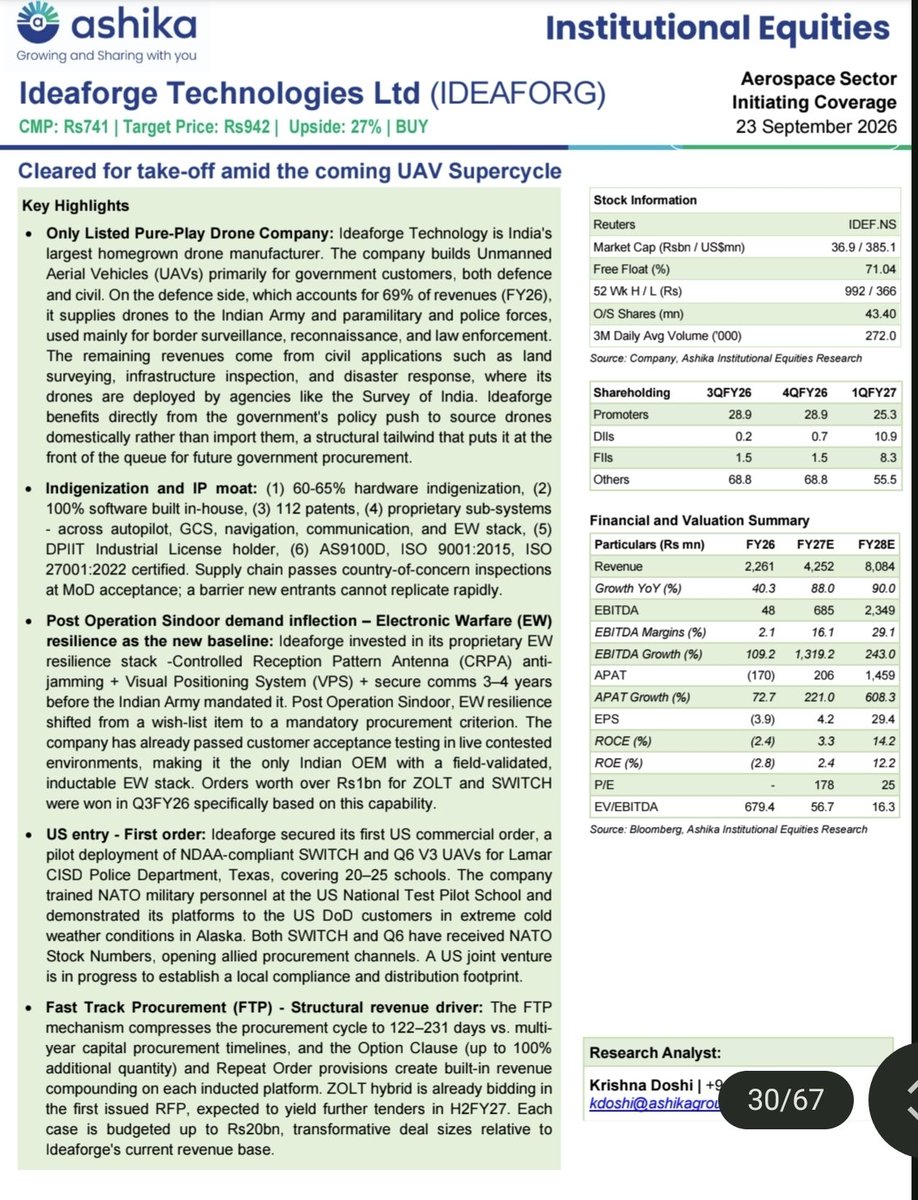
#IDEAFORGE — THE UAV (Unmanned Ariel Vehicle) SUPER CYCLE MAY BE JUST BEGINNING
Ashika initiates coverage with BUY, TP ₹942 vs CMP ₹741 — 27% upside.
FY 26 -28 estimate -
Revenue: ₹226 Cr → ₹425 Cr → ₹808 Cr
FY28E EBITDA: ₹2,349 Cr
FY28E PAT: ₹1,459 Cr
FY28E EBITDA margin: ~29%
FY28 PE projected as 25 💥
The bigger story is the TAM + operating leverage.
Demand pipeline is huge: • ISAT: 700–800 units for Army
• ULPGM: 350–400 units
• Joint MALE RPA: 360+ units
• ISRE/SIGINT and other UAV categories add further demand
The report highlights an 8–20 year defence UAV demand roadmap, creating a potentially very large addressable market for indigenous drone manufacturers.
~ Defence already ~69% of revenue
~ 60–65% hardware indigenisation
~ 100% software/IP stack in-house
~ Strong EW, surveillance & autonomous capabilities
#IdeaForge #Defence #UAV #Drones #DefenceStocks #MakeInIndia
INDIA Bought FCNR deposits to bring dollars and save the currency.
And now the currency is still falling.
India will now have to return them along with interest on them.
SGB was a disaster.
Now this will result in another one.
Illiterates running the policies.
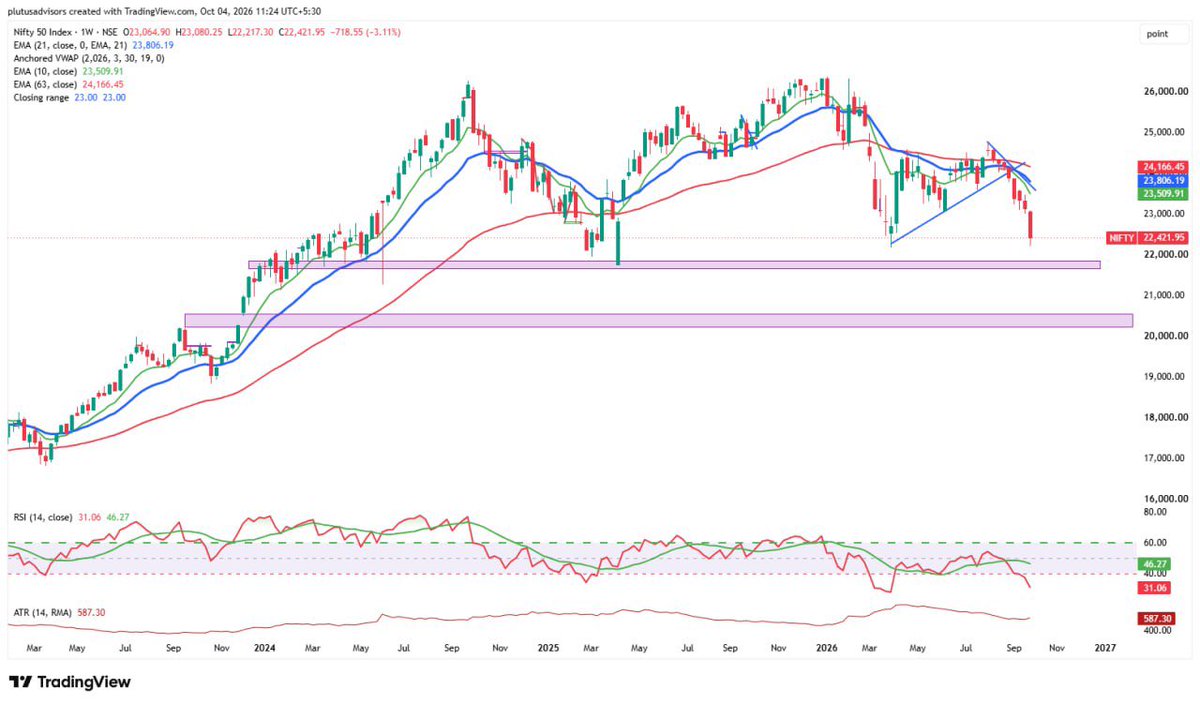
NIFTY 50 WEEKLY UPDATE:
Nifty has decisively broken the 23,000 support with a strong bearish candle, confirming a lower-high, lower-low structure & well below Weekly EMA-21 & EMA-63
Resistance: 23100-23200 (Supply Zone)
Next Support: 21800-22000
Note: Some relief for bulls only above 22850.
This is just a 1 week view , long term investors can safely ignore this .
Disclaimer: For educational purposes only. Not investment advice. Market investments are subject to market risks. Plutus Advisors | SEBI Reg. RA No-INH000010229
🚨 INDIA’S ECONOMIC PRESSURE IS REACHING CRISIS LEVELS.
The war is hurting economies around the world, but some countries are getting hit much harder than others.
India is now one of them.
Start with the rupee.
It is having its worst year against the US dollar since 2022, down around 6% so far in 2026.
At the same time, Indian stocks have fallen for 8 straight weeks, the longest losing streak since the dot-com bubble burst.
Indian stocks have also dropped to a record low relative to global equities.
And foreign investors are selling aggressively.
FIIs sold around $12.8 billion in March, followed by roughly $7.3 billion in April, $5.8 billion in May, $5.1 billion in June, and $4.6 billion in September.
From January through September, foreign investors sold roughly $42 billion worth of Indian equities in the cash market.
And now the bond market is getting hit too.
India’s 10-year government bond yield has crossed 7.20%, a 2.5-year high.
Then comes inflation.
Retail inflation jumped from 4.45% to an 8-month high of 4.82% in August.
Wholesale inflation has climbed to 9.92%.
And oil could make all of this even worse.
India’s average crude purchase price reached $116.04/barrel in September, the highest since the US-Iran war began.
The Indian crude basket even crossed $120/barrel in late September.
India imports around 85-90% of its crude, and every sustained $10 rise in oil can add roughly $12-15 billion to its annual import bill.
In August alone, India’s crude import bill jumped 18% to $11.7 billion, even though import volumes actually fell 3%.
Oil companies are already estimated to be losing around ₹530 crore every day.
That includes roughly ₹8/litre on petrol, ₹9/litre on diesel, and ₹300 per LPG cylinder.
India has also already seen around 4 rounds of petrol and diesel price hikes since February, taking prices up by roughly 7-8%.
And getting cheaper oil is becoming harder too.
India had been buying discounted Russian crude, but the new US sanctions law gives the president authority to impose tariffs of up to 100% on major buyers of Russian oil.
Venezuelan supply is falling as well.
Shipments to India dropped from roughly 297,000 bpd to 253,000 bpd in September.
Now add food to the problem.
India’s monsoon rainfall came in 12.6% below normal, the fourth-lowest since 2001.
That matters because agriculture still contributes around 16-18% of GDP, supports roughly 42-46% of the workforce, and around 50-55% of arable land still depends heavily on monsoon rainfall.
India’s foreign minister has already warned about a possible major food crisis in the coming months because of wars, grain disruptions, fertilizer shortages, and climate pressure.
So look at what is happening at the same time:
Rupee: worst year since 2022.
Stocks: the longest losing streak since the dot-com crash.
FIIs: roughly $42 billion sold.
Indian stocks vs. global stocks: record low.
10Y yield: 2.5-year high.
Retail inflation: 8-month high.
Crude: $116.04/barrel.
Oil companies: losing ₹530 crore a day.
Cheap Russian oil: under threat.
Monsoon: fourth-worst since 2001.
Food crisis risk: rising.
One of these problems alone is manageable.
The scary part is that India is now dealing with almost all of them at once, and each one can make the next one worse.
MSFT, NVDA, AAPL and META alone added about 300 points to the S&P in Q3, more than 200% of the index's total gain. The other 499-ish stocks together subtracted about 150 points: Citadel
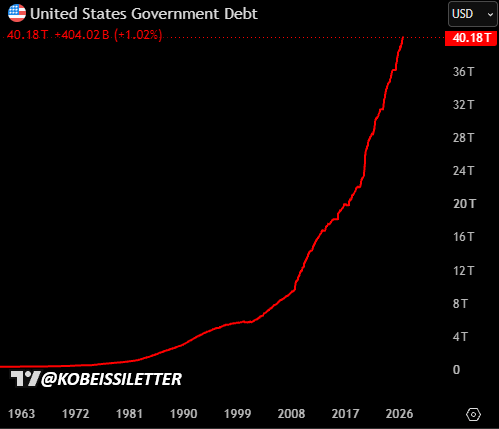
BREAKING: President Trump says higher US inflation will "pay off" US debt "very rapidly" in response to total US debt rising above $40 trillion.
"I know I'm the best in the world... you can pay off the debt through other means. But the one thing that you can do is pay it off through growth, and we've never had growth like this," Trump said.
US Treasury yields hit a new high of the day after the statement.
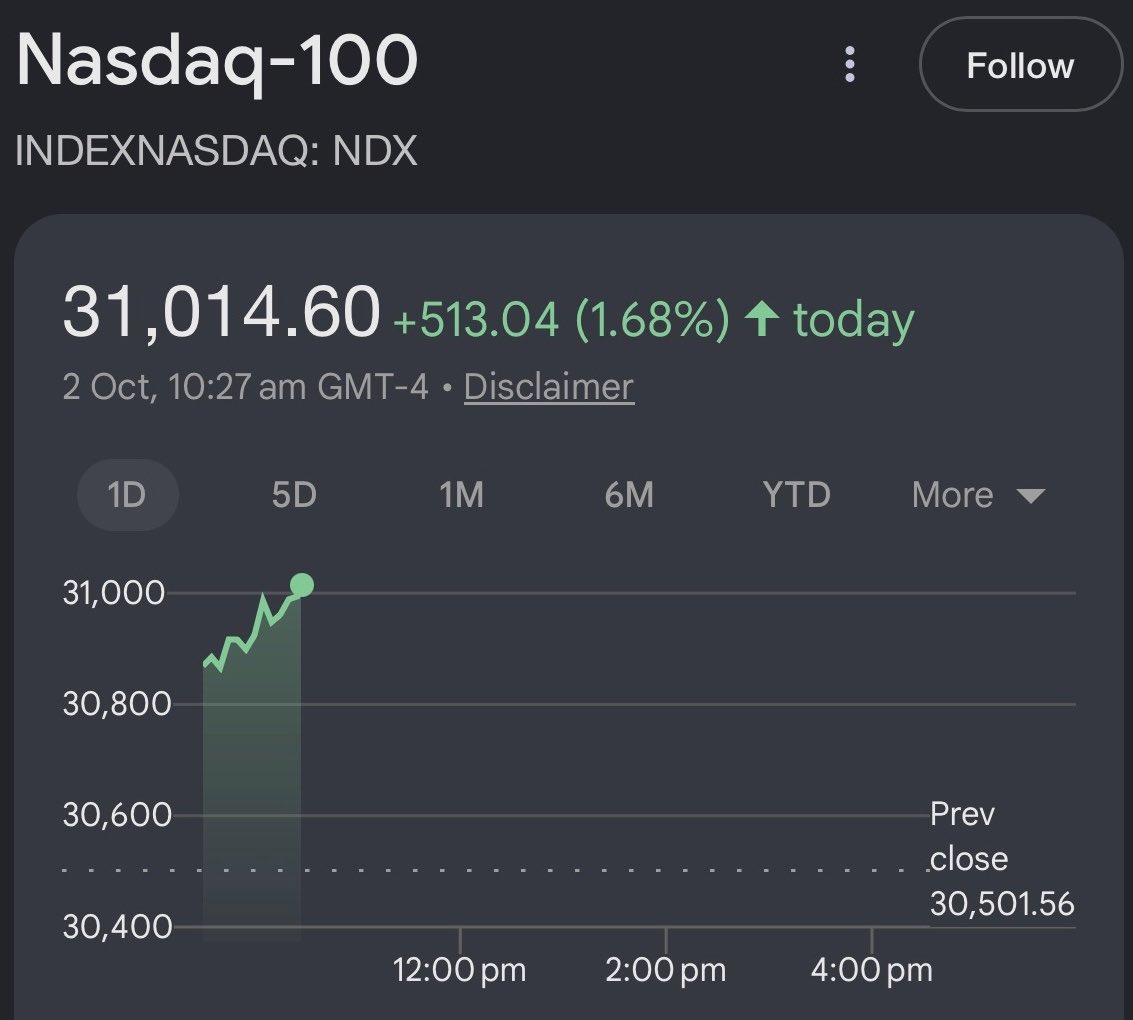
NASDAQ has hit a fresh all time high.
This is the stock market of a country
> That is struggling with record Inflation
> That has one of the most unpredictable man as president
> That is directly involved in a war
> That has record high debt and bond yields above 5%
But still stock market is hitting fresh highs, compare it our record GDP Growth and low Inflation data. Nifty 50 is struggling from last 5 years.
What's wrong? Wrong Data or wrong policies.
Shocking stat of the day:
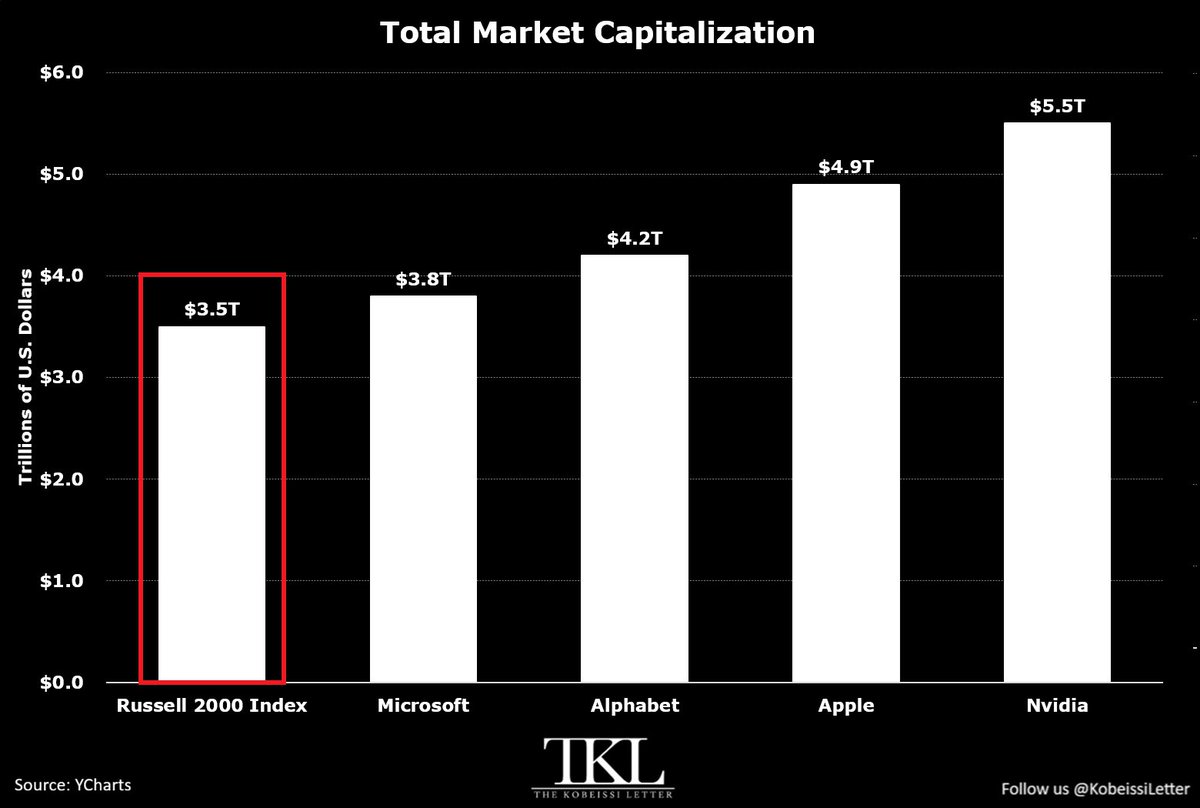
Each of the top 4 S&P 500 companies is now larger than the entire Russell 2000 Index, which has a total market cap of $3.5 trillion.
Nvidia, $NVDA, alone, with a $5.7 trillion market cap, exceeds the small-cap index by $2.2 trillion.
At the same time, Apple, $AAPL, with its $4.9 trillion market cap, is worth $1.4 trillion more than the Russell 2000.
Alphabet, $GOOGL, and Microsoft, $MSFT, are valued at $4.2 trillion and $3.8 trillion, respectively, also surpassing the combined market cap of the Russell.
These 4 big tech stocks are now collectively valued at a massive $18.6 trillion, accounting for 26% of the S&P 500’s total market cap.
Meanwhile, the Russell 2000 represents ~7% of the total US equity market, despite containing nearly 2,000 companies.
Big tech has never been bigger.
Making 1 semiconductor chip needs over 500 different chemicals and 50 different gases. Right now, INOX Air Products makes about 12 of those gases inside India.
Company committed Rs 500 crore to build gas hub right next to Tata fab in Dholera, and plans to add 10 more gases But even after that, 20 to 25 gases still need importing. Getting approved as semiconductor supplier takes 9 to 18 months for each material. Fab itself can start on time, but building all 450 suppliers around it takes years
Tata Electronics signed 16 deals at SEMICON India 2026 to bring global companies into Dholera fab operations. ASML from Netherlands will provide chipmaking machines.
Nexperia will help with chip testing. Fujifilm will start making semiconductor materials locally. Merck will supply very pure chemicals needed for chip production. These partners come from Europe, Japan, Singapore, and India.
India government has received between $11 and $12 billion in proposals from companies that want to be part of semiconductor supply chain here. Each deal brings capability India did not have before
In US, every 1 person working directly in chip factory supports about 5 to 6 more jobs in surrounding economy. Tata Dholera fab in Gujarat plans 20,000 direct and indirect jobs.
Tata assembly plant in Assam adds 27,000 more. Combined, that is 47,000 positions across 2 facilities. On top of that, 450 suppliers will set up inside 363 acre vendor park next to Dholera fab, each bringing its own team.
Rs 91,000 crore investment creates not just chips but full industrial cluster with its own employment base.
just think about Butterfly effect , India will Disappoint yu but surprise yu too :)
eMudhra’s acquisition story is actually quite interesting if we see all of them together. ( Self reference post 5)
It does not look like random M&A.
TWO95 International, USA
= US enterprise access and digital transformation capability
Sendrcrypt, USA
= Secure communication and email security capability
CRYPTAS, Austria
= PKI, encryption, key management, European customer base and regulatory access through PrimeSign
AI Cyber Forge, USA
= Secrets management, Just-in-Time credentials, PKI automation and encryption capability
So slowly eMudhra is building all the blocks around digital trust.
From digital signature and certificates, they are moving towards:
Identity
Authentication
PKI
Encryption
Secrets management
Access control
Secure communication
AI agent security
This is why I feel eMudhra should not be looked at only as a digital signature company anymore.
The larger picture looks like:
India capability + US enterprise access + European regulatory footprint + new cybersecurity capabilities
= possibility of becoming a global digital trust platform.
Now the important thing to track is whether these acquisitions start cross-selling into each other’s customer base.
If that happens, then the acquisition value can be much larger than the revenue they purchased.
US added just 29K jobs in Sept (vs ~90K expected).
Unemployment rate ticked up to 4.2%. Soft report.
October Fed rate hike odds plunge to ~15-20%.
Markets cheer the cooler labor data.
Nasdaq fresh all time high .