The legendary Ruth Slenczynska, born on January 15, 1925, is the last living student of Rachmaninoff. At 91 years old, she gives a breathtaking performance of Brahms' Intermezzo Op.118 No.2. 🎹
Before we had silicon chips, we had needle and thread?
In the 1960s, NASA didn’t ‘upload’ code; they sewed it. To get Apollo 11 to the moon, skilled weavers (often called ‘Little Old Ladies’) literally hand-stitched software into physical objects.
By passing copper wire through tiny magnetic rings, they created Core Rope Memory. The logic was beautifully simple: wire through a ring was a ‘1’; wire around it was a ‘0’. Because the code was physically woven, it was virtually indestructible. It couldn’t be deleted, it couldn’t crash, and it survived the intense radiation of deep space with just 72 kilobytes of data: millions of times less than a single photo on your phone today.
It proves sometimes the most advanced tech is actually handmade.
The results were astounding — it manipulates the flow of time.
By applying the mathematical elegance of the Fibonacci sequence to quantum hardware, researchers have created a new phase of matter that preserves data four times longer.
Physicists have achieved a major breakthrough in quantum computing by using laser pulses patterned after the Fibonacci sequence to create a stable new phase of matter.
In an experiment involving a lineup of ten atoms, researchers at the Flatiron Institute discovered that blasting qubits with this mathematical rhythm allowed them to maintain their quantum state for an impressive 5.5 seconds—nearly four times longer than standard methods.
This remarkable stability stems from the quasi-periodic nature of the Fibonacci sequence, which effectively creates a temporal "quasicrystal" that organizes information without repeating it, shielding the system from the environmental noise that typically crashes quantum calculations.
The most mind-bending aspect of this discovery is how it manipulates the flow of time within the quantum system. Lead author Philip Dumistrescu explains that the Fibonacci pulses make the system behave as if it exists in two distinct directions of time simultaneously.
This complex temporal structure acts as a protective barrier, canceling out the errors that usually live on the edges of the quantum array. By overcoming the extreme fragility of qubits, this "two-time" approach provides a much-needed path toward developing reliable, large-scale quantum computers capable of solving problems that are currently impossible for classical machines.
source: Dumistrescu, P. T., et al.. Dynamical topological phases realized in a trapped-ion quantum simulator. Nature.
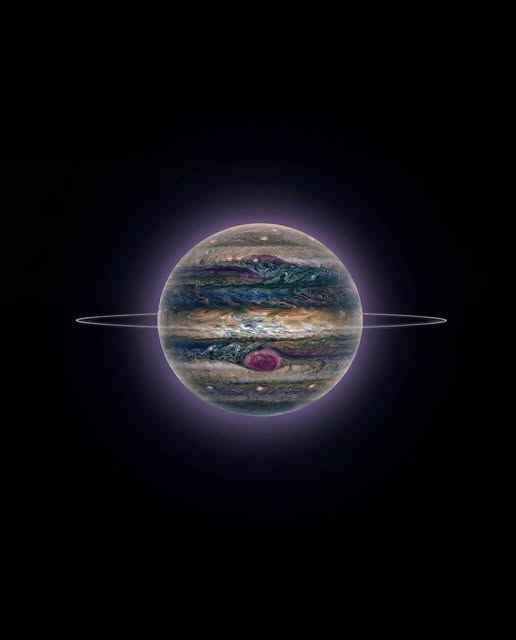
Amazing: Jupiter's rotation as seen by Hubble
This is not a real-time video. Rather, a sequence of images of the planet captured by Hubble that have been digitally mapped onto a spherical model
Credit: NASA, ESA, J. DePasquale (STScI), A. Simon (NASA-GSFC)
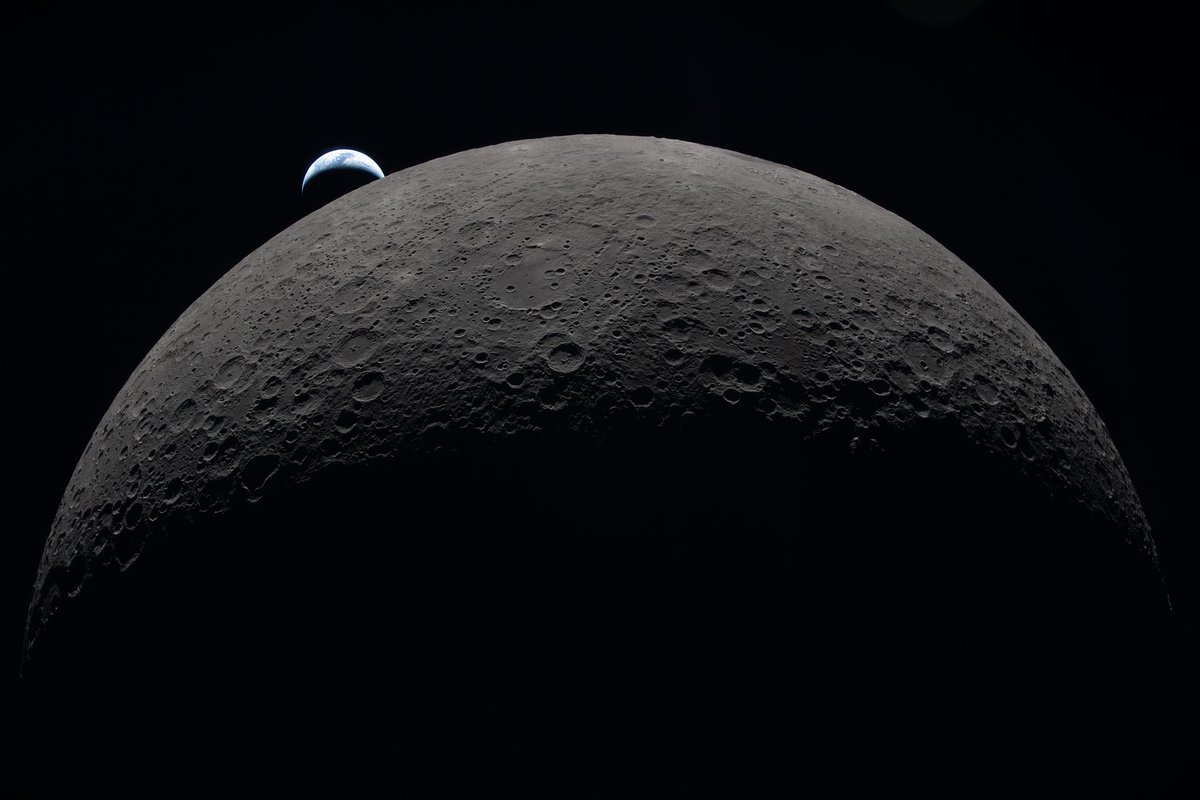
What the Artemis II astronauts did over the last 10 days was a testament to their bravery. And the fact that they traveled farther from Earth than anyone ever has, re-entered our atmosphere at more than 24,000 mph, and splashed down safely was a testament to human ingenuity. Thanks to everyone at @NASA for making this mission possible, and for taking us along for the ride.