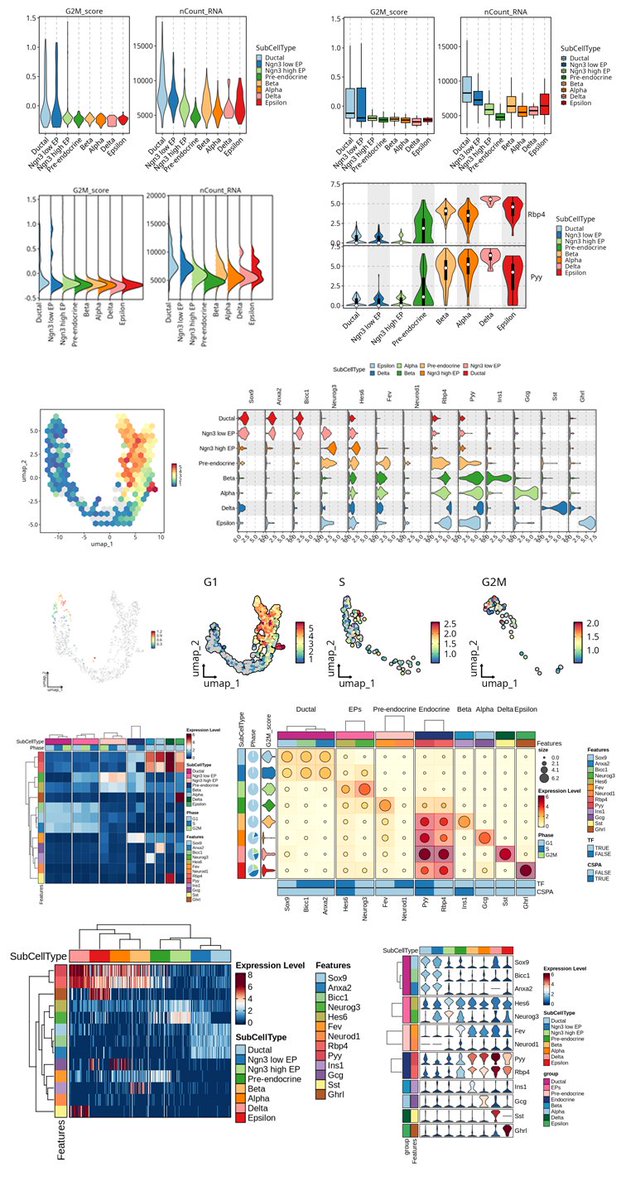
Happy to share our latest article on Arabidopsis BORDER proteins @CurrentBiology https://t.co/obMGZ7J9pn
These negative transcription elongation factors appear to repress the expression of genes through different mechanisms.
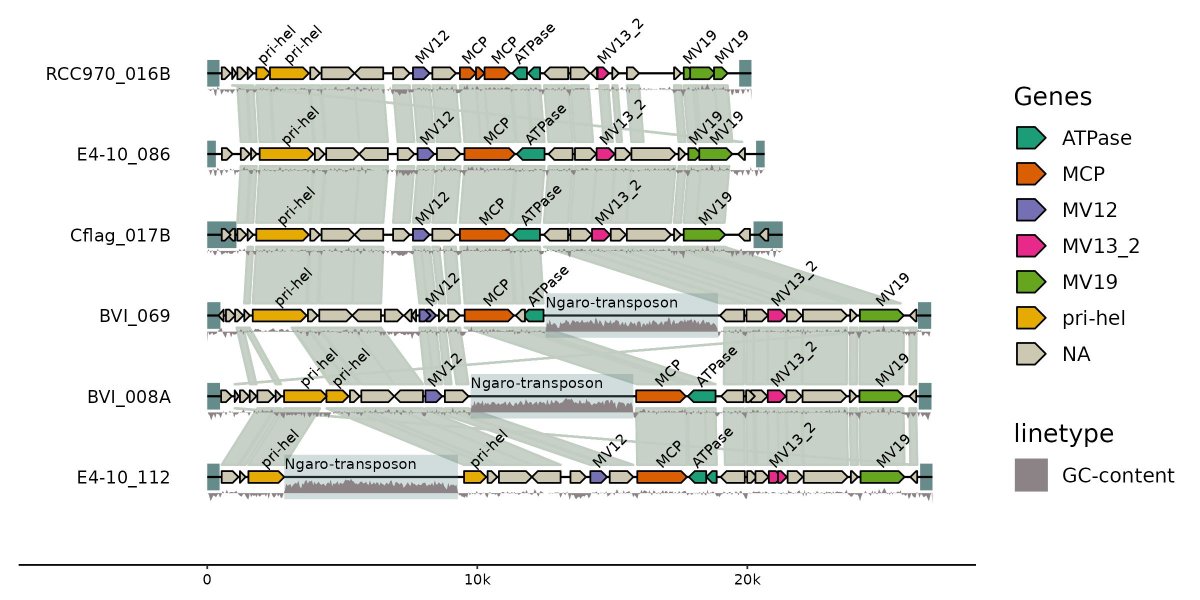
Visualize genomic data with ease using gggenomes, an R package that extends ggplot2 to handle and display genomic information intuitively. Whether you’re comparing genomes, analyzing features, or showcasing synteny, gggenomes provides the tools you need to turn complex genomic data into clear, informative visualizations.
Why use gggenomes?
✔️ Genomic-focused visualizations: Specifically designed for handling genomic data, including features, alignments, and comparative analysis.
✔️ Versatile and modular: Create detailed and layered plots for diverse genomic scenarios with flexibility for customization.
✔️ Built on ggplot2: Leverages ggplot2’s familiar framework, making it easy for users to adapt and enhance their visualizations.
The example visualization shown here is taken directly from the gggenomes GitHub repository, demonstrating how it transforms genomic data into compelling plots: https://t.co/FzE2wNzHeP
Curious to learn more about creating data visualizations in R and using tools like ggplot2 and its extensions? Check out my online course, "Data Visualization in R Using ggplot2 & Friends!"
Further details: https://t.co/ztlEzoEDWv
#tidyverse #statisticsclass #RStats #database #datavis #R #ggplot2 #Python #VisualAnalytics
Today in @ScienceMagazine, we report a new DNA editing technology to seamlessly write massive changes into the right place in the human genome.
The reason gene editing hasn't transformed human health is that current gene editing technologies like CRISPR are very limited.
The problem with CRISPR is that it cuts up your DNA, and then hopes that unreliable cellular DNA repair will make the wanted edit. @geochurch famously called it genome vandalism. More precise versions of CRISPR only edit less than 100 bases - often only a single base. Therefore, it's not suited to make large changes safely.
However, most diseases are not the result of mutations in one location. Instead, their causes are spread all across the 3 billion base pairs in the genome.
We found bridge RNAs in bacterial “jumping genes” that allow us to make safe and arbitrary changes (insert, cut out, or flip) to every nucleotide within (up to) a 1 million bp sequence in your DNA.
In the paper, we show that we can correct the disease-causing DNA repeats that cause Friedreich's ataxia (which is a rare neurological disease). The same approach could be applied to Huntington’s and other repeat expansion disorders.
At @arcinstitute, we're working towards a full Turing machine for biology. Evo, our DNA foundation model, helps us design the optimal healthy DNA sequences. And Bridge recombination gives us the ability to seamlessly write these changes into the right place in the genome.
This work was a wonderful collaboration with my @arcinstitute cofounder @SKonermann and led by the indefatigable @ntperry13, alongside our amazing bridge editing team: @BartieLiam@dhruvakatrekar@Gabogonzalez515@mgdurrant@james_jw_pai@AlisonFanton Juliana Martins Masa Hiraizumi @chiaroscurale@hnisimasu
Happy to share our new computational pipeline to predict the protein functional consequences of alternative RNA processing events: https://t.co/FGfMDPQS2f
This a really exciting leap forward for genomic sequence to activity gene regulation models. It is a genuine improvement over pretty much all SOTA models spanning a wide range of regulatory, transcriptional and post-transcriptional processes. 1/
Excited to introduce LiftOn – an open-source tool for accurate liftover of genome annotations (GFF) across assemblies. 🚀
👉 Code &community: https://t.co/Ri8KjyLPaN
It’s been incredibly rewarding building this for the genomics community. Thank you to all collaborators/friends!
Love this work from @KexinHuang5 + colleagues. An AI co-pilot in my view is a very useful, practical framing of using agents to enhance the efficiency of biomedical science.
Also appreciate @KexinHuang5 's grounded presentation of his work.
This was clearly an immense effort
Bioinformatics folks: check out our @biorxivpreprint on a new, very efficient and accurate system for automated genome annotation, EviAnn, led by @AlekseyZimin5 https://t.co/jy6k4OvAd9
Interested in chromatin and transcription in plants? 🌱🧬 looking for a lab to do a postdoc? 🤓our lab invites applicants for the MSCA postdoc fellowships 2025 call!! Interested, please PM!! Check conditions and eligibility here:
https://t.co/ofGqHnhCXv
Making intrabodies from antibodies just got easier! Learn how we made 𝟭𝟵 intrabodies to bind and light up peptides and histone modifications in live cells. And thanks to Academia, all sequences are freely available. (video credit: Yuko Sato @YukoSatoT2) https://t.co/QCwflxYH1m
Why is it that gene promoters are so good at avoiding DNA methylation? Work from Ming Wang, Yan He et al., shows that H3K4me3, enriched at promoters, acts as an anti-DNA methylation mark by recruiting DNA demethylase enzymes! Nice work guys! https://t.co/oSZ0jDZ295
Fun #epgienetics review for Sunday!
Histone PTMs and DNA-templated processes (e.g. transcription) are deeply linked, but the mechanisms driving their cross-talk remain unclear.
López-Hernández et al. cover the latest research on this key question - Enjoy!
https://t.co/2f9lf4D8OM
New year, new assemblies!
I'm excited to announce Autocycler, my new tool for consensus assembly of long-read bacterial genomes!
It's the successor to Trycycler, designed to be faster and less reliant on user intervention.
Check it out: https://t.co/NksiyESF7u
(1/5)
📢 Appel à propositions pour les mini #symposiums pour @JOBIM2025
➡️ deadline : 17/01/2025 18h
➡️ objectif : réunir des scientifiques autour de thématiques spécialisées en #bioinformatique
➡️ durée : 3 heures
➡️ autofinancement (enveloppe de soutien possible via la #SFBI)
Interested in chromatin and transcription in plants?🌱🧬 looking for a lab to do a postdoc? 🤓 our lab invites applicants for the following calls: #JuanDeLaCierva from @AgEInves https://t.co/6awimSNofs and #CIAPOS from @GVAeducacio https://t.co/QyqdaPUHMk Interested, please PM!!
Single Cell & Spatial Transcriptomics Analysis
@cshlcourses@CSHL
Key Dates
Application Deadline: March 15th, 2025
Arrival: June 26th by 6pm EST
Departure: July 14th around 12pm EST
Topics
-Droplet-based single cell RNA-seq using RNA Flex Technology.
-Single-Cell Imaging using Single cell Transcriptomics And Multimodal Profiling though imaging (STAMP) using Xenium Technology.
-Spatial Transcriptomics of tissues using Visium HD
-Single-Cell Western blot
-Single-Cell Mass Spectrometry
-Photoactivatable Single cell probes
-Introduction to Bioinformatics (R/Python)
-Single-Cell and Spatial Transctiptomics Bioinformatics and more!
Amazing evening speakers too!
https://t.co/ckMUw0nV35