The Every team runs as much work as possible through agents. To help the whole team share skills when a new model comes out, they built a company agent on Claude Managed Agents that everyone uses in Slack.
Once it caught on internally, they released it to their subscribers.
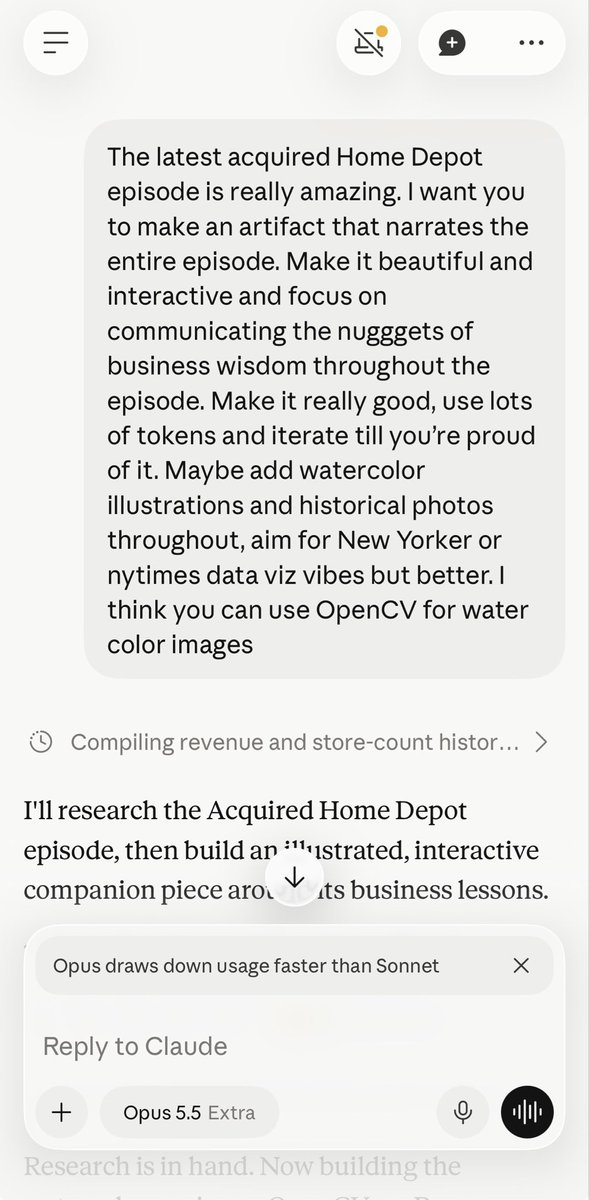
I asked Opus 5.5 to make an interactive website companion for the latest @AcquiredFM Home Depot episode. It came out pretty nice!
Water color illustrations all drawn by Claude, too: https://t.co/Camrfu3bwT
Episode here: https://t.co/x2t57gdjxr
I am surprised that people are surprised this is how I prompt Claude.
Talk to Claude the way you would a coworker. There's no secret to prompting. There's no need to be overly scaffolded or prescriptive for most tasks -- give Claude a goal, and it will figure it out.
Back in the Sonnet 3.5 days, your prompt mattered a lot. Nowadays, it's much more important to communicate to the model:
1. What you want it to do
2. How much effort you want it to spend
3. How it should verify that it did the right thing
I've been working on a skill that makes better HTML plans in Claude Code.
It uses simple language, shows code snippets, surfaces questions & makes mockups. Linting reduces the normal failure cases that Claude runs into.
Would love your feedback before shipping more broadly!
.@OpenRouter co-founder Alex Atallah on the "everyone is building the same thing" take:
"This reminds me of this tweet I saw... Everybody's building an agent loop with notifications, third-party connectors, context management, memory, sandboxes, agentic web search, an always-on agent on top."
"This product is showing up everywhere. It is showing up everywhere, but these are just the new table-stakes primitives."
"A 2005 version of that tweet would be: 'Oh, everybody's building the same thing. A database, a users table, a sign-in page, a sign-up page, a profile page, a logout page. Everything's the same.'"
"There's like a lot of differentiation really. There's table-stakes needs for AI just like there's table-stakes needs for the web."
@alexatallah@amasad
yesterday i showed claude code using codex's computer use, today i got some more fucking fire for you
claude can also drive codex's official chrome extension, and it controls chromium browsers beautifully
all in the background, without the "allow" popup chrome devtools mcp throws at you every time a new agent connects
it even handles more than one browser: each install of the extension gets its own instance id, so claude knows which is which
i have helium as my main and chrome for work, and claude code now uses both
first, install the chrome plugin in the codex app and add openai's chatgpt extension to your chromium browser (or all of them, if you have a few)
then give this to your claude:
"Set up Codex's Chrome extension for you on my Mac. I've installed the Chrome plugin in the Codex app and the extension. Use Codex's computer use MCP server as user MCP "codex-cu": keep it if it's already registered, otherwise copy the "cua_repl" entry from ~/.codex/plugins/cache/openai-bundled/unified-computer-use/<newest version>/.mcp.json. Its browser side rejects calls without Codex turn metadata, so put a small stdio proxy in front that adds _meta["x-codex-turn-metadata"] (session_id and turn_id as a JSON string) to every tools/call. Add a Stop hook that tells this session's proxy to call the hidden turn_ended tool and start a new turn_id, so your tabs get released without touching other sessions. Test it by opening a tab straight at a URL in each browser with cua.createBrowserTab(browserId, url). Browsers can all report as "Chrome", so if I have several, ask me which test tab showed up in which browser."
got more than one browser and ok with it touching your claude.md? give it this too:
"Write each browser's name and metadata.extensionInstanceId into my global CLAUDE.md, with a note to pick browsers by that id and open tabs straight at a URL."
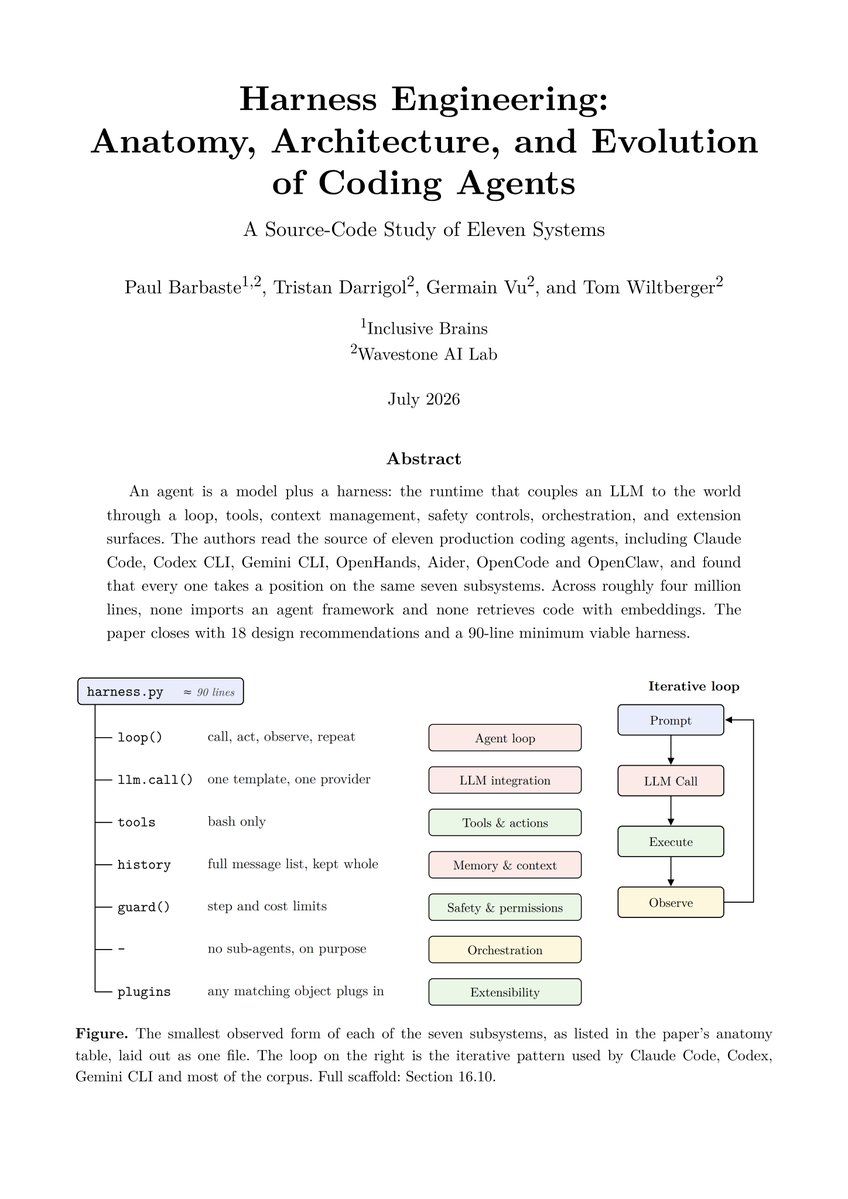
This might be the most useful paper on AI agents this year.
A team at Wavestone AI Lab took apart Claude Code, Codex and 9 more and found the 7-part blueprint every good agent is built on.
Their definition: an agent is a model plus a harness. All 11 agents build the harness from the same 7 parts. Only the size changes.
> Loop: Mini-SWE-Agent is a plain while loop. OpenHands logs every event so a run can be replayed
> LLM layer: one prompt template on one side, 29 provider profiles on the other
> Tools: some agents only have bash, the biggest has 43 typed tools loaded on demand
> Memory: from keep-the-whole-history to notes the agent maintains across sessions
> Safety: from a simple step limit to policy rules plus a reviewer model plus an OS sandbox
> Orchestration: Aider skips sub-agents on purpose, others fork them with their own context
> Extensions: hooks, skills and MCP. SKILL.md is in 9 of 11, MCP in 8
The paper ends with a 90-line harness covering all 7 parts, a solid starting point for your own.
Key pages:
> p.4: the 7-part map
> p.12: the 3 loop types, with Claude Code and Codex as examples
> p.53: why none of them use frameworks or embeddings
> p.67: 18 design recommendations
> p.71: the 90-line harness you can copy
Introducing AgentCraft: a multi-agent harness that runs inside Minecraft ⛏️
A team of Claude agents plans, builds in real worktrees, and walks over when they need you.
People always ask us WHY we spend tens of thousands of dollars per episode.
The answer is simple.
We're taking baby steps until we make our $200M looking feature film.
You get to copy our entire playbook each week.
Full 3D process and Dreamina prompts below👇🏼🧵
I'm excited to share our new film Moloch, about how we all get disempowered without AI going rogue. It’s the 4th (and IMHO least discussed) dystopian AI scenario:
1) Rogue AI
2) Obedient AI misused
3) Obedient AI causes 1984
4) Race-to-replace by obedient AI
Synopsis: As AI triggers worldwide job loss, an engineer who built the tech struggles with dark forces, her family & her CEO over pulling the plug.
Starring Fiona Hampton, Parker Sawyers, David Buttle & Buddy Wignall-Ho.
Written & directed by Tom Cozens.
It's an Owl In Space production in collaboration with FLI.
We worked really hard on this and hope you find it thought-provoking!
Cool eval. Simply ask an LLM “Land or Water?” and give it a latitude and longitude coordinate as text. Ask 16,200 times, plot as image. The models know. From compressing the internet.
It's completely legal to:
• Go on google trends
• Find problem people are struggling with
• Turn those problems into digital assets
• Without revealing your name
• Without showing your face
I made $65k last month doing it.
Here's exactly how it works:
Claude can now help you build evaluations and hillclimb on them.
In this article, we share guidance on eval design & skills that Claude Code can use to improve your applications.
https://t.co/PgKFC2DWth
"Anyone can do nearly anything; but most people aren’t, yet."
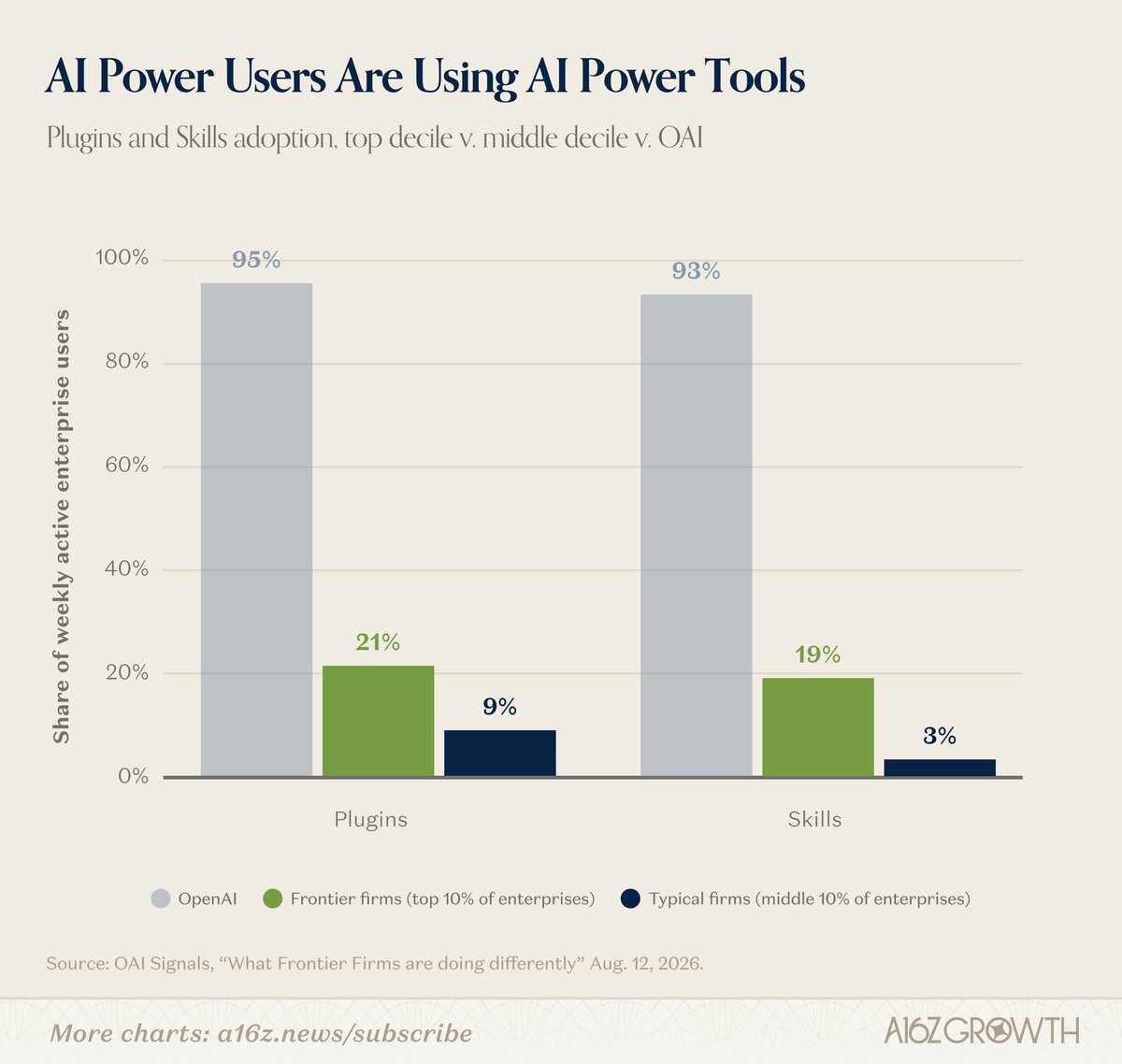
Who uses AI power tools every week:
- OpenAI's own team: 93%
- The top 10% of companies: 19%
- A typical company: 3%
@DavidGeorge83 on why most people haven't been awakened as AI customers yet: https://t.co/olQMa4aNng