1) There is now also an paper on caring for patients with (very) severe ME/CFS.
The guide describes how care should be adapted, from nutrition and personal hygiene to communication and dealing with energy limits and stress.
@nypost Thiamine is very important for the energy intensive Wernicke’s area in the brain. High dose thiamine has helped many people. It's a water soluble vitamin that is incredibly safe and should be tried before pharmacological routes.
@TakeThiamine
https://t.co/FHZMtCX6kz
“Psilocybin, the psychedelic component of magic mushrooms, has previously been touted as an effective treatment for depression, anxiety, addiction, and PTSD — but now researchers say it has the potential to be used in Alzheimer’s intervention as well.
In this case study, published in Frontiers in Neuroscience, researchers focused on an 80-year-old Japanese American woman with Alzheimer’s. She had declined over the previous decade and was reduced to urinary incontinence, speaking in single syllables, and dependence on caregivers for mobility support and daily living.
She was then given a 5g dose of magic mushrooms.
During the initial phase, she was agitated, sweated profusely and entered a prolonged sleep state that suggested unconsciousness. But around hour 19, she began speaking in full autobiographical sentences, recalling life events she had been unable to articulate for years.
In the days and weeks that followed, more incredible changes emerged. She regained urinary continence, even in the evenings, and began dressing herself. She was able to make and maintain eye contact, remember social interactions, emotionally respond to others, and hold lucid conversations.”
Highlights from recent German TV that looked at brain retraining for #MECFS.
A doctor with #MECFS says the programme made her feel she just had to keep trying harder. She eventually suffered a severe crash.
She is “angry” and says that these programmes are endangering people.
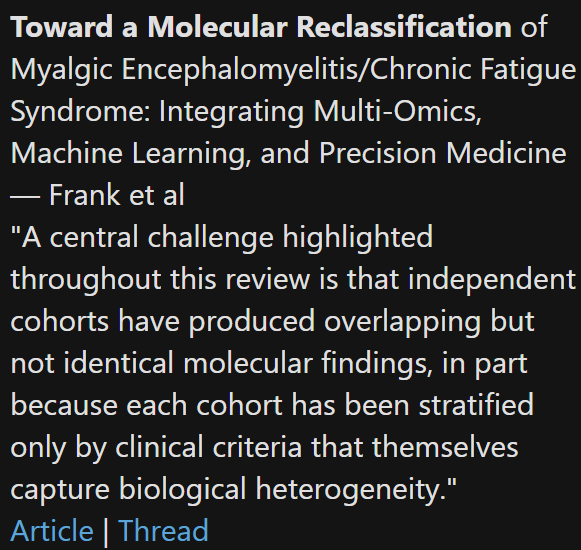
Toward a Molecular Reclassification of Myalgic Encephalomyelitis/Chronic Fatigue Syndrome: Integrating Multi-Omics, Machine Learning, and Precision Medicine
https://t.co/I4izwrh0ga
Screenshot from Science for ME weekly update
#MEcfs#CFS
Said Dr. Mark Painter in a recent episode of PolyBio’s Lab Visits: “What we’re seeing in a third of people with Long COVID, maybe more, is evidence that T cells recognizing either SARS-CoV-2—or in some different people, herpesviruses—are persistently activated. Which is suggestive that those viruses are present somewhere in the body.”
Listen to the full interview here: https://t.co/g3CnbSqNsl
🔗 Paper
📖 Factors Associated with Long COVID in the Pediatric Population: A Retrospective Case–Control Study
FYI/@LongCovidKids
https://t.co/OLCOgMLYrg
“I don’t think I can think of another condition that would be treated this way.”
Dr Anna Brooks, Liggins Institute.
A powerful opening to Zoe Madden-Smith’s award-winning RE:News documentary on #MECFS
Also featuring @rhirhiarhii
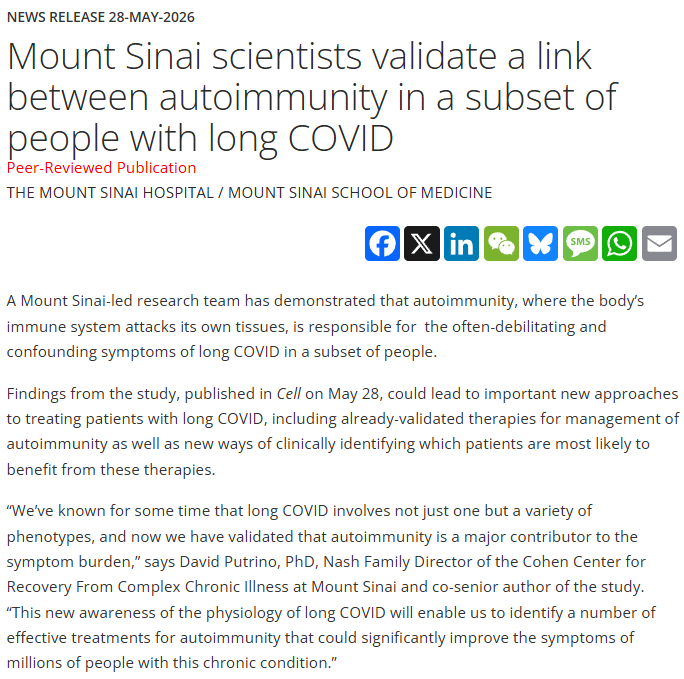
News Release 28-May-2026:
Mount Sinai scientists validate a link between autoimmunity in a subset of people with long COVID
https://t.co/MBj6mlndk5
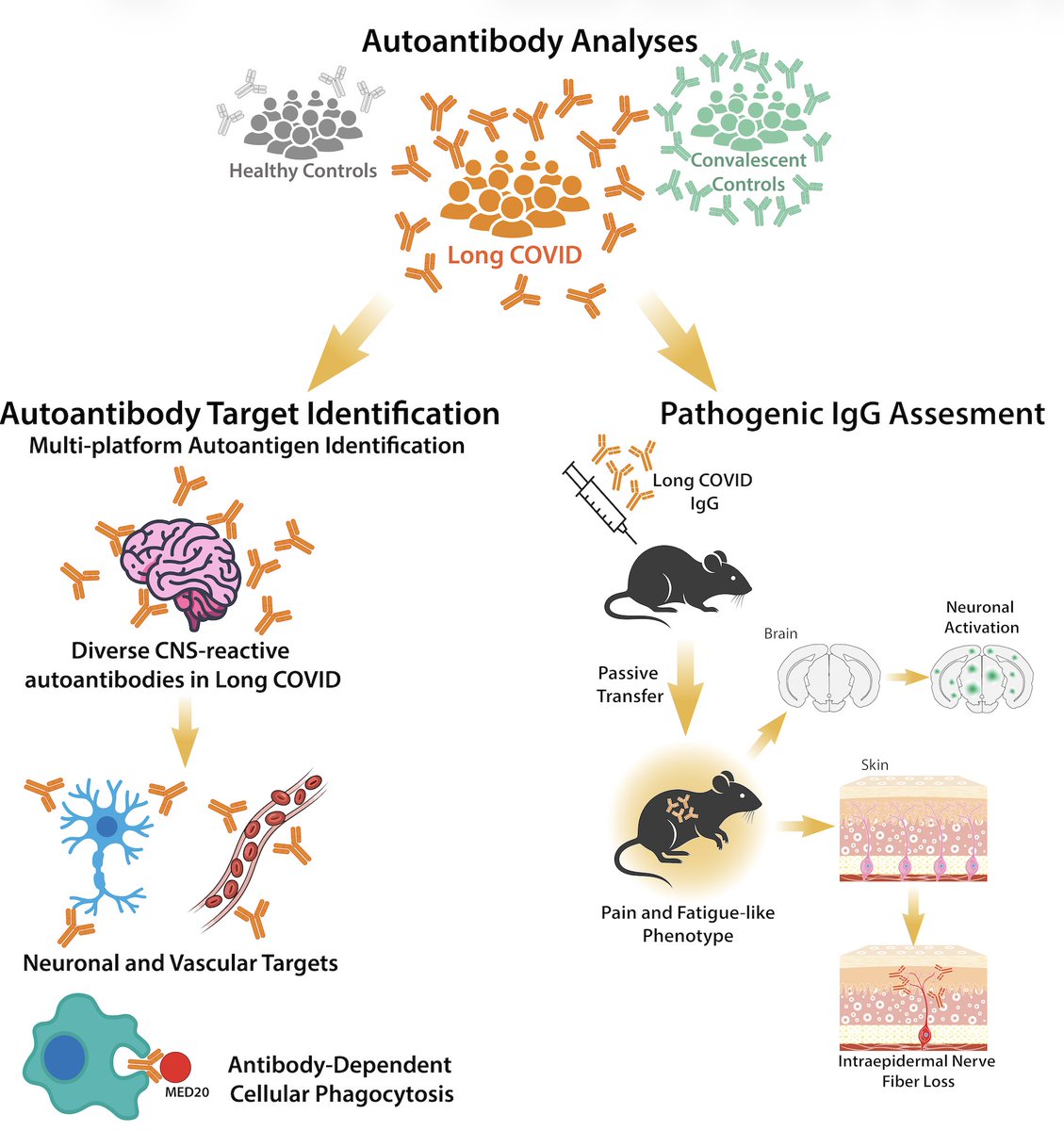
A causal link between autoantibodies and neurological symptoms in long COVID
https://t.co/nio5ZE3bA3
#LongCovid
Excited to share our study by @keylas3 et al. on pathological autoantibodies in people with Long COVID. We asked whether IgG in patients with Long COVID bind to human tissues/antigens and cause pathologies when transferred into mice. With @PutrinoLab
https://t.co/tcowCufWyf
🔵What is shown here is not just “poor fitness” or simple deconditioning. It is a failure of parasympathetic reactivation after exercise, leaving patients stuck in persistent sympathetic dominance when recovery should already be happening.
And in a relevant subgroup of Long COVID and ME/CFS, this may fit very well with anti-GPCR autoimmunity, especially anti-M3.
Why does M3 matter?
Because it is involved in key parasympathetic functions:
-autonomic regulation and orthostatic tolerance
-tear, saliva, and sweat gland function
-gastrointestinal motility and secretion
-visual accommodation
So when M3 signaling is impaired, the result can look exactly like what many patients describe every day:
POTS, tachycardia, dizziness, “empty head,” crashes after exertion, dryness, poor thermoregulation, slow digestion, and heat intolerance.
This is why post-exertional autonomic dysfunction in Long COVID/ME should not be dismissed as “just deconditioning.”
In many patients, it may reflect a real autoimmune parasympathetic failure.
We discussed this framework in our latest article as well.
News Release 26-May-2026:
"Mayo Clinic study details set of options family medicine physicians may consider to treat ME/CFS and long covid"
https://t.co/vIwPy3fx8H
Paper:
https://t.co/iHRKH5iN4E
#MEcfs#LongCovid
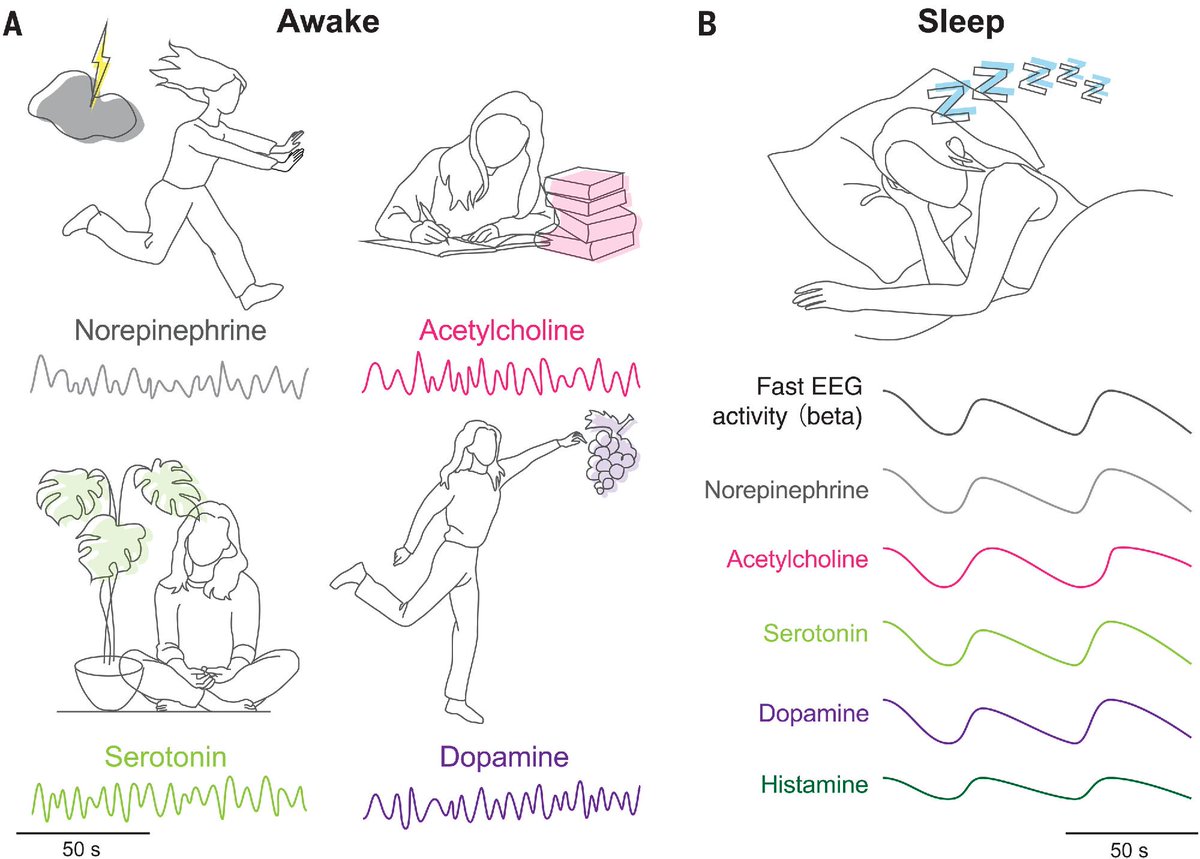
Recent studies have revealed the synchronization of neuromodulators including norepinephrine, serotonin, acetylcholine, dopamine, and histamine during sleep.
A new #ScienceReview explores what potential role the synchronization of these oscillations may play in health. https://t.co/fcDdHm1SDP
NIH Clinical Center, 122 people. ME/CFS and long COVID showed lower brain norepinephrine pathway activity, linked to fatigue, poorer health, weaker grip endurance, and post exertional malaise.
https://t.co/NsqjKePuVG
🩵I think this is the future.
Deep B-cell depletion + antivirals may be the first real curative strategy for ME/CFS and Long COVID — although some patients may still carry permanent sequelae from previous autoimmune damage.
University of Miami researchers report that long COVID may damage blood vessel lining, disrupting blood flow and oxygen delivery.
Vitamin C and L-arginine improved vessel function in two small trials, but larger studies are needed.
https://t.co/FggeRj7sYj
We have known for a while that #LongCOVID pathobiology for many involves reactivation of various herpesviruses. As we continue to validate this it is great to see this work coming out in collaboration with @VirusesImmunity’s incredible team. Here we
https://t.co/mm7FkGqQh6
1/