BITCOIN RAILS #62: BITCOIN'S 3 BIGGEST CHALLENGES | with @neha Director of Digital Currency Initiative (DCI) @MIT
🔗 YOUTUBE: https://t.co/nswGm6QUQc
🌱 SPOTIFY: https://t.co/sVca75jLgt
Neha Narula is the Director of the MIT Digital Currency Initiative, where she focuses on Bitcoin research and the broader design tradeoffs of decentralized money systems.
Her work often centers on what Bitcoin gets right—and where it runs into hard limits—especially around scaling, decentralization, and how systems behave as global demand increases.
In this interview, Neha and I explore longer-term risks to Bitcoin—including advancements in quantum computing and the implications of a diminishing block subsidy—as well as the ongoing challenge of scaling Bitcoin without losing access to self-custody.
A thoughtful conversation on how Bitcoin may change in the coming years, we also explore its social and governance dynamics—including tensions within the development community over protocol changes, scaling philosophies, and the future direction of the system.
This episode of Bitcoin Rails is brought to you by:
LayerTwo Labs @LayerTwoLabs — developing research, software, and technologies for scaling Bitcoin via the integration of Drivechains (BIP 300/301)
Hashi on @SuiNetwork — a primitive for executing Bitcoin Defi transactions, without having to trust a federated bridge or other centralized entity
BitBox @BitBoxSwiss— an open-source Bitcoin-only hardware wallet, with smooth UX and no compromises on security. Check out Bitbox [dot] swiss and use code BITCOINRAILS to get a discount
TIMESTAMPS:
00:00 Intro
00:17 Neha’s Origins
02:26 Bitcoin to MIT
04:40 Media Lab Culture and Mission
11:34 CBDCs as Digital Cash Debate
24:42 Funding Model and Bitcoin Security Budget
29:55 Reorg Risk and Quantum Computing
32:14 Bitcoin Dev Funding Map
42:49 Governance and Corporate Stakes
50:23 Quantum Tradeoffs Framework
56:02 Post Quantum Proposals
58:59 Prioritize PQ Transactions
01:00:54 Satoshi Coins Debate
01:02:12 Mining Incentives And Price
01:08:08 Corporate Funding And Governance
01:10:54 Scaling Self Custody And L2s
01:20:30 Bitcoin Kernel And Wrap Up
While everyone was away during the weekend, @const_reborn dropped a bombshell that is currently shaking all subnet owners and teams. Yesterday, we saw most subnet owners who had been silent come out and speak to their communities, with some even claiming their subnet is legit and not a bunk.
In case you missed the announcement, this is exactly what was posted:
"Hello @everyone in the Bittensor family.
Public service announcement: Starting next week, we will be introducing an interim measure to block emissions on Bittensor subnets which are engaging in active foul play and/or with no clear path to adding value into the Bittensor ecosystem.
This will need to be done on a case-by-case basis, however the criteria for blocked emissions will revolve around the following:
1) Long-term burning of 100% miner emissions with no plan from the team to bring them online.
2) Active self-mining i.e. subnets that do not have code and instead use stake weight to pass emissions to their own keys.
3) Dead or fully abandoned subnets, or those that have not announced themselves i.e. "unclaimed" subnets.
4) Subnets engaged in TaoFlow exploitation, such as 104, which have very little to no chain activity from the network at large.
A chain operation to block emission will be available on Tuesday to carry this out. Note this is not a long term solution as further protocol upgrades such as conviction, shorting, and the eventual full decentralized governance system of Bittensor, coming into play this year, will allow much more organic and swarm based intelligence to organize Bittensor's emission vector.
In the near term, I believe that there is broad support and consensus for this activity as it will drive more value towards subnets on Bittensor (you know who you are) that are pushing forward a decentralized vision for artificial intelligence.
Thank you everyone
Much love"
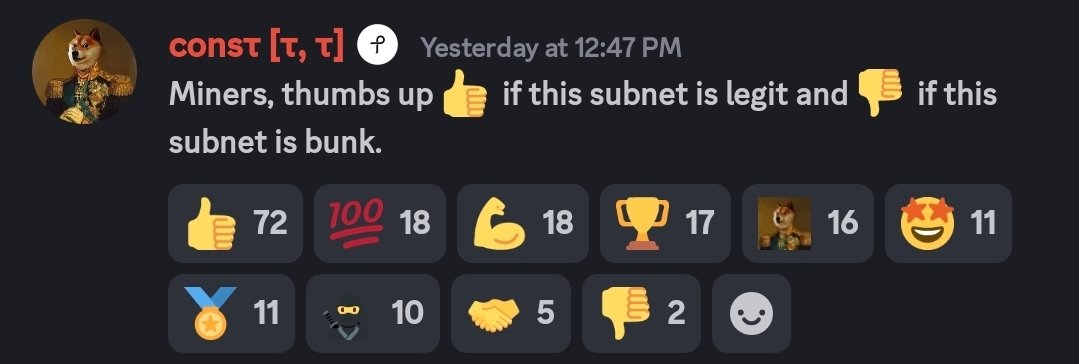
@const_reborn didn’t stop there. After the announcement post was made, he launched another operation by entering different subnet channels and asking a question that allowed miners to react based on whether they believed a subnet was legit or bunk.
Here’s what he asked:
“Miners, thumbs up 👍 if this subnet is legit and 👎 if this subnet is bunk.”
We scanned through the subnet channels to compile the final results based on miners’ reactions:
Here are the final stats:
▫️78 subnets were classified as legit
▫️57 subnets were classified as bunk
📌 Note: While compiling this data, we discovered that many subnets had an equal number of reactions on both the legit and bunk sides. In such cases, we included those subnets in both columns, which is why the total exceeds 128 subnets.
During the process, we also noticed that some subnet teams were using alt accounts to react positively to their own subnet so they could appear legit.
At the same time, we observed that some individuals were reacting negatively against genuinely active subnets in an attempt to push them into the bunk category.
We understand this may not be the final screening method the @opentensor will use, but what Const did gave the community a chance to openly express their opinions on which subnets are actually building and which ones may only be here to extract money.
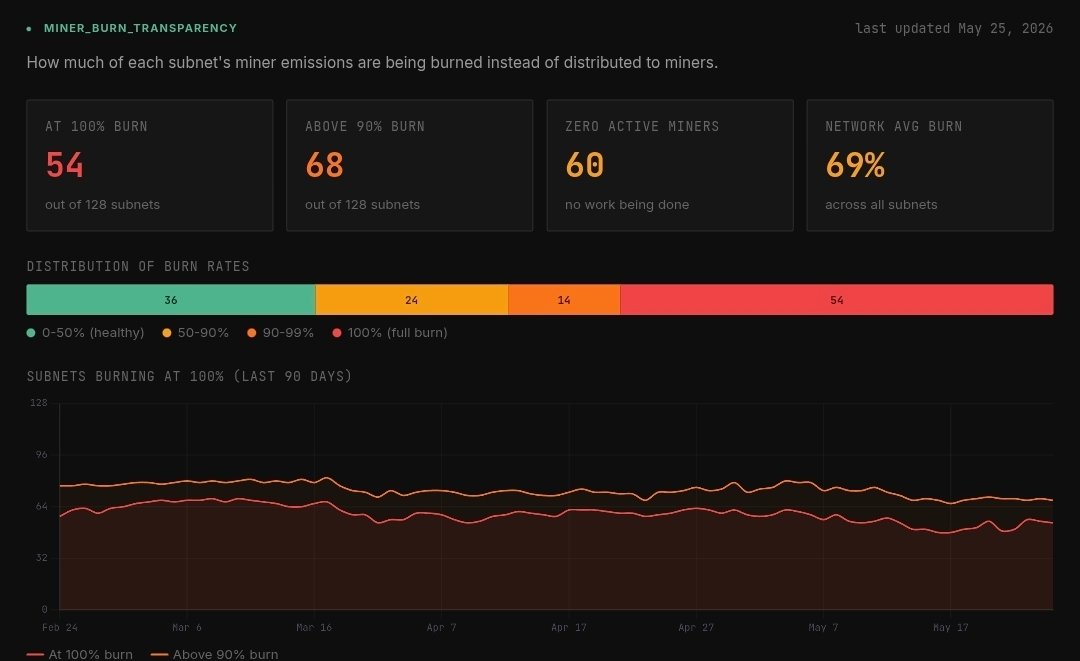
For additional network stats and more insight into the ongoing issues within the network, the following data was sourced from @IntoTAO:
❌ 54 subnets are burning at 100%
❌ 60 subnets have no active miners
❌ The network average burn rate is 69%
We genuinely believe the cleansing that is about to happen across the Bittensor network is important and could help position the ecosystem to a much higher standard as it continues to grow. So expect significant changes to begin happening this week.
And as @CryptoZPunisher said earlier:
“Adapt or die, no matter the timing.”
Good luck to all subnet owners and teams out there 👍
Most $TAO holders are flying blind.
They bought the token.
They watched the price.
They read the threads.
But they have never opened the one tool that shows them everything happening inside the Bittensor network in real time.
It is called Taostats.
It is free.
And after reading this, you will never look at $TAO the same way again.
Here is exactly how to use it.
Step 1: Start at the Subnets page.
This is the heartbeat of the entire network. Every subnet running on Bittensor is listed here with:
- its current emission rate
- the number of active miners and validators
- real-time performance data
The emission rate is the most important number on this page. It tells you exactly how much TAO is flowing into each subnet every block.
High emission means the network is directing significant resources toward that subnet's commodity. Low emission means the market has not yet recognised its value, or the subnet has not yet proven itself.
Watch which subnets are gaining emission share over time. That movement tells you where the network believes the most valuable work is being done, before any headline announces it.
Step 2: Use the Subnet pages to go deeper.
Click any subnet, and you enter a complete dashboard for that individual market.
- The TradingView chart shows you the alpha token price history for that subnet. Alpha tokens are the subnet-specific tokens that sit inside TAO's broader economy. Their price relative to TAO tells you how the market is valuing that subnet's specific commodity.
- The Metagraph is the full list of every miner and validator currently active in the subnet: their UID, their stake, their trust score, their emission share. This is the raw intelligence layer. The miners consistently earning the most emissions are producing the work the validators collectively agree is the most valuable.
- The Sentiment Index gives you a real-time community temperature reading on each subnet. Not price sentiment. Ecosystem sentiment. Whether the participants building inside the subnet believe it is healthy and improving.
Step 3: Check Validators before you stake anything.
This is the step most people skip and regret.
The Validators page on Taostats shows you the performance history of every validator on the network: their VTrust score, their emission consistency, and their weight-setting behaviour across subnets.
VTrust is the metric that matters most. It measures how closely a validator's judgments align with the honest stake-weighted majority across the network. High VTrust means the validator is doing genuine work and being rewarded for it. Low VTrust means the validator is either lazy, copying other validators' weights, or attempting to manipulate the system.
When you delegate your TAO to a validator, you are trusting them with your emissions. Taostats shows you exactly which validators have earned that trust over time, and which ones have not.
Never stake blind again.
Step 4: Use the Blockchain explorer to track real movement.
The Blockchain section of Taostats logs every transfer, every staking transaction, and every extrinsic called on the Bittensor chain in real time.
This is where you track what wallets are actually doing:
- Large staking transactions from unknown addresses
- Subnet registration events that signal a new market is about to go live
- Neuron registration burns that show demand for participation in a specific subnet is accelerating
The people who read on-chain data before the narrative catches up to it are the ones who position correctly before the crowd notices the move.
Step 5: Track your own portfolio inside the Dashboard.
Connect your coldkey address, and Taostats builds you a complete portfolio view:
- Your TAO balance
- Your staking positions
- Your delegation returns
- Your yield over time
The yield calculator is particularly useful. It shows you the actual return you are generating from your staking position in real TAO terms, not in percentage estimates that assume conditions that may not hold.
If your yield is lower than the network average for your validator tier, Taostats shows you that too. Switching validators takes one transaction. The data to make that decision intelligently is right in front of you.
The bigger picture.
Most people holding $TAO are making decisions based on price charts and social media sentiment. Both of those inputs are downstream of what is actually happening inside the network.
Subnet emission shifts.
Validator VTrust changes.
On-chain registration events.
Neuron burn rates.
Alpha token price movements relative to TAO.
All of it is live on Taostats right now. All of it is free. All of it tells you something the price chart cannot.
The investors who understand Bittensor at the data layer will always be positioned ahead of the investors who understand it at the narrative layer.
Taostats is the data layer.
Bookmark it. Open it daily. The network is telling you exactly what it is doing if you know where to look.
Bittensor Ecosystem Highlights of the Week #61
// SUBNET UPDATES & ACHIEVEMENTS
➤ @metanova_labs SN68
They announced their partnership with @onepot_ai, a new AI molecule synthesis lab.
(https://t.co/oDFIjmttha)
➤ @webuildscore SN44
The Detect-fire skill is now live.
(https://t.co/R44NPIohaw)
On the Detect Cricket Delivery challenge, they’re now distributing rewards proportionally to model quality.
(https://t.co/JSl9JzDgQY)
➤ @babelbit SN59
Babelbit unveiled their new website.
(https://t.co/xmdB1RYtdj)
They’re also showing promising benchmark results.
(https://t.co/h3breBa6b5)
➤ @404gen_ SN17
Personal API keys + pay-as-you-go credits are now live on 404.
(https://t.co/iqcLSRot6v)
➤ @IOTA_SN9 SN9
They’re now training a 15B parameter model on IOTA.
(https://t.co/6A6mpxiYnl)
➤ @ConnitoAI SN102
They just dropped Connito Whitepaper V1, “a framework for decentralized, composable MoE adaptation”.
(https://t.co/Lx5I6aCdtK)
➤ @zeussubnet SN18
Zeus published the technical architecture and preliminary performance report for their V2, which has been live for around 2 months.
(https://t.co/KGqkX4I4db)
➤ @b1m_ai SN105
Prism, their orchestrator scoring system, is now live.
(https://t.co/C33bzD49BR)
➤ @chutes_ai SN64
Chutes shared some early results from their decentralized large-scale MoE training.
(https://t.co/TWgpTG31QW)
➤ @trishoolai SN23
Astroware, Trishool’s parent company, has been accepted into Nvidia’s Inception program.
(https://t.co/NVxlfBnZf0)
➤ @heydittoai SN118
Ditto got Const’s validation, and they released some new features, including an integration with OpenClaw and Hermes.
(https://t.co/kicAllgj5l)
➤ @bitsecai SN60
Their new leaderboard is now live.
(https://t.co/nGx73wujM9)
➤ @subnet71 SN71
The new Leadpoet subnet dashboard is live.
(https://t.co/YDUBNVIvNY)
➤ @resilabsai SN46
They’re launching a dedicated network for off-market property valuations.
(https://t.co/IdJMaGoJtO)
➤ @TrajectoryRL SN11
They introduced Terminal-Bench as their new benchmark.
(https://t.co/QQSLft8Cie)
➤ @SynthdataCo SN50
Synth LLM is now available to users on the free plan for a limited time.
(https://t.co/79BeMmkSw6)
➤ @TensorUSD SN113
TensorUSD is now operating as a DAO.
(https://t.co/BwRtaHmiev)
➤ @mvtrx_79 SN79
MVTRX updated their website.
(https://t.co/VQcE7tq7ci)
➤ @ridges_ai SN62
They shipped some improvements to their dashboard.
(https://t.co/VLSYvYYkFc)
// NEW SUBNETS
➤ @cacheon_ai SN14
Cacheon is a new subnet incentivizing LLM inference optimization.
(https://t.co/7xdzclWd6Q)
➤ @eirel_ai SN36
Eirel is an ��execution layer for multimodal AI workflows”.
(https://t.co/9bqKuqKbBL)
// BITTENSOR ECOSYSTEM
➤ @bitstarterAI x @Systango
They’re partnering to bring better engineering to Bitstarter teams.
(https://t.co/XJmTIE3Y7f)
// PODCASTS & ARTICLES
➤ @opentensor Novelty Search with @cacheon_ai and @Bitrecs
(https://t.co/LbwL4IQAkv)
➤ Hash Rate by @markjeffrey with @josercaldera from @yanez__ai
(https://t.co/mJZcaJVhWs)
➤ Hash Rate with @AndorranAi from @SwarmSubnet
(https://t.co/klo5BLJv9A)
➤ @sunrisedefi podcast with @MaxScore
(https://t.co/zOzoJqPflX)
➤ @gordonfrayne podcast with @peytonspencer and @sebyrubino
(https://t.co/VyDwWf5Qoa)
➤ @dsvfund Revenue Search with @vocence_bt
(https://t.co/GPi96jgT8o)
➤ @jon_durbin article “Chutes: a glance behind, and a leap ahead”
(https://t.co/kskQDzclTO)
$TAO
Been digging deeper into https://t.co/E5KHI7NND6 lately and honestly it feels super early still. Most people in Bittensor are still chasing narratives while @AlphaGapTAO is starting to surface actual signal before the crowd catches on. The AGAP scoring system is kinda ridiculous once you really start digging in to it
I’ve done a lot of fundamental and price analysis on Targon SN4 within the Bittensor ecosystem.
I keep coming back to the same conclusion: it looks highly undervalued.
There are metaverse projects trading at 2.5x the Targon market cap right now that arguably provide little to no utility.
Meanwhile, Targon has multiple real-world use cases, partnerships, and < 5m tokens in circulation, at the time of writing. [2.3m staked or 49.15% of the 4.68m circulating] There's also another 502.99K tokens that have been burned of the total supply of 21m.
Targon Market Cap: $81.86
Targon SN4 Price: $17.46
It seems obvious that everyone should want to trend towards decentralized confidential compute, not away from it.
If the Targon Virtual Machine proves valuable within the Bittensor ecosystem, external demand could grow significantly as users become more aware of the risks and limitations of centralized AI.
They’ve also attracted backing from major investors and appear to have a team more than capable of competing with industry competitors.
My research is nowhere near finished, but I’m buying Targon SN4. 💊