When Muhammad first appeared in 7th-century Arabia, he was speaking to a deeply tribal society. The earliest Quranic revelations from Mecca emphasized monotheism, charity, judgment, patience, and endurance under persecution. They also challenged some brutal practices of the time, including infanticide, tribal revenge, and abuses against women and the poor.
In that sense, the early Meccan message was often progressive relative to the culture in which it emerged. It sought to civilize and restrain some of the harsher aspects of Arabian tribal society, replacing blood feuds with moral accountability and elevating concern for the weak and disadvantaged, and many of the peaceful, tolerant, and humanitarian verses most frequently quoted in the West come from this early Meccan period, when Muhammad and his followers were a small, vulnerable minority with little political or military power.
But then it all changed.
As Muhammad’s movement grew, opposition hardened. The Jewish tribes of Arabia largely rejected his claim to prophethood. Pagan tribes resisted his authority. What began as a small religious movement became a political and military power.
And the religion that had once appealed to conscience now commanded armies. The movement that had preached endurance under persecution increasingly pursued submission through power. The language of persuasion gave way to the language of conquest. The focus shifted from surviving within society to ruling it.
And Islam’s own calendar reflects that transformation.
The Islamic calendar does not begin with Muhammad’s birth. It does not begin with his first revelation in 610 CE. It begins with the Hijra in 622 CE - Muhammad’s migration to Medina, where he became not only a prophet, but a ruler, commander, military leader and a war lord.
Christianity dates itself from Christ’s birth. Judaism counts from creation. Islam begins its clock from the moment its prophet acquired political power.
The later Medinian revelations reflect the same shift.
Compare:
“There is no compulsion in religion” (Quran 2:256)
with:
“Fight those who do not believe in Allah...” (Quran 9:29)
or:
“Kill the polytheists wherever you find them...” (Quran 9:5)
or:
“O you who believe, do not take the Jews and Christians as allies...” (Quran 5:51)
The movement from Mecca to Medina (The Hijra) is not just geographic. It is theological, political, and military. The Quran moves from the language of a persecuted minority to the language of a victorious state. That's the reason when Mamdani speaks of the Hijra - it's not an innocent story of immigration and acceptance, but one of supremacy and conquest.
And this leads to one of the important doctrines in Islam: naskh, or abrogation.
Classical Islamic jurists recognized that some Quranic verses appear to contradict others. Their solution was that later revelations can supersede earlier ones. The Medinian versus supercede the Mecca ones.
That has enormous consequences.
When modern Western commentators quote only the peaceful verses, they are ignoring how classical Islamic law traditionally resolved these contradictions: later more extreme Medinian verses carry greater legal weight than earlier peaceful passages when the two conflict.
This creates a serious challenge for peaceful reform.
In Christianity, institutions could be challenged by appealing to scripture against Church authority. In Judaism, the Written Torah exists alongside a vast Oral Torah tradition of debate, interpretation, and legal evolution through the Talmud and centuries of rabbinic scholarship.
Islam developed differently.
Traditional Sunni doctrine holds that Muhammad was the final prophet and that the Quran is the direct word of God, revealed in Arabic and preserved without error. Muhammad is treated as morally infallible, so actions that would be condemned everywhere else - beheadings, child marriage, and broken treaties - are not merely excused or ignored, but preserved as examples to be studied, defended, and emulated. And the text is not generally treated as inspired commentary or human reflection, but as divine revelation itself.
That means Islam reformers often face a uniquely difficult problem. They are not merely arguing against clerics, institutions, or historical traditions. They are confronting texts that believers regard as perfect, final, and unchangeable.
This is why Islamist movements such as the Muslim Brotherhood, al-Qaeda, ISIS, and others are not simply inventing ideas from nowhere. They draw on concepts rooted in classical jurisprudence, including the division between territories governed by Islamic law and those outside it who need to be conquered - known as Dar al-Islam and Dar al-Harb: the house of Islam and the house of war.
There are more clues.
One of the most recognizable phrases in Islam is the Takbir: "Allahu Akbar."
Western media routinely translates it as "God is Great".
It doesn't mean that.
It means "God is greater" - a comparative (الله أكبر vs. الله هو الأكبر).
Greater than what? Than your god, your system, your laws, your civilization. It's a supremacist declaration, not a prayer in the western sense.
That's the reason this phrase was also associated with the military campaigns of early Islam and became a battlefield cry used by Muslim armies for centuries, and why jihadists today shout "Allahu Akbar" while carrying out terror attacks. It proclaimed not merely devotion to God, but confidence that God's authority would triumph over all competing authorities.
The problem cannot be solved by pretending the texts and traditions do not exist, and that "Islam is the religion of peace". Resistance to Jihad requires reform. Reform requires honesty. And honesty begins by admitting that Islam’s own historical arc - from revelation, to state power, to war - is written not only in its scriptures, traditions, and culture but even in the calendar by which it counts time.
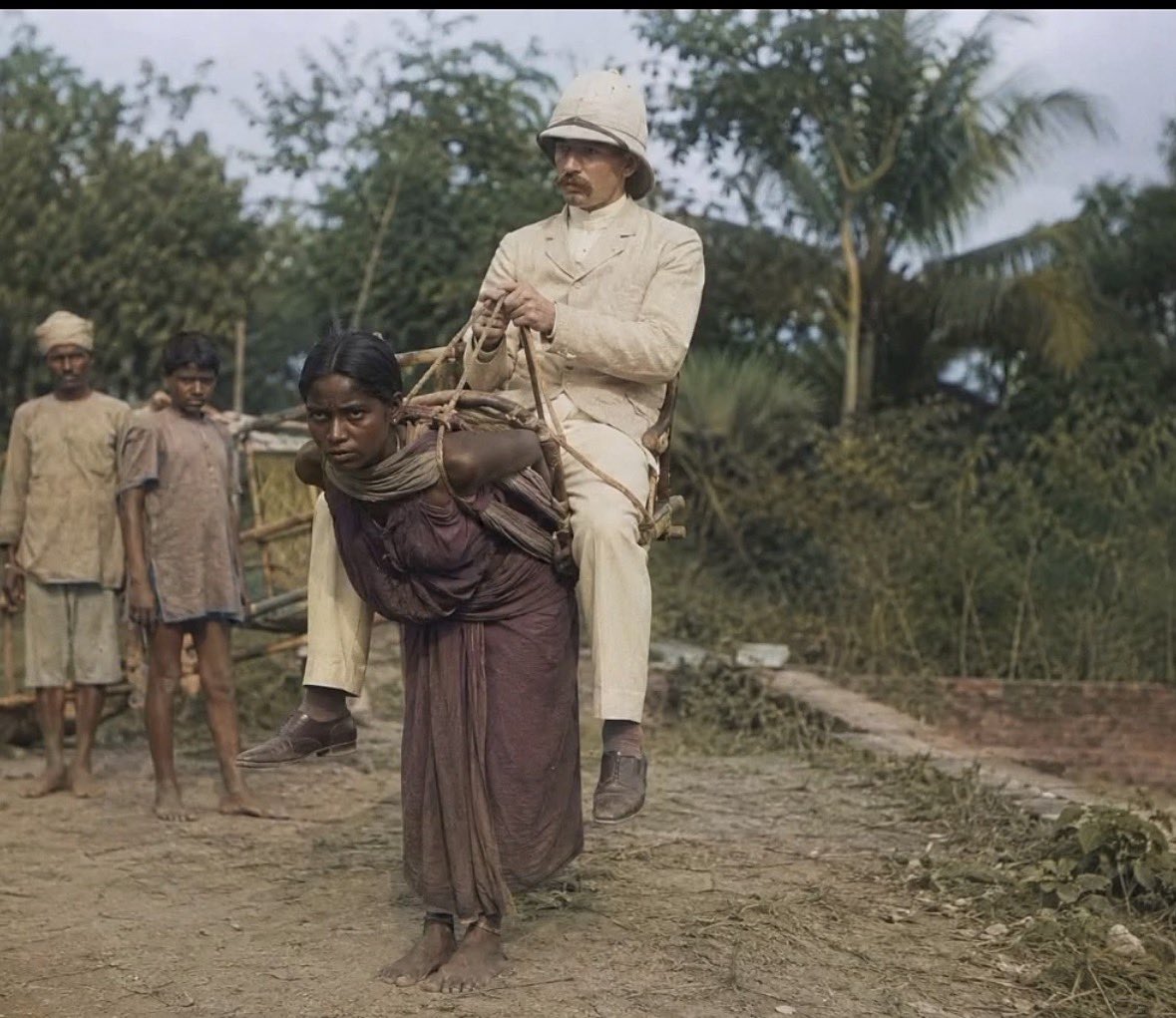
A Bengali woman carrying a British merchant on her back…
📸 This photo was taken in 1903, at the height of British colonialism in the Indian subcontinent. This isn't just a picture…
it's a slap in the face to all those who sing the praises of "Western civilization." This is the true face of colonialism, which they still try to beautify in history books.
It's slavery and the humiliation of human beings, the crushing of human dignity, simply because they don't belong to the white race! And then they ask you about terrorism…
The history of Western colonialism is full of massacres, slavery, plunder, and starvation… But they reduce terrorism to oppressed peoples struggling for their dignity! 🩸
The effects of what British colonialism did in India—the killing, starvation, plunder, and contempt for humanity—are still evident today. Millions
were killed, wealth was stolen, and generations were displaced… all under the banner of a false "enlightenment"!
A Japanese immunologist spent 20 years proving that the chemicals trees release into the air walk into your bloodstream, hunt down your stress hormones, and arm your immune system in ways no therapist or pharmaceutical has ever matched, and most of the data has been sitting in Japanese medical journals for two decades waiting to be translated.
His name is Qing Li.
He is a clinical professor at Nippon Medical School in Tokyo and the president of the Japanese Society of Forest Medicine. The Japanese government has been funding his research since 2004, and the body of work he has produced is the reason forest bathing is now an officially prescribed clinical therapy in Japan and Korea.
The story actually starts in 1982, when the Japanese Ministry of Agriculture, Forestry and Fisheries coined the term shinrin-yoku to describe the practice of slow, mindful walking in a forest. They did it for a practical reason.
Japan was urbanizing fast, stress-related illness was climbing, and the country had thousands of square kilometers of forest sitting unused. The idea was to give people a reason to walk into the trees... They had no idea what was actually happening to the human body during those walks until Qing Li ran the first proper experiment in 2005.
He took twelve healthy adult men on a three-day, two-night trip to a forest park. They walked for a few hours each day. Nothing strenuous. No prescribed routes or breathing exercises. They simply walked slowly through the trees, breathing the air, looking at the forest.
Li drew blood and urine samples before the trip, on the second day, on the third day, on day seven after returning home, and again on day thirty.
The numbers that came back from the lab were not what anyone expected.
The activity of a specific type of immune cell called the natural killer cell, which is the cell your body uses to hunt down cancer cells and virus-infected cells before they can spread, had jumped by roughly 50 percent during the forest trip. The actual number of natural killer cells circulating in the bloodstream had increased significantly.
Three different anti-cancer proteins that those cells produce, called perforin, granzymes, and granulysin, had all risen sharply. And the effect did not disappear when the men went home. The immune boost was still measurable on day seven and was still partially present on day thirty.
Two hours a day in a forest had upgraded the immune system for a full month.
Li ran the same experiment with women a year later and found nearly identical results. Then he ran it with a control group who took a three-day trip through an urban area with the same amount of walking, the same hotel quality, and the same diet.
The urban group showed no measurable change in natural killer cell activity at all. The forest was doing the work, not the vacation.
The mechanism turned out to be a class of airborne molecules called phytoncides. Trees produce these compounds to defend themselves against insects, bacteria, and fungi. Pine, cedar, oak, and cypress trees release them in particularly large amounts, especially in warmer weather and after rainfall.
When you walk through a forest, you are inhaling those molecules into your lungs and absorbing them through your skin, and once inside your body they appear to directly stimulate the production and activity of the very immune cells Li was measuring in his lab.
Roughly 50 percent of the health benefit of a forest walk, according to Li's data, comes from the chemistry of the air itself. The other half comes from what the forest is doing to your nervous system.
This is where it stops being only about the immune system and starts being about stress.
A separate Japanese research team measured cortisol, the body's main stress hormone, in 84 participants across 35 different forest sites. They drew samples before and after a 30-minute walk in each forest and compared them to control walks in matched urban environments. The cortisol levels of the people who walked in the forest were lower than the cortisol levels of the people who walked in the city by a significant margin. Their heart rates were lower. Their blood pressure was lower.
The activity of their parasympathetic nervous system, which is the part responsible for rest and recovery, had gone up. The activity of their sympathetic nervous system, which is the part that drives fight or flight, had gone down.
Then a researcher at the University of Michigan named MaryCarol Hunter ran the cleanest version of this experiment ever done. She recruited participants from a city and told them to take a nature pill three times a week for eight weeks.
They were free to choose the time, the place, and the duration of the nature experience, as long as it was outside, in daylight, and free of phones, conversations, and aerobic exercise. They sent her saliva samples before and after each session so she could measure cortisol changes accurately and rule out the normal daily drop in stress hormones that happens to everyone.
The result was that participants experienced a 21.3 percent drop in cortisol per hour spent in nature, with the biggest payoff happening between minutes 20 and 30 of the walk.
After that, the cortisol kept dropping, but more slowly. The threshold dose for measurable stress relief was just 20 minutes outside in something that looked and felt like nature.
What none of this means is that nature is a substitute for therapy or for medication when someone genuinely needs them. Therapy treats different things than a walk does, and Li himself has been careful in interviews to call forest bathing a complementary intervention rather than a replacement for clinical care.
But what the research has settled is that the human body has a physiological response to being among trees that operates on the same biological systems modern medicine is trying to reach with drugs and clinical protocols, and that response is fast, measurable, and free.
The strangest part of Li's work is the implication he keeps repeating in interviews. The average person now spends more than 90 percent of their life indoors. Their cortisol stays elevated. Their natural killer cells stay sluggish.
Their parasympathetic nervous system rarely gets a chance to take over. The system that was tuned by millions of years of life under a canopy of trees is being asked to run permanently inside a box made of drywall and screens.
Your body has not forgotten what it is supposed to do in a forest. It is waiting for you to walk into one.
1,000 years before modern ultrasounds existed, how did our ancestors know exactly what a baby looks like inside a mother's womb?
Located in various Tamil Nadu temples like the Sri Sundara Kamakshi Temple and the Kundadam Vadukunathar Swamy Temple, this stone carving perfectly mirrors the position seen in modern medical scans. The level of anatomical detail left on these temple pillars is simply baffling! Did ancient Indian architects possess a deep knowledge of medical science encoded in stone?
It is worth noting that ancient Indian medical systems like Ayurveda have documented detailed theories on human development for centuries. The Garbhopanishad, for instance, provides a month-by-month description of embryonic development. While these descriptions are impressive for their time, scholars often distinguish between the existence of philosophical or observational knowledge (based on traditional medical literature) and the claim of advanced modern technological "decoding".
Let me know your thoughts in the comments!
📽️MandirDham
आगा खां पैलेस - यही वो जेल है जहाँ महात्मा' मोहनदास करमचंद गांधी को 2 साल तक यातनाएं दी गई थीं।
सजा इतनी कठोर थी कि 'बापू' को स्नान करने के लिए 10×10 फिट के संगमरमर लगे बाथरूम में नहाना पड़ता था।
सजा इतनी कठोर थी कि बापू को 8×8 फिट के नर्म, मुलायम मखमली बिस्तर में सोने के लिए मजबूर किया जाता था।
सजा इतनी कठोर थी कि 20 एकड़ में फैले आगा खां पैलेस की हरी हरी मुलायम घास(लॅान) में घूमने के लिए मजबूर किया जाता था।
सजा इतनी कठोर थी कि 12×12 फिट के स्टडी रूम में आलीशान टेबल कुर्सी में बेहतरीन इंग्लैंड के कागज में लेखन के लिए मजबूर किया गया।
और हां, सजा इतनी कठोर थी कि बापू की पत्नी भी साथ में रहती थी।
सजा इतनी कठोर थी कि आने जाने के लिए मर्सडीज कार में बैठने को मजबूर किया जाता था।
और उधर वीर सावरकर को इतनी आसान सजा मिली थी, हाथ पांव लोहे की जंजीरों से बंधे थे और दो जन्म की कालापानी की और उसमे भी रोज कोल्हू से तेल निकालना पड़ता था।
गांधी देश के बापू बन गए और सावरकर जी अंग्रेजो से माफी मानने वाला !
नोट:-जिसे विश्वास नही है वे पुणे में स्थित आगा खां पैलेस घूम आए, जो आज भी गांधी संग्रहालय के रूप में है।
72 years old. Walked into British bullets with Vande Mataram on her lips. Her name,Matangini Hazra. 🔥🔥🔥
Married at 12. Widowed at 18. No formal education. She led 6,000 protestors against a British police station. Flag held high. Shot once. Then again. Then again. Her last words …… Vande Mataram. 🇮🇳
Sri Vidyashankara Temple in Sringeri, Karnataka ~a true wonder of Vedic architecture.
Its 12 pillars, adorned with zodiac signs, are engineered so brilliantly that sunlight touches each one sequentially, following the order of the 12 months.
The Timothy Initiative (TTI), a United States-based Christian evangelical non-profit organization, is facing severe regulatory scrutiny in India over an alleged illegal foreign funding network used for large-scale religious expansion. Following investigations by the Directorate of Enforcement (ED), Indian authorities have registered a First Information Report (FIR) under the stringent Unlawful Activities (Prevention) Act (UAPA) and the Bharatiya Nyaya Sanhita (BNS). The case outlines an intricate method designed to bypass the Foreign Contribution (Regulation) Act (FCRA) to fund church planting and conversions in sensitive regions.
According to the ED complaint filed in Bengaluru, TTI did not hold a legal registration under the FCRA. To circumvent this bottleneck, the organization allegedly established a cross-border cash pipeline:
Over 1,000 international debit cards, primarily issued by the US-based Truist Bank, were smuggled into India.
Many of these cards reportedly operated under fake or dummy names, such as "Santosh Kumar".
Local operatives used the cards to systematically withdraw cash nationwide. Between November 2025 and April 2026 alone, approximately ₹92.55 crore to ₹95 crore ($10 million) was funneled through this system.
Raids uncovered a hidden online billing and accounting platform operated from outside India to keep track of the distributed cash.
Everything is connected.
From the human body to the planet, from consciousness to the cosmos, the same principle repeats itself: structure, flow, balance, and return.
When the system is aligned, there is coherence, stability, clarity, and harmony. When one part breaks, the disturbance echoes through the whole.
Nature teaches a timeless lesson—every level of existence follows patterns. Understanding those patterns is not merely knowledge; it is wisdom.
The question is simple:
Does what you build hold together all the way through?
Disgusting.
This Marxist professor, Apoorvanand, is spreading hate against Hindus by calling every Hindu a murderer and a rapist.
He is getting a salary from taxpayers' money.
He must face legal consequences for this statement.
Idiot.
Tamil village names as shown in 1854 in present day Kalahasti, sullurpet, venkatagiri, Tirupati, sathyavedu, puttur taluks. We will now dissect their present state.
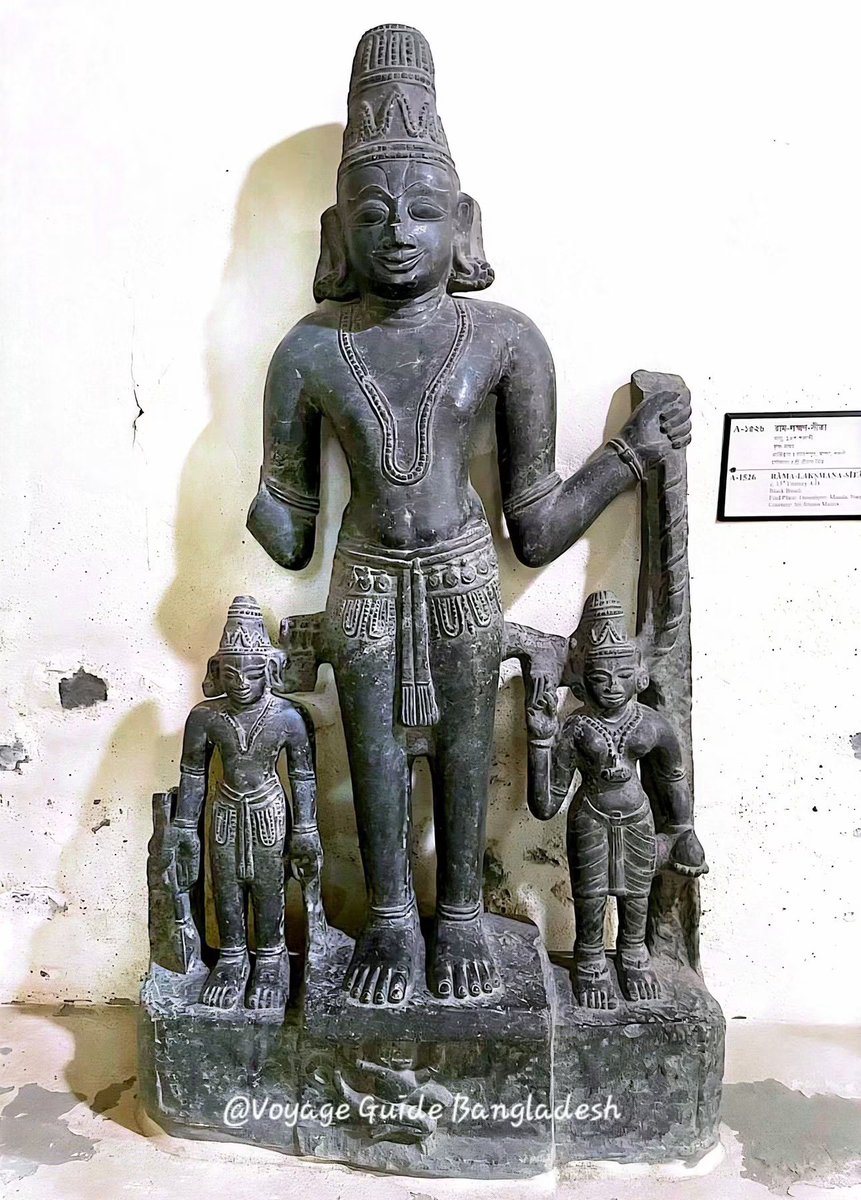
Sri Rama has always been an integral part of Bengal history.
Worship of Sri Rama not being a part of Bengal history is a Marxist-Islamist created lie.
The given image is a murti of Sri Rama, Lakshmana, and Sita, dated around 11-12th century CE, Bengal. It is now kept at the Varendra Research Museum in 🇧🇩 .
Niharranjan Roy in his book “Bangalir itihaas- Adi parbo” (pp 634-636), mentions terracotta plaques depicting narratives from the Ramayana in the Paharpur temple remains (also now in 🇧🇩), which are dated to early Pala period (around 8th century CE).
According to Roy, worship of Sri Vishnu and His avtars was well in place in Bengal even in the pre-Gupta era.
Sri Rama was, is, and will remain a part of Bengal.
It’s Marxism and Islamism that are foreign to Bengal and not part of real Bengal history or culture!
"Saar The Caste System only Exists in Hindus and India Saar"🤡
This is an absolute lie Caste/Social Hierarchy existed everywhere it's just was propagated to us in a way that we believe everything happened from us only so White Masters feel Superior and more forward than Indians
"Hindu have been so much radicalized that every Hindu is a potential murderer or a potential rapist.
Every Hindu is raping a Muslim woman either in reality or in dreams"
- Apoorvanand (Marxist, Professor at Delhi University)
This man is mentally sick, he needs treatment now
Today we remember Veera Vanchinathan who sacrificed his life for the freedom of Bharath. On 17 June 1911, Vanchinathan entered a first-class compartment at Maniyachi Junction and shot Tirunelveli Collector Ashe, who was responsible for the repression of the Swadeshi movement and the persecution of V.O. Chidambaram Pillai and Subramania Siva. Moments later, Vanchi took his own life rather than be captured.
He was only twenty-five. He had given up his career, distanced himself from family life and chosen a path from which he knew there would be no return. His method may be debated, but his courage, sacrifice and uncompromising commitment to Bharat’s freedom cannot be denied.
On his remembrance day, let us honour the martyr who placed the nation above his own life.
Only idiots and Britain haters blame Churchill for the Bengal Famine
This myth only became popular in 2010 after a ridiculous book was published by a far-left journalist with no historical training
This is what REALLY happened:
1. A cyclone hit Bengal in 1942, destroying crops
2. They were already suffering from the worst rice brown spot epidemic on record
3. Normally in a famine grain would be imported from Burma, Malaya, Phillipines, Thailand etc. But WW2 ws raging and our Japanese enemy now controlled those areas
4. The Japanese had bombed Indian ports, which also destroyed grain
5. Shipping grain in was hugely dangerous because Japanese fleet was blockading the Bay of Bengal and sinking ships
Remember, the Axis powers were sinking one ship every day and had sunk around a million tons of shipping in 1942.
6. On top of that local Indian speculative traders were unforgivably HOARDING grain. With inflation rife, this was classic wartime speculation as they could make (and expected to make) much more money by hoarding rather than selling immediately.
7. Local government and administrators were slow to act and initially told the UK government there was enough grain in Bengal.
One can blame the democratically elected Government of Bengal, people like Huseyn Shaheed Suhrawardy (Minister of Civil Supplies for the newly formed Muslim League) and Sir John Herbert (the Governor of Bengal) for exacerbating conditions in the Bengal Famine. But not Churchill.
What did Churchill do? Everything he could.
Remember also, he was thousands of miles away in a different continent fighting the Second World War and preparing for D-Day.
Yet despite all his other commitments he worked hard to save the people of Bengal.
1. When the British government found out about the famine’s severity in August 1943, they authorised around 1 million tons of grain to be shipped to India between then and December 1944.
2. Churchill pushed Australia to send wheat
3. Churchill personally requested shipping assistance from U.S. President Roosevelt in April 1944 to transport it from Australia. Roosevelt declined, stating US ships were needed for the Pacific campaign and the upcoming D-Day operations.
4. Thanks to Churchill grain arrived from Iraq (barley), and Canada as well as Australia.
5. Crucially, Churchill was responsible for appointing the man who played such a pivotal role in stopping the Bengal Famine: Field Marshal Wavell. Wavell knew India and its people extremely well and was a magician of logistics. He drafted in the army to move food supplies and halted the famine.
Why are tax payers funding Helen Cammock's ignorant, anti-British propaganda at the @NPGLondon?