At this point every CEO should be asking what their strategy is to avoid model lock-in.
If it isn’t clear what Anthropic is doing, it is:
- build something amazing
- decide who gets to use it after you prompt it if the prompt falls into areas they deem unacceptable by their sole standard
To be clear this is completely above board and legal. It’s just an idiotic risk for corporate users to bear especially as the coding models become equivalent.
The business continuity risk will become more obvious as companies accidentally trip over Anthropic’s ToS and have to decide if they will subsume their business viability to them by doubling down on Anthropic models or find open source (and, btw, much cheaper) alternatives where they are in control.
As stated previously, get ready to be inundated with the term “control plane” which is the natural solution to this problem.
Shameless plug - this is what 8090’s been building as we expected this moment to arrive…
If you’d like to learn more: https://t.co/fkfTXgdfXK
Two US aviators went down near the Strait of Hormuz. DoW used an autonomous @Saronic Corsair to find and bring them home - the 1st drone rescue at sea in military history.
This is why we build: to keep our troops safe. This was science fiction. American builders made it real 🇺🇸.
This is biblical.
A woman in her eighties. Ten years into Alzheimer's. Hadn't spoken a full sentence in five years.
Takes one, 5 gram dose of psilocybin.
She slept 19 hours and woke up and spoke for hours about her life, recognized family and held real conversations. She regained bladder control after five years, walked on her own. and dressed herself. Gains held for weeks.
JUST IN: 80-year-old woman with advanced Alzheimer’s reportedly briefly regained speech, bladder control, & memory after taking psilocybin mushrooms.
The Three Humans Left in a VC Firm
Fred Wilson, co-founder, Union Square Ventures, interviewed by Michael Mignano (USV)
[I post one executive summary daily of an interview I enjoyed and learnt from. I loved this interview that @mignano did with @fredwilson, who I've learnt a tremendous amount from on the board of Coinbase. Tons of great nuggets for founders and investors.]
Summary: After 40 years in venture, Wilson has rebuilt USV around a single conviction. Only three things in the firm still need a human: picking the thesis, building relationships with founders working in that thesis, and supporting them after the check. Everything else, including sourcing, diligence, term sheets, and CRM, is being handed to agents. The interview is a working sketch of what a venture firm looks like when the back half of its job becomes software, and a clear read on what stays human-only and why.
1. The Three Humans Left. A year ago Wilson wrote a memo to his partners saying that if he were starting USV from scratch today, only three jobs would stay with humans: high-level thesis development, building relationships with founders inside that thesis, and supporting them after the check. Everything else gets handed to agents. USV is now executing on that memo, not theorizing about it. For founders raising, this is the new operating profile of the firm sitting across the table.
2. Agents Love Data Rooms. "I hate data rooms. Agents love data rooms." USV no longer asks a junior associate to scrub the data room before a term sheet. An agent reads the room and answers questions in conversation: cap table, vesting, founder ownership, anything in the corpus. The effect on partner time is direct, with less work on the parts of the job no one enjoys and more time with founders.
3. Term Sheets Without Lawyers. USV's term sheets are now written by an agent, with no outside counsel stamp at the term-sheet stage. The firm seeded the agent with standard term sheets by sector and by stage, then partners shape each document in conversation with the agent. Wilson does not yet trust an agent to write long-form definitive docs. The implication for founders: term sheets land faster, with less round-trip friction, and the cost structure of the next-generation venture firm starts to drop.
4. The Kill Zone Test. Wilson ran a sample contract through a legal-AI startup and through raw Claude Code, side by side, and Claude's markup was better. "All of legal AI is in the kill zone." The test is portable to almost any AI vendor pitch. If a wrapper company cannot outperform the raw model on the thing it sells, the wrapper is paying for the privilege of being disrupted. Operators should run the same test before signing a multi-year contract.
5. No Wrappers Allowed. To survive the kill zone you cannot wrap a model. You have to rebuild the business model from scratch around the new economics. Cursor is the example Wilson reaches for: it has been hugely successful, but more developers are dropping back to raw Claude Code, and nothing stops Anthropic from shipping an IDE. A defensible AI company redesigns the workflow itself, so the foundation lab would have to abandon its current pricing model to copy.
6. Energy Is the AI Trade. About a third of USV's deployment now goes to energy, because no matter which model wins, the winner needs power. The firm has backed a decentralized model-training network and a company that turns each grid-scale solar and wind plant into a mini data center selling inference tokens. The trade is indexed to AI without forcing USV to pick the model. Builders hunting for a less crowded adjacent market should read the same memo, because the picks and shovels of AI run through electricity.
7. Sellers, Not Coders. The skill USV now overweights in founders is selling: recruiting, fundraising, convincing customers, inspiring teams. Forty years has taught Wilson that the founder who can tell the story and bring it to life wins more often than the founder who can write the code. The corollary is uncomfortable for technical founders. "Actually being able to write code is probably not a big deal anymore," though enough technical vision to see three moves ahead still matters. If you are a CEO who cannot recruit, that is now your constraint.
8. The 80–90% Open Source Window. Open-source models, especially the ones shipping out of Asia, are running at 80 to 90 percent of the quality of the closed frontier models. Right now the closed labs are subsidizing usage, so price does not force the comparison. When the labs have to charge a real margin, open source becomes a serious value alternative and the playing field levels. Wilson is not betting the firm on this outcome, but he is hedging into the quadrant where open source wins.
9. Founders Still Want Humans. Founders do not want to raise money from an agent. They want to know the human they are getting in business with, and that is why Wilson does not see VC automating itself out of a job in the short term. The firm can automate the back half of the workflow. The front half, sitting across from a founder at 11 p.m. when they have had a horrible day, stays human.
10. Don't Pass on Price. The biggest regrets of Wilson's career are deals he passed on because the price was too high. The market-clearing valuation will almost always feel uncomfortable a year later, and the right answer is to find a way in, even if that means buying secondary instead of leading the round. Saying no on price is a defensive move masquerading as discipline. Founders raising can use the line in negotiation, because a firm that walks on price is telling you it has not adjusted to the current market.
11. Offense Over Defense. Wilson lost $25 million in six months in 2001 and learned that getting it wrong is a byproduct of the job, not a verdict on the investor. He spent his first 15 years scared of losing money and only got good at venture once he stopped playing defense. The advice is harder to apply for someone breaking in, because the first checks really do matter, but the directive holds at every level. For operators, the analog is the founder who refuses to ship until the product is perfect, because you cannot win a game you are not playing.
12. The Relationship Is the Moat. After 40 years and an AI rebuild of the firm, Wilson's one-line summary of the venture business is the same as it was on day one. The relationship between the investor and the founder is the secret sauce. Everything else, including the work USV used to staff up to do, gets compressed by technology. Find great founders, build real relationships with them, and help them build great companies. If your venture pitch to LPs does not lead with that, you are pitching the wrong business.
Uber’s COO has said that it’s getting “harder to justify” its AI costs because there was no way to show a link between AI spend and any meaningful increase in useful features. This is the first time I’ve seen a company say this directly.
https://t.co/xUhZvtpwah
Today we reduced headcount by 22%. The business is the strongest it's ever been. So I think it's important to be direct about what I'm seeing and why.
First, I made this decision and I own it. I did it because the way to operate at the highest level of productivity is changing, and to win the future, ClickUp needs to change with it.
Second, this wasn't about cutting costs. Most savings from this change will flow directly back into the people who stay. We'll be introducing million-dollar salary bands. If you create outsized impact using AI, you'll be paid outside of traditional bands.
Most importantly, I have the deepest gratitude for those affected. We're doing this from a position of strength specifically so we can take care of people properly. Everyone affected receives a package aimed at honoring their contributions and easing the transition.
I only see two options: wait for this to play out gradually in the market or be honest about what I'm seeing and act proactively.
THE 100X ORGANIZATION
The primary change is that we're restructuring around what I call 100x org. The goal is 100x output. The roles required to build at the highest level are fundamentally different than they were a year ago.
Incremental improvements to existing systems won't get us there. We need new ones. That means creating enough disruption to rebuild rather than iterate on what's already broken.
The common narrative is that AI makes everyone more productive. It doesn't. Many of the workflows of today, if left unchanged, create bottlenecks in AI systems.
These roles will evolve. But waiting for that to happen naturally means falling behind now.
The 100x org is actually heavily dependent on people - infinitely more than today. This is only possible with 10x people that have embraced and adopted new ways of working.
THE BUILDERS, AGENT MANAGERS, AND FRONT-LINERS
— THE BUILDERS: 10X ENGINEERS
I don't think most companies have internalized what's actually happening with AI in engineering. The common narrative is that AI makes all engineers more productive. That may be true in isolation, but at an organization level - that is the farthest thing from reality.
Here's what we've validated recently at ClickUp: the great engineers, the ones who can orchestrate, architect, and review, are becoming 100x engineers. They're not writing code. They're directing agents that write code. The skill is judgment.
AI makes the best engineers wildly more productive, and everyone else using AI slows these engineers down.
Think about it - the bottlenecks are (1) orchestration - telling AI what to do, and (2) reviewing - what AI did. Everything is leapfrogged and no longer needed.
So who do you want orchestrating and reviewing code?
And how do you want your best engineers to spend their time?
If your best engineers are spending time reviewing other people's code, then this is inherently an inefficient bottleneck. These engineers can review their agent's code much faster than reviewing human code.
The new world is about enabling your 10x engineers to become 100x.
The wrong strategy is to push every engineer to use infinite tokens. Companies doing this are celebrating 500% more pull requests. But customer outcomes don't match the volume of code being generated.
I call this the great reckoning of AI coding, and every company will face this soon if not already.
More code is just another bottleneck to the best engineers, and ultimately to your company's impact as well.
— THE BUILDERS: 10X PRODUCT MANAGERS
Product management and design roles are merging.
Designers that have customer focus, become more like product managers.
And product managers that have intuition for UX become more like designers.
The bottleneck of user research is gone. It takes us just one mention of an agent to kickoff research and analyze results.
The bottleneck of product <> design iteration is also gone. The product builder iterates on their own, along with agents and skills that ensure alignment with quality and strategy.
Also controversial today - I believe that the wrong strategy is to have your PMs shipping code - that just introduces another bottleneck that the best engineers will waste their time on.
To be clear, PMs should be coding but they should do this in a playground to iterate, validate, and scope. That code should not go to production.
Everything outside of managing systems, orchestrating AI, and reviewing output becomes a bottleneck.
That's why the other roles that are critical along with these are the systems managers (to reduce bottlenecks) along with a bottleneck you can't replace - customer meeting time.
— THE SYSTEM MANAGERS
Ironically, the people that automate their jobs with AI will always have a job. They become owners of the AI systems - agent managers. We have many examples of these people at ClickUp.
The underlying systems in which we operate are absolutely critical to get right. I think most companies are delusional to think they can iterate on existing systems and compete in this new world.
You must create enough disruption so that old systems are deprecated entirely. If there's any definition for 'AI native' that's what it is.
— THE FRONT-LINERS
In a world that will become saturated with AI communication, the human touch will matter more than anything to customers.
This is a bottleneck that you shouldn't replace - even when agents are high enough quality to do video meetings.
One-on-one meeting time with customers is something that shouldn't be automated. The systems around the meetings should be - so that front-liners spend nearly 100% of their time with customers.
REWARDING 100X IMPACT
In a world where companies are able to do so much more with less, where does that excess money go?
In our case, much of the savings in this new operating model will flow directly back to those that enabled it.
We must reward people that create productivity accordingly. This aligns incentives on both sides. Plus, in a world where your best people create 100x impact, you can't afford to lose them.
You should aim to retain these employees for decades. The context they have and their ability to efficiently orchestrate and review will be nearly impossible to replace.
Compensation bands of today should be thrown out the door. We're introducing $1 million cash/year salary bands with a path available to nearly everyone in the company if they produce 100x impact by creating or managing AI systems.
THE FUTURE
Nearly every company will make changes like these. The ones that do it proactively will define what comes next.
The future is not fewer people. It's different work, new roles, and better rewards for those who embrace it. We're already seeing entirely new roles emerge, like Agent Managers, that didn't exist a year ago.
ClickUp is positioning to lead this shift, not just internally, but for our customers too. I've never been more certain about where we're headed.
Today, RADAR announced a $170 million Series B, bringing our valuation to more than $1 billion.
We believe Physical AI can transform the 80% of global commerce that still happens in stores.
Retailers lose an estimated $1 trillion each year because their stores lack real-time visibility into what they have and where it is. RADAR is helping close that gap with 99% item-level inventory accuracy in real time, already deployed in more than 1,400 stores with leading retailers including American Eagle Outfitters and Gap Inc. brands such as Old Navy.
We are just getting started.
A big thank you to our investors, including @nimble_partners, @gideonstrategic, @AlignVentures, @sound_ventures_, @ycombinator, our customers, including @AEO and @Gap Inc., @OldNavy and the entire RADAR team for helping bring us to this moment.
If you are running a consulting business and you are deploying Anthropic or OpenAI directly into your organization (I’m looking at you PwC and Accenture) you are letting the fox into the hen house.
OpenAI and Anthropic are openly funding and starting competitors to you while also using your usage to drive more success for them.
This is not a failure on their part but a failure on your part.
Consulting businesses that understand this are adopting a control plane that allows them to arbitrate where tokens go and who generates tokens for them.
Controlling the tokens is controlling the spice (Dune).
This was a key pillar of 8090’s global partnership with EY and they key feature of our Software Factory. We control token generation and can direct them to any model provider.
We are close to another global partnership and will announce it soon.
These organizations refuse to accept the disruption standing still or, even worse, by adopting and accelerating the companies who want to disrupt them.
New: @ServiceNow is the latest major public company to say it’s blown through its full year budget for AI coding tools from Anthropic in the first few months of 2026, just like @Uber CTO @praveenTweets said abt his company. “It’s a really hard problem,” CIO Kellie Romack said.
Billionaire Michael Milken joked “if a US company replaces the US-born CEO with a CEO born in India, I buy the stock”
But he reveals he hasn’t backtested the idea.
So we did.
In the last 15yrs, that would’ve 50x’d your money: 7.5x more $$ and >2x IRR vs S&P500: 30% vs 14%!
why are so many startup pitches still selling 'AI employee' when the real money is in becoming the system of record that every agent is forced to touch?
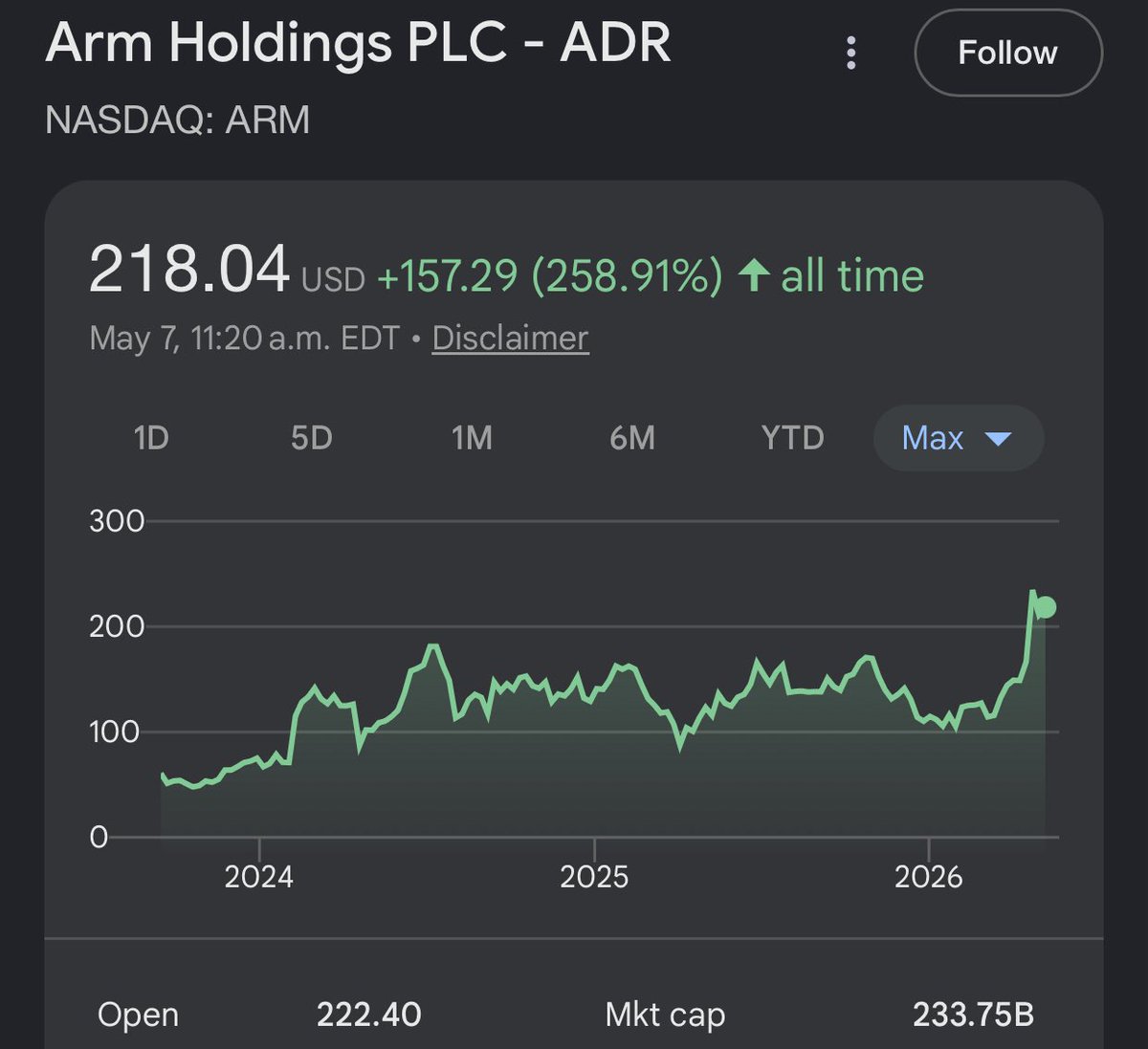
Masa took Arm private for $32B in 2016.
Went pubic again in 2024 and market cap is now $234B.
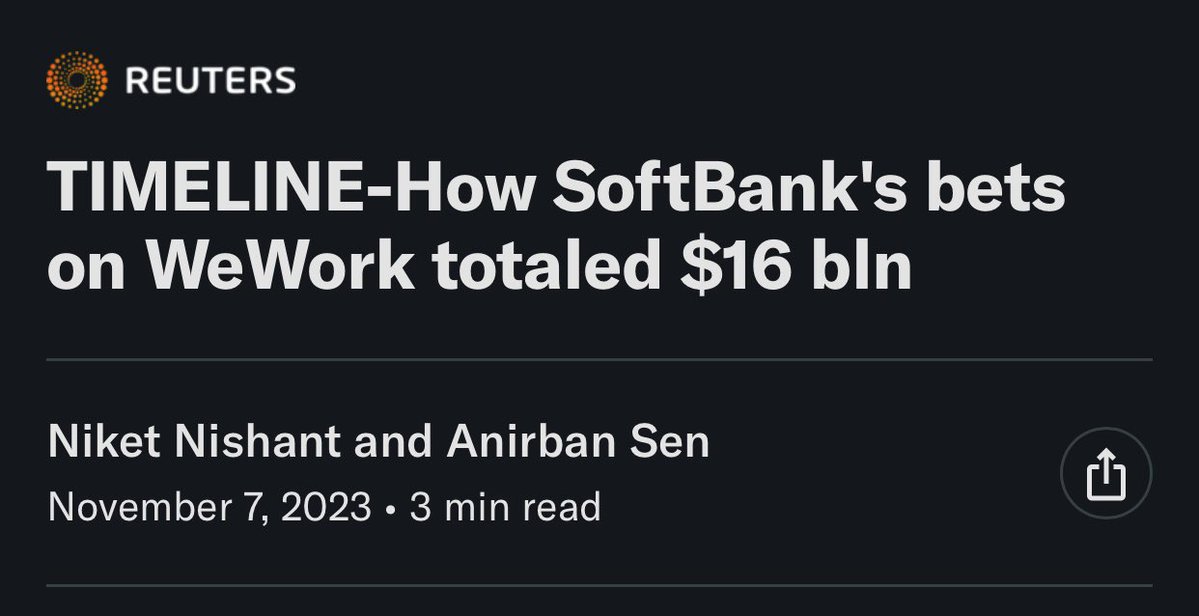
He owns 87%, which is around $204B. So, Masa is now up $172B on Arm, which is more than 10x the amount he lost on WeWork ($16B). Wild.
Kraken parent @Payward is acquiring Reap, a payments infrastructure company connecting card networks, traditional finance rails, and stablecoin-native settlement into a single platform.
@reapglobal expands @PaywardServices with globally regulated card issuance and stablecoin payments.
https://t.co/j7CDTURKqe