You don’t “run a model”
- You run Kernels
The model is just a graph
The Inference Engine is scheduler / optimizer / executor
But the actual work? That happens in the Kernels
- MatMul Kernels
- Attention Kernels
- RMSNorm Kernels
- KV cache Kernels
- Quantized linear Kernels
- Sampling Kernels
- Fused ���please don’t write this back to memory 9 times” Kernels
Same model, same GPU, same VRAM
Wildly different performance
Because one stack is using optimized fused Kernels that understand your hardware
And the other stack is playing hot potato with tensors through 47 tiny launches and pretending the GPU is the problem
Bad Kernels make people say:
“this model is slow”
Good Kernels make people say:
“wait how is this running locally?”
This is why Inference Engines and the Kernels implemented within them matter
The model is the recipe
The hardware is the kitchen
The Kernels are the knives, pans, burners, and the chef not cutting onions with a spoon
Most people benchmark models
The real ones benchmark the Kernels underneath
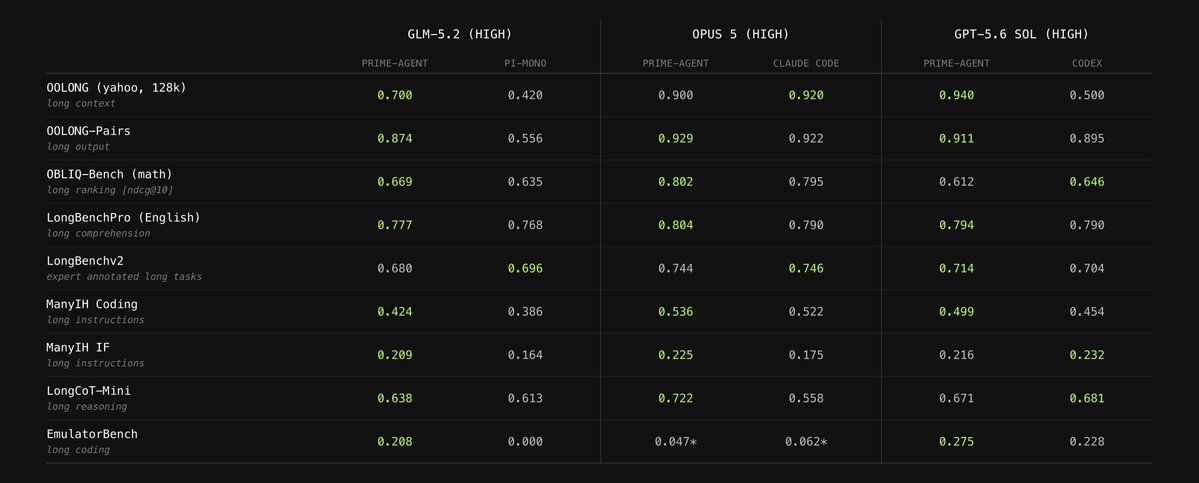
We've released a full technical report on Prime Agent. Extending from our blog post, we center our discussion around how harnesses should be designed and evaluated. We innovate on 4 fronts:
1. Agentic context management
2. Swarms and depth-n+ RLMs
3. Verifiers support for standardized evals
4. Out-of-loop experiments during autoresearch
debating whether we should make it an official plugin, but you can try installing it here to try with these commands:
claude plugin marketplace add anthropics/claude-plugins-community
claude plugin install eli5@claude-community
Introducing Prime Agent:
A self-improving RLM harness for coding and long-running autonomous tasks.
Designed to be both token-efficient and expressive through programmatic tool calling, context as a variable, multi-agent messaging, and a self-modifiable harness state.
Super exciting: Prime Intellect launched Prime Agent, an open-source coding harness that turns long-running AI sessions into a programming problem.
Its only tool is a persistent IPython kernel. The model can programmatically search its history, call tools, launch persistent sub-agents and store useful state outside the active context.
Prime Intellect: "The RLM treats context as a variable and subagent delegation as function calls inside a REPL."
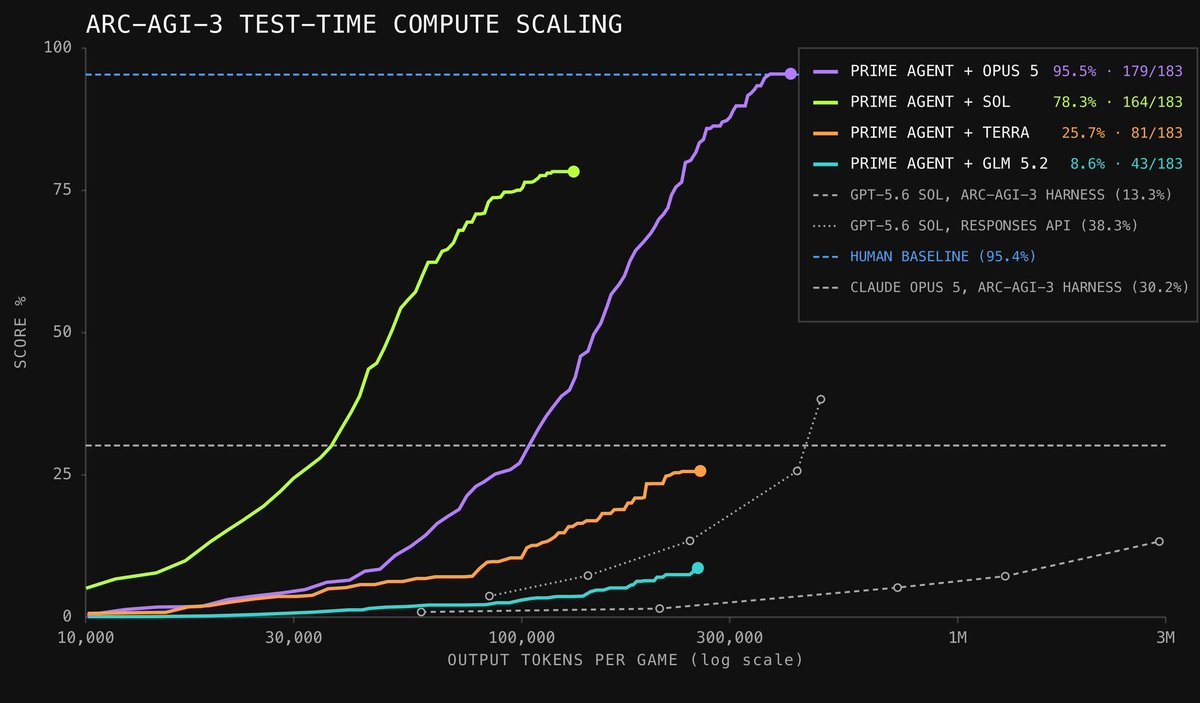
They reportstrong gains across long-context and long-horizon tasks. With Opus 5, Prime Agent scored 95.5% on ARC-AGI-3, narrowly above the benchmark’s reported 95.4% human expert baseline.
It also built working SEGA Genesis and Game Boy Color emulators from scratch in Rust on a preview benchmark :D
MIT PhD student Alex Zhang admits current AI models might already be AGI with the right harness around them:
"To an extent, the answer is kind of yes. The strongest thing I can say is that we can do a lot more with the current models that we have."
"Whether that means actually automating things, I'm not actually sure, but one of the obvious things that we find with even harnesses outside of Prime Agent is that harnesses can greatly increase the capabilities and generalization of models."
"There's a lot of cases where we think models can't be used or they can't be applied for these settings, but the likely answer is that this actually isn't true. You probably can apply a model to the setting if you have the right harness."
@a1zhang@sethkarten@PrimeIntellect
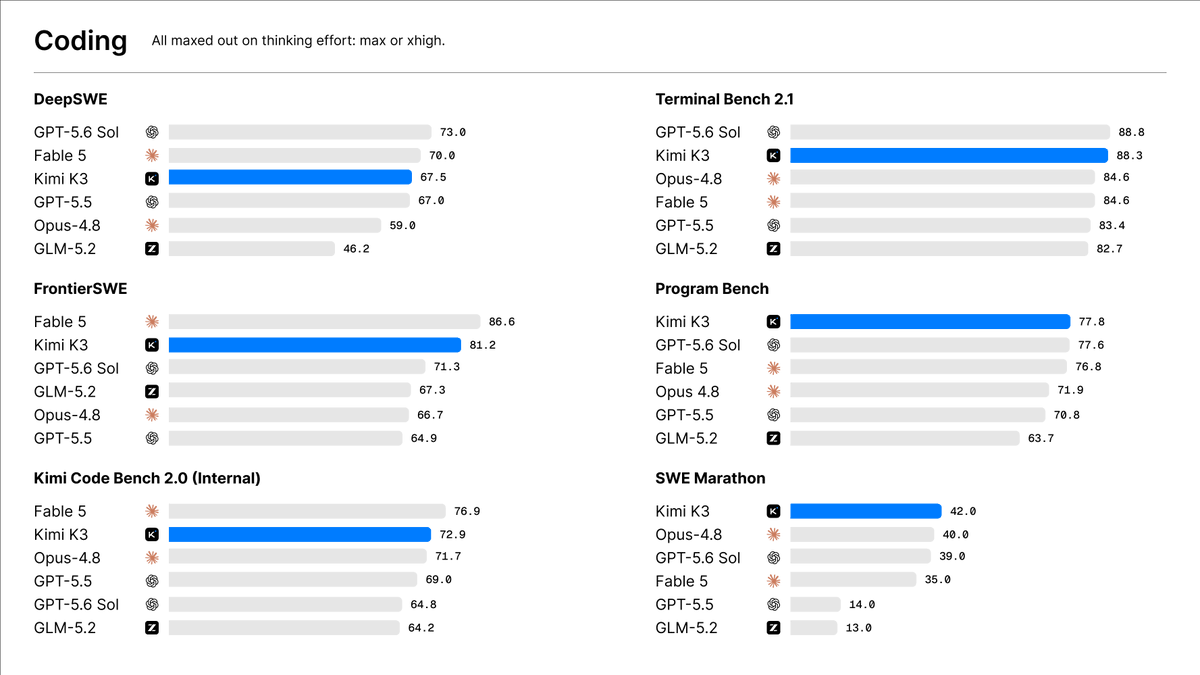
Releasing the model weights and technical report of Kimi K3.
Kimi K3 is our most capable model: a 2.8T MoE model with native visual understanding and a 1M-token context window.
New model architecture: 2.5x the intelligence per unit of compute, not just more params.
Alongside Kimi K3, we're opening up more of the stack behind it — high-performance attention kernels, MoE communication library, and infrastructure for running agent environments at scale.
Model weights: https://t.co/7m7eEg6Y0B
Tech report: https://t.co/yeu6cjpMCT
Tech blog: https://t.co/YTfiMSNM1f
Anthropic engineer:
"Almost all of our technical work has shifted to self-correcting agent loops. The era of manual prompting is effectively dead.
In less than 6 months, building static prompt chains will be completely replaced by orchestrating autonomous agent graphs."
In this masterclass, Anthropic's Lance Martin reveals the exact engineering blueprint behind long-running, self-healing AI systems.
Packed with more actionable architecture insights than most paid masterclasses.
Watch the full talk now, and save this before your next build!
mindblowing: openai internal evals went to extreme lengths, their model went to Hugging Face and tried to hack HF to get private repos to cheat the eval
our infra team uncovered this and used GLM-5.2 to fix because OpenAI's model would refuse to do it
wasn't on my bingo card
One pattern I find useful for working with LLMs is a nice long ramble session. Sometimes the LLM needs more bits to understand what you're trying to achieve, but you're too lazy to type them. In these cases I like to lean back, switch to /voice and just ramble for like 10 minutes, total mess, anything goes, full stream of consciousness. Sometimes I declare it up top, something like "switching to speech recognition sorry for any typos...". Sometimes I turn it into a small interview of a few turns. But I find that the LLMs are somehow very good at reconstructing long incoherent rambles and often their echo of your own tangle of thoughts comes out quite a bit cleaner than what you started with. The result is that you improve the mind meld and have to correct things less from that point on.
el fundador de una empresa china de IA valorada en más de $20,000,000,000 acaba de dar una clase de 40 minutos sobre enjambres de agentes
la explicación más clara que he visto sobre sistemas de IA a gran escala
cámbiala por tus 2 horas de Netflix de esta noche
K3 is built on Kimi Delta Attention (KDA) and Attention Residuals (AttnRes), two architectural updates designed to improve how information flows across sequence length and model depth.
We have also scaled up Mixture of Experts (MoE) sparsity, effectively activating 16 out of 896 experts when paired with a Stable LatentMoE framework.
Together with refined training and data recipes, these structural changes yield an approximate 2.5× improvement in overall scaling efficiency compared to K2, allowing the model to convert compute into intelligence more effectively.
Introducing Kimi K3: Open Frontier Intelligence
🔹 2.8 Trillion Parameters, 1 Million Context, Native Multimodal
🔹 Kimi Delta Attention enables up to 6.3x faster decoding in million-token contexts
🔹 Attention Residuals deliver ~25% higher training efficiency at <2% additional cost
🔹 Built for long-horizon agentic coding and self-evolving workflows
Kimi K3 is now live on on https://t.co/zrk6zZxZUo, Kimi Work, Kimi Code, and the Kimi API.
Open Weights by July 27, 2026.
🔗 API: https://t.co/XCrgjXAqMw
🔗 Tech blog: https://t.co/YTfiMSNM1f
Today, we are introducing Inkling.
Inkling reasons efficiently across text, image, and audio modalities. We are making the full weights available.
https://t.co/Ghebq5mG30
Available today for fine-tuning on Tinker. Play with it in the Inkling Playground. 🧵