Introducing Contrastive Language Model (CLM): an ultra-fast System One Model trained with a contrastive learning objective that connects states and actions.
CLM-8B is pre-trained on internet-scale data and delivers up to 9× faster inference than Jev ⚡ while achieving comparable performance across computer-use, gaming, and tool-calling tasks.
With lightweight fine-tuning, CLM-8B sets a new SOTA on challenging agentic coding benchmarks, such as DeepSWE (81.6%) and Terminal-Bench 2.1 (87.6%). In contrast, Jev fails to serve as an effective verifier for these long-horizon tasks.
We also build an efficient training and serving infra for CLMs by disaggregating states and actions, allowing their embeddings to be cached and reused independently. This substantially reduces inference latency in settings where the state evolves continuously while the action set remains fixed.
Finally, we establish scaling laws for CLMs and show that the test contrastive loss decreases predictably as a power law in training compute, model size, and dataset size.
📄 Blog: https://t.co/zwi9JOHKGx
💻 Code: https://t.co/rsHRYCGR8I
🗣️ Discord: https://t.co/Uqtdefvo3J
🤗 Data & Models: https://t.co/wdSWGGO3hu
More details on CLM’s architecture, data recipe, and scaling laws in the thread below 🧵
We're offering grants of up to $50,000 in Claude usage credits to researchers accelerating cures for rare diseases.
This is our first focused call within AI for Science, our program supporting scientists using Claude to speed up discovery. https://t.co/rZEmwh07cd
The most capable reasoning systems in AI scale inference compute along several axes: sequential compute to think longer, parallel compute to sample many independent attempts, and aggregative compute to synthesize prior traces into a new improved one. But during training, we only optimize how models use sequential compute. This creates a fundamental mismatch between how we ultimately deploy these systems and how we train them, leaving much of search and synthesis unoptimized.
We introduce SPIRAL, an RL framework for making all inference-compute primitives end-to-end learnable: models learn to coordinate sequential, parallel, and aggregative reasoning using only the reward of the final output. Work with @ifdita_hasan (co-lead), @michaelyli_ , @oshaikh13 , @yoonholeee , @DorsaSadigh , @chelseabfinn , @noahdgoodman 🧵
Today we release Token Superposition Training (TST), a modification to the standard LLM pretraining loop that produces a 2-3× wall-clock speedup at matched FLOPs without changing the model architecture, optimizer, tokenizer, or training data.
During the first third of training, the model reads and predicts contiguous bags of tokens, averaging their embeddings on the input side and predicting the next bag with a modified cross-entropy on the output side. For the remainder of the run, it trains normally on next-token prediction. The inference-time model is identical to one produced by conventional pretraining.
Validated at 270M, 600M, and 3B dense scales, and at 10B-A1B MoE.
The work on TST was led by @bloc97_, @gigant_theo, and @theemozilla.
Introducing EgoVerse: an ecosystem for robot learning from egocentric human data.
Built and tested by 4 research labs + 3 industry partners, EgoVerse enables both science and scaling
1300+ hrs, 240 scenes, 2000+ tasks, and growing
Dataset design, findings, and ecosystem 🧵
The Qwen3.5 series maintains near-lossless accuracy under 4-bit weight and KV cache quantization.
In terms of long-context efficiency:
Qwen3.5-27B supports 800K+ context length
Qwen3.5-35B-A3B exceeds 1M context on consumer-grade GPUs with 32GB VRAM
Qwen3.5-122B-A10B supports 1M+ context length on server-grade GPUs with 80GB VRAM
In addition, we have open-sourced the Qwen3.5-35B-A3B-Base model to better support research and innovation.
We can't wait to see what the community builds next!
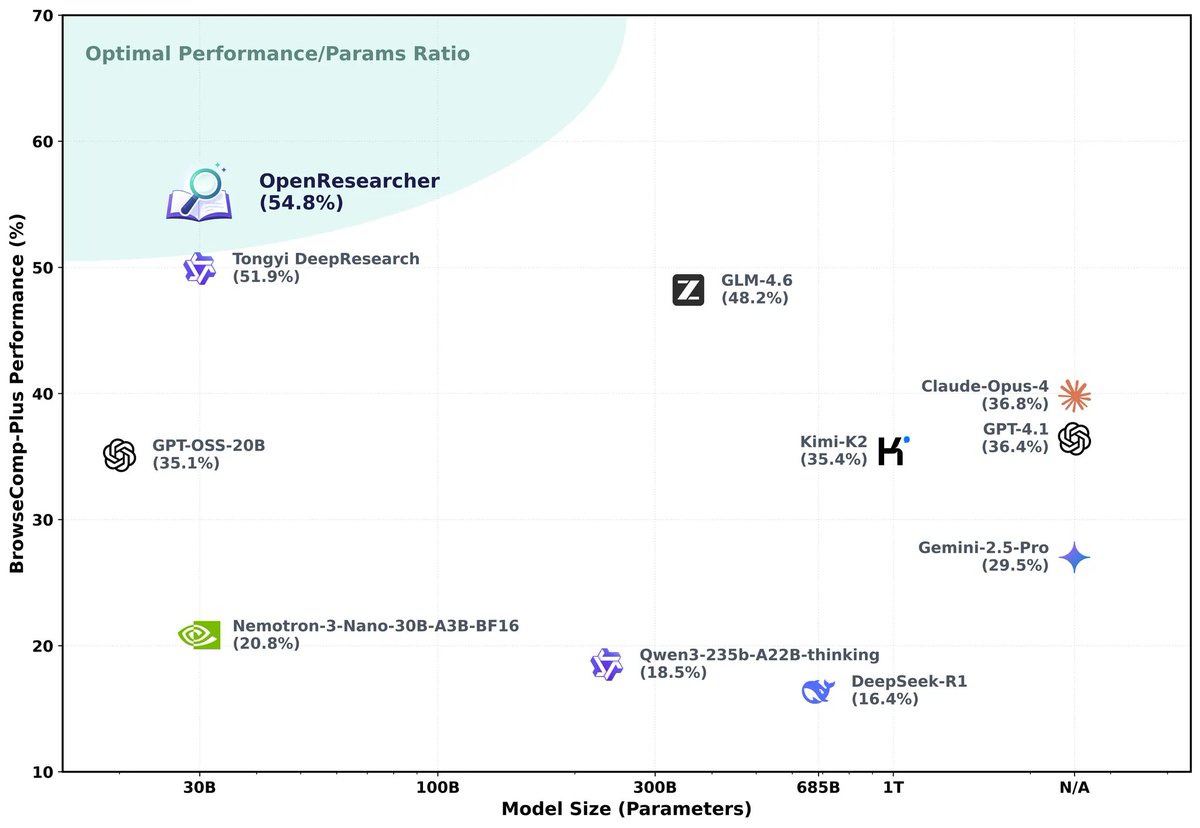
🚀 Introducing OpenResearcher: a fully offline pipeline for synthesizing 100+ turn deep-research trajectories—no search/scrape APIs, no rate limits, no nondeterminism.
💡 We use GPT-OSS-120B + a local retriever + a 10T-token corpus to generate long-horizon tool-use traces (search → open → find) that look like real browsing, but are free + reproducible.
📈 The payoff: SFT on these trajectories turns Nemotron-3-Nano-30B-A3B from 20.8% → 54.8% accuracy on BrowseComp-Plus (+34.0).
🧩 What makes it work?
🔎 Offline corpus = 15M FineWeb docs + 10K “gold” passages (bootstrapped once)
🧰 Explicit browsing primitives = better evidence-finding than “retrieve-and-read”
🎯 Reject sampling = keep only successful long-horizon traces
🧵 And we’re releasing everything:
✅ code + search engine + corpus recipe
✅ 96K-ish trajectories + eval logs
✅ trained models + live demo
👨💻 GitHub: https://t.co/0yWxIRzyDz
🤗 Models & data: https://t.co/AtweQjWF73
🚀 Demo: https://t.co/yBOXSoeWZ9
🔎 Eval logs: https://t.co/zIqfq0TKca
#llms #agentic #deepresearch #tooluse #opensource #retrieval #SFT
Probably the first model released on 2026 and the number looks super impressive as a 40B model!
Congratulations to the IQuest team!
Model available on @huggingface
https://t.co/aLdaibhrNS
Looking forward for more inference provider support.
This paper shows that wildly different AI models for molecules, materials, and proteins are independently learning the same underlying representation of matter
suggesting we’re converging on a shared physics-grounded “latent reality” that proves scientific foundation models might actually be generalizable across domains
We got our robots to wash pans, clean windows, make peanut butter sandwiches, and more!
Fine-tuning our latest model enables all of these tasks, and this has interesting implications for robotics, Moravec's paradox, and the future of large models in embodied AI.
More below!
We did a fun side project of fine-tuning π’s latest model on most of the tasks from Benjie Holson’s “Robot Olympics” blog post.
The robot was able to autonomously complete all of the 10 tasks that we attempted. 🤖
Blog post: https://t.co/1SoB6t2Zir
We discovered an emergent property of VLAs like π0/π0.5/π0.6: as we scale up pre-training, the model learns to align human videos and robot data!
This gives us a simple way to leverage human videos. Once π0.5 knows how to control robots, it can naturally learn from human video.
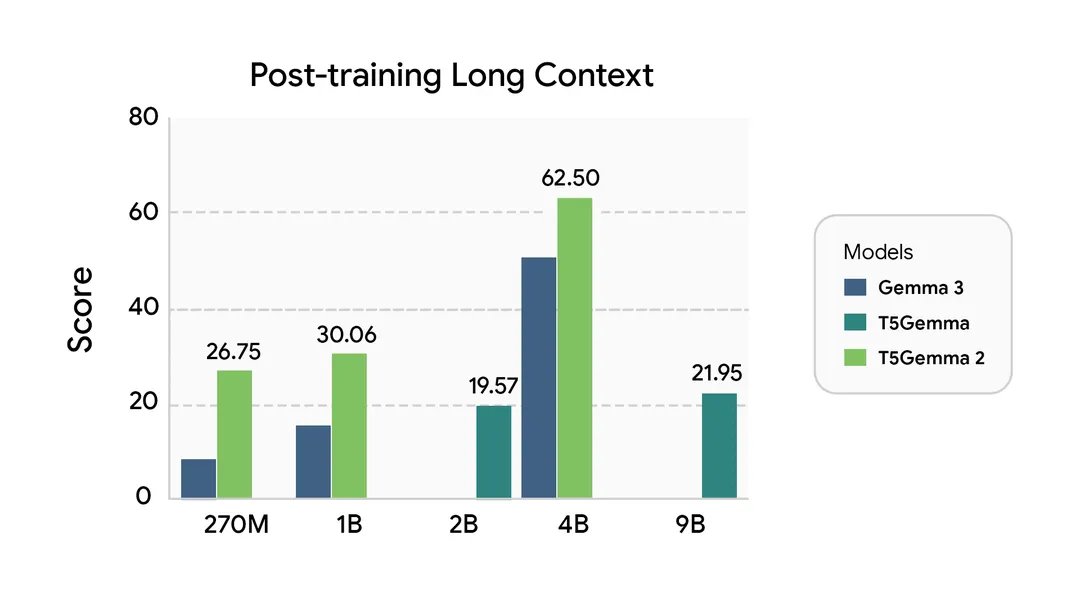
Introducing T5Gemma 2, the next generation of encoder-decoder models 🚀
Built on top of Gemma 3, we were able to build compact models at sizes of 270m-270m, 1B-1B, and 4B-4B sizes.
While most models today are decoder-only, T5Gemma 2 is the first (I'm aware of) multimodal, long-context, and heavily multilingual (140 languages) encoder-decoder model out there.
We hope this model enables the model research community as well as the community of devs ready to explore with new architectures.
Blog: https://t.co/12ScxYcjxa
Models: https://t.co/D38wNFo5Bc
Paper: https://t.co/2rypSQ7Bf6
A year ago, I took a big bet and shifted my research to world models. We started with navigation, but the vision was broader: simulate any interaction with the environment, including fine grained manipulation.
Today we introduce DexWM, a world model for dexterous manipulation. Trained on 900+ hours of human and robot video, DexWM lets us imagine, plan, and execute dexterous actions on a real robot.
I had a long, substantive conversation with @sama about OpenAI's strategic positioning, its plan to build memory into ChatGPT, its enterprise play, compute, AI devices, and whether AGI is still a useful term.
Full episode below:
0:00 Code red, strategic moats
6:55 Personalization’s potential
9:15 AI-first products vs. bolt-ons
19:07 AI relationships
23:10 Enterprise and GDPval
28:53 Why so much compute?
48:34 AI cloud, IPO, AGI lightening round
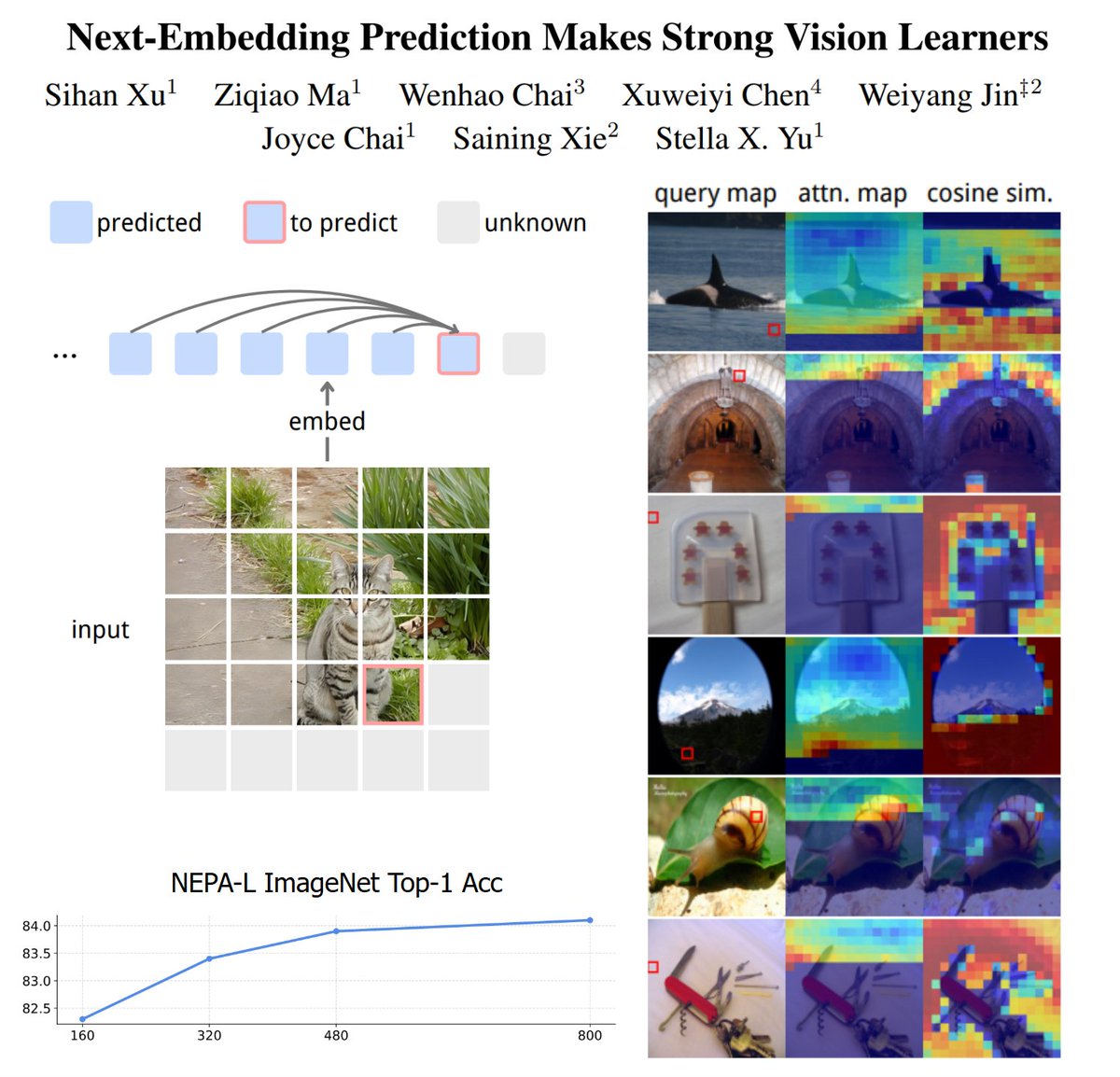
NEPA: Next-Embedding Predictive Autoregression
A simple objective for visual SSL and generative pretraining. Instead of reconstructing pixels or predicting discrete tokens, we train an autoregressive model to predict the next embedding given all previous embeddings.
Key ideas:
- One self-supervised signal: cosine-style next-embedding prediction
- Autoregression runs directly on the embeddings from a native encoder (no offline encoder)
- No pixel decoder (and loss), no contrastive pairs, no task-specific heads, no random masks
Scales into modern ViT backbones and stays competitive after supervised fine-tuning:
- ImageNet-1K (Base 83.8%; Large 85.3%)
- ADE20K
Fully open-sourced with reproducibility verified:
- Homepage: https://t.co/9SoEshkeiO
- Paper: https://t.co/gwILijFBDQ
- Code: https://t.co/GaAWvK4tQT
- Weights: https://t.co/pTNAMtVPwf
This work is led by @6SihanXu and advised by @SLED_AI, @sainingxie, and Stella X. Yu. Contributors: me, @wenhaocha1, @ChenXuweiyi, and @JinWeiyang18434.
Pass/fail benchmarks are saturated. It’s time for FrontierCS. 🚀
150+ unsolved, verifiable problems ranging from competitive programming to real-world research. Designed by PhDs & ICPC experts to evolve model intelligence. 🎓🧠
🧵👇Check it out!
Paper: https://t.co/nMorPLD5q0
We’re open-sourcing Perception Encoder Audiovisual (PE-AV), the technical engine that helps drive SAM Audio’s state-of-the-art audio separation.
Built on our Perception Encoder model from earlier this year, PE-AV integrates audio with visual perception, achieving state-of-the-art results across a wide range of audio and video benchmarks. Its native multimodal support can assist people in everyday tasks, including sound detection and richer audio-visual scene understanding.
🔗 Read the paper: https://t.co/RLWJOgG2uz
🔗 Download the code: https://t.co/1L5ZqCZlxq