I've been in the poker world for almost 20 years.
I've battled the best, played millions of hands, and watched the game evolve.
Want to become one of the best yourself?
Here are 5 qualities successful poker players have in common:
Passive poker study is easy to overvalue.
Watching a 60-minute video feels productive, but you may remember almost none of it.
Use trainers, quizzes, hand reviews and other methods that force you to make decisions.
Study should make you actively think.
Dusting off this tweet from April because this gap in shared understanding of LLM capability is *widening*. It's now less "two groups of people speaking past each other" and more a sharp funnel.
- Napkin math somewhere around 6B people (~75% of the population) have barely come in contact with LLMs at all.
- Around 1-2B (~20%) are casual and infrequent users of free-tier ChatGPT-like products. This group sees derpy chatbots and treats them a bit like a better Google search, a writing aid, or etc. Maybe an agent tries to book you a flight. I have non-tech friends who (reasonably, imo) say they have not much use for it at all. Even many professionals outside of math&code are in this tier. For example, execs and many other functions spend a lot of their time talking to other people, so while they understand what is happening intellectually, it is still second-hand and a bit abstract.
- Now we get to professional use of frontier-grade LLMs in math&code. Somewhere around 20M people (0.2%) see first-hand that large, complex projects that used to take them weeks/months can now be completed by agents with a prompt. Building apps, copying apps, translating apps, decompiling apps from binaries... This has all happened very quickly and recently - less than 1 year ago, I was writing code manually by hand, typing memorized computer code commands into a code editor character by character, occasionally pressing Tab to autocomplete a little chunk of code.
- And finally we get to the ~5,000 people (~0.00006%) with access to frontier-grade systems internally. The external world has seen the preview. It looks like swarms of thousands of agents collaborating over weeks on software mega projects: minting zero days, running cyber attacks and defenses at machine speeds, discovering new science, advancing the frontier of mathematics. Things that would have taken top professionals in the industry years of work. Meanwhile, human review and comprehension are starting to fall behind. For example, people are still involved in the "archeology" of the OpenAI-HF incident from many months ago. Mathematicians may be poring over the 722 manuscripts on frontier mathematics for a while.
The funnel is driven by a combination of factors:
1. The impact scales with ambition, problem size, and horizon. A question with a paragraph answer barely stresses the system. You need a reservoir of big, difficult problems that you really care about. This aspect drives the consumer / professional dimension of the funnel.
2. The jaggedness of the system (which I have written about a lot separately). Capability peaks in domains that are digital, verifiable and economically valuable. This is because LLM capability emerges from reinforcement learning on verifiable rewards on a curated environment mixture driven by revenue potential. This aspect primarily drives the area (e.g. math&code) dimension of the funnel.
3. Access. Free-tier, paid-tier, internal.
So this is the weirdness of the moment. The general public has mostly not interacted with these systems. When they have, it looks like a derpy chatbot. The majority of professionals still see only a modest uplift. And a small sliver of professionals are experiencing the vertigo of the curve going vertical. And it is all happening at the same time.
Now out: The updated edition of my book The Innovators: How a Group of Hackers, Geniuses, and Geeks Created the Digital Revolution. It has a new intro arguing how the "hands-on imperative" and the Ada Lovelace/Steve Jobs belief in human-computer partnership should rule in the era of AI. https://t.co/Jjw1JGE7b3
Amazon banning agents is the first opportunity I've seen since Amazon was founded for a startup to create an Amazon competitor. People will want agents to buy stuff for them. It will be one of the main use cases. And they won't want to use some Amazon-supplied agent to do it.
If you are trying to understand how AI may impact “your business” and “your brand,” I highly recommend you listen to this grounded discussion from @btaylor (@SierraPlatform). Bret eloquently separates near term opportunity from the all too common rhetoric. https://t.co/MMsnG6W6EB
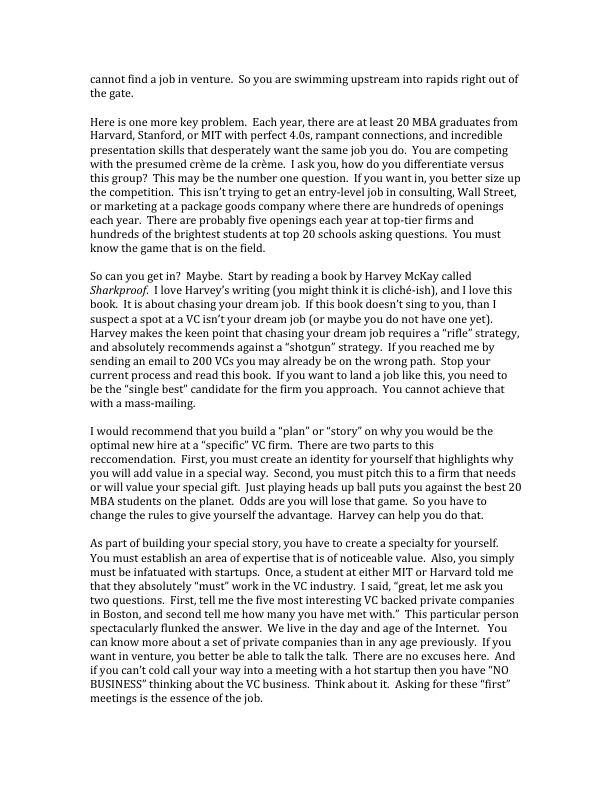
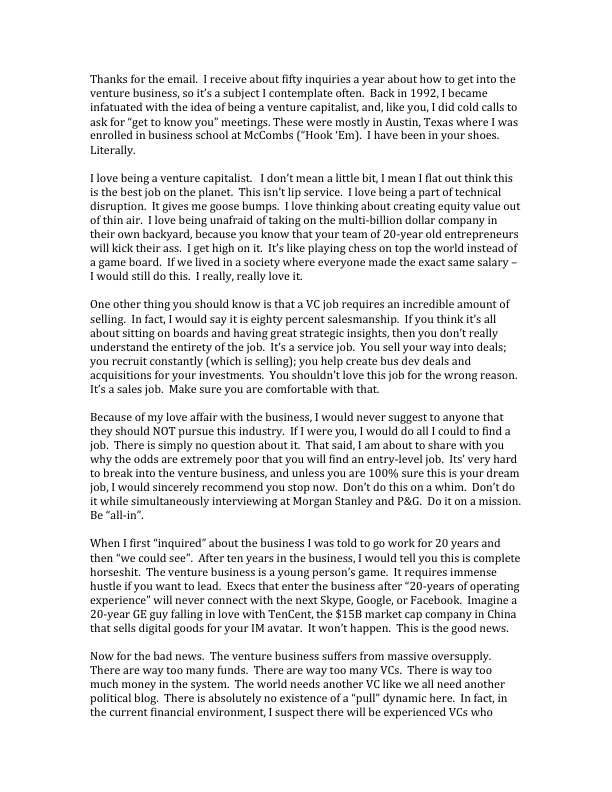
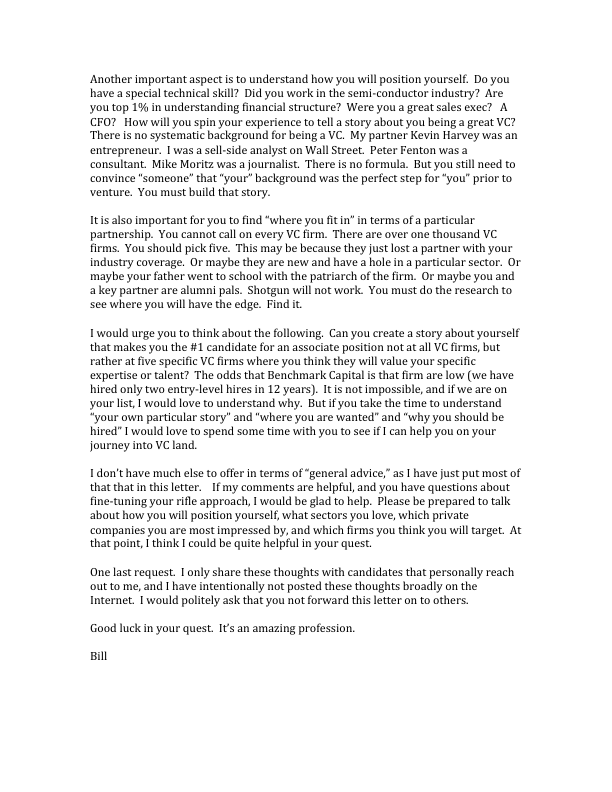
"So You Want to be a VC"
Im enjoying this week in Boston visiting students promoting my new book - Runnin Down a Dream. Not surprisingly, many ask me about trying to break into venture capital. I wrote a letter answering this question 15 years ago. I would send it out when people inquired. I'm making it public for the first time - with zero modifications.
1) I think it holds up well
2) make sure and read my new book also
3) I probably can't help with followups (as suggested in the letter)
Hope you find it useful. Good luck!
For the past 15 years, I have played the highest games in the world.
One massive misconceptions is that high stakes poker is always super out of line, hardcore battling, crazy plays left and right.
Nonsense.
Here are 4 boring skills, pros have mastered to win huge in poker:
Today, with over 100 industry partners, we introduced the NVIDIA Open Agent Safety Platform, bringing together OpenShell and Sentry.
Artificial intelligence is extraordinary technology that will advance discovery, productivity, security, health, and prosperity for generations to come.
But its full promise can only be realized when people have confidence that AI is being built to be safe and deployed with wisdom and responsibility.
This is bigger than a single product. It's the beginning of an open ecosystem to build the trust layer for safe agent systems.
Together, we are building the foundation of the AI economy.
Trust and innovation are not in conflict. Safety is how trust is earned. We must build not only the most capable AI, but the most trusted AI, so that this extraordinary technology can realize its enormous promise for the world. https://t.co/ugYWQ1MyRi
The difference between GTO and exploitative poker is easiest as a chess analogy:
In poker you play your range against their range — strategy vs strategy, like two chessboards.
The difference from chess: the boards are invisible.
GTO: you set up your board optimally without knowing how they’re setting up theirs.
Exploitative: you figure out how they’re arranging their invisible board, then counter it.
There is no contradiction, they complement each other.
Stan Druckenmiller: "I've always believed markets are smarter than I am."
Here is how he uses that.
"They send out a message. And if I listen to them properly, no matter how powerful my thesis, if they're screaming something else, it's telling me you've got to reevaluate."
His first mentor had a saying for it.
"100 million Frenchmen can't be wrong."
Then he gives the example, and it is not a flattering one.
Facebook had reported great earnings. The stock was $122, opened at $131 after hours, and three days later it was trading at $116.
"So the analysts come in, and they're giving me this. I said, nothing's wrong. It's great. I said, no, kid, you're wrong. Something's going to come out. You just don't know it yet."
Then he tells you how that turned out.
"Anyway, a year later, the stock was like $220. So that didn't mean anything."
Read that again. The rule he lives by misfired, and he told the story anyway. That is why I trust it. He is telling you where it breaks: over a week or two, price gives you noise. Over months, it gives you signal.
The same idea in a bigger trade: on the night Trump was elected, he says, bonds got murdered and stocks opened down, and the market was predicting a recovery while the talking heads said it was the end of the world.
"The market was right."
And on the asymmetry that made his best trades great, on the 1992 pound bet.
"It was a one way bet. It was either going to be flat or we're going to make 15 or 20 percent."
Compare that to the Brexit trade he passed on: make 10% or lose 10%, and he could not figure out which one.
So do this. For every position, write two lines. One: the thesis. Two: the price move that would make you reevaluate before you add. Check it weekly, not daily. And look for bets where the downside is flat and the upside is 15 to 20 percent, before you look for bets you are sure about.
The whole segment is 9 minutes. Watch it below.
Every day I take one story like this and turn it into a rule you can use the same day. Follow so tomorrow's finds you.
Ray Dalio. Paul Tudor Jones. Steve Cohen. The three most feared traders on Wall Street all survived Black Monday using the same document - and made sure the MIT professor who wrote it never had to work again.
A 2026 classified working note restored from MIT's restricted archive. "Probability & Risk." The framework that let $2B desks calculate exactly how much they could lose before they lost it. On Black Monday, the traders who had it walked away with portfolios intact. Some walked away up.
Their gratitude made him a fortune.
Here's what was inside.
Value at Risk. Expected Shortfall. The Efficient Frontier. Every risk desk at Goldman Sachs, Citadel, and Bridgewater runs these exact calculations on $100B+ in assets today. In 1987, when Black Monday wiped $500 billion off the market in a single day - the traders who had this framework knew their number before the bell rang. They sized positions accordingly. They survived.
The ones who didn't have it got margin-called into zero.
The core idea: VaR tells you how much you might lose. Expected Shortfall tells you how much you can really lose when markets break. The difference between those two numbers is what separates a fund that survives a crash from one that gets liquidated at the bottom.
Monte Carlo simulation. 10,000 paths modeled before a single dollar goes at risk. The document runs the exact calculation - 12% expected return, -2.8% VaR on worst days. Bridgewater uses the same method on $150B today. So does every quant desk paying analysts $600k+ to run it.
Watch the moment [Fig. 2]
The Efficient Frontier. One curve.
Every point below it: you're leaving money on the table. Every point above it: impossible. One point on the curve: the portfolio that survives anything.
The chart that told $2B traders exactly where to stand before the floor collapsed.
MIT Mathematical Methods for Financial Decisions - Restricted, 2026
Declassified from archive
bookmark this





![0xLupenn's tweet photo. Ray Dalio. Paul Tudor Jones. Steve Cohen. The three most feared traders on Wall Street all survived Black Monday using the same document - and made sure the MIT professor who wrote it never had to work again.
A 2026 classified working note restored from MIT's restricted archive. "Probability & Risk." The framework that let $2B desks calculate exactly how much they could lose before they lost it. On Black Monday, the traders who had it walked away with portfolios intact. Some walked away up.
Their gratitude made him a fortune.
Here's what was inside.
Value at Risk. Expected Shortfall. The Efficient Frontier. Every risk desk at Goldman Sachs, Citadel, and Bridgewater runs these exact calculations on $100B+ in assets today. In 1987, when Black Monday wiped $500 billion off the market in a single day - the traders who had this framework knew their number before the bell rang. They sized positions accordingly. They survived.
The ones who didn't have it got margin-called into zero.
The core idea: VaR tells you how much you might lose. Expected Shortfall tells you how much you can really lose when markets break. The difference between those two numbers is what separates a fund that survives a crash from one that gets liquidated at the bottom.
Monte Carlo simulation. 10,000 paths modeled before a single dollar goes at risk. The document runs the exact calculation - 12% expected return, -2.8% VaR on worst days. Bridgewater uses the same method on $150B today. So does every quant desk paying analysts $600k+ to run it.
Watch the moment [Fig. 2]
The Efficient Frontier. One curve.
Every point below it: you're leaving money on the table. Every point above it: impossible. One point on the curve: the portfolio that survives anything.
The chart that told $2B traders exactly where to stand before the floor collapsed.
MIT Mathematical Methods for Financial Decisions - Restricted, 2026
Declassified from archive
bookmark this](https://pbs.twimg.com/media/HTAma82WgAAHuZR.jpg)





