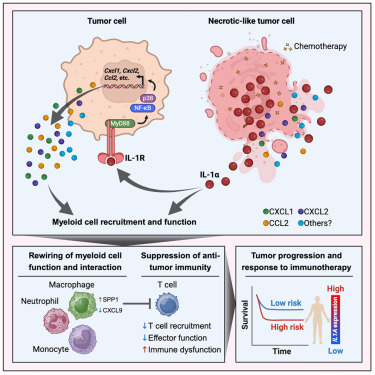
Thrilled to share our story out in Cancer Cell, led by the amazing Kay Hanggi (now on the job market). We show that necrotic forms of cell death and the subsequent release of IL1a drives myeloid-based immune suppression in models of breast cancer. (1/11)
https://t.co/7cafJW2KSQ
Interleukin-1α release during necrotic-like cell death generates myeloid-driven immunosuppression that restricts anti-tumor immunity https://t.co/O0ApLwnjBE
Excited to share our latest by @Triantafyllia14 where we find that IFNg acts as a metabolic switch to prune tumor-associated lymphangiogenesis and unlink immune surveillance and metastasis https://t.co/Hqfxke50kE #theLundLab
#ScienceSaturday
➡️ Did you know that some chemotherapies can enhance the immune response against #cancer?
❓ How might we potentiate this?
➡️ @Ruffell_Lab and colleagues from @moffittnews found that the necrotic cell death induced by #chemotherapy releases IL-1 alpha which induces immunosuppressive myeloid cells. Inhibiting IL-1 alpha in combination with chemotherapy enhanced antitumor responses.
‼️ This may be a promising approach for future clinical trials.
🔗 Here’s a link to the full study- https://t.co/62RIKWqLBe
@Cancer_Cell
Thrilled to share our story out in Cancer Cell, led by the amazing Kay Hanggi (now on the job market). We show that necrotic forms of cell death and the subsequent release of IL1a drives myeloid-based immune suppression in models of breast cancer. (1/11)
https://t.co/7cafJW2KSQ
Thanks to Kay for his dedication to the project and the lab over the years. Also to everyone that contributed, including those on the app: @gatechatl@DeNardoLabWUSM@CeliasDaiana (11/11)
Finally, it is unclear if there are divergent roles for tumor IL1a versus host IL1B due to different expression patterns or methods of release. (10/11)