What SNP variation is sufficient to connect an outbreak strain with its potential environmental source?
Check out what we learned from genomic analyses of a Serratia marcescens outbreak.
Appreciate the collaborative efforts of all involved!
https://t.co/24oJH4UOsG
New paper out on Serratia marcescens outbreak. Thanks to all my colleagues at MCPHL, CCHCS, and CDPH who brought this work to fruition.😁 https://t.co/KwBOQc2TIc
In new study led by @timcyuu, we measure how mutations to H3 flu HA affect cell entry, stability & antibody escape
We find pleiotropic effects of mutations on these phenotypes shape evolution: epistasis alleviates cell-entry but not stability constraints
https://t.co/mZs4KdCvkv
Monitoring viral evolution at population scale (in almost real-time) for the first time in the history of virology is leading to unprecedented findings like this
@jbloom_lab Thank you for your thorough analysis! Im not familiar with the H3 vs H5 numbering. Do you know where I can get more info on that? Confusing if you are trying to compare mutations & the same mutation is labeled differently. Is there a reason you didn't look at the other segments?
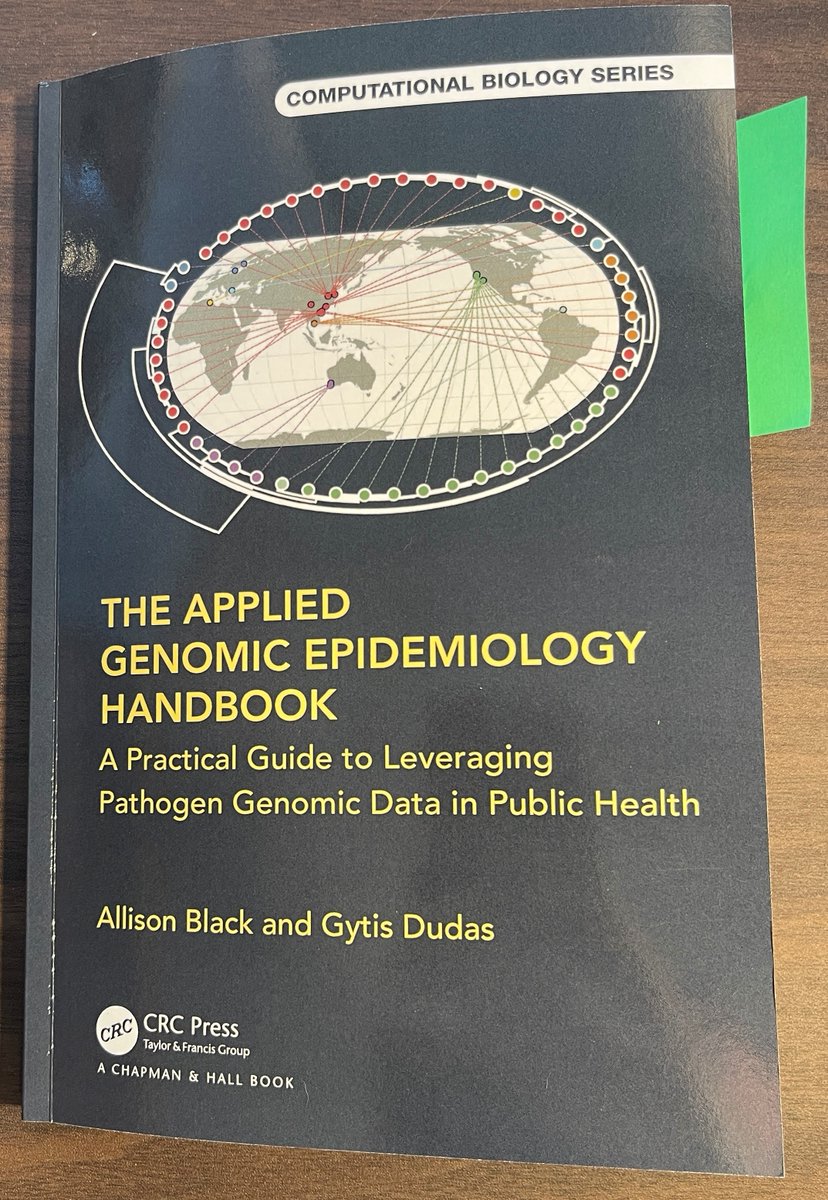
Just got my hands on "The Applied Genomic Epidemiology Handbook" - a game-changer for public health pros! 📚 Major kudos to @alliblk (@WADeptHealth), @evogytis (@VU_LT), with contributions from @EpiDemos82 (@UCF), and Janeece Pourroy (@ChanZuckerberg). It's packed with practical tips & real-world case studies on leveraging pathogen genomic data. A must-read for anyone in #PublicHealth or #GenomicEpidemiology.
And even better - you can get it on Amazon: https://t.co/A3DEXuRFV8
#Epidemiology #PathogenGenomics
Genomics Unit Chief Classification: RESEARCH SCIENTIST SUPERVISOR I (EPIDEMIOLOGY/BIOSTATISTICS) $8,984.00 - $11,196.00# of Positions: 1 Work Location: Sacramento County Telework: Hybrid Job Type: Permanent, Full Time https://t.co/JW9l5QnWrE
We're looking for a Research Scientist Supervisor I. This position supports the California Department of Public Health’s (CDPH) mission and strategic plan by providing scientific leadership on SARS-CoV-2 and coordinating with partners working on other respiratory viruses.
This recruitment is posted in the Sacramento and Contra Costa County locations. Final Filing Date: 3/28/24 Position Details Job Code #: JC-419501 Position #(s): 581-410-5643-909
@SolidEvidence I'm curious what their reasoning is. I know with cryptic lineages there was the concern of violating patient rights or what not, but I didn't realize there was a concern with not being public health significant. I think you have to push back. A lot of ppl just don't understand.
Joint statement by @UNDP, @UNFPA, @UNICEF, @WFP and WHO on humanitarian supplies crossing into Gaza
A first, but limited, shipment of life-saving humanitarian supplies from the United Nations and the Egyptian Red Crescent entered Gaza today on 20 trucks, passing through the Rafah Crossing.
It will provide an urgently needed lifeline to some of the hundreds of thousands of civilians, mostly women and children, who have been cut off from water, food, medicine, fuel and other essentials. But it is only a small beginning and far from enough. More than 1.6 million people in Gaza are in critical need of humanitarian aid. Children, pregnant women and the elderly remain the most vulnerable. Nearly half of Gaza’s population are children.
With so much civilian infrastructure in Gaza damaged or destroyed in nearly two weeks of constant bombings, including shelters, health facilities, water, sanitation, and electrical systems, time is running out before mortality rates could skyrocket due to disease outbreaks and lack of health-care capacity.
Hospitals are overwhelmed with casualties. Civilians face mounting challenges in accessing essential food supplies. Health facilities no longer have fuel and are running on small amounts they have secured locally. These are expected to run out in the next day or so. Water production capacity is at 5 per cent of normal levels. Pre-positioned humanitarian supplies have already been depleted. Vulnerable people are at greatest risk and children are dying at an alarming rate and being denied their right to protection, food, water and health care.
Nearly one-third of the population of Palestine was food insecure before this conflict in Gaza. Today stocks in shops are nearly exhausted and bakeries are closing, while tens of thousands of people are displaced and unable to cook or safely purchase food.
We call for a humanitarian ceasefire, along with immediate, unrestricted humanitarian access throughout Gaza to allow humanitarian actors to reach civilians in need, save lives and prevent further human suffering. Flows of humanitarian aid must be at scale and sustained, and allow all Gazans to preserve their dignity.
We call for safe and sustained access to water, food, health – including sexual and reproductive health – and fuel, which is necessary to enable essential services.
We call for the protection of all civilians and civilian infrastructure in Gaza, including health-care facilities.
We call for the protection of humanitarian workers in Gaza who are risking their lives in the service of others.
And we call for the utmost respect of international humanitarian law by all parties.
Gaza was a desperate humanitarian situation before the most recent hostilities. It is now catastrophic. The world must do more.