UPS has banned its drivers from turning left since 2004. The company says the rule saves 10 million gallons of fuel a year and let it pull 1,100 trucks off the road. The same logic is why this intersection needs zero lights.
The left turn is the villain of the entire road system.
A normal four-way intersection has 32 points where two cars can hit each other. Sixteen of them sit inside the box, and every one of those is a crossing conflict, the kind that produces a T-bone at 45 mph. Twelve of the sixteen involve someone turning left across oncoming traffic.
Delete the left turn and the count drops from 32 to 14. Crossing conflicts fall 87%.
That is what the loops in this design are doing. Nobody turns left. You turn right, drive a few hundred feet, U-turn through the median, and come back to the road you wanted. Three gentle merges replace one gamble against oncoming cars.
Michigan has been building these since the late 1960s, which is why engineers call it the Michigan Left. Minnesota put its first one in Willmar and went three years without a single fatal or serious injury crash. Across the states that adopted the design, injury and fatal crashes fell 54%.
The render skips the cost. Every crossing driver goes farther, and those U-turn loops eat land, which is why you find these on wide rural highways and almost never downtown. Minnesota's math is that it can build 10 to 20 of them for the price of one overpass.
Traffic lights exist to referee left turns. Take the left turn away and the referee has nothing to do.
This is probably the best chart to illustrate Poland’s unbelievable economic boom. Wages doubled in just six years.
With continued strong growth and almost no unemployment, they will keep rising.
Such a refreshing contrast to the left-green stagnation in other countries.
Everyone is talking about what Cybercab and autonomous vehicles means for the future of transportation. I want to talk about what it means for real estate.
Here is a site plan of a 76 unit apartment project we just finished in Dallas. It is leasing up now. Look at the site plan. Half the land is surface parking.
That is how many small(ish) apartment buildings have been designed for decades.
Cities used to require it. Many, including Dallas, are now getting rid of parking minimums. But that does not change much on its own. We will keep building as much parking as our renters demand. So will every other developer. Renters bring cars (especially in Texas).
So the parking stays until the cars change.
Here is what we did differently. The building and the parking lot are two legally separate tax parcels. If the parking is no longer needed, we can build on the lot without touching the building. On this site that means another 70 to 80 apartments.
No new land. No acquisition cost. Same property, roughly double the units.
And you may not even need robotaxis to get there. You just need cars smart enough to park themselves. Door to door. Bumper to bumper. Drop me off under the porte cochere, then go park yourself in a parking structure in a cheaper part of town. Half the parking field disappears right there.
Now run that across a whole city.
Every surface lot. Every oversized parking field. Every empty corner of a multifamily site. Each one becomes a development opportunity if the need for parking change drastically.
More housing. Less asphalt. More housing where people want to live.
Waymo, Zoox, and Robotaxi arriving in Dallas matters more than most people think. Robot cars do not just change how people move. They may change what we build and where it is built.
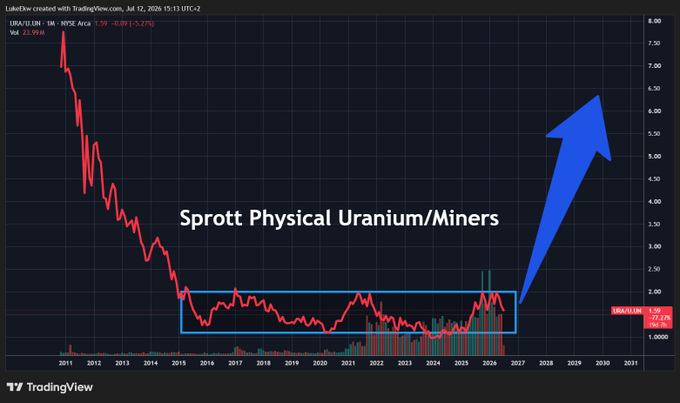
Uranium miners are trading near historic lows relative to the price of uranium.
To reach the previous cycle highs, miners would need to outperform uranium by roughly 5:1.
And the outlook for uranium has rarely been stronger.
- By 2035, uranium supply is projected to fall ~20%
- Over the same period, demand is expected to rise ~20%
That's roughly a 50 million lb annual deficit.
Put differently:
The market needs the equivalent of ~3 of the world's largest uranium mines to come online within the next decade.
The problem:
- It takes ~20 years from exploration to first production.
- Those mines don't exist, and even if they were discovered tomorrow, they wouldn't arrive in time.
We all don't own enough uranium for what's coming
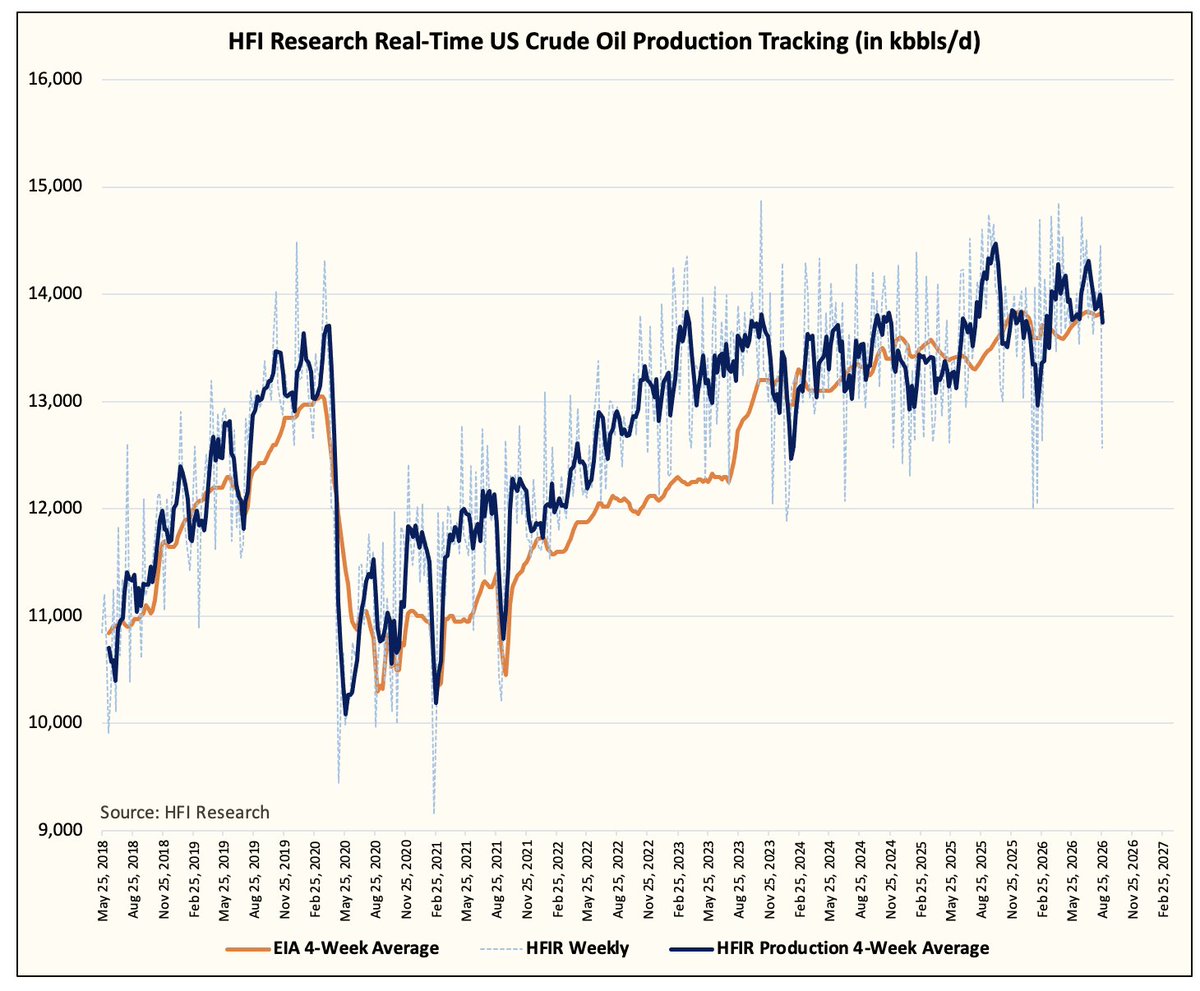
No momentum in US crude oil production.
In fact, I would argue that we are actually rolling over.
Outside of Exxon this year, I believe US shale is actually disappointing versus the current oil price backdrop.
Throwing rubbish in a landfill is (usually) better for the environment than recycling it. With few exceptions, recycling ends up emitting more CO2 and costing more money, while landfills are cheap and secure.
- Recycling mid-tier plastics (like plastic bottles or butter tubs) costs thousands of dollars per ton of CO2 saved. It's cheaper to do direct air CO2 capture than that! And there is no shortage of plastic, nor any problem with sequestering it in the ground once we're done with it.
- Modern landfills are extraordinarily secure and are *much* more than just big piles of trash. They capture 75%–95% of methane gas. Groundwater contamination is doesn't really happen with landfills built since 1990. A study of 31 landfills built since 1988 in NY found no adverse effect at all on local groundwater quality.
- The crusade against single-use plastics has driven us to products that use far more materials and energy and would need to be used an absurd number of times to actually be an improvement. A steel straw needs to be used 150 times to be worth using. A ceramic mug needs to be used 1,000 times to beat a polystyrene cup. A cotton bag needs to be reused 173 times to beat single-use.
- Some things ARE worth recycling. Recycling metal saves a huge amount of energy and material – recycling aluminium saves 95% of the energy spent on making fresh stuff. So we do a lot of it already: about 30% of steel worldwide is recycled.
Modern, well-run landfills cause minimal environmental damage. We have plenty of space for them – less than 0.01% of the US is used for landfill and only about 0.02% of Germany. We can even build on top of old landfills, so the land area is not spent permanently.
New in @WorksInProgMag, @robertwiblin and @chalmermagne on why it's usually best to just bury your trash. https://t.co/TsGJdcwG76
Western academia is a giant, supra-national safe space for leftist ideologues. Within its hallowed halls, leftists can spend their lives in a kind of fantastic alternate reality, confident that no one around them will be so gauche as to confront them with facts. For this reason, academia doesn’t just attract leftists, it attracts the most neurotic, emotionally fragile, and intellectually conforming leftists. This is the reason why leftist academics react with such outrage and horror when they find that somehow, in spite of all their precautions, a conservative has slipped into their midst and is asking questions. It is not just their ideology that is threatened, it is their tenuous grip on sanity.
MORGAN STANLEY SHARPLY RAISES OIL PRICE FORECASTS
Morgan Stanley lifted its 4Q Brent forecast to $100/bbl from $75 and WTI to $96 from $76.
For 1Q 2027, it now sees Brent at $95 and WTI at $91, while 2Q forecasts rise to $90 and $86, respectively.
Separately, a WSJ survey shows major banks expect 2026 Brent to average $83.81/bbl and WTI $78.79, before falling to $71.22 and $67.33 in 2027.
Oil is a geopolitical thermometer today and a disinflation signal tomorrow.
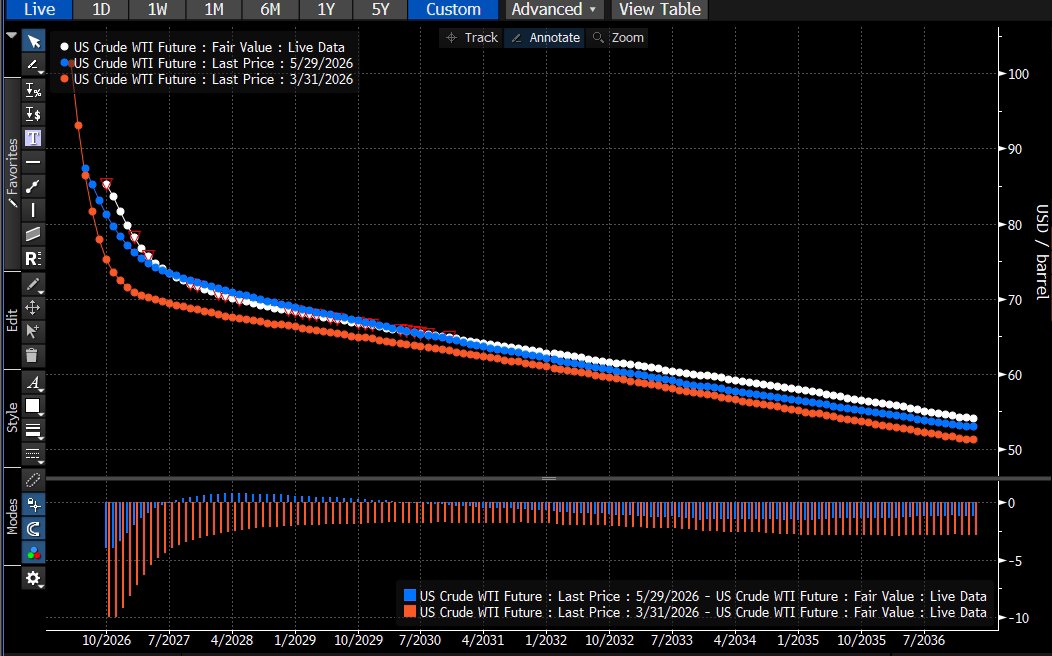
The WTI curve is in deep backwardation. The front price carries a geopolitical risk premium, but every deferred contract is lower: mid-$70s within a year, ~$70 by 2030, low-$50s by 2036.
Markets are not pricing an energy inflation shock. They are pricing a transitory supply scare on top of weak demand, rising non-OPEC supply, and the lagged effect of tight money.
Central banks that panic over a headline oil print will be tightening into a price the market already expects to slump. The curve discounts deep disinflation by year end.
via Bloomberg
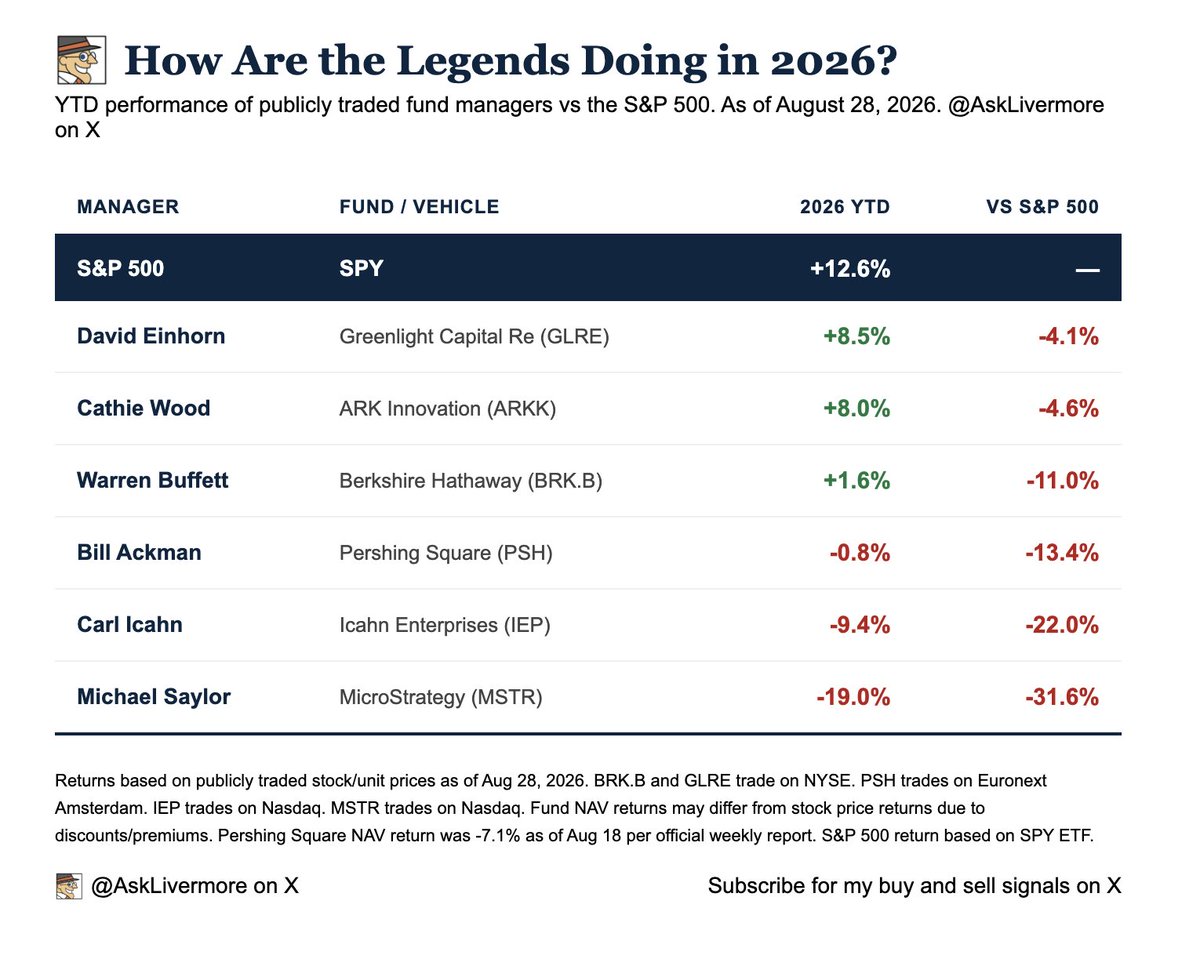
Every single "legend" is losing to the S&P 500 this year.
David Einhorn -4.1%
Cathie Wood -4.6%
Warren Buffett -11.0%
Bill Ackman -13.4%
Carl Icahn -22.0%
Michael Saylor -31.6%
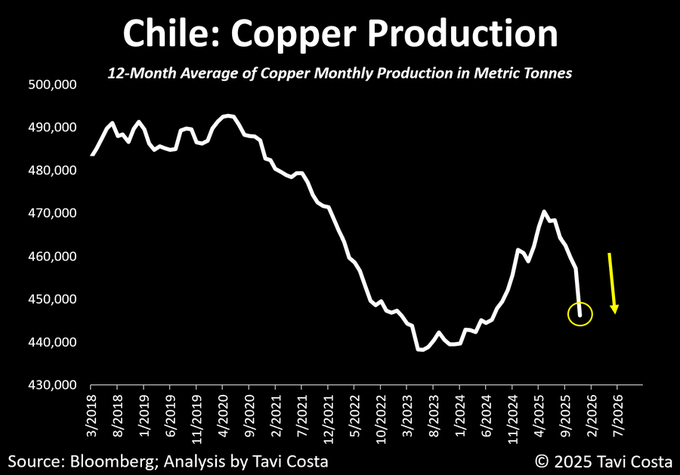
Chile’s copper production is plunging.
- Chile accounts for 24% of global copper production
- Chile’s copper production is expected to peak in 2027
This is one of the key reasons copper deficits are piling up.
The world’s largest copper producer is nearing its peak, just as AI-driven demand for copper remains strong and US plans to reshore it's manufactoring base.
We don't own enough copper for what's coming
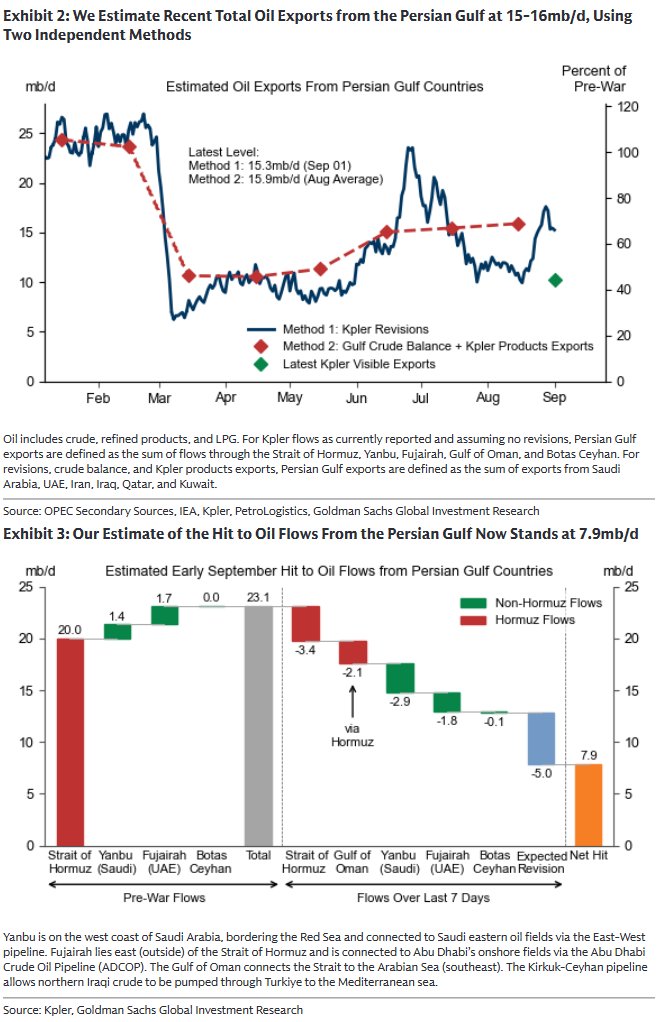
Saudi Arabia's oil flows are being rapidly rerouted:
Saudi Arabia's combined Persian Gulf and Red Sea crude exports averaged just 3.23 million barrels per day over the first 23 days of August, on track for their lowest monthly level since the start of the Iran War.
By comparison, the previous low was 3.65 million barrels per day in the full month of May.
This follows a warning from Yemen's Houthis last month who said they could block shipping through Saudi Arabia's Red Sea route, prompting exporters to shift more shipments away from the port of Yanbu.
Yanbu is located on Saudi Arabia's Red Sea coast in the west and is connected to the Saudi's eastern oil fields via a 746-mile pipeline, allowing crude to bypass the Strait of Hormuz entirely.
As a result, Saudi Arabia is sharply increasing loadings from the Persian Gulf port of Ras Tanura, its largest export conduit, with ~7 million barrels of shipping capacity loaded there on Tuesday alone.
Saudi Arabia’s crude exports remain highly volatile.
There is evidence that US Navy engineers widened and dredged this area between two islands in Oman.
This is now enabling oil tankers to avoid Iran in the Strait of Hormuz.
🚨 The regime overleveraged the Strait of Hormuz, and the war is now forcing the region to rediscover old routes and build entirely new ones designed to make Iran’s geography less powerful.
The passage now attracting attention on the Omani side is Fakk al Asad, between Jazirat Musandam and the Musandam Peninsula.
Despite viral claims, it is not a secret new American canal. Historical records show the passage existed and was used by ships more than a century ago.
That matters because the Islamic Republic spent decades cultivating the idea that it could turn Hormuz into a strategic choke point whenever it wanted. By finally attempting to exercise that leverage on a massive scale, it gave Persian Gulf countries an enormous incentive to find every possible way around it.
Old Omani passages are gaining renewed strategic relevance while Saudi Arabia expands its Red Sea export infrastructure, the UAE builds additional capacity toward Fujairah, and other Persian Gulf states pursue pipelines, ports and overland alternatives that reduce their dependence on Hormuz.
The Islamic Republic weaponized Iran’s geography so aggressively that it accelerated the region’s efforts to design around it.
And unlike a wartime maneuver, those alternative routes will still be there long after the war is over.
🚨Recent satellite imagery suggests that the Department of War has conducted a covert dredging operation to open up a never-before-used shipping corridor through the Omani side of the Strait of Hormuz.
The corridor in question is an approximately 1,600-foot-wide waterway with a natural depth of about 93 feet, meaning that only a small amount of dredging would have been necessary to make it safe for VLCCs (Very Large Crude Carriers).
Worth noting, ships navigating this corridor remain completely outside the Iranian regime’s line of sight due to the Omani island of Jazirat Musandam and the curvature of the Earth.
Follow: @MorseReport