🚨 Calling clinicians across India!
Join #PrAImaan#ValiDATAthon to evaluate AI-generated clinical responses. 🩺
🏅 Hands-on training | Certification | Research opportunities
📍 Ahmedabad, Tumkur, Mysuru, Bengaluru, Eluru & Puducherry
📲 Scan the QR to register!
Many of our lab members work 10 PM to 4 PM, chill during the evenings (except for weekly evening standups) then again work at night post dinner till late night and sleep off.
🚨Update: Alongside existing perks we are also now giving Claude Max (Premium User in Teams) to all on site researchers with us! :)
2 days left to apply! ✌️
🔥Today, we are releasing one of the first visual reasoning benchmarks for autonomous AI diagnosis in healthcare!
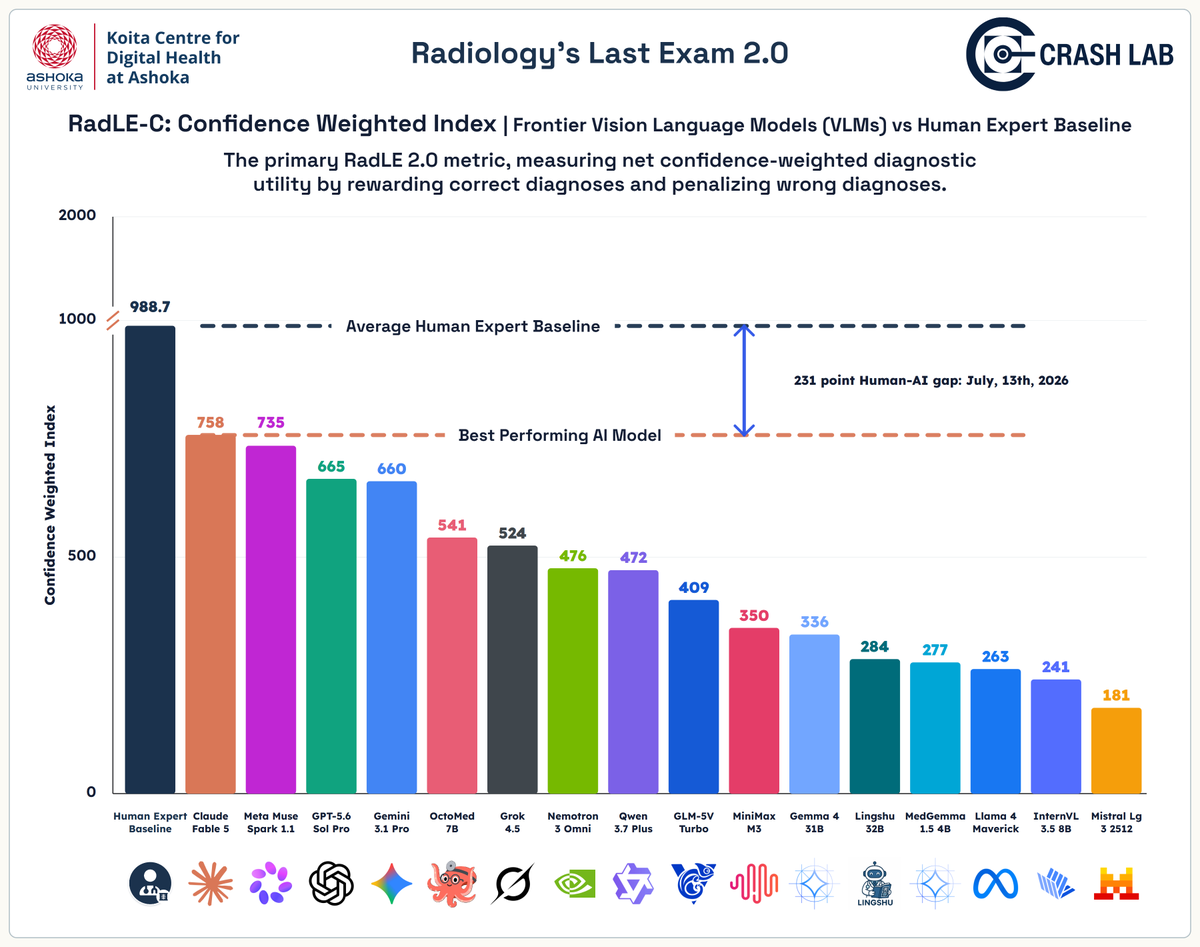
🚀Introducing Radiology’s Last Exam 2.0 (RadLE 2.0) from @CRASHLabAI, an uncertainty-aware benchmark for autonomous diagnosis in radiology!
✅In the last few days, the AI frontier has moved significantly. @OpenAI launched GPT-5.6 Sol. @Meta launched Muse Spark 1.1. @xAI dropped Grok 4.5.
🙌We’ve benchmarked all frontier, open-source and medical VLMs in RadLE2.0 and the leaderboard is now LIVE!
🚨 Before AI models are handed autonomy, one question matters more than any accuracy score: Do they know when to STOP and hand over to a human?
⚠️ A confident wrong diagnosis is far more dangerous than an honest “I don’t know.” Yet most models are bad at admitting the latter!
🚀 We release five RadLE 2.0 Scores: Confidence Weighted, Reliability, Accuracy, Safety and Handover Readiness and we find that models from @OpenAI@AnthropicAI@MetaAI@GoogleDeepMind@xAI@nvidia@Alibaba_Qwen@MistralAI@MiniMax_AI all score very differently as they optimize for different metrics!
🚨But most importantly, NONE of the Models have been able to reach the average human expert baseline!
⚡️A thread on what we found and which models aced our metrics! Link to the leaderboard and technical report at the end of the thread!
🔥TL;DR: Radiology's Last Exam 2.0 releasing this week! Stay tuned!
✅People are increasingly using frontier AI models for healthcare diagnosis. And the promise of autonomous AI systems in healthcare has also surfaced recently.
🚨But unchecked social media hype around AI-reported diagnoses is creating a blind trust in models not cleared by any regulatory body.
🤔Just because your AI chatbot sounds confident does it mean it is accurate?
🙌At @CRASHLabAI, we have been actively asking: Are we truly ready for autonomous healthcare systems? With Radiology's Last Exam (RadLE) 1.0 last year, we tested whether the speculation about doctors becoming obsolete actually holds up. Today's AI genuinely works for many common presentations. Where it falls behind are the rare ones!
🔥This week, as the @AIforGood conference commences in Geneva, with world's AI leaders flying in, we are releasing RadLE 2.0 to benchmark the readiness of autonomous AI agents for radiologic diagnosis.
🚨We believe that a model which gives wrong answers confidently is far more dangerous in medicine than one that admits uncertainty! This week, we are going to share with you whether human beings or AI models win this battle. :)
✅RadLE 2.0 is coming… and you will surely want to see these results! Follow @CRASHLabAI and stay tuned!
🇨🇭P.S. If you are in Switzerland for the Summit or around @EPFL or @ETH Zurich for the next 2 weeks, I will be here and happy to meet!
#RadLE #HealthcareAI #RadiologyAI
🚀India deserves its own open source radiology and medical foundation models, evaluated on Indian data and built by Indian teams. We are hiring clinicians, engineers and researchers to make that happen. 🇮🇳 Please repost to help us reach to the right candidates!
✅At @KCDH_A (Koita Centre for Digital Health at Ashoka University) @AshokaUniv and CRASH Lab, we often get asked whether we are training the next generation of scientists, physicians, and engineers for the healthcare AI boom that is coming, and the debate usually ends with the same conclusion: that AI will create many more jobs but those jobs will demand a different set of skills to use, build and evaluate AI. If we are being honest, we have not been doing enough on this front, which is exactly what we are changing today.
🔥We are expanding our team and opening positions across research, engineering, and clinical roles, all sitting within fully funded projects of national and international scale, where we build India's own open source healthcare foundational models, run large-scale national evaluations, and create the benchmarks for foundational models and agentic workflows that are actually relevant to the Indian setup.
🚨We are hiring Senior Research Fellows, Clinical Evaluation Leads, and AI Evaluation Engineers, and we are grateful to our supporters and collaborators, including @IndiaDST, @gatesfoundation, @FoundationKoita, @NUSingapore, @MSFTResearch, @AarthiScans etc. who are part of this effort!
👇🏽We will be rolling out interviews starting next week, so please apply as soon as you can, because we will be closing positions as suitable candidates come through and all the roles get filled!
🇮🇳This is a chance to be in India and build for India, learning from some of the best people and teams who have built a few of the finest models and evaluation frameworks anywhere, and because it is an academic role, it gives you the experience and exposure to cutting-edge AI research and development from teams who have published across @ScienceMagazine, @Nature, @TheLancet, @NEJM_AI, etc. and hopefully, together, we get to spearhead the healthcare transformation journey for the country!
🧵 Roles below 👇
I recently stepped away from delivering guest lectures at these IIT (n) x [Random Startup] collaboration courses a while ago. The model didn’t sit right with me… ₹30-40k for content that’s often outdated when the cohort even finishes, taught by people who haven’t shipped anything in healthcare AI or done any robust research themselves.
I’ve been thinking about what would actually move the needle for Indian doctors, residents, and medical students trying to make sense of this space. Most are confused and I get requests every day from radiologists asking what is a good course for AI.
But I do not want to offer another certificate to hang on LinkedIn (there are many on Coursera) but genuine literacy that clears doubts of clinicians, spot overhyped tools, and make informed career decisions as AI reshapes practice.
So I’m putting together a small team to build something different: an affordable, modular course that meets people where they are in their AI journey… whether a final-year MBBS student curious about the field or a practicing radiologist trying to figure out AI.
What am I looking for? Unit economics that work. No ₹40k overheads subsidizing fancy production. Enough to ensure that we are able to sustain and continue delivering some value.
Will be starting with foundations. If it delivers value, we build forward with domain experts. If it doesn’t, we learn why.
This is very personal for me as I gave up teaching when I left AIIMS to focus on research full-time… and I’ve missed it more than I expected. If you’re someone who’s passionate about teaching in this space and wants to build something meaningful, feel free to join.
We may fail to compete with big names and associations and may also raise some eyebrows. But the attempt feels necessary.
🚀Thank you to @Googleorg and @OpenAI for their recent support to #CRASHLab at @AshokaUniv as we build benchmarks and advance healthcare AI research in India!🇮🇳
✅We're a small but growing lab (predominantly led by volunteer researchers), and we're grateful for every bit of support along the way.❤️
so let me get this straight
all of ai twitter was telling people to buy a mac mini to run openclaw, which is literally just a framework, an orchestration layer that sends api requests to actual ai models. something you can run on a $5/month vps. which is exactly what i do btw
but when google drops gemma 4, an actual large language model that you can run and fine-tune locally on that same mac mini, with no api costs, no subscriptions, no third party dependencies, completely yours under apache 2.0
the ai community is silent
you were buying $800 hardware to run a wrapper but ignoring the actual ai model that would justify that hardware
this tells you everything you need to know about the average iq of ai twitter
Why Google why?
I am a Google AI Pro user
Till yesterday, Gemini 3.1 Pro (High/Low) quota refreshed every 5 hours. After this announcement, it takes 5 days to refresh
> Gemini 3 Flash now takes 5 hours to refresh
> They added an option to use AI credits but I do not know how they consume
They already removed the 5 hour quota of Claude models for Pro users, and now they did it for their own Gemini model also
🚀 Today we are open-sourcing JMDN, the decentralized network powering @JMDT_Blockchain, the truth layer for verifiable information.
JMDN is built for high-performance peer-to-peer communication, enabling nodes to discover, sync, and propagate data across the network.
The ecosystem leverages Zero-Knowledge Proofs (ZKPs) to enable verifiable data integrity without exposing underlying information.
🔗 Repo: https://t.co/oKkCfJIGvG
We’re inviting the community to explore, test, break, improve, and contribute.
Builders, researchers, and protocol nerds: your ideas and pull requests are welcome.
Node hosting guides and faucet access are coming soon.
#Web3 #Blockchain #ZKP #OpenSource #P2P #JMDT