I don’t think it’s crazy to argue, btw, that LTF should have put its weight behind Bores. Bores was ultimately the centrist on AI. The victor, Lasher, is in fact more radical on AI than Bores. LTF’s “victory” here is that a guy who supports a data-center moratorium won, and the guy who supports frontier transparency and auditing (which LTF now supports!) lost. Is that really a win?
Talk about involution. I do hope the AI-optimist side of this gets its act together.
Thanks to @phutrick for pointing this out to me!
1/5: AI safety advocates worry about AI being too anthropomorphic, or about AI having a personality at all. But what if AI having a robust personality is the solution? Post-training requires persona selection, and personality design could be the way safety guidelines actually stick, the way discretion gets operationalized across every conversation. In my latest, I argue that child safety debates should focus on engineering better AI personalities rather than trying to ban them: 🧵
5/5: This field is socioaffective alignment: the study and engineering of AI personality traits that promote user wellbeing. The interventions that shape AI character are often unintuitive and poorly understood. The work @AmandaAskell and others at @AnthropicAI have done on persona design shows this is serious engineering. We need much more of it. Millions of people already interact with AI regularly and meaningfully. We should be deliberate about what kind of character meets them there.
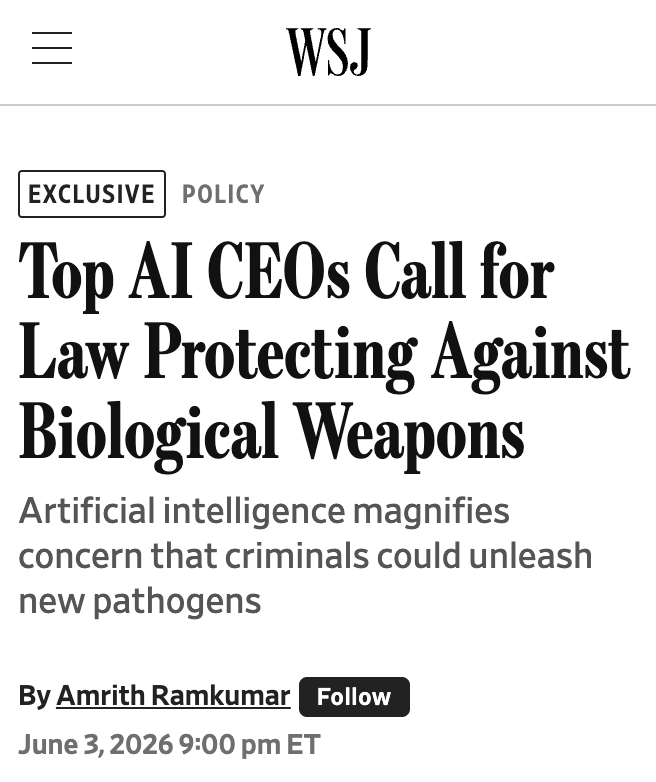
No one should be able to order a bioweapon through the mail.
@IFP & @JoinFAI are proud to co-lead an open letter calling for mandatory DNA synthesis screening & recordkeeping.
Signatories include:
- Sam Altman, CEO & Co-Founder, OpenAI
- Dario Amodei, CEO & Co-Founder, Anthropic
- David Baker, Director, Institute for Protein Design; 2024 Nobel Prize in Chemistry recipient
- Patrick Collison, CEO & Co-Founder, Stripe
- Paul Graham, Founder, Y Combinator
- Demis Hassabis, CEO, Google DeepMind; 2024 Nobel Prize in Chemistry recipient
- Emily Leproust, CEO & Co-Founder, Twist Bioscience
- Lawrence Lessig, Roy L. Furman Professor of Law and Leadership, Harvard Law School
- Gerald W. Parker, former Special Assistant to the President for Biosecurity and Pandemic Response
- Mustafa Suleyman, CEO, Microsoft AI
- Alex Tabarrok, Professor of Economics, George Mason University
- Alexandr Wang, Chief AI Officer, Meta; Founder, Scale AI
- Christine E. Wormuth, President & CEO, Nuclear Threat Initiative; 25th Secretary of the Army
Read the letter and see the full list of signatories: https://t.co/BwZiJXw3JT
Many DNA synthesis companies voluntarily screen orders to mitigate biosecurity risks, but no law requires them to do so.
Leaders in AI, biotech, life sciences, national security, and the nucleic acid synthesis industry agree that Congress should act to strengthen safeguards against biological threats.
@deanwball put it well in the WSJ:
“If you’re synthesizing the stuff that yields biological life and viruses, we’re asking you to screen to see whether it is dangerous in some way. That seems like a reasonable thing for society to insist upon.”
On the denominator question, I guess that’s fair in principle, but Thomas Bloom’s companion paper directly addresses this. He notes the model succeeded by systematically exploring directions humans dismissed as unpromising, not by brute-force guessing. We know the technique itself was novel.
On generalization outside math, I agree we should be cautious, and so does Cal Newport (who wrote about this). And he compared this to CAD software enabling Frank Gehry’s architectural designs. He sees this as a way to augment human creativity (in other words, useful). That framing is miles from “stochastic parrot,” which is what I was pushing back on.
Also, yes, I’m aware this was an OpenAI model, not Claude. I brought up Anthropic’s growth as evidence against the broader “AI bubble” thesis in the article I quote-tweeted.
Can't believe we're doubling down on "it's just a stupid stochastic parrot" when OpenAI disproved a longstanding conjecture in discrete geometry less than 24 hours ago.
We need more Bores's, and less of whatever this is.
Today, Matthew Scherer argues that the most pressing AI-driven crisis is the overestimation of AI’s capabilities and impacts, which has produced a historically large speculative AI bubble.
Today’s announcement from @CommerceGov and @POTUS to invest in quantum computing companies and new quantum foundries is an important step toward securing American leadership in quantum technology development and deployment. @PrinehaN and I outlined our vision of how domestic manufacturing and supply chain security are critical to America’s quantum future. The deals announced today put those ideas in action. Welcome to the quantum moment.
"The umbrella North America’s Building Trades Unions said it hit a record number of members and apprentices in 2025.
"The organization’s president, Sean McGarvey, compared it to the build trades’ expansion in the 1950s. He attributes today’s growth to data centers, power plants and legislation under former President Joe Biden that subsidized the construction of semiconductor and electric vehicle battery factories, energy efficiency projects and grid transmission improvements.
"Data centers’ voracious energy needs are setting off a power plant construction boom and delivering a one-two punch of new life to unions whose members also build and maintain boilers, ductwork, pipelines and other power infrastructure."