We ranked in number 4 which is very sad that we can go for the international competition of ABU Robocon 2023. This year we upgraded alot such as using STM32-CanBus with Minj PC, Program ROS2 and using optimal control NMPC.We decided to public our work here https://t.co/MeQiHIyGcc
Meet Mistral Large 4, aka Le Chonk.
• 1T parameters, natively multimodal. 49B active.
It is the best open weights model from US or Europe on aggregated benchmarks.
• State-of-the-art on critical workloads, including cyber defense, manufacturing and finance and it surpasses closed frontier models on visual grounding.
• Forged in Europe end-to-end and is deployable from Europe via our own Mistral Cloud infrastructure.
• Available to all via API today. Working with cybersecurity partners privately.
Open weights release end of October.
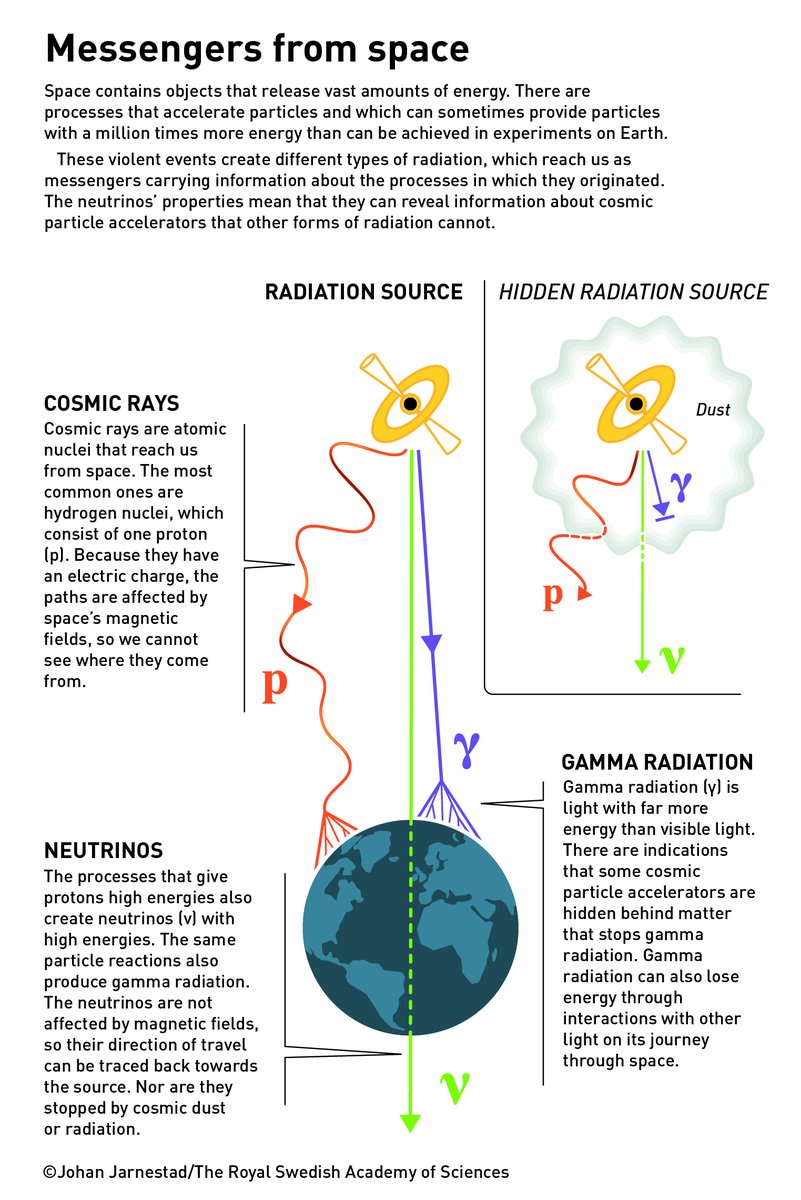
Scientists have long known that the cosmos contains natural particle accelerators, which fire out particles with energies up a million times more than can be achieved in laboratories on Earth. Much about these sources is mysterious: what are they, where are they, and what are the main processes inside them?
Neutrinos with extremely high energies are created in the same environments as other types of particles. However, unlike other particles, neutrinos reach us without changing direction or losing energy. This means they can provide information that is not available in any other way.
Newly awarded physics laureate Francis Halzen first presented his vision for capturing neutrinos at the South Pole in 1988. When a neutrino collides with an atomic nucleus, it produces a flash of light that can be tracked by sensors in the clear glacial ice. The South Pole’s ice has many advantages, as it is free from various types of interference and the area is geologically stable, with no earthquakes. Halzen and his idea soon gained the support of other researchers and, just a few years later, preliminary testing was conducted on sensors in ice.
#NobelPrize
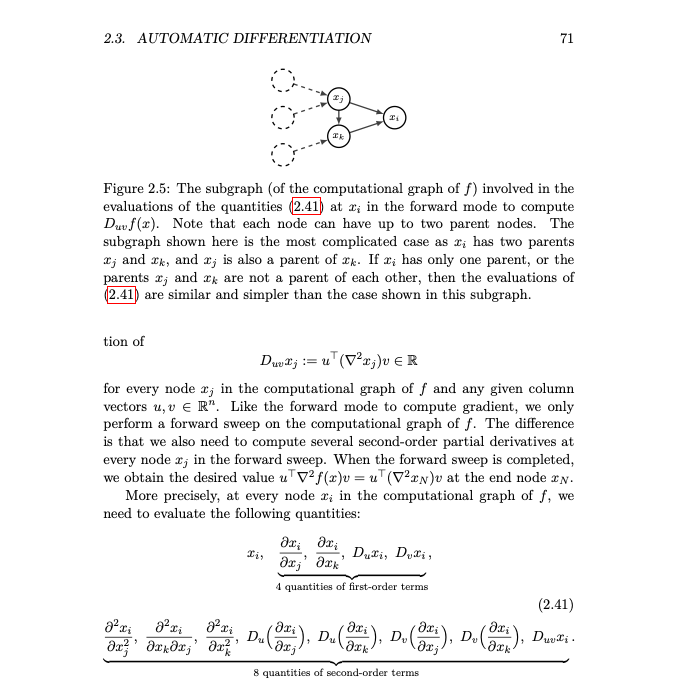
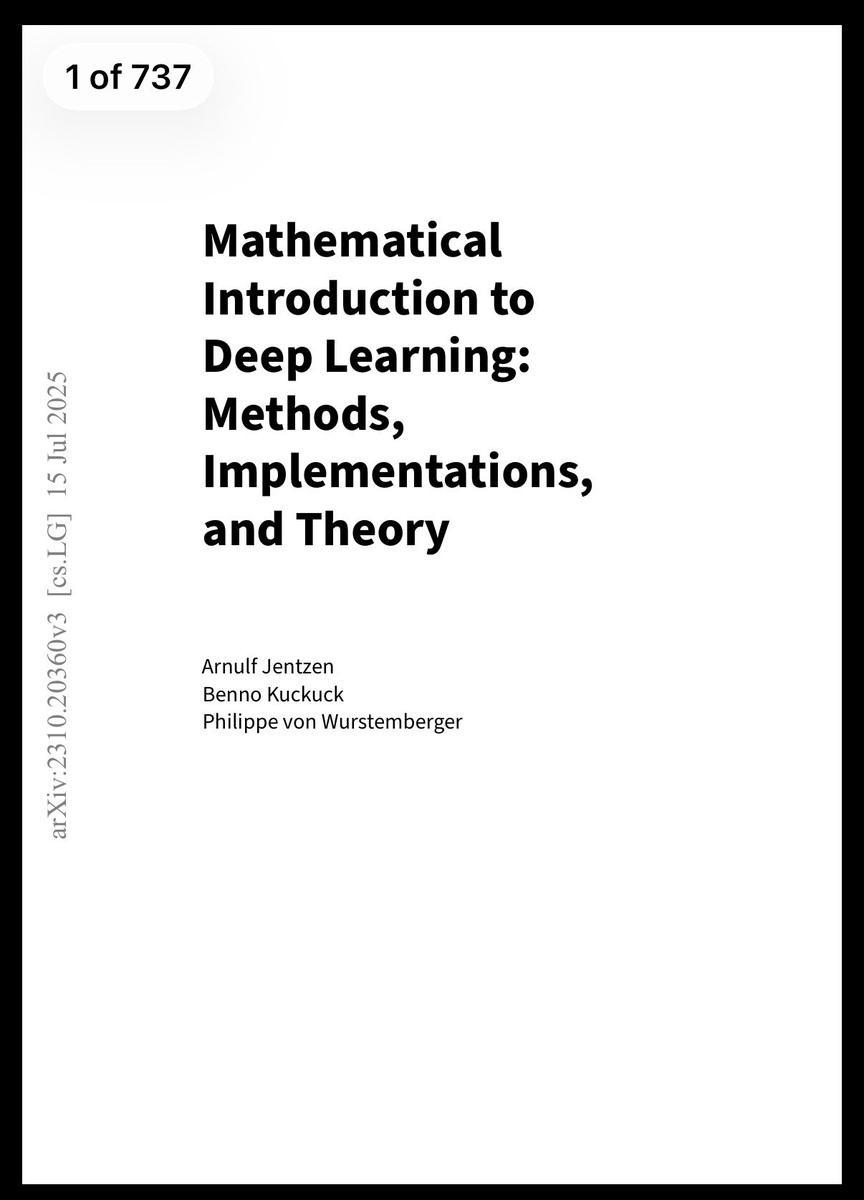
"Mathematical Foundations of Deep Learning: Theory and Algorithms" is one of the most interesting resources I've shared on the mathematical foundations of deep learning. It's a new 2026 book with more than 300 pages dedicated to understanding deep learning from a mathematical perspective.
The materials in this book are organized around several foundational themes, covering deep neural networks and approximation theory, the Universal Approximation Theorem, network architectures and training, automatic differentiation, deterministic and stochastic optimization, reinforcement learning, and Markov decision processes.
An entire chapter is also dedicated to the mathematical foundations of generative models, covering VAEs, GANs, diffusion models, probability density control, and flow matching.
https://t.co/7A75Ii3jv6
Loop Engineering is dying. Graph Engineering is replacing it.
A Chinese developer just explained the shift better than anyone, and most people are still building agents the old way.
The whole thing in 4 points:
→ single-agent loops break because they go "goal blind"
→ a graph has 4 parts: nodes, edges, state, policy
→ 3 topologies run everything: diamond, supervisor, pipeline
→ Anthropic already documented 5 official workflow patterns
The lesson nobody wants to hear: it's not about how many agents you run.
It's about the determinism you build in. Verifiers. Code fallbacks. Reality anchors.
LLMs keep getting bigger. Compute budgets, unfortunately, do not.
This fall @Stanford, we (@AnayMehrotra@gvelegkas and Amin Saberi) are teaching MS&E 319: Efficient Generative Language Models.
The course asks a simple question: given a modeling goal and a limited computational budget, how should we choose the training objective, model architecture, and inference algorithm?
We’ll cover some of the main ideas, and occasionally surprising tricks, that make large language models more efficient, including efficient pre-training, mixture-of-experts architectures, attention and KV-cache compression, quantization, speculative decoding, LoRA, RLHF, DPO, and distillation.
And no, “just buy more GPUs” will not be the only answer.
We’ll try to post all the lecture materials and recordings as the course unfolds.
https://t.co/o7VZOtxkqv
following some requests, i’ve open-sourced my GPT-6 Astra robotics experiments (MuJoCo environments, controllers, and recorded runs):
https://t.co/2D0wE2IhGT
After co-inventing ChatGPT, I kept asking myself: why have superhuman chat models not led to AGI?
I’ve spent the last 2 years in stealth building a new way to train models (RLCD), and a new type of frontier AI model that we are releasing today: Jev
• 20-200x faster
• 40-400x cheaper (w/ output tokens free)
• Frontier composable intelligence optimized for decisions
AFAICT the shortest path to AI-based economic revolution
An Introductory Course to World Models, 23 lectures
Free> Get all the Interactive HTMLs, Slides (PDF) & and collection of resources https://t.co/X0mXy9Dmh7
Explore this huge curated collection of some of the best mathematics books ever written — spanning classical foundations, probability, analysis, geometry, and problem-solving texts used by mathematicians, scientists, engineers, and AI researchers: https://t.co/7ixaFw1vfi
The list is organized by these topics:
Math
Machine Learning
Physics
Econometrics
Optimization
Information Theory
Signal Pprocessing
History
Probability
ETH Zurich just open-sourced their entire 2026 robot learning course.
Not a MOOC. The actual course. Slides, lecture recordings, coding assignments, GitHub repo.
The curriculum goes from imitation learning and RL all the way to Vision-Language-Action models and foundation models for robotics.
Guest lectures from the co-founder of Physical Intelligence. The creator of Diffusion Policy. Pieter Abbeel. Dieter Fox.
12 weeks. Free. No signup.
Taught by Oier Mees and the team at ETH Zurich.
If you want to understand where robot intelligence is actually heading… this is the reading list the field is using right now.
📍[https://t.co/eKsIjILi60]
——
Weekly robotics and AI insights.
Subscribe free: https://t.co/9Nm01QUcw3
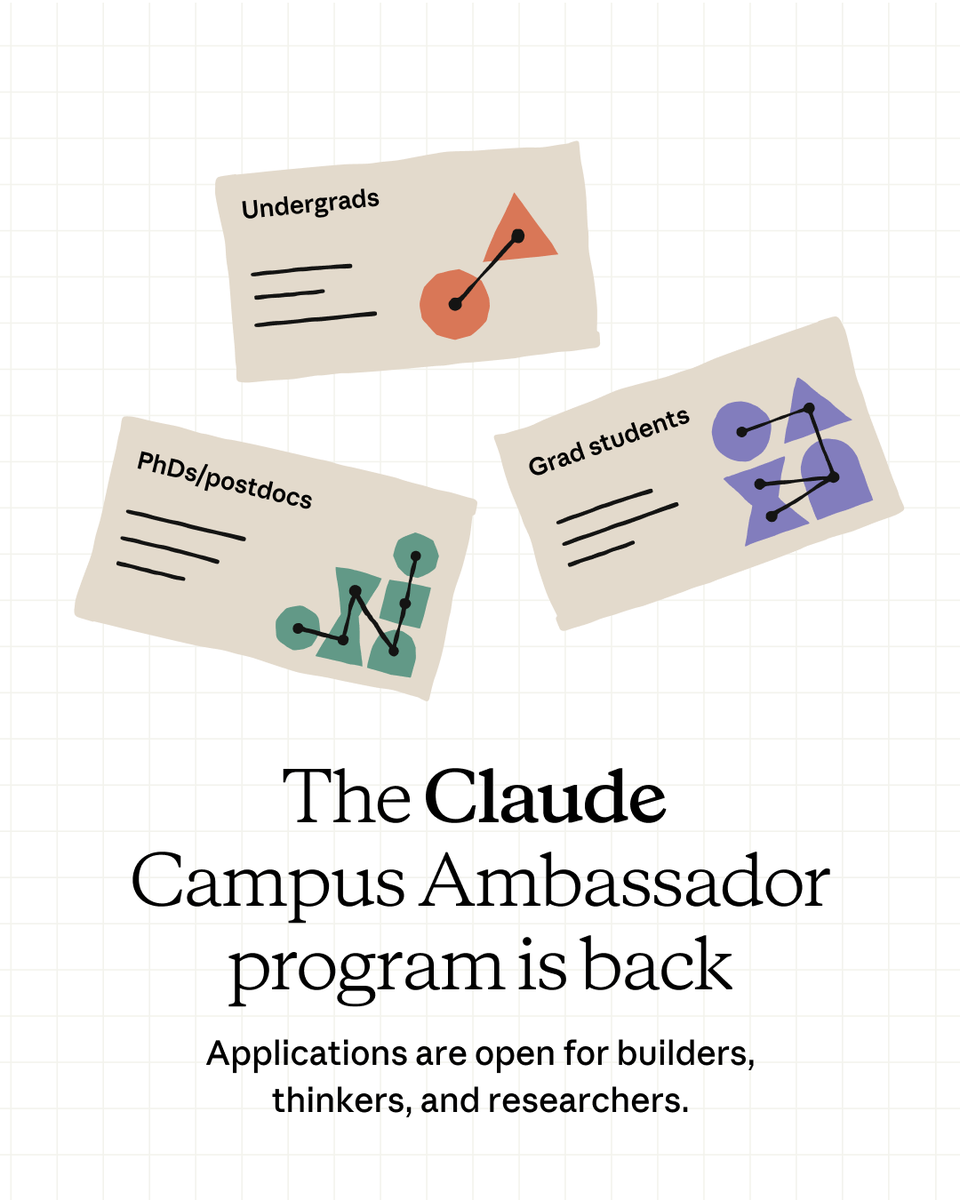
Applications are open for the Claude Campus Ambassadors program. This year, we’re expanding opportunities to more students, with three tracks for undergrads, graduate students, and PhDs/postdocs.
Apply here: https://t.co/h8X1D0TZv7











![KirkDBorne's tweet photo. Foundations of Large Language Models: https://t.co/wZmeFmRqgY [277-page PDF] https://t.co/bk4gj059Qy](https://pbs.twimg.com/media/HSN_XDzXgAANLdZ.jpg)
![IlirAliu_'s tweet photo. ETH Zurich just open-sourced their entire 2026 robot learning course.
Not a MOOC. The actual course. Slides, lecture recordings, coding assignments, GitHub repo.
The curriculum goes from imitation learning and RL all the way to Vision-Language-Action models and foundation models for robotics.
Guest lectures from the co-founder of Physical Intelligence. The creator of Diffusion Policy. Pieter Abbeel. Dieter Fox.
12 weeks. Free. No signup.
Taught by Oier Mees and the team at ETH Zurich.
If you want to understand where robot intelligence is actually heading… this is the reading list the field is using right now.
📍[https://t.co/eKsIjILi60]
——
Weekly robotics and AI insights.
Subscribe free: https://t.co/9Nm01QUcw3](https://pbs.twimg.com/media/HReL_DmWIAI7iFg.jpg)