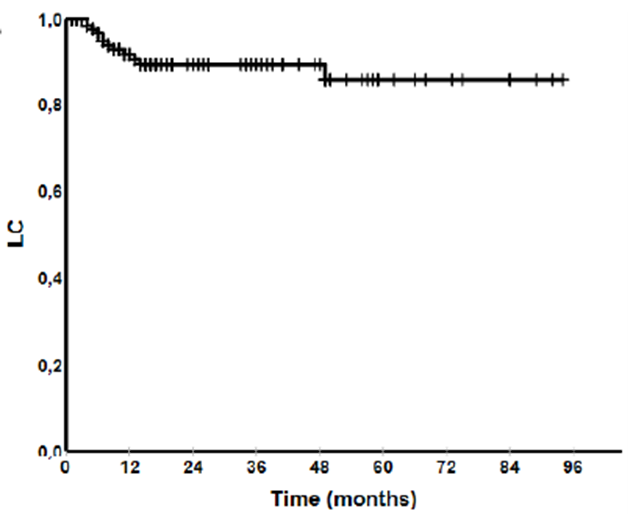
Is 25Gy/5 to post-op cavity after resection brain met effective?
Yes, according to this study
~90% LC at 1 and 4 years
Symptomatic Radiation Necrosis 3%
Fantastic Gray Zone case and commentaries that touch on the key issues in managing esthesioneuroblastoma.
A Scent of Doubt: The Dilemmas of Adjuvant Therapy in Esthesioneuroblastoma - International Journal of Radiation Oncology, Biology, Physics
https://t.co/pCysgmaTnM
🚨Hungry for a new α/β study?🚨
🧪📉 We often quote α/β ratios in clinic as if they’re fixed truths — but where do those numbers actually come from?
This study compared in vitro vs. clinical α/β estimates across prostate, breast, and head & neck cancers and...
... they often do NOT match.
Key findings:
📍Prostate: in vitro α/β ~3.8 Gy vs clinical ~2.3 Gy
🦀Breast: fairly similar (~3.6-3.9 Gy)
🗣️H&N: clinical estimates actually HIGHER than lab estimates (~14 vs 9 Gy)
Why it matters for everyday radonc 👇
⚠️ The “standard” α/β assumptions we use for BED/EQD2 calculations, hypofractionation discussions, and protocol design may oversimplify real tumors.
🧬 Tumor heterogeneity, hypoxia, stem-cell populations, ADT, and the tumor microenvironment likely make clinical tumors behave very differently from cell lines grown in a dish.
💡 Practical takeaway:
When we debate fractionation schedules or compare regimens, remember that the radiobiology behind those BED calculations is probably messier than the spreadsheet suggests.
The paper also reinforces that the classic “10 Gy for most tumors” assumption likely doesn’t hold true for many disease sites. 📚
https://t.co/5JOWRK6G6d
@ASTRO_org
Enjoy the Symposium on Adaptive Radiotherapy during next @SEOR_ESP annual meeting in Alicante,June 5th !! Happy to meet Spanish coll. and exchange experiences of advanced radiation oncology with this international panel. @GenesisCareES@fcounago@DrewMoghanaki@MikeChuongMD
El ensayo HEAT confirma que la #SBRT (36.25 Gy en 5 fracciones) es no inferior a la radioterapia hipofraccionada convencional en cáncer de próstata de bajo-intermedio riesgo, con menos toxicidad GI aguda y más cómoda para el paciente.
¡La #AHRT sigue ganando terreno!
#ESTRO26
#ESTRO26
Happy to be attending the annual European meeting @ESTRO_RT to showcase our work as a #headneckcancer#NasopharyngealCancer community working TOGETHER to improve care for our patients
💪🏻💪🏻💪🏻
Glad to see a packed audience at 8AM on D3 of the conference
Absolutely terrific work by @DrSymYoung to report the long-term outcomes of our INRT experience from two prospective trials (INRT-AIR and DARTBOARD).
Short version: with long-term follow-up (median 5.2 years for INRT-AIR, 3 years for DARTBOARD), we've seen zero solitary elective nodal recurrences.
Longer version: ESTRO has highlighted novel approaches to managing the elective neck in HNSCC, and I believe the future will be very different than the present. Current ENI fields deliver the majority of the integral dose to patients and contribute substantially to critical structures (swallowing and xerostomia OARs). Minimizing ENI dose and volume may meaningfully improve the short- and especially long-term tolerance of radiotherapy.
A few more thoughts on our INRT paradigm below:
#ESTRO26 - 📣 FASTRACKII final results, median F/U of 5 years. Thank you patients, funders, investigators - #kidneycancer#kcsm
1) 100% Local Control: No local recurrences were observed at 36, 60, or 84 months.
2) 100% Cancer-Specific Survival
3) Grade 3 AEs remain at 10%
Dose–volume effects link multiple cerebral substructures to cognitive decline. Neurocognitive toxicity reflects distributed network injury beyond the hippocampus.
@ESTRO_RT CNS focus group on @RO_GreenJournal https://t.co/JptGO6G4zu
We present our results with the single fraction in NSCLC and lung metastases. We highlight the excellent results and convenience in an aging population with comorbidities and geographically dispersed. #ESTRO26#SABR
🎯 100% Local Control & 100% Cancer-Specific Survival. Long-term results of the FASTRACK II trial primary #kidneycancer.
✅ No local failures or cancer deaths
✅ Safe for high-risk/inoperable patients
✅ Kidney function preserved long-term
#ESTRO26#RadOnc#SABR@_ShankarSiva
iENE es útil (especialmente por su alta especificidad), pero no es perfecto.
La correlación con pENE sigue siendo moderada y hay muchos falsos negativos.
Necesitamos criterios estandarizados (HNCIG) y más datos para integrarlo de forma fiable en las decisiones clínicas. #ESTRO26
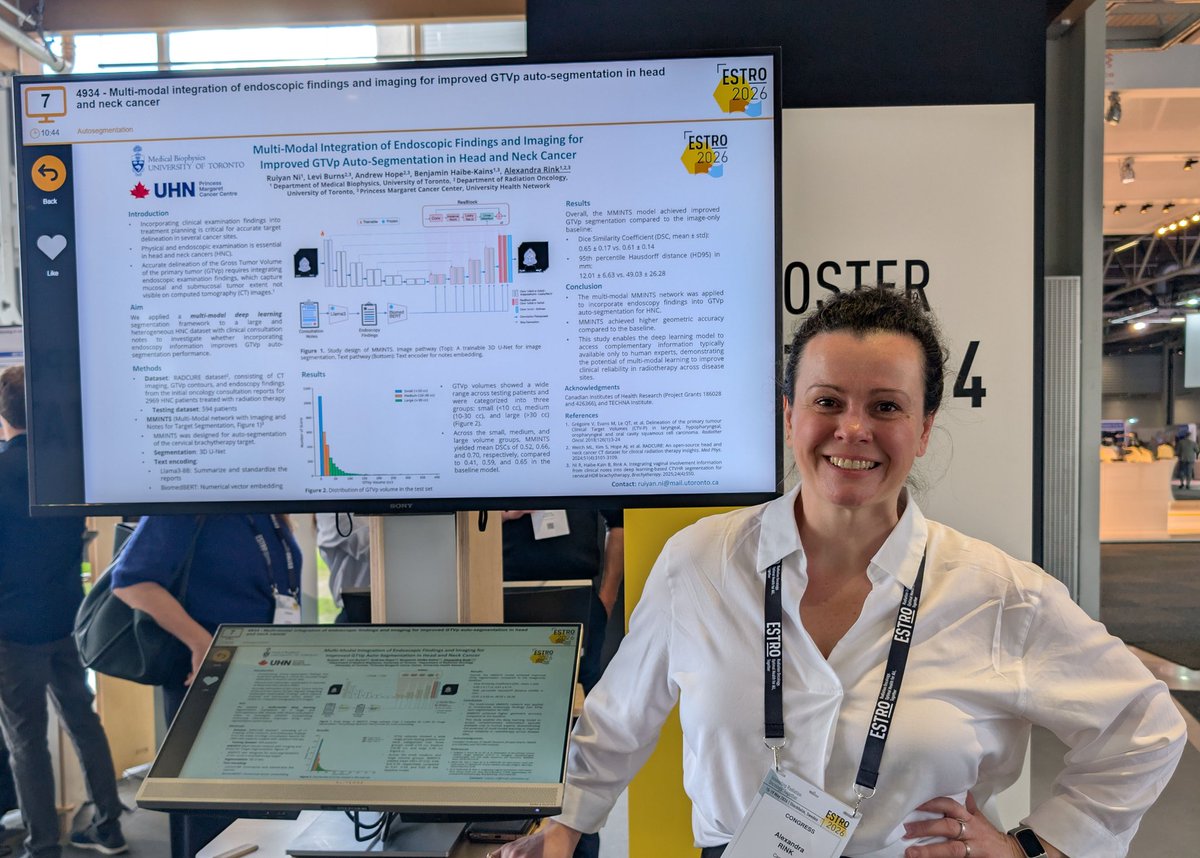
Presenting @ruiyan_ni's poster on using LLM and multi-modal architecture to augment radiotherapy target volume. Adding clinical findings, such as endoscopy notes, appears to improve volumetric accuracy of target volumes for Head & Neck cancers.
#ESTRO2026@RadMedPM@UofTDRO
20 años de EORTC 22922: Irradiar cadena mamaria interna + supraclavicular reduce mortalidad por cáncer de mama (22,4% → 18,6%), pero aumenta mortalidad no oncológica (15,8% → 20,4%). Sin beneficio en SG. Mismos resultados en pN0. RT moderna podría cambiarlo. #ESTRO26#BCSM
New in #practicalRO: A Case-Based Guide: Demonstrating the ReCOG Consensus for Dosimetric Assessment and Reporting in Reirradiation. #radonc https://t.co/54Ohj7vGhz


![OncoAlert's tweet photo. Day TWO of #ESTRO26 Coverage by OncoAlert 🚨
De-intensification of postoperative radiotherapy in HNSCC by omitting contralateral elective neck irradiation– long term outcomes of the DIREKHT trial Presented by Charlotte Frei 🇩🇪
#RadOnc ☢️
The DIREKHT trial is a prospective multicentre phase II trial investigating de-intensified risk-adapted radiation in patients with newly diagnosed, non-metastatic HNSCC after surgery. A total of 140 patients were included in the analysis. After five years, overall locoregional recurrence rate was 6.0% (95% CI [1.9; 9.9]). Cumulative incidence of locoregional recurrence was 3.0% (95%-CI [0.1; 5.8]). Details on recurrence patterns and dysphagia rates are presented at ESTRO 2026.
@ESTRO_RT
@yasemin09896924
@LindaMrissa
@christian_roenn
@Valeriadionisi
@gerryhanna
@clchiang_hk
@mtugceyilmaz
@B_Tomasik
@gmpetrianni
@CiroFranzese1
@Atem84
@piet_ost
@brachyexpert
@BlanceS90
@The_PT_Explorer
@BarbaraJereczek
@Mat_Guc
@ZilliThomas
@AnnaKirby17
@PBlanchardMD
@achoud72
Pinging OA faculty
@MKnoll_MD
@_ShankarSiva
@Icro_Meattini
@seanmmcbride
@NiuSanford
@nataliagandur
@acampsmalea
@to_be_elizabeth](https://pbs.twimg.com/media/HIbrg-HWUAAvxYR.jpg)
![OncoAlert's tweet photo. Day TWO of #ESTRO26 Coverage by OncoAlert 🚨
De-intensification of postoperative radiotherapy in HNSCC by omitting contralateral elective neck irradiation– long term outcomes of the DIREKHT trial Presented by Charlotte Frei 🇩🇪
#RadOnc ☢️
The DIREKHT trial is a prospective multicentre phase II trial investigating de-intensified risk-adapted radiation in patients with newly diagnosed, non-metastatic HNSCC after surgery. A total of 140 patients were included in the analysis. After five years, overall locoregional recurrence rate was 6.0% (95% CI [1.9; 9.9]). Cumulative incidence of locoregional recurrence was 3.0% (95%-CI [0.1; 5.8]). Details on recurrence patterns and dysphagia rates are presented at ESTRO 2026.
@ESTRO_RT
@yasemin09896924
@LindaMrissa
@christian_roenn
@Valeriadionisi
@gerryhanna
@clchiang_hk
@mtugceyilmaz
@B_Tomasik
@gmpetrianni
@CiroFranzese1
@Atem84
@piet_ost
@brachyexpert
@BlanceS90
@The_PT_Explorer
@BarbaraJereczek
@Mat_Guc
@ZilliThomas
@AnnaKirby17
@PBlanchardMD
@achoud72
Pinging OA faculty
@MKnoll_MD
@_ShankarSiva
@Icro_Meattini
@seanmmcbride
@NiuSanford
@nataliagandur
@acampsmalea
@to_be_elizabeth](https://pbs.twimg.com/media/HIbrg9GW4AEY1X2.jpg)
![OncoAlert's tweet photo. Day TWO of #ESTRO26 Coverage by OncoAlert 🚨
De-intensification of postoperative radiotherapy in HNSCC by omitting contralateral elective neck irradiation– long term outcomes of the DIREKHT trial Presented by Charlotte Frei 🇩🇪
#RadOnc ☢️
The DIREKHT trial is a prospective multicentre phase II trial investigating de-intensified risk-adapted radiation in patients with newly diagnosed, non-metastatic HNSCC after surgery. A total of 140 patients were included in the analysis. After five years, overall locoregional recurrence rate was 6.0% (95% CI [1.9; 9.9]). Cumulative incidence of locoregional recurrence was 3.0% (95%-CI [0.1; 5.8]). Details on recurrence patterns and dysphagia rates are presented at ESTRO 2026.
@ESTRO_RT
@yasemin09896924
@LindaMrissa
@christian_roenn
@Valeriadionisi
@gerryhanna
@clchiang_hk
@mtugceyilmaz
@B_Tomasik
@gmpetrianni
@CiroFranzese1
@Atem84
@piet_ost
@brachyexpert
@BlanceS90
@The_PT_Explorer
@BarbaraJereczek
@Mat_Guc
@ZilliThomas
@AnnaKirby17
@PBlanchardMD
@achoud72
Pinging OA faculty
@MKnoll_MD
@_ShankarSiva
@Icro_Meattini
@seanmmcbride
@NiuSanford
@nataliagandur
@acampsmalea
@to_be_elizabeth](https://pbs.twimg.com/media/HIbrg71XcAAxgrj.jpg)






![OncoAlert's tweet photo. Day TWO of #ESTRO26 Coverage by OncoAlert 🚨
De-intensification of postoperative radiotherapy in HNSCC by omitting contralateral elective neck irradiation– long term outcomes of the DIREKHT trial Presented by Charlotte Frei 🇩🇪
#RadOnc ☢️
The DIREKHT trial is a prospective multicentre phase II trial investigating de-intensified risk-adapted radiation in patients with newly diagnosed, non-metastatic HNSCC after surgery. A total of 140 patients were included in the analysis. After five years, overall locoregional recurrence rate was 6.0% (95% CI [1.9; 9.9]). Cumulative incidence of locoregional recurrence was 3.0% (95%-CI [0.1; 5.8]). Details on recurrence patterns and dysphagia rates are presented at ESTRO 2026.
@ESTRO_RT
@yasemin09896924
@LindaMrissa
@christian_roenn
@Valeriadionisi
@gerryhanna
@clchiang_hk
@mtugceyilmaz
@B_Tomasik
@gmpetrianni
@CiroFranzese1
@Atem84
@piet_ost
@brachyexpert
@BlanceS90
@The_PT_Explorer
@BarbaraJereczek
@Mat_Guc
@ZilliThomas
@AnnaKirby17
@PBlanchardMD
@achoud72
Pinging OA faculty
@MKnoll_MD
@_ShankarSiva
@Icro_Meattini
@seanmmcbride
@NiuSanford
@nataliagandur
@acampsmalea
@to_be_elizabeth](https://pbs.twimg.com/media/HIbrg-lWkAAK1bp.jpg)





