JAWLP is the first law journal to publish on the greater Web3 space; formerly the Journal of Blockchain Law & Policy, its coverage has expanded to include AI.
📚 The Stanford Journal of Blockchain Law & Policy just published Vol. 9, No. 2, featuring three new papers from the Kleros-Stanford Symposium on Decentralized Justice and AI.
Peer-reviewed research on what arbitration becomes when AI agents and tokenized real-world assets move onchain ↓
Really enjoyed reading these! I actually submitted here myself a while back, and there's so much great work going up. Loved @ProfVyas piece and Bahadir Köksal's research in particular. Now I really need to dig into the research on blockchain/AI automation ↔ state authority.
The new edition of the Stanford Journal of Blockchain Law & Policy is out!
Including papers from the Kleros-Stanford Symposium Series on the convergence between AI and decentralized justice.
Read it now! 👇
My article Fairness by Design: Verifiable Execution in On-Chain Markets was published in the @Stanford_JBLP this week.
Last month, the @SECGov proposed rescinding Rules 611 and 610(e) and asked for public comment on how markets can achieve fair and competitive execution. I think this is a real opportunity for crypto to show how it represents a real improvement over traditional market structure.
When I worked on Best Execution cases at the SEC, it was notoriously hard to investigate and prove. We had to reconstruct what happened after the fact from fragmented order, routing, pricing, and execution data to determine whether a broker had exercised reasonable judgment under the circumstances.
That experience inspired the question behind this article: what would market fairness look like if execution quality were easier to observe and verify in the first place?
On-chain markets offer an important technological advance. Transactions occur on shared infrastructure, market states and execution paths can be independently examined, and auctions, routing systems, sequencing mechanisms, and cryptographic attestations can make aspects of execution transparent, auditable, and sometimes provable.
This matters because on-chain markets aren't simply reproducing traditional finance on different rails. They present the possibility of a better model: one that relies less on costly reconstruction and burdensome compliance programs and more on direct, verifiable evidence of how execution occurred. My article examines some of the promising design innovation happening on Ethereum and Solana today.
At a moment when the SEC is reconsidering core elements of Regulation NMS, it is worth paying attention to the ways on-chain markets may already be solving problems the traditional system has struggled with for decades.
What does “best execution,” a foundational duty in our capital markets, mean when execution is transparent and programmable by default?
Pleased to share that the Stanford Journal of Blockchain Law & Policy (@Stanford_JBLP), which I've long admired for its policy analysis of emerging technologies, will be publishing my paper, Fairness By Design: Verifiable Execution in On-Chain Markets, as a peer-reviewed Article in its next bi-annual issue.
So much talk of on-chain capital markets focuses on speed, cost, and efficiency. I wanted to spur deeper discussion of fairness and integrity - in some ways the harder, but equally important, issue confronting the transition to tokenized equities markets. My paper explores how experiments in verifiable execution are showing how on-chain markets can achieve these important policy goals via the unique properties of decentralized, blockchain-based systems themselves. 👇
Currently, there's the "Kleros-Stanford Symposium Series" open, a call for papers on decentralized justice and AI: interactions, tensions and synergies.
A great opportunity to have your research showcased in one of the top journals in our industry! 👇
https://t.co/F3NKAysCP5
Super happy my most recent paper on "A Developer Theory of Disclosure" is finally out and published in @Stanford's crypto and blockchain law journal.
The idea was super simple: developers and consumers share some really important interests and priorities. Let's make the most of it.
📚 New read in the Stanford Journal of Blockchain Law & Policy: “Universal Digital Law Codex (UDLC).”
Big idea: Web3 is borderless, but the legal layer isn’t: “code is law” doesn’t handle enforceability, jurisdiction, or due process.
@Kleros_io is glad to support JBLP alongside the @ethereumfndn.
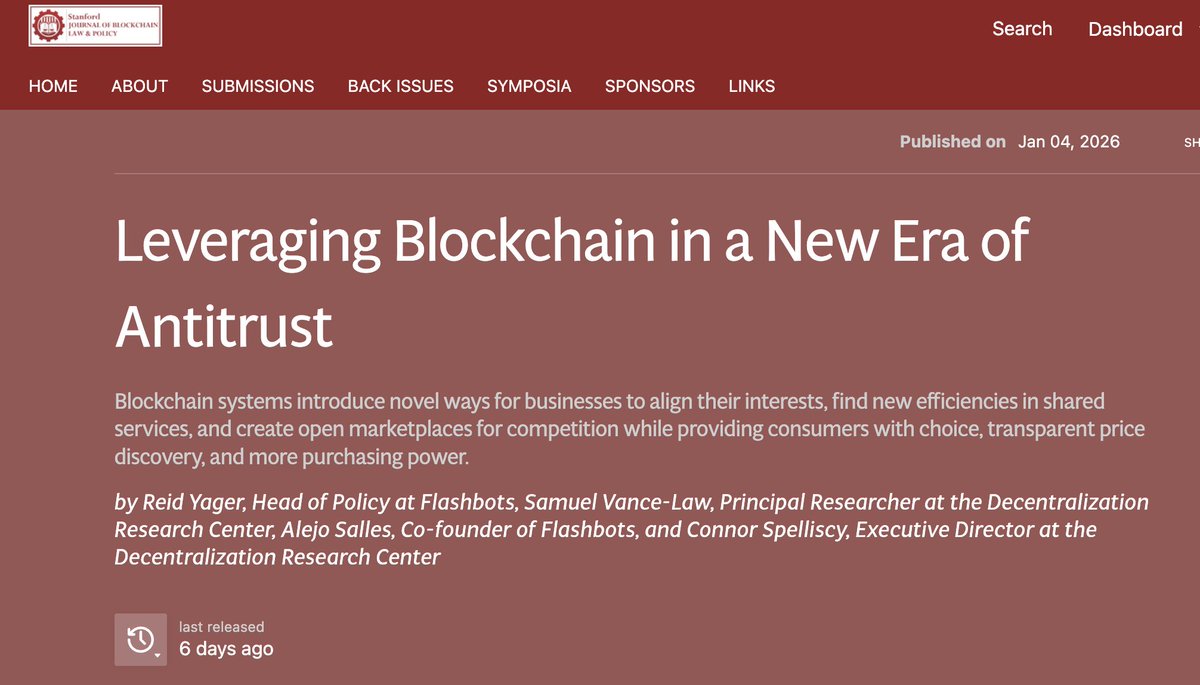
"Leveraging Blockchain in a New Era of Antitrust," our new comment out in @Stanford_JBLP in collaboration with Flashbots.
@0xYager, @samuelvancelaw, @fiiiu_, @c_spelliscy
A big thanks to @steve_s_nam and the whole team at Stanford.
https://t.co/D5x7bnFmUF
🎓 @Stanford_JBLP published our foundational work on Decentralized Justice.
Now, together with @ethereumfndn, we’re proud to join forces with the Journal to support the next wave of peer-reviewed research in the intersection between blockchain and law. ↓
LAUNCHING THE KLEROS-STANFORD SYMPOSIUM SERIES!
Call for Papers at @Stanford_JBLP:
"Decentralized Justice and Artificial Intelligence: Interactions, Tensions, and Synergies."
A new interdisciplinary platform exploring how blockchain and AI are reshaping governance.🧵👇
1/ We’re delighted to announce that Kleros is partnering with the Stanford Journal of Blockchain Law & Policy (@Stanford_JBLP), the first academic law journal dedicated to the blockchain ecosystem. 🧵👇
https://t.co/uqztJWvyFG