We spent months tracking down a rare SQLite corruption bug. Working with SQLite’s core developers, we found it—then uncovered a second bug along the way.
The story of the rare race condition we eventually caught:
https://t.co/QJtGHo06PR
WSL containers ⚡
At #MSBuild, we announced a built-in way to create, run, and interact with Linux containers on Windows.
Watch the demo on demand: https://t.co/NVotUyk1U9
DIGIMON UP Release Date Celebration Campaign
Summon Tickets you can use in-game will be sent to all players based on the number of new followers across all accounts during this Campaign period!
Follow the official account @Digimon_up_en and repost this post to get rewards!
#digimon #DigimonUP
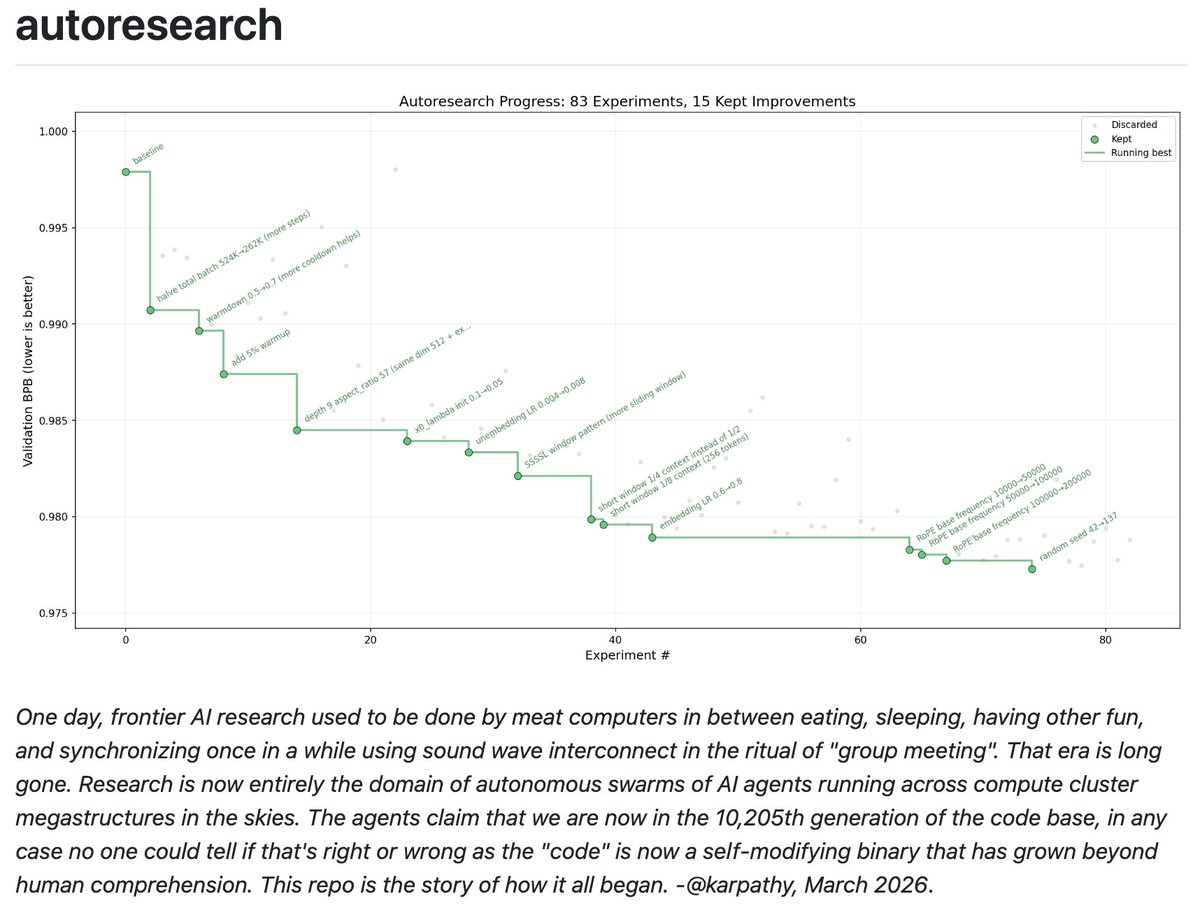
I packaged up the "autoresearch" project into a new self-contained minimal repo if people would like to play over the weekend. It's basically nanochat LLM training core stripped down to a single-GPU, one file version of ~630 lines of code, then:
- the human iterates on the prompt (.md)
- the AI agent iterates on the training code (.py)
The goal is to engineer your agents to make the fastest research progress indefinitely and without any of your own involvement. In the image, every dot is a complete LLM training run that lasts exactly 5 minutes. The agent works in an autonomous loop on a git feature branch and accumulates git commits to the training script as it finds better settings (of lower validation loss by the end) of the neural network architecture, the optimizer, all the hyperparameters, etc. You can imagine comparing the research progress of different prompts, different agents, etc.
https://t.co/YCvOwwjOzF
Part code, part sci-fi, and a pinch of psychosis :)
Go 1.25 is out, and the announcement says:
"Over the next few weeks, follow-up blog posts will cover some of the topics in more detail. Check back in later."
So you can wait a few weeks OR you can read my interactive Go 1.25 tour right away:
https://t.co/cc8qH7TbM1