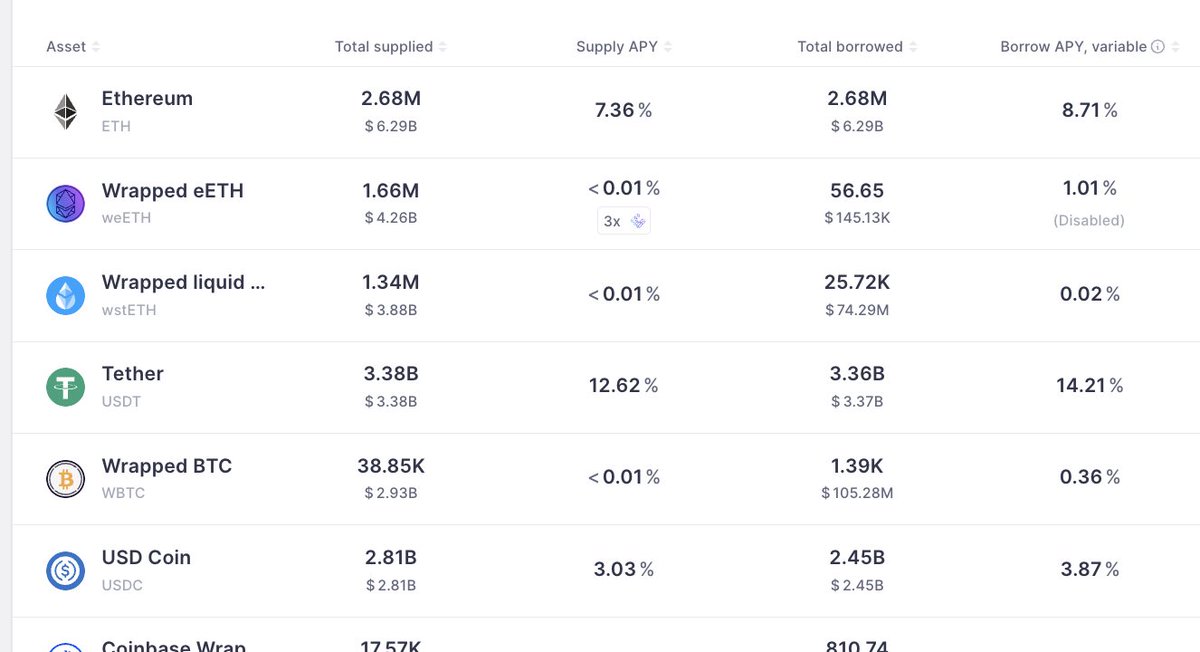
with stablecoin markets beginning to become illiquid, the situation is now entering a more dangerous stage imo
to break down the driving factors:
the ETH market is ~16.5% backed by rsETH, and rsETH backed loans could see up to 10-15% haircut in emode if losses are socialized equally on mainnet & external chains, leaving 2-3% residual haircut for ETH suppliers after wiping out umbrella
ETH suppliers are naturally incentivized to get out ASAP to avoid this, so utilization is pinned at 100%, and borrow rates are not high enough to incentivized repayment of unrelated LST loops (wstETH, weETH) to free up liquidity
because it is impossible to withdraw ETH, users borrowing stables like USDT against ETH collateral cant unwind their position even when the rates for stablecoin borrowing start to spike, which severs the typical incentives scheme keeping these markets healthy
now we have 2 unhealthy incentives based on the markets becoming locked at 100% utilization
1) ETH holders cannot unwind their positions to maintain healthy LTVs, and liquidators cant withdraw/sell collateral to close positions atomically, meaning that ETHUSD price drop could potentially cause bad debt
2) users supplying USDT have a perverse incentive to max-borrow other stablecoins as a way of exiting, the position has positive carry (for now) so the optionality has low cost, while if conditions worsen they can get at least 75% of their position value out of the market
bottom line is, for these pooled/rehypothecated lending markets to function properly, liquidity must be preserved AT ALL COSTS. recent slope2 changes nerfing Aave's max borrow rates are having a negative effect and significantly increasing the risk of cascading market failure
Perp DEXs - The Financial Supercenters of the Internet Economy
Perp DEXs are not just another flavor of crypto exchange. They are the financial supercenters of the internet economy. The TAM is so insanely large that it blows my mind every time I sit down and think about it.
From Wall Street to On-Chain Supercenters
Financial supercenters already exist in the physical world. Think WallSt/NYC, London, Dubai, Hong Kong, and Singapore. These places are magnets for capital and talent because they centralize liquidity, information, and access.
Now zoom out. In the on-chain world, the equivalent is the perp DEX. Each perp DEX is one of several superclusters of liquidity that will exist on-chain in the future. These will be the beating hearts of the global digital economy.
Who Will Access Them?
Commercial businesses, whether they are apps, appchains, or entire DAOs, will access these hubs to:
- issue tokens
- invest cash into yield-bearing strategies
- borrow and lend against their assets
- hedge risks just like corporates do today with futures and swaps
- borrow and lend against their assets.
At the same time, speculators and arbitrageurs will continuously interact with these markets, compressing spreads, creating efficiency, and deepening liquidity.
The attractiveness of one supercenter over another will come down to the "costs" of accessing liquidity:
1) price (fees, spreads, slippage, cost of capital)
2) size + immediacy (how much size can be executed without moving the market)
3) risk of information slippage
4) ease of access (execution complexity, onboarding)
The winners will be the superclusters that provide the most choice while reducing these costs.
TAM: You Are Not Bullish Enough
When I say the TAM here is large, I don’t mean a 10x. I mean orders of magnitude larger. Think about it this way: the TAM for perp DEXs is equal to the TAM of all financial businesses combined:
- brokerages like Robinhood, Schwab, IBKR
- exchanges like CME, ICE, Nasdaq
- asset managers like BlackRock, Vanguard
- banks like JPMorgan, Goldman Sachs
- clearinghouses and settlement systems like DTCC
A perp DEX combines all of the above and makes them seamlessly composable. It’s the single point of convergence point for entire financial stack.
Why Valuations Will Go Parabolic
The market is still wildly mispricing what perp DEXs represent imo. Liquidity has powerful, reflexive network effects. Once a venue becomes the deepest and cheapest hub, it becomes a black hole for liquidity with intense gravity. Composability amplifies this further as it expands the surface area for activity. These supercenters are permissionless by design with global access and no bottlenecks. Anyone with a wallet can participate. No CEX or Tradfi institution can match this direct-access, structural advantage. Finally as native L1/L2 yield is unlocked (via bridge lending and censorship-resistant, yield bearing stables) and achieve scale, it increases the costs to move those dollars to other venues. In that context, today’s “billions” valuations are nothing but rounding errors, these entities are playing for TRILLIONS.
So when I say you’re not bullish enough, I mean it literally.
Perp DEXs aren’t just the next Robinhood or Binance. They are the next Wall Street, CME, Goldman, DTCC and the next BlackRock — combined, composable, borderless, and native to the internet. We are still early but the direction is clear: the future of finance isn’t scattered across silos. It’s concentrated in a handful of on-chain supercenters.
And those supercenters are perp DEXs.
Paradexio
“What’s the kindest thing anyone’s ever done for you?”
It’s always @patrick_oshag’s final question.
Here are 4 of the most powerful answers we've heard.
From strangers who intervened at life-or-death moments to simple acts that changed someone's course.
This talk from @DistributedMarz covers key blockers to the rollup-centric roadmap achieving its full potential -> lack of innovation and lack of coordination
Innovation -> L2s can lead with user facing features like native account abstraction, multiple concurrent proposers, FOCIL, and more. No need to wait for L1 upgrades
Coordination -> Common standards are needed to make L2s feel like one unified Ethereum and share knowledge, especially on zk provers
These challenges are solvable and will be
https://t.co/DJYSVVg9Og
1/12_$175B+ or roughly 28% of the total post-merge Uniswap v2 & v3 volume result from stat arb transactions. Only 2.44% of the total volume comes from atomic arbitrage, highlighting the efficiency advantage of stat arbitrage. In our recent research, we aim to quantify and understand the scope of the AMM stat arb market on Ethereum.
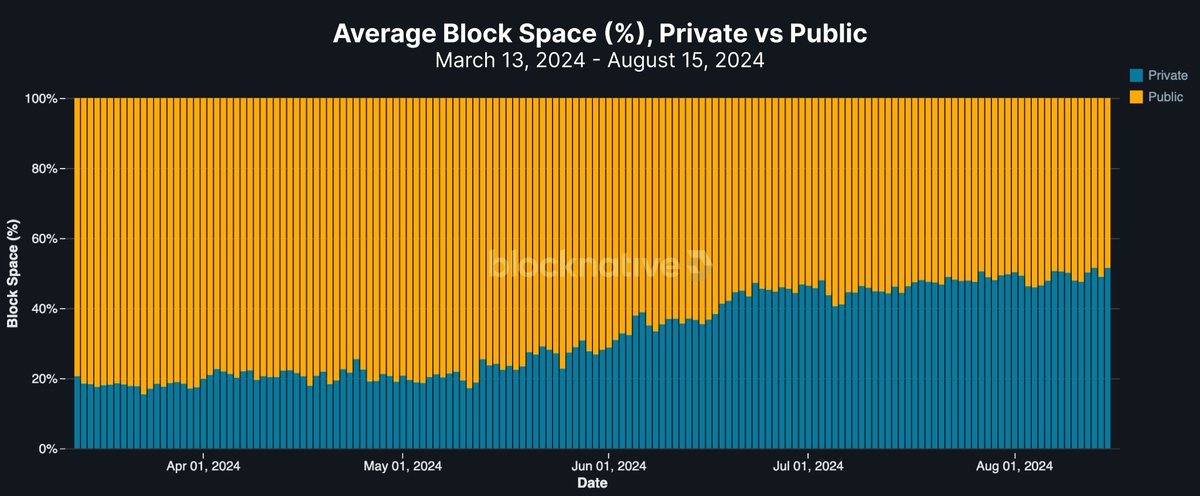
Private transactions now consume >50% of Ethereum L1 gas.
Our new analysis shows the "flippening" - a crucial turning point in how we understand and analyze Ethereum's network dynamics.
https://t.co/L3D59bINaH
🤑Top 20 Fee Generating Protocols in Crypto in the Past 30 Days👇
🗳️Key takeaways:
▪️5/20 are L1 blockchains, while only 1/20 is an L2 blockchain
▪️Outside of L1 & L2 blockchains, all other protocols belong to the DeFi category
▪️Among the top 20, Ethereum generated the most Fees ~$180M, and Base the least ~$6M (given that the activity on Base has outpaced the Ethereum L1, this is a sign that L2 scaling is working)
▪️Lido generates ~2x in Fees compared to Jito, but Jito is growing faster
▪️Uniswap DAO generates the most fees among DEXs, and Uniswap Labs generates the least in the same category
▪️MakerDAO and Ethena dominate the decentralized Stablecoin issuers category (note that neither Circle nor Tether are included here since they earn their Fees & Revenue offchain at the moment)
▪️Aave is the clear market leader in the lending category, with a ~$30M gap to Morpho (2nd in the lending Market sector)
▪️Only Ethereum, Tron, Bitcoin, and Lido generated over $100M in Fees over the past 30 days
***
FAQ
🗳️What are Fees?
▪️The aggregate fees paid by the end users of the protocol’s service.
▪️The methodology for Fees varies between Market sectors, because protocols in different Market sectors tend to have different business models:
- Blockchains L1 & L2 = sell blockspace for transaction fees
- Liquid staking = invest users’ stake to earn staking rewards
- Exchange (DEX, Derivatives) = enable asset exchange against trading fees
- Lending = provide loans against interest payments
- Stablecoin issuers = provide access to USD against interest payments and/or invest user deposits to earn yield
- Asset management = invest user deposits to earn yield
🗳️What’s the difference between Fees and Revenue?
▪️Revenue is calculated based on the take rate (%) that the protocol applies to Fees.
▪️The take rate can be anything between 0-100%.
▪️Currently, the Uniswap DAO and Bitcoin both have a take rate of 0%, whereas Ethereum tends to have a take rate of ~80%.
🗳️What’s the difference between Revenue and Earnings?
▪️Earnings is calculated by subtracting (i) Token incentives, and (ii) Operating expenses from the Revenue.
▪️Token incentives = an indication of how much the protocol spends on user acquisition. It’s calculated as the USD value of protocol’s native tokens that have been distributed to users.
▪️Operating expenses = an indication of how much the protocol spends on personnel and infrastructure to develop, maintain, and improve the protocol.
▪️Note that a vast majority of protocols do not post their Operating expenses onchain, which is why that metric is yet to be added for most protocols.
🗳️When should you look at Fees vs. Revenue or Earnings?
▪️As a rule of thumb, investors should pay attention to Fees for early-stage protocols that have not yet started to monetize, and Revenue and/or Earnings for protocols that have started to monetize:
- Early-stage: Fees, indicates that the protocol has paying customers.
- Later-stage: Revenue, indicates that the protocol is able to monetize its paying customers.
- Mature-stage: Earnings, indicates that the protocol is able to return value to its tokenholders.
▪️It’s also important to look at the ratios between:
- Revenue / Fees = ideally, the protocol has so much leverage over its supply-side (LPs) that it can charge a high take rate on the Fees.
- Earnings / Revenue = ideally, the protocol operates with a low (i) user acquisition spend, and (ii) operational overhead, which leads it to retain a high % of Revenue as Earnings.
@sama Battle of Red Cliffs as is depicted by the Romance of the Three Kingdoms, by Luo Guangzhong (year 1522). Closing in on the troops of Cao Cao as his chain of boat is defeated by Sun Quan
1/13 Uniswap V4 launch is just around the corner.
It's not just an upgrade; it's a transformation from protocol to platform.
Imagine the iPhone finally getting the Apple Store.
And here's why it worries me: 🧵
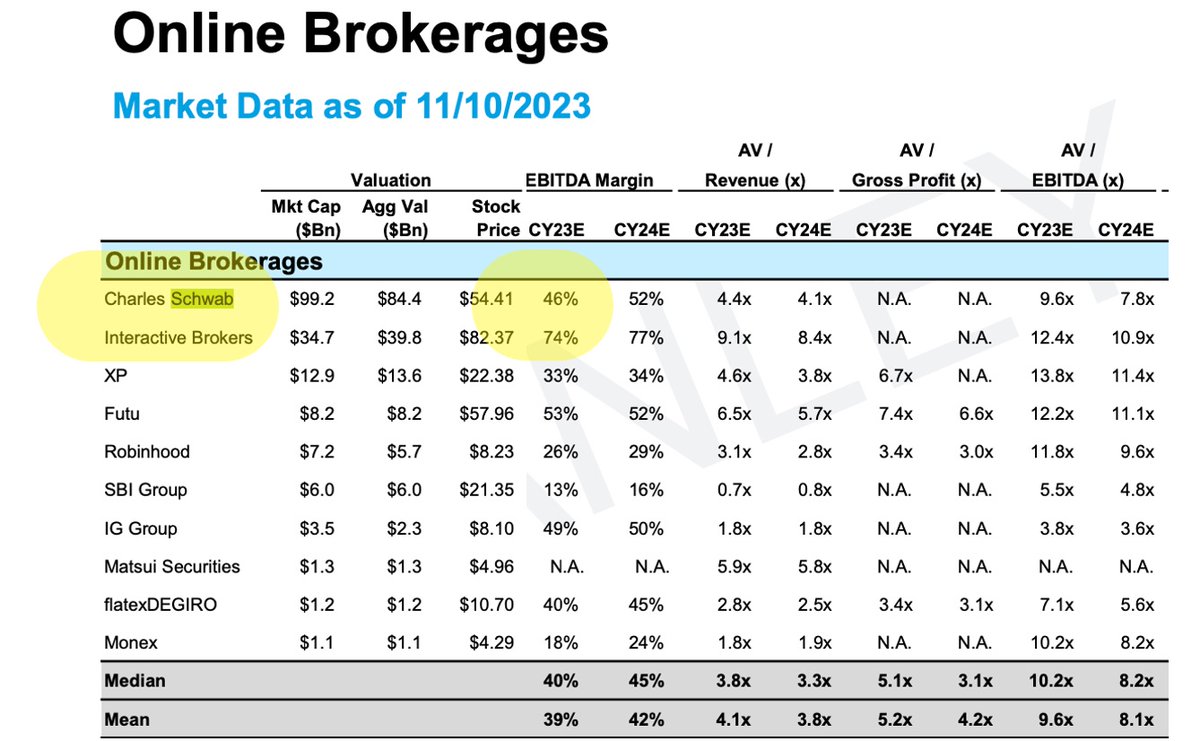
Wealthfront news buried the lead...40% EBITDA margins.
$50+ B in aum => 25 bps fee => $125+ M rev => 40% ebitda => $50M EBITDA
same EBITDA margin as Schwab which has 50x more assets ($2.5T in aum).
helpful to understand what scale you need to get what margins in asset management business.
Sam and I are shocked and saddened by what the board did today.
Let us first say thank you to all the incredible people who we have worked with at OpenAI, our customers, our investors, and all of those who have been reaching out.
We too are still trying to figure out exactly what happened. Here is what we know:
- Last night, Sam got a text from Ilya asking to talk at noon Friday. Sam joined a Google Meet and the whole board, except Greg, was there. Ilya told Sam he was being fired and that the news was going out very soon.
- At 12:19pm, Greg got a text from Ilya asking for a quick call. At 12:23pm, Ilya sent a Google Meet link. Greg was told that he was being removed from the board (but was vital to the company and would retain his role) and that Sam had been fired. Around the same time, OpenAI published a blog post.
- As far as we know, the management team was made aware of this shortly after, other than Mira who found out the night prior.
The outpouring of support has been really nice; thank you, but please don’t spend any time being concerned. We will be fine. Greater things coming soon.
SoFi bulls miss a few points.
Let's cut to the heart of the matter - SoFi is a personal loan business.
It relies on capital markets for cashflow. That presents a structural flaw to the business model.
When a recession ultimately arrives, the losses will hit SoFi in 3 ways
🧵
@zmanian@pythianism True but AAAs also more so worried about the looks and sustainable monetization which crypto games have not yet figured out (waiting to be proven wrong
Most people understand there are trust relationships while using OFAs and private endpoints, but what does this look like in the presence of a vertically integrated builder?
🧵...