We built an 8000 sqft. high-throughput wet-lab in 30 days, to solve molecular discovery - starting with pesticides.
Most teams in drug-discovery don’t receive target-organism verification until clinical trials. Pesticides allow us to rapidly validate our model in the target organism directly. With the help of our high-throughput lab, we were able to generate compounds that killed a $13 billion pest, the Fall Armyworm.
We believe that the bitter lesson is coming for biology.
We partnered with @moritz_stephan@oqbrady and @CarloWillem because of their vision, tenacity, and track record in building some of the most impactful products of this generation.
@hone Engines are already helping enterprises deliver outcomes, built by one of the most talent-dense teams in AI. Learn more at https://t.co/PLdW8kuh8N
Today Hone launches Engines: AI that owns business outcomes.
Chatbots give answers. Agents do tasks. Engines deliver outcomes, and we hold them responsible for creating real value, measured in actual dollars instead of tokens or vibes.
You point it at a business metric, and the Engine figures out the rest. It onboards itself, builds the necessary agents, skills, and memories, collaborates with the right people, and gets better with experience.
From AI leaders to global enterprises, our customers have already used Engines to:
• Uncover millions in procurement savings
• Optimize product funnels
• Manage credit risk
• Increase qualified pipeline in new territories
• Accelerate implementations and improve account management
To scale this impact across the economy, we’ve raised a $60M seed led by Benchmark and Index with participation from Elad Gil, Hanabi, Definition, Diffusion, Lux, SV Angel, and Align.
AI’s raw capabilities are far ahead of the value it creates in the real world, and Engines will help close the gap.
Here’s how they work…
Excited to announce @Furientis@DeptofWar OTA contract for 100mi interceptor and $25M Seed raise led by @benchmark!
This couldn't have happened w/o our incredible engineering team testing at industry best pace. Join us- we're hiring across all disciplines!
https://t.co/ankNypRwAG
As AI moves into the physical world, @safeworldai is working with leading robotics companies and enterprises to ensure safe and successful deployments. Congratulations to the team on their launch! https://t.co/tOefRQAaPI
Today, I’m excited to introduce @safeworldai!
Our mission: improve robot safety for the next billion machines.
AI is moving from screens into the physical world. Robots are becoming more capable, more autonomous, and increasingly operating around people.
But more capable robots require more capable ways to test them. 🧵
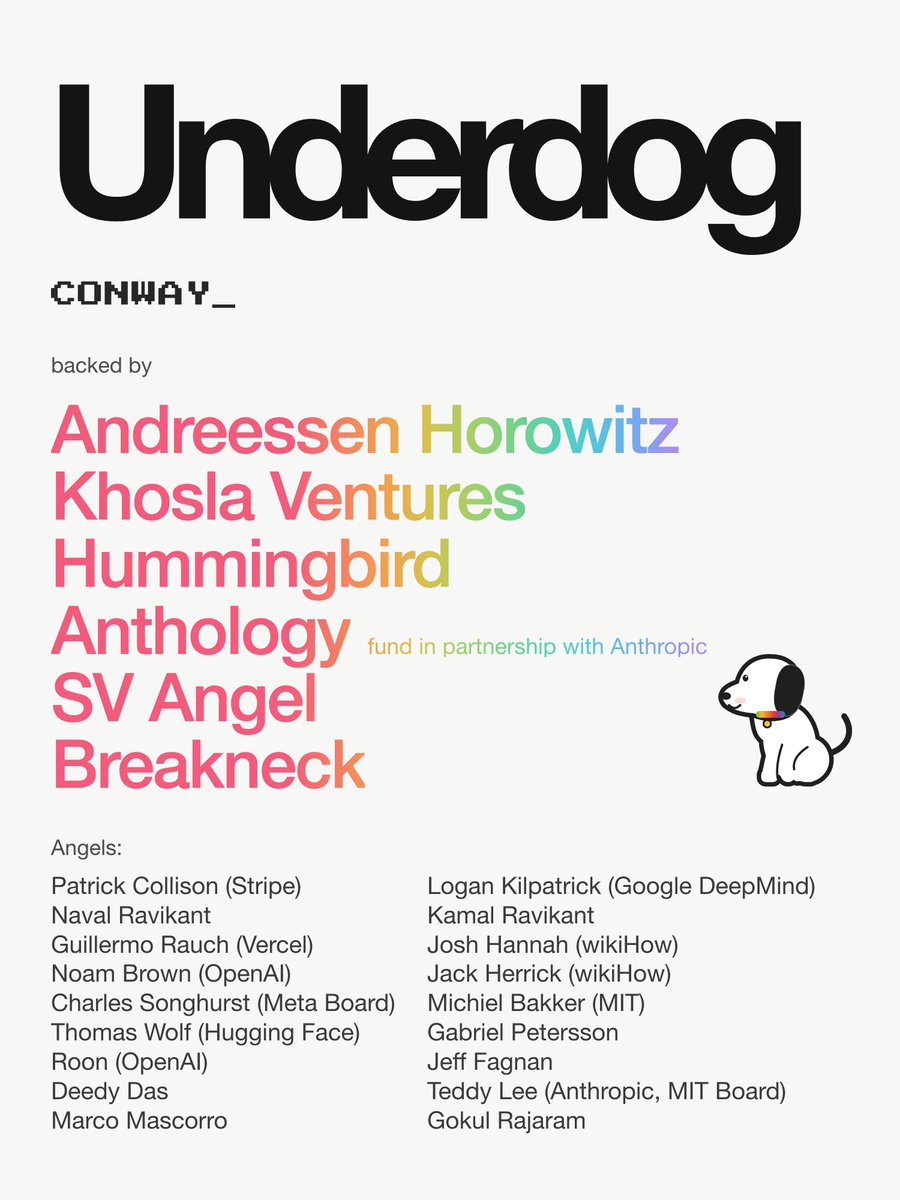
Introducing Underdog, your Private Personal AI on devices you already own
Today we're announcing our backing from @a16z@khoslaventures@HummingbirdVC Anthology (@AnthropicAI@MenloVentures) @patrickc@naval@rauchg@polynoamial@Thom_Wolf@Mascobot@tszzl@OfficialLoganK and other top AI leaders
Our mission is to provide free, capable, reliable and private AI to billions of people.
Underdog’s Law: today’s frontier intelligence reaches your devices in six months.
We’re starting with fast, capable AI that runs on consumer hardware. By co-designing models and inference engines, we’re pushing the frontier of capability, speed, power and data efficiency.
Our research also spans agentic commerce, confidential inference, and how AI will reshape the internet economy.
Privacy and capability no longer needs to be a tradeoff. If you believe in this future, join us. Time to build.
Thrilled to support the incredible team at @flowenghq! AI has transformed how software gets built, and Flow is bringing that same leap in speed and iteration to hardware engineering.
Flow has raised a $50M Series B at a $750M valuation, co-led by Antonio Gracias (Valor) and Gavin Baker (Atreides) with Sequoia Capital, Roelof Botha (SpaceX, Block), and more.
When I became a mechanical engineer, I wanted to invent. In reality, 90% of the day to day execution work (CAD, excel, sim) was digital manual labour. That’s about to flip. The engineer’s role will change more profoundly than at any point since the invention of CAD, with humans focusing on invention, architecture, tradeoffs and judgement calls, and agents taking the grunt work.
Anduril, Joby, Stoke Space, Rivian & many more - Flow is now the default platform for requirements and verification for frontier hardware teams. But it’s not just next-gen anymore. Industry giants including General Motors PPU and Volkswagen & Rivian’s joint venture (RV Tech) are reshaping their core development practices with Flow’s AI.
The revolution is just starting. Models are getting better quickly at CAD, analysis, simulation, and tool use. In the next year, AI will move from integrating the work to doing the work.
One day, this shift won't just enable us to iterate faster, it will enable us to design a class of products that we could not have dreamt of before.
We’re hiring.
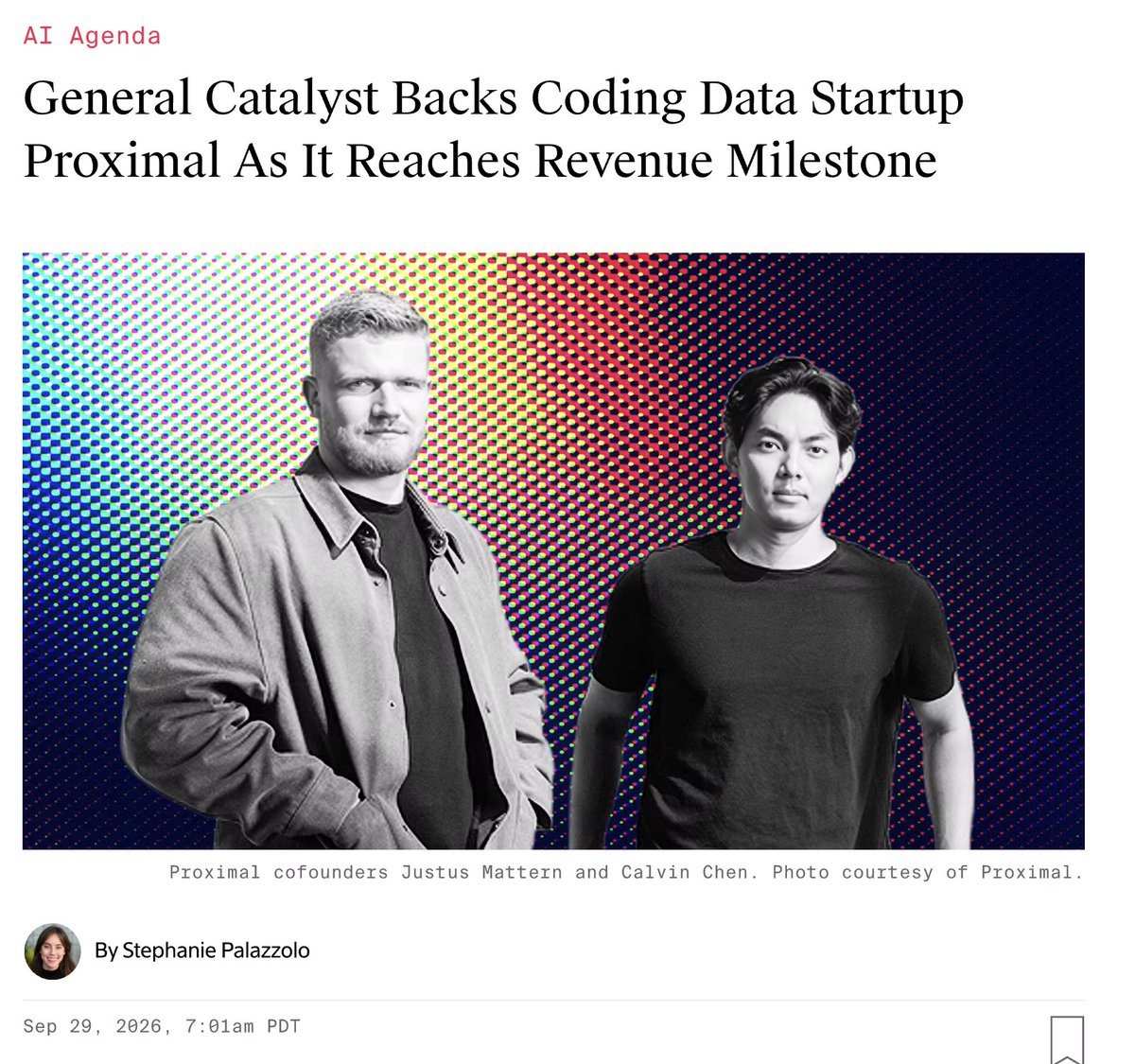
Proximal builds infrastructure that enables AI to improve from real-world experience.
In the past year, we have grown to more than $200M in annualized revenue helping frontier labs and enterprises improve coding agents. Now, we are expanding beyond software engineering.
Recent progress in mathematics demonstrates what happens when models are trained in domains with massive amounts of public data and easy verifiability, making it easy to find weaknesses, generate training tasks, and iterate quickly.
We build infrastructure that enables this feedback loop in other domains: we are excited about a world in which AI systems design targeted drugs, accelerate chip design, and rewrite legacy software that still runs hospitals, power grids, governments, and other critical infrastructure.
Since starting, we have assembled a small team of researchers and engineers and built world-class infrastructure for post-training and synthetic data research to overcome the challenges of scaling manual data curation.
Our team comes from Cursor, Google DeepMind, Meta Superintelligence, Prime Intellect, Citadel, and Jane Street. More than half are former founders.
We’re fortunate to be backed by investors who share that vision, including @generalcatalyst who led our $15M Seed Round at a $300M valuation, as well as @chemistry, @svangel, @dvlamoen and individuals like @LiamFedus, @kevinweil, and @bernhardsson
We’ve raised $85M for this moment.
Introducing Warp 2.0: The first AI Head of HR.
Every company is building AI to replace jobs. Warp is building AI to do the jobs no human should have to:
If you work in HR, I want you to spend time with the manager who needs help or building company culture people actually want to work at.
If you’re a founder, I want you to focus on signing clients or spending time with your family.
You shouldn’t have to figure out how to register state tax in California. You shouldn’t have to pay outrageous penalties because you don't know what a DE 9C is.
I want to make HR human again. Today, this is finally possible with the Warp Agent.
I’d love for you to see it in action: https://t.co/mztyoG7RYw
The next frontier of AI is in the physical world. @watneyrobotics is building autonomous systems at scale with an incredibly focused and talent-dense team. Congratulations on the Series A!
We’ve raised $80 million in Series A funding, co-led by the Valor Atreides AI Fund and Hummingbird Ventures, with continued participation from Conviction, Abstract, A*, and Grant Gordon. This brings our total raised to over $100 million.
We started Watney by asking a simple question -- what can a robot enable in industries where the work remains valuable on an infinite horizon? We found an answer in the fundamental inputs to civilization: energy, matter, and intelligence.
A robot will never be as charming as a barista or as personable as a housekeeper, but it can be more exacting than a surgeon. And, a breakthrough in one quickly becomes the capability of millions. We don’t imitate human motions or processes. We care about the new, differentiated capabilities robots can unlock. We work on problems where our choice of embodiment gives us an order of magnitude advantage, whether through precision, reliability, or scale.
Compute is just beginning to transform society, but it’s constrained by execution. Since 2025, Watney has been serving the largest hyperscalers in the world, helping accelerate their compute rollout through an end-to-end deployment model.
Across hundreds of thousands of hours in customer facilities, our systems have achieved more than four nines of reliability. They’ve enabled our customers to build data centers faster, at larger scales, and with more ambitious architectures. Today, we operate the largest fleet of dexterous robots running 24/7/365 across the United States.
This is all to say, it's an exciting time at Watney. We’re all here because we want to see more ambition in the physical world. We are hiring across all domains. Join us.
This has been a long time coming.
Announcing GSI and our first release: the first full-stack product for state-of-the-art robotics data. Built by roboticists, for robotics.
Starting today, you can get a lightweight 6 camera cap and wrist cameras: fully wireless, ergonomic, and sensor complete.
From there, Grounded API produces SOTA 3D enrichments at the click of a button.
From meeting my co-founder @vincentjliu during my first year at Stanford, we’ve been waiting for this moment in AI.
Fast forward through my PhD with @pabbeel at UC Berkeley and our work on EgoZero and FeeltheForce. We've come full circle.
Immense gratitude to our early investors @pabbeel@naval@LerrelPinto@Thom_Wolf@_milankovac_@rob_fergus and many others.
All success in robotics comes down to leveraging the best data. Today, that is where we start.
After such a consequential week for AI, with the leading labs demonstrating real progress, today's news feels especially timely: @SVAngel is launching Project Blueprint, a comprehensive effort to forge consensus among industry leaders and lawmakers around durable solutions to the hardest AI policy opportunities so that all Americans can benefit from AI. And we've brought on @JayCarney to run it. https://t.co/0qb7MIGknd
We are encouraged by the reaction of Sam Altman, Dario Amodei and Demis Hassabis to the launch of Project Blueprint:
Sam Altman, co-founder and CEO of OpenAI: "We have before us a technology of immense and still-unfolding wonder. I believe AI has the power to heal people, to discover cures and to deliver abundance on a scale the world has never known before. But we need a way for the world to build trust in the technology so that we can all get to share these benefits. National safety requirements for the most capable systems are a great first step, ideally building towards a global framework for advanced AI models. I’m glad Ron is bringing the people building AI and policymakers together to help move that work forward.”
Dario Amodei, CEO and co-founder, Anthropic: "AI is advancing faster than our institutions can adapt, and the most important decisions about how it is developed and deployed will be made in the next few years. If those decisions are to serve the public, they can't rest with AI companies alone. Industry and policymakers need to work through them together, with an honest, shared understanding of what these systems can do. We're glad to support Project Blueprint's effort to make that possible."
Demis Hassabis, chairman and co-founder of Google DeepMind and the chief scientist of Alphabet: "We have long said that AI development needs to be both bold and responsible. We support bringing industry and lawmakers together around public policies that promote both innovation and safety."
We’re excited to welcome @JayCarney to SV Angel to lead Project Blueprint, strengthening the relationship between technology leaders and policymakers while building bipartisan cooperation around America’s AI future.
After such a consequential week for AI, with the leading labs demonstrating real progress, today's news feels especially timely: @SVAngel is launching Project Blueprint, a comprehensive effort to forge consensus among industry leaders and lawmakers around durable solutions to the hardest AI policy challenges. And we've brought on @JayCarney to run it. For America and our economy and our security, there’s nothing more important than getting the right policies in place.
https://t.co/8UXQaFZwln
Extraordinary milestone from @SkildAI — from first deployment to $100M ARR and more than sixty customers in just 10 months. In robotics, deployment isn't downstream of research. It is itself a research frontier, and that shaped how Skild has built S1. Congrats to @deepakpathak and the whole team.
We just hit 100M ARR within 10 months of starting deployments.
We are in factory lines. On construction sites. In kitchens. In data centers.
Cleaning. Welding. Building. Cooking.
Deploying.
We are releasing FrontierSWE v2, our updated ultra-long horizon coding benchmark
V2 features an expanded task suite and improved methodology. We see large performance gaps between frontier models, with Claude Fable 5.1 leading by a wide margin
meet @mostik_ai!
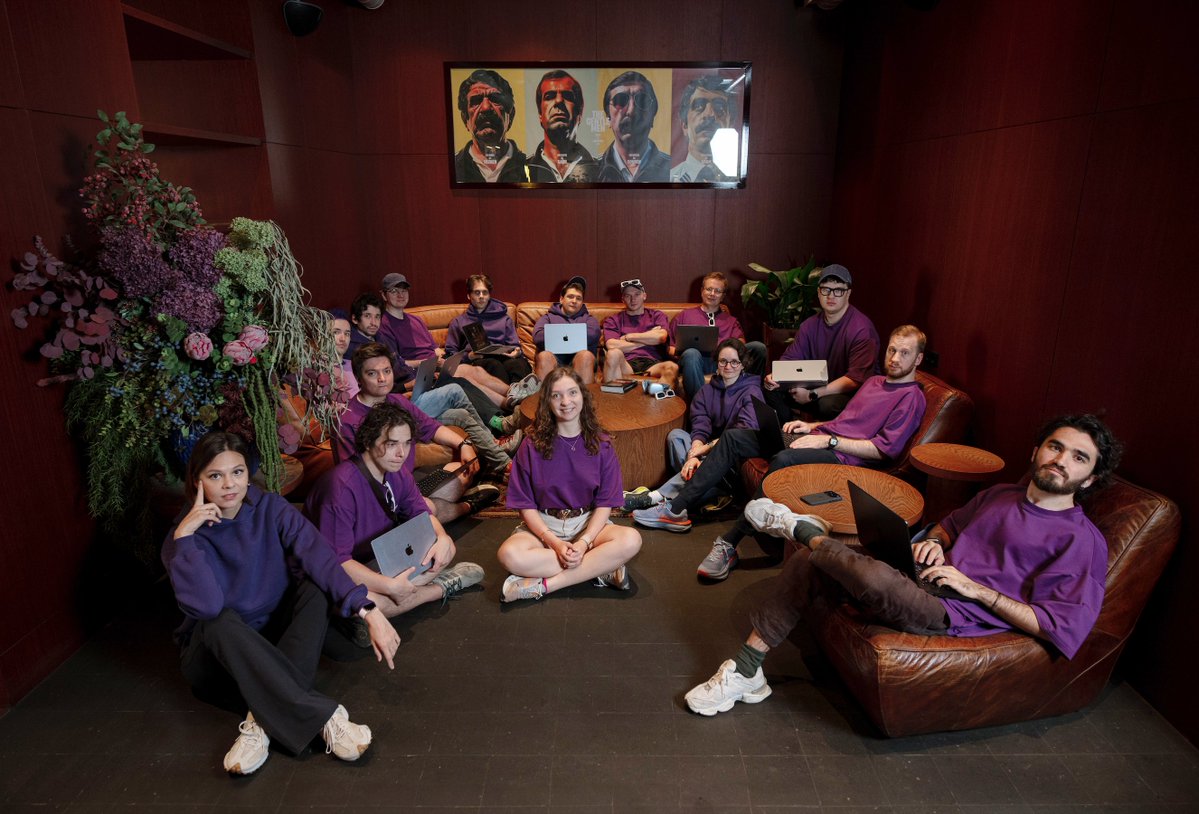
what happens when you put 12 PhDs in one room for four months? first place on the ARC-AGI leaderboard, which I can't say much about while the competition is still running. and this, which I can.
everyone's arguing about whether open models will catch up to frontier models. we think it's the wrong question. here's the one we pose: why does a frontier model have to generate your answer at all, when the only thing you need from it is the reasoning?
we do this by enabling models to communicate in latent space. through our protocol, hidden states pass straight from a frontier model into a small one running on your infrastructure -- no text between them, and neither model is fine-tuned. two models from different families, sharing reasoning, both left untouched.
how do we know it works? we tested it on a setup where a 753B model reads the problem, and a 4B edge-class model writes the answer. with this approach, we get results 80% as accurate as the frontier model, but at 20x faster performance.
we're committed to preventing frontier model lock-in and are already partnering with inference providers to accelerate open-weight adoption. we've done this between 15 of us, in four months, 12 PhDs and a Fields medalist, backed by @generalcatalyst
WIRED has the first external account of the company and the work: https://t.co/tP8nItCsDl
full writeup, the setup, and all the numbers: https://t.co/C9NZ5vtV1V
Introducing S1, our new foundation model that learns from one example.
It can be taught 10-minute long tasks that it has never seen before, from one video prompt without any fine-tuning.
Watch S1 operate in real-time via in-context learning:
Introducing S1, our new foundation model that learns from one example.
It can be taught 10-minute long tasks that it has never seen before, from one video prompt without any fine-tuning.
Watch S1 operate in real-time via in-context learning:
Signups are now open on Code[dot]Storage.
Today, more new repos are created per second on Code Storage than any other platform.
Lovable, Bolt, Amp, Poke, and many more of the largest agentic workloads store their code and agent memory at scale using https://t.co/oJLq0faUTg.
At Cartesia, our #1 value is "Get the fundamentals right".
This value has been with us since Day 0. It shaped the research @_albertgu led during our PhDs: rather than using the same algorithms & architectures for every problem, he asked whether they were the right tool for the job.
New algorithms will help us process the raw data in domains like audio, video, health, and robotics, and SSMs were born from that observation.
At @cartesia, the same value is core to how we build models. We've obsessed over every detail in building our 10-layer cake (parfait?): data, systems, algorithms, post-training & RL, evals, inference, serving, platform, product surfaces, and customer feedback loops.
These foundations enable us not only to produce world-class models, but to rapidly turn research advances into production-ready systems that scale reliably across millions of interactions.
As a researcher myself, it's exciting to see that we're #1 on AA. From my perspective, the most exciting result is our leading position on the Controlled Voices benchmark.
It's hard to game that benchmark because @ArtificialAnlys clones the same 8 voices on every model. It truly tests the model's ability to generalize. We're both #1 and #2 on that benchmark now with Sonic-3.6 and Sonic-3.5.
We're just scratching the surface. Our latest algorithms haven't fully made their way into these models yet. The work is advancing faster than ever before, and we have exciting new results in model intelligence & data efficiency coming soon.
Audio is the first step - it’s one of the simplest physical signals of the world. We’re tackling multimodal models next - models that will bridge the gap between knowledge & reasoning (text), and the physical world (other domains).
Our core belief is that a fundamentally sound approach that uses the right algorithms will generalize to all the data arising from the dance of atoms in our universe. From audio to video, robotics, biology, and everything else.
Expect many more exciting releases from us in the coming months.