In 1942, the Japanese rounded up all Chinese men in Singapore.
They were filtering out the healthy young ones to execute.
Lee Kuan Yew was 18. A guard pointed at him and said: "Go to that lorry."
He knew what that meant. The lorry went to the beaches. The beaches meant machine guns.
He asked: "Can I collect my other things?"
They said yes.
He walked away, found his family's gardener, and hid in his quarters for two days.
When they changed the screening inspectors, he tried again. This time, he got through.
The ones sent to that lorry were taken to the beaches and shot. Somewhere between 50,000 and 100,000 didn't survive.
60 years later, he sat down at Harvard to explain how he built Singapore from a tiny island into one of the wealthiest nations on Earth:
On what the war did to him:
"We lived in happy, placid colonial Singapore in the 1920s and 30s. The British Empire would have lasted another thousand years, so we thought."
Then the Japanese came. In less than one and a half months, the British collapsed.
"Three and a half years of hell. Butchery. Brutality. Many didn't survive. I was fortunate. I did."
"But it changed us."
"What right did they have to do this to us? Why did the British let us down so badly?"
When the war ended, Lee went to Cambridge to study law. But he was watching with different eyes.
"Can they govern me better than I can govern myself? Because they scooted when the Japanese came in. And why shouldn't I be running the place?"
On learning languages to lead:
Lee was the best speaker in English. But only 20% of Singapore spoke English.
The masses spoke Hokkien, Mandarin, and Malay.
"So every day at lunchtime, instead of having lunch, I would sit down with a Hokkien teacher and laboriously and painfully learn to convert my Mandarin into Hokkien."
"Had I not mastered that, the battle would be lost by default."
His first speech in Hokkien, the kids laughed at him.
"I said, please don't laugh. Help me. I'm trying to get you to understanding."
By 6 months, he could get his ideas across. By 2 years, he was fluent.
"Believe it or not, at the end of two years I could speak better than most of them."
"That came respect."
It showed two things: how determined he was, and how sincere. Here was a man doing all these other things and still learning their language just to talk to them.
On fighting the Communists:
The Communists had been organizing since 1923. The year Lee was born.
"Here we were in the 1950s trying to beat them. And they are professionals at organization."
They had elimination squads. Guerrillas in the jungle. Killer squads in the towns.
Lee stood up and said no.
"They denied that they were Communists. 'We're just left-wing socialists.' So I did a series of 12 broadcasts to set the scene. And I made it in three languages."
English. Malay. Mandarin. 20 minutes each.
"When I finished each broadcast, the director of the station couldn't see me. Went into the room and found me lying on the floor trying to recover my breath."
"But it was a fight for survival. Life or death."
On where trust comes from:
"It's difficult to establish trust in times of calm. You just say, 'Well, it's an argument, therefore I'm a better guy than you.'"
"But when the chips are down and you can get eliminated in a very unpleasant way and you show that you're prepared for it and you'll fight for them, it makes a difference."
"Without that trust, we could not have built Singapore."
On IQ vs EQ:
Harvard asked him: would you prefer high IQ or high EQ in a leader?
"IQ, you can get beautiful paper done. Complex formulas worked out. Elegant solutions."
"But when you've got to get a team to work and put that formula into practice, you're dealing with human beings."
"If you're not good at EQ, you can't sense that A doesn't get on with B, and you put them in the same team. It's no good."
He rated his own EQ as 7 or 8 out of 10. His IQ as "maybe 120."
But he had colleagues who could sense a person instantly.
"He shook hands with the man and said, 'I recoiled when I felt his palm. Evil man.' And he was. How does he know? I don't know."
"So I learned whenever I had to do interviews to choose people, I would get people who are very good at seeing through a candidate."
On corruption:
Singapore in the 1950s was full of deals, bribes, and organized crime.
"When we took over, we decided that this was the critical factor. If we did not make it so that every dollar put in at the top reaches the ground as one dollar, we're not going to succeed."
"We came in and made a symbolic act. We dressed in white shirts, white trousers, and said we will be what we represent."
He put the anti-corruption bureau under his personal portfolio.
"I gave the director the authority to investigate everybody and everything. All ministers. Including myself."
One of his own colleagues took half a million in bribes. When the investigation started, he asked to see Lee.
"I said, if I see you then I'll be a witness in court. So best not see me. Better see your lawyer."
The man committed suicide. Left a note saying: "As an oriental gentleman who believes in honor, I have to pay the supreme price."
"It's a heavy price. But it reminds every minister that there are no exceptions."
On consistency:
Lee had three journalists analyze 40 years of his speeches.
He asked them: what was the dominant theme?
All three said the same thing: consistency.
"What I said at the beginning, throughout all that period, the theme stayed loud and clear."
"That made it simple. Because you know where you stand with me. And you know what I want to do."
On delivering results:
"We deliver the homes, the schools, the jobs, the hospitals."
"Today, 98% of our people own their own homes. The smallest would be about $100,000 US. The biggest about $300,000."
"Once you own that amount of assets, you are not in favor of risking it with a crazy government. Your assets will go down in value."
"But that was planned."
Why? Because Singapore is small. Everyone does national service. If you're going to fight, you better be fighting for something you own.
"So we give everybody a stake."
On changing culture slowly:
Lee wanted Singapore to speak English. But he couldn't force it.
"Had I passed a law and said you will all learn English, we would have had mayhem. Riots."
Instead, he let parents watch who got the best jobs. The jobs were already there, from the multinationals and banks. They all used English.
"They watched and saw who got the best jobs. And they switched."
It took 16 years.
"I did not want to have said 16 years. Because in those 16 years I lost 20,000 Chinese graduates who had poor jobs. I wanted to make it shorter. I couldn't. I would have run into flack."
On whether leadership can be taught:
Lee quoted Isaac Singer, the Nobel Prize winner for Yiddish literature.
Someone asked Singer: "Can you make a writer write great literature?"
He paused. Then said: "If he has the writer in him, I will make him a good writer in a shorter time."
Lee's version:
"Can you make a leader of anybody? I don't think so."
"He must have some of the ingredients. He must have that high energy level. He must have the ability to project himself, his ideas. He must have the desire, almost instinctively, to say 'let's do something better.' Of wanting to do something for his fellow men and not just for himself and his family."
"You can't teach those things. He's either got it or he hasn't got it."
"But if he's got that, then you can save him a lot of trouble."
On sustaining yourself:
Harvard asked how he managed despair over decades of leadership.
"If your message is one of despair, then you should not be a leader. You must give people hope."
"But there are moments when you feel very down. Either because you're physically down, or emotionally down, or because the world has turned adverse against you."
"When you are in that condition, the first thing you do is get a good night's sleep. Then get a swim or chase a ball. Get the cobwebs out of your mind."
"If you're not fit, you're going to make mistakes. Physically fit. You must stay physically and mentally fit."
In his later years, he learned to meditate.
"At the end of 20 minutes to half an hour, my pulse rate can go down from 100 to about 60. You can feel yourself subside. You still your mind. You empty your mind."
"Then when you are rested, you resume quietly. You still got the same problems. Maybe you sleep on it. Come back. Look at it for a few days. Then decide."
This 2 hour Harvard interview will teach you more about leadership than every business book you've read combined.
Bookmark & give it 2 hours this weekend, no matter what.
The mathematician who outperformed Buffett, Soros, and Dalio, generated $100B+, avg. 66% returns will teach you more about investing than a $200K MBA.
Bookmark this & give it 1 hour, no matter what. It’ll be the most productive thing you do this week.
Instead of watching an hour of Netflix, watch this 1 hour lecture on Bloomberg Terminal. It will teach you more about trading markets than a 2 month internship at Goldman Sachs or JPMorgan.
Today’s market strength was textbook. This is exactly what markets do during corrections when they get stretched to oversold levels. As I said just recently, "some of the biggest rallies occur during bear markets and corrections." Today was a perfect example.
Traders rushed in after headlines hit that Iran’s president signaled a willingness to end the conflict with the U.S. The Dow exploded higher by 1,125 points. But let’s not confuse cause and effect. The news may have been the trigger, but the market was already set up for a rally. It was oversold and primed. Now comes the part where discipline matters.
We ignore the first few days of a rally attempt. That’s potential noise. What matters is whether the market can follow through and whether leadership begins to emerge and proper setups develop.
Technically, this is a classic snapback: Indexes that broke below the 200-day are rallying back toward it, while Indexes that held the 200-day are bouncing off it. That’s typical countertrend behavior until proven otherwise.
Expect volatility to remain elevated. That’s not where low-risk money is made, but it's certainly where the risk is. Your job during corrections is simple: identify the stocks showing the best relative strength and the tightest price action. Those are your future leaders when the market finally turns.
On the macro side, nothing has been resolved. Higher crude prices are still a problem. Yesterday’s rally did nothing to materially bring down oil. The bigger issue is still in play and the jury still out. Oil at these levels feeds inflation, pressures growth, and gives the Fed a reason to stay on hold longer. Yields stay elevated in that environment.
To cut through all the noise, I look to the market itself, which has a much better track record of telling us the truth than the politicians, the analysts, the news, and the gurus.
The four steps of the bottoming process are:
1. Oversold – The difference between an ordinary pullback and an oversold condition starts with price, but it does not end there. Poor breadth and and a lack of volume confirmed follow through describe a one-sided market, and one not to trust.
2. Rally – Inevitably, the market bounces from its oversold condition. A high-quality rally is broad-based. A low-quality rally is defined by short covering and driven primarily by the stocks that have declined the most. Again, the character of the rally is important to distinguish. So far, we simply don't have enough data to make a confident determination, so patience is the watch word while we wait.
3. Retest – After the rally, there is almost always a retest. The popular averages approach, and in some cases breach, their oversold lows. The key to a successful retest is less selling pressure, such as fewer stocks below their moving averages, fewer stocks, sectors, and markets making new lows, less total volume, and less downside volume. If the retest fails, the process reverts and we generally start looking for divergences during lower lows. In the event of unexpected news, it is possible for the market to recover in a "V" fashion with no retest. In that case, we look at breadth confirmation and participation.
4. Breadth thrusts – In the final phase, not only do benchmark indices rally sharply with few pullbacks, but they do so with an extremely high percentage of stocks, sectors, and markets participating, or what technical analysts call breadth thrusts. In rare cases, the market has skipped step 3. With strong enough breadth, retests are not necessary. The Covid bottom is an example of a pretty powerful V-shaped recovery.
Bottom line:
This was an oversold rally, sparked by headlines—but not defined by them, and certainly not confirmation of a reliable bottom.
Now we watch:
--Quality of follow-through
--Emergence of leadership
--Market internals and model health
If the rally lacks quality, if economic pressure builds, or if leading stocks begin to deteriorate, then this remains what it likely is—a rally within a correction.
Stay objective. Let the market prove itself. If you are going to trade, do so incrementally.
https://t.co/JXzFFTmMtn
I've stopped reading Gulf war headlines. Here's what I track instead.
We run an India-focused equity fund. 85% of India's crude comes from imports. Half of that normally passes through Hormuz. So yes — this crisis is personal.
But the information environment right now is garbage. Trump says the war ends tomorrow. Iran says Hormuz is shut forever. One analyst says $150 oil, another says $60. You can't build a portfolio view on this.
So I've narrowed it down to 4 signals. These are priced by people with real money on the line. They don't lie.
1. Ship insurance premiums through Hormuz
This is the single best signal. Lloyd's underwriters have billions at stake on every pricing call. Before the war, insuring a tanker through Hormuz cost 0.25% of the ship's value. Today it's 3.5–10% — and almost nobody is buying. A $100M tanker that cost $250K to insure now costs up to $10M. When this drops below 2%, the people with the most to lose are telling you it's getting safer. No press conference can replicate that.
2. How many ships are actually crossing
Every ship carries a GPS tracker (AIS). You can count exactly how many cross Hormuz each day. Before: 100+. Now: 8. That's a 92% collapse. You can't spin a ship being somewhere it isn't. Iran is letting some Chinese and Indian ships through, but it's a trickle. When this number crosses 30–40, trade is resuming. You can track this free on the WTO Hormuz Trade Tracker.
3. Paper oil vs real oil
This one most people miss entirely. Brent crude (the headline price) is at $112. But Dubai physical — what Asian buyers actually pay for delivered oil — is at $126. That's a $14 gap. It exists because Trump's comments keep pushing paper prices down. Traders call it jawboning. But the refiners buying cargo aren't getting any discount. If you're looking at Brent to assess India's oil bill, you're looking at the wrong number.
4. The mid-April cliff
Multiple emergency measures expire around the same time. The 400 million barrel SPR release runs dry ~April 15. The US waiver letting India buy Russian crude expires. Formosa Plastics has declared force majeure from April 1. Right now these stopgaps are keeping the supply gap at ~5 mb/d. Without them, BCA Research estimates it doubles to 10 mb/d — the largest crude disruption ever. If Hormuz doesn't reopen by mid-April, we're in uncharted territory.
Bottom line: track the insurance premium, the ship count, the paper-physical spread, and the April timeline. Everything else is noise.
Gold ✨
Silver
Updates.
Keeping it simple.
Gold MUST hold its major trendline (4530).
So far, it sits in the safe zone.
Silver needs to hold above 80; otherwise, 71 comes into play. Silver’s primary trendline sits at 60.
Both continue to hold their golden zones.
🚨WARNING🚨
They first ignored the warnings of the Great Martis on Bitcoin. Now livelihoods have been lost.
The second , they ignored the opportunities in precious metals. Fortunes were there to be made, yet missed.
The third, they ignored the alerts about silver and gold’s unsustainable parabolic moves. More livelihoods destroyed.
Now the most vital warning of all.
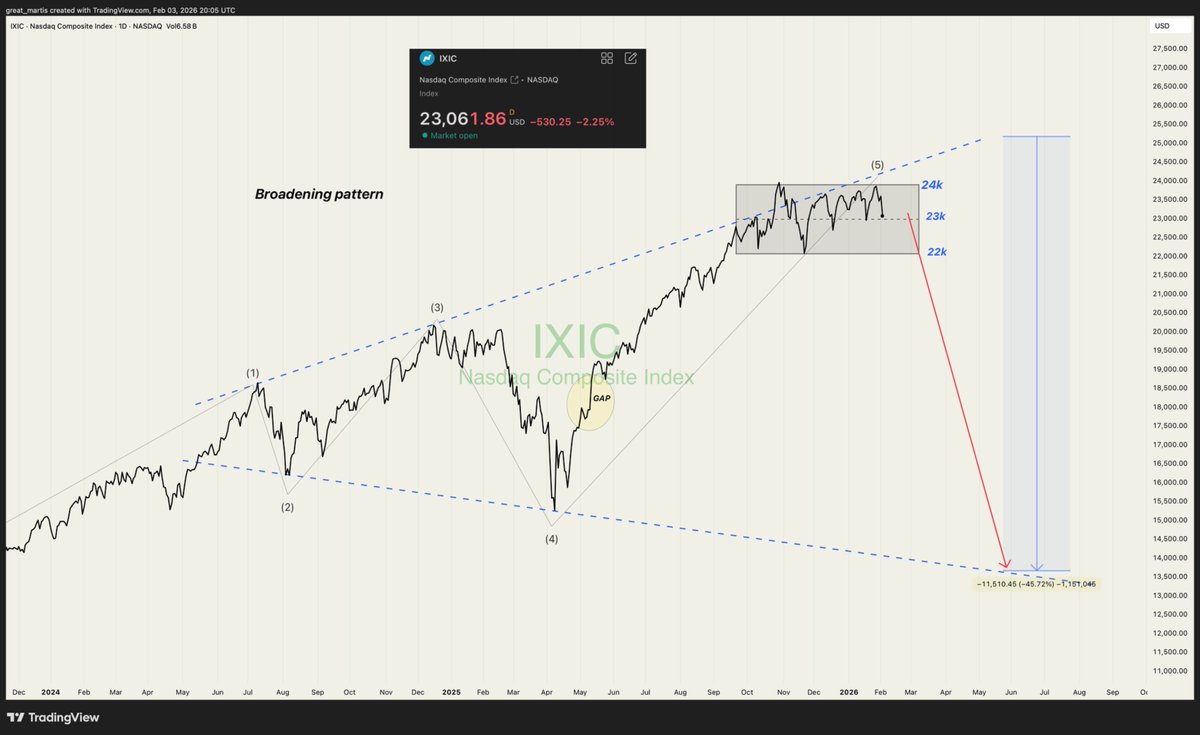
The infamous yet beautiful Nasdaq broadening pattern grows ever more likely to play out in full force. 23k is the first line of defense.
The last line of defense is 22k. Once 22k falls, the broadening pattern’s lower boundary is triggered...chaos follows.
Ladies and gentlemen, it’s all fun and games… until the Great One is proven right once again.
Yours truly,
THE GREAT MARTIS
GOD BLESS AND GOD SPEED.
She's beautiful .
Something to ponder: The "Sovereignty Spread" is the difference between the market price of a commodity and the system-level cost a state is willing to bear to suppress that price.
In traditional company accounting, a mine that costs $50 per ton to operate and sells at $45 is a failure. It shuts down. But at the system level, that same mine is rational if its output reduces input costs across a much larger industrial base.
The new Simandou iron ore mine in Guinea is the perfect proof of this mechanism.
Think of Simandou not as a mine, but as a deflation machine.
It is the world’s largest high-grade reserve, unlocked by a $20B railway financed by China (Baowu). To a Western miner, that $20B capital cost demands a 5-6 year return on investment based on selling ore.
But China imports roughly 1B tons of iron ore annually. By introducing 100M tons of new supply, they don't need to make a profit on the ore; they just need to crash the global price. A mere $10-per-ton reduction yields annual savings of $10B across their remaining import volume. Simandou pays for itself in 24 months simply by forcing Rio Tinto and BHP to lower their prices.
But the mechanics get worse for the incumbents when you look at the physics of the ore itself.
Comparing a 100M ton order for Simandou’s 65.5% grade against Fortescue’s 57% grade reveals a double penalty. Processing the lower grade dirt yields 8.5 M tons less steel. To get the same amount of metal, the mill must purchase an additional 15M tons of Fortescue ore. At $100 a ton, that is a $1.5B surcharge just to stand still.
Then comes the energy penalty. The impurities in that low-grade ore force the blast furnace to burn significantly more fuel .. That is an extra $1.1 B coal bill. On a nominal 100M ton contract, the steelmaker using Simandou effectively saves $2.6B compared to the rival using Fortescue.
This renders the competitor’s product mathematically obsolete. Fortescue is not selling a cheaper alternative; they are selling a liability that requires a multibillion-dollar subsidy from the customer just to process.
The final nail in the coffin is the carbon profile.
That $1.1B in extra coal is a carbon bomb, releasing 20 M tons of additional CO2, roughly equivalent to putting 4M cars on the road. If you price that carbon at $50 a ton, you add another $1B to the bill. We have reached a point of tragic irony where Simandou’s high-grade ore, dug by diesel trucks, is greener than Fortescue’s low-grade ore, dug by battery trucks, simply because the emissions occur at the smelter, not the mine.
FMG looks like the Blackberry phone of Iron Ore producers
The precise magnitude and timing of this effect are not fixed.
The price response depends on global steel demand, Brazilian supply elasticity, scrap substitution, freight spreads, and inventory cycles.
But the asymmetry is structural, not cyclical. At China’s import scale, even a partial and temporary suppression of the clearing price generates multi-billion-dollar annual savings that overwhelm project-level losses.
Therefore, the model is robust across a wide range of market conditions, because it is driven by volume dominance and grade physics, not by assumptions of perfect execution or static demand.
This is how State Capitalism competes with Western Stateless Capitalism.
The project’s payoff does not depend on the mine's profitability; it depends on eroding external pricing power.
If you project this model across Copper and Nickel, you see the future. The entity that focuses on the quarterly profit of the mine will always lose to the entity that monetizes the efficiency of the factory.
It changes mining valuations across the board.
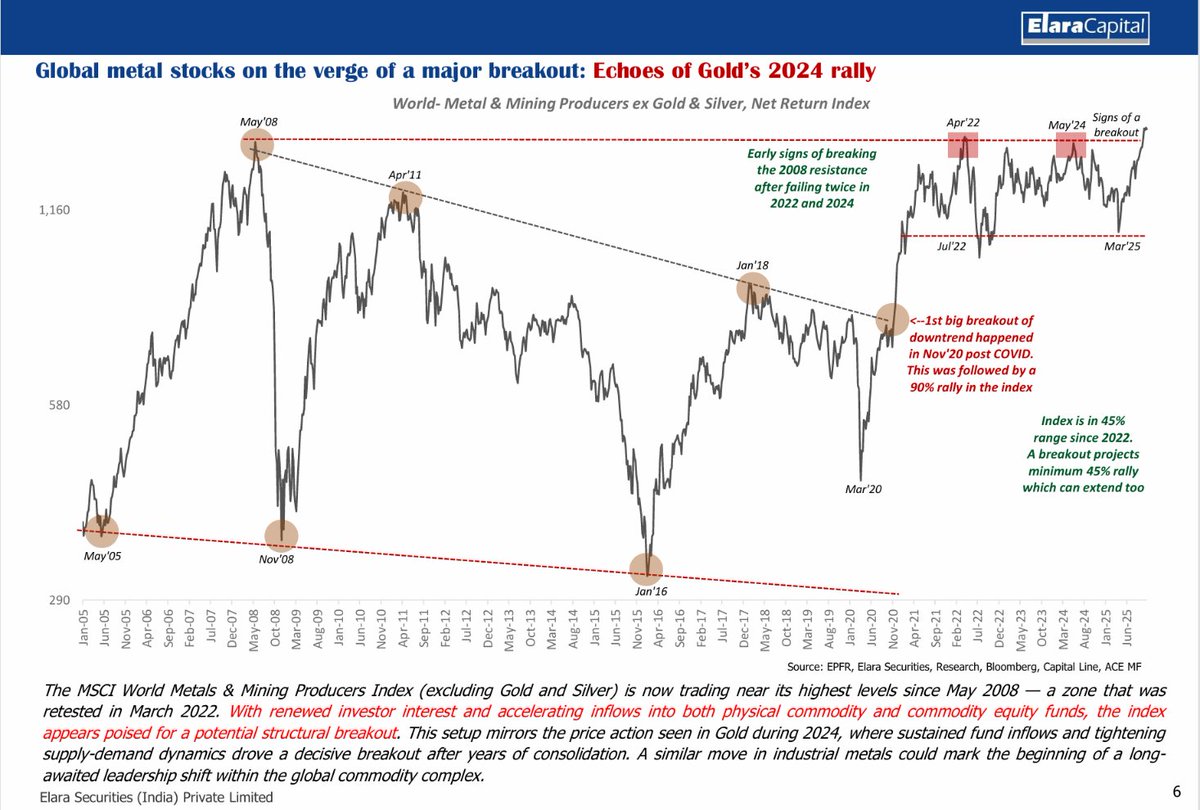
Industrial metals like Copper, Aluminium, and Zinc are all nearing multi-year breakout zones, while Silver is approaching its 1981 and 2011 highs. Once the current supply overhang is absorbed, these assets could see a strong price re-rating.
(via Elara securities)
Freeport has declared force majeure at Grasberg — and with good reason.
This will shake both copper and gold balances. Let me explain why.
Grasberg is a giant. One of the largest mines on earth, producing ~1.7bn pounds of copper (≈2% of global supply) and ~1.6Moz of gold pa (≈1.5% of global supply).
Think of it as a vast underground city: 28,000 employees, 250 km of tunnels across dozens of levels. Each year, 35–40 km of new tunnels are added — roughly the length of Switzerland’s Gotthard Base Tunnel (57 km), the world’s longest rail tunnel.
At its heart lies the Grasberg Block Cave (GBC), which accounts for ~70% of reserves and output. Other sections include Big Gossan and Deep MLZ.
On Sept 8, disaster struck: ~800,000 tons of wet material suddenly rushed in, flooding multiple underground levels. The mud hit GBC directly — the very core of Grasberg’s production.
A catastrophic failure. How was this even possible?
Block caving itself may become central to the story. Out of more than 12,000 active mines worldwide, only ~20 have ever used block caving — a handful do so today - El Teniente in Chile; Oyu Tolgoi in the desert in Mongolia; Cadia East & Northparks, both Australia; Palabora, SA; who else? That’s <0.1% of all mines.
None do so or did in the past within a similar rainy climate as Grasberg does.
Block Caving is an extremely rarely applied mining method, reserved for very large, low-grade underground ore bodies which themselves are exceptionally rare. Most mining is open-pit, stoping, or cut-and-fill.
Block Caving has economic appeal — low cost per ton — but the geotechnical risks are likely immense. Once caving starts, the process is essentially an engineered collapse of the mountain. What could possibly go wrong?
That’s why this accident isn’t just a local disaster IMHO. It could become a case study for the entire mining method. Perhaps it wasn’t well understood how block caving behaves under Indonesia’s heavy rainfall and complex geology? I don’t know — but I wouldn’t be surprised if that proves decisive.
My view? By year-end, Freeport will be fortunate just to understand the mechanics of this accident. Until then, production forecasts are pure guesswork.
Such a failure should (a) have been impossible, and (b) means operations can only restart once it’s crystal clear why it happened and how it can be prevented from happening again.
Analysts say full recovery is likely by 2027. That’s total nonsense. Nobody really knows. A true “known unknown.”
What is known: any company with less strength and brainpower than Freeport McMoRan would likely go bankrupt from this. Think Victoria Gold — a minor heap leach pad slide sank it within weeks.
Mining companies get hit twice: revenues vanish while capital costs to fix the damage soar, and regulators delay re-issuing permits until safety is proven. And this accident involves death. It’s a total nightmare.
My view? This is no quick fix. With infrastructure damaged, safety paramount, at least two confirmed dead and five still missing, investigations ongoing, potential class actions looming, and permitting hurdles ahead, the road back for Grasberg will be long and uncertain.
The only good news: Grasberg adds too much to the GDP of Indonesia to not fix this nightmare.