Even capable teams can struggle to reach the labs buying robotics labelling work.
On THOR, labs set the brief and pay only for units they accept. Annotation firms deliver against it, and build a track record through verified, accepted work.
Every job’s reward is funded before work starts. Firms are paid when a unit passes verification, and again when the buyer accepts it.
We’ve signed our first robotics video labelling contracts. Work starts with action captioning on first-person video, in a private pilot with whitelisted labelling firms.
NVIDIA is teaching robots physical work by showing them video of people doing it.
Its new model, GR00T 2, was pretrained on about 17 hours of human footage for every hour of robot teleoperation data.
Teleoperation requires a real robot and an operator. Video of people doesn’t, so it scales faster.
That footage is increasingly open. In November alone, @NVIDIArobotics, @GroundedSI and @hublabs released about 120,000 hours under licences that allow commercial use.
To find specific actions in those hours, labs need labels: what happens, and when it starts and ends.
These releases do ship with labels, but each follows its publisher’s own definitions and review process. GroundedSI says people reviewed captions covering 1,000 of its 10,000 hours. Hub says its labels have not been checked by people.
Our read: as more labs train robots on video of people, more of the footage they use for specific tasks will need labelling and checking to their own definitions.
Where existing labels don’t meet a lab’s needs, THOR helps get the footage labelled that way and verified against its criteria.
THOR Signals · Datasets
@tardhus During the initial private pilot you can apply here to be considered for whitelisting: https://t.co/TkCPyKky0L
After beta, we open things up to permissionless mining
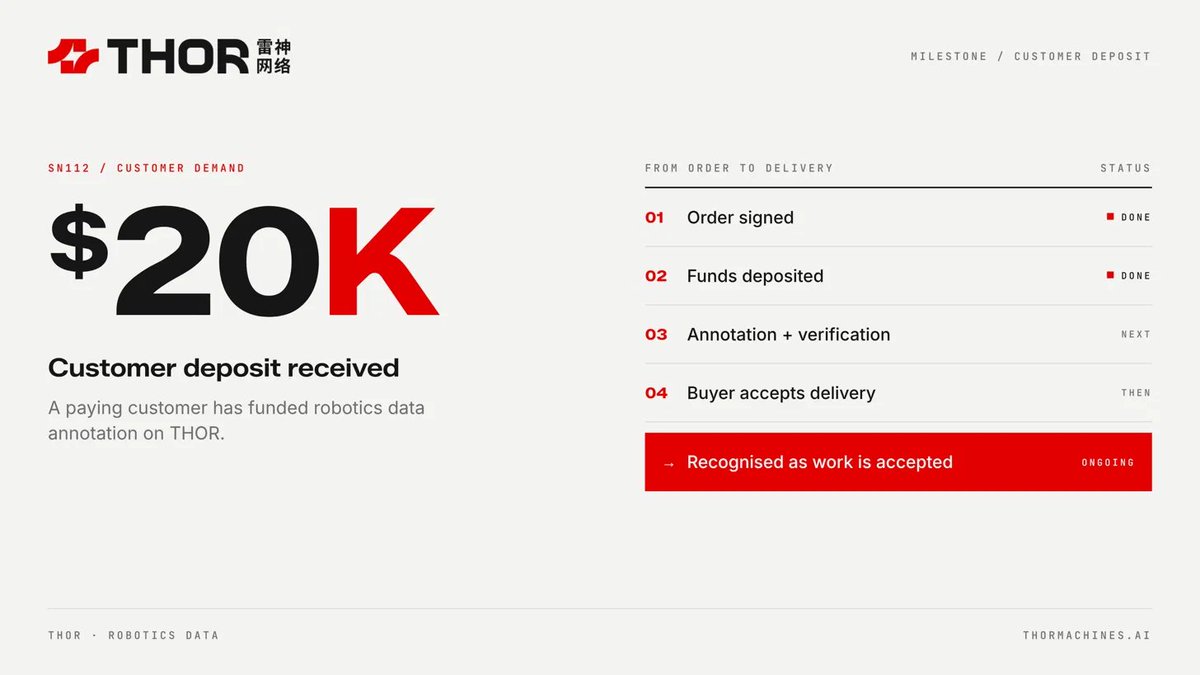
$20K. THOR’s first customer deposit landed onchain before work began.
This deposit was matched within our whitelisted miner set for annotation work.
Miners are paid as work passes verification.
Buyers pay only for accepted units.
A data network should start with customer demand.
THOR’s first jobs come from signed robotics labelling contracts.
Customers fund each job upfront into an onchain deposit contract and pay only for accepted units.
A share of those payments funds SN112 alpha buybacks.
16 seconds of someone unloading a dishwasher.
A THOR miner turns that footage into a structured record: eight actions, each with a start and end time.
At scale, labels like these become training and evaluation data for robots.
Action labelling is THOR’s first task type. Every THOR task is built to the customer’s brief, and work is checked before delivery.
“Model training is not hard. But I need a lot of data… to train my robots.”
We hear this from robotics labs constantly.
Software AI learned from the internet. Robots must learn from the real world, where usable data is still scarce.
That’s why THOR starts with data.
October was THOR’s first month live on Bittensor SN112.
• First robotics labelling contracts signed
• 3 annotation firms onboarded
• Invite-only orderbook
• https://t.co/356MulFOdT launched
November is about delivery: signed contracts → accepted work → subnet revenue.
THOR Signals · Capital
@Figure_robot tried to buy robot training data. Vendors couldn’t hit the throughput, diversity or quality it needed.
So it built its own pipeline, and in August committed $1B+ to data and compute over 12 months.
Meanwhile, data suppliers are raising:
→ @MeckaAI: $60M Series B led by Sequoia, with Nvidia and M12 joining.
→ @MaxinsightsAI: $30M seed led by Peak XV. 2M+ hours of human activity video captured, with 1.5M rated “model-ready” under its internal scoring system.
As more capital flows into collection, more data needs verifying, and that’s where things slip.
Pantheon audited 3,546 episodes across nine open robotics datasets and found 27% had at least one medium or high severity issue. That's open data, not these suppliers’, but it shows how easily problems get through.
Figure’s answer: keep filtering, fraud review and deduplication in-house.
Our view: an open market for robotics data needs verification buyers trust enough to cut back their own checking.
THOR’s pilot is testing whether independent verification can match buyers’ own quality calls, and cut the time they spend checking.
Per Scale’s paper, FineART’s subtask training raised success from 32% to 100% on one spatial task. Building that dataset took three teams: one to collect, one to annotate, one to verify.
Many labs can’t staff three teams. They need open infrastructure that can do that work.
In collaboration with @HuggingFace, we’ve released the largest open robot dataset, alongside their first open System 1-System 2 model that can reason over step-by-step actions.
FineART is built with 40K+ demonstrations across 151 tasks and 500K subtask labels.
Together, the dataset and model were designed for each other, and both are available on @LeRobotHF where robotics developers work today.
“The main lesson of thirty-five years of AI research is that the hard problems are easy and the easy problems are hard.”
Steven Pinker, 1994
Robots still struggle with what a toddler does without thinking.
THOR is building the data network to help them learn.
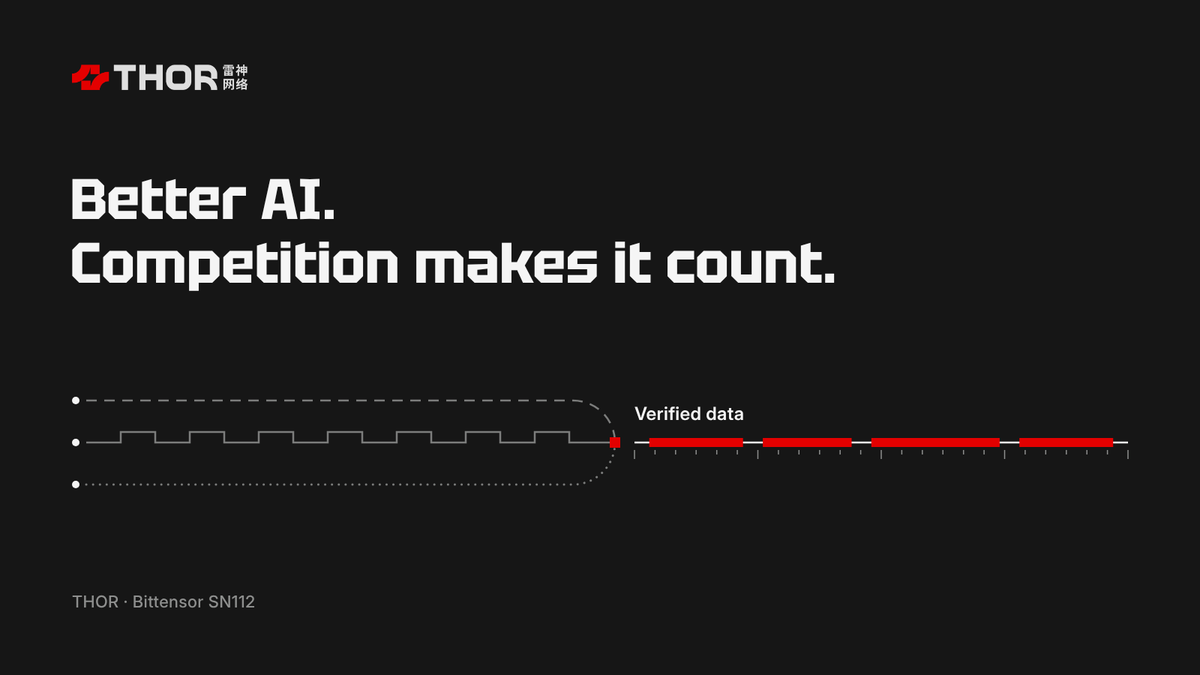
If everyone has access to better AI models, what do contributors compete on?
How well they use them.
Models like GPT-6 Astra and NVIDIA’s Flora are getting much better at labelling robotics video. NVIDIA estimates inference compute costs below $1 per hour of footage for Flora.
But customer-ready data has to meet timing, description and quality requirements. Verification and rework carry costs too.
On Bittensor Subnet 112, THOR is designed to tie rewards to verified output, giving contributors an incentive to improve their models, tools and workflows. A better workflow raises the bar for everyone.
The test for THOR is whether that competition delivers reliable robotics training data at a lower total cost.
Better AI expands what’s possible. Competition makes it count.
Robotics will scale one deployment at a time: one robot, one task, one environment.
And each can expose edge cases the training data never covered.
THOR is building an open marketplace for annotation and verification to cover them, so training keeps pace with deployment.
When is the ChatGPT moment for robotics?
Some say it's happened, some say it's coming. How capable are Physical AI models today? What does the adoption curve for robotics look like?
We've talked to most of the major players and make sense of it here
https://t.co/gblg1DdpH2
500,000+ hours of raw video behind one robotics model. A city subsidising companies' data purchases.
China's robotics data work is turning into a supply chain.
This is THOR Signals, our new series on the robotics data market, starting with China.
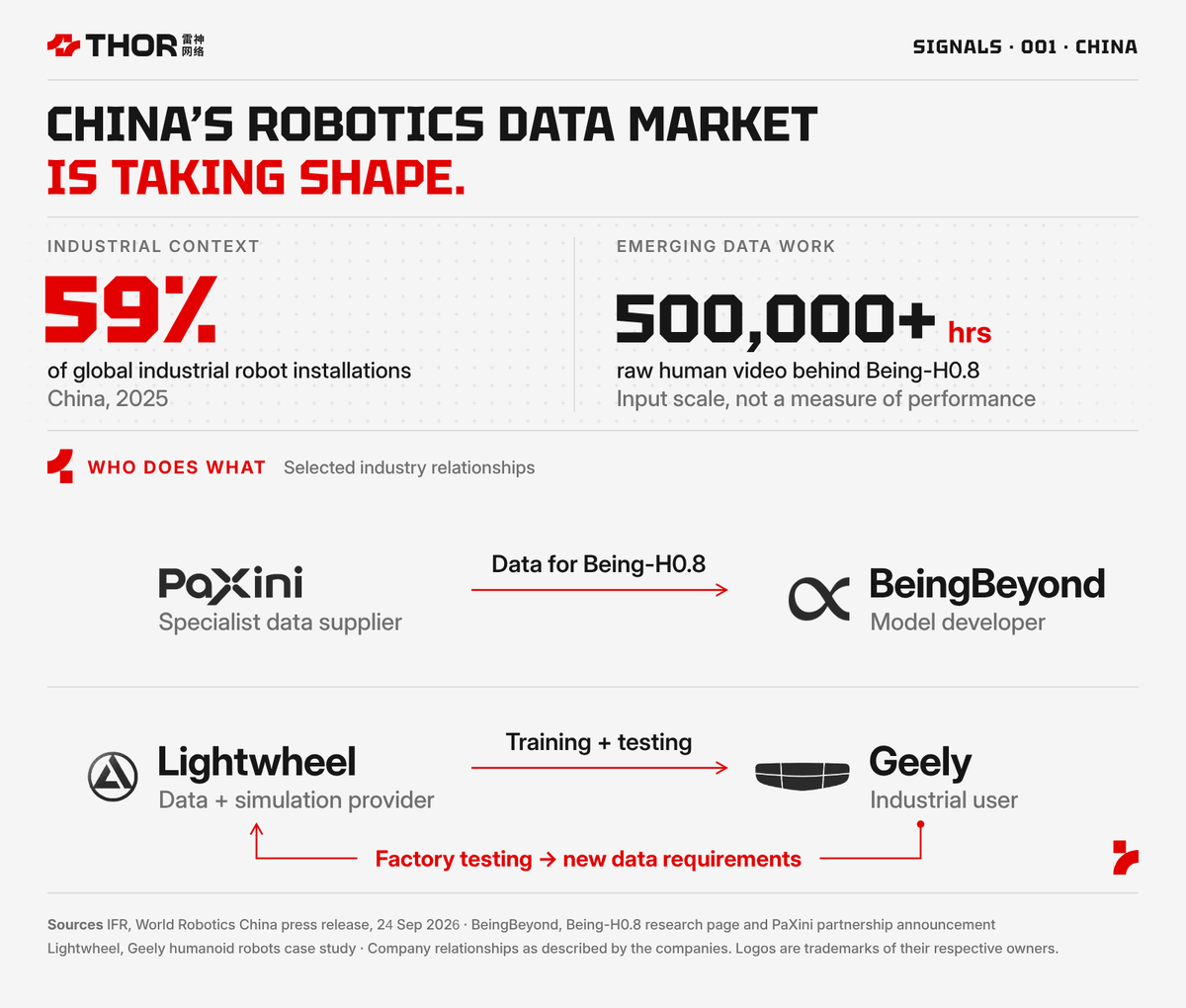
For context, China accounted for 59% of global industrial robot installations in 2025. Within that industry, three roles are taking shape:
• @beingbeyond_: model development
BeingBeyond builds models that help robots understand their surroundings and perform physical tasks. For Being-H0.8, the model behind those 500,000+ hours, raw video was filtered, reconstructed and reviewed before training.
• @PaXiniAI: specialist data supply
PaXini makes tactile sensors and training data combining vision, touch and movement. BeingBeyond names it an important data partner for Being-H0.8.
• @LightwheelAI: connecting training with deployment
Lightwheel supplies simulation, demonstration data and evaluation, and reported about $100M in Q1 2026 orders. At automaker Geely, factory demonstrations feed training, and testing shows where more data is needed.
Government is shaping demand too. Hangzhou's 2026–2027 action plan subsidises companies' purchases of data products and services (up to 30%, capped at RMB300,000). The national pilot base there invited outside data partners on 30 September across 25 task scenarios.
What we don't know yet: how much teams outsource, and which services they buy repeatedly.
For THOR, that's the question: which tasks do teams commission externally, and why choose a specialist over building in-house?
More from THOR in China to come.
THOR Signals · China