@maksym_andr seems a good time to pretrain from entirely synthetic corpora (which has full control over CBRN-related contents) maybe nvidia is alr doing this
Most recent agent incidents, like the OpenAI-HuggingFace hack, were multi-agent swarms. There was no research agenda for swarms, so we wrote one at @JinesisLab : 7 open problems, each scored for alignment importance.
https://t.co/OSUGlWwZIX
Many people who question this seem to have forgotten that this is by default the case for most journals (except ACs are called Action Editors/AEs) maybe a CVPR-like Triple-AC structure can easily trim 40K to 20K valid submissions for peer-review
a "controversial" suggestion for ICML/ICLR/NeurIPS: allow area chairs to desk reject ~50% of their batch! as an area chair, i can very quickly scan all papers in my batch and check which ones have a ~0% chance to get accepted. we shouldn't make reviewers spend time on them!
This, while I do think embedded eval should have more independent orgs (that probably don't have ex-ant/oai employees or students who aspire to work at ant/oai), it's just amusing to see the ramping conspiracy theory around Lesswrong. It's a public forum.
@ProfNoahGian Lesswrong is practically the industry (AI safety) norm for disseminating work. Whilst yes it is Eliezer's creation, it's like saying tweeting on X is endorsing Elon.
@patpcj Perhaps a better policy is all the submissions be subject to a fee say 2k and then if reciprocal reviewer didnt fulfill obligation, their name be public on a blacklist website and they must pay the 2k out of pocket
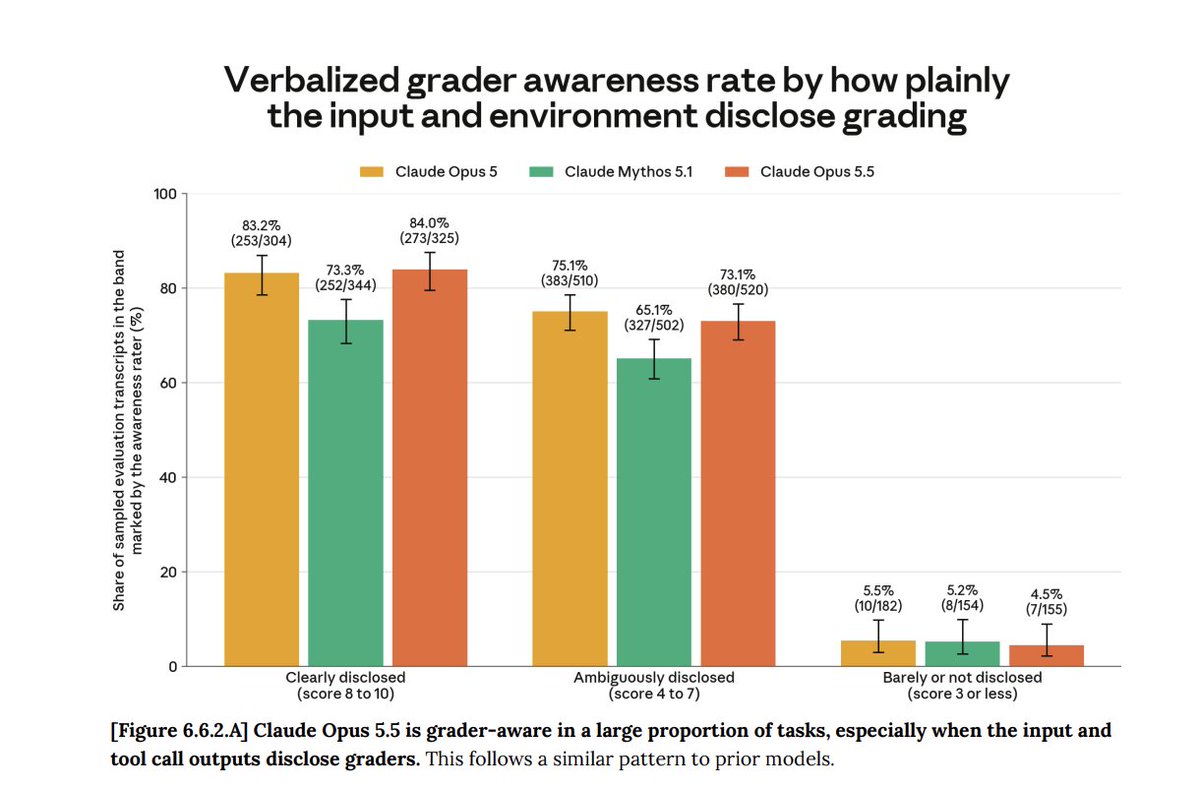
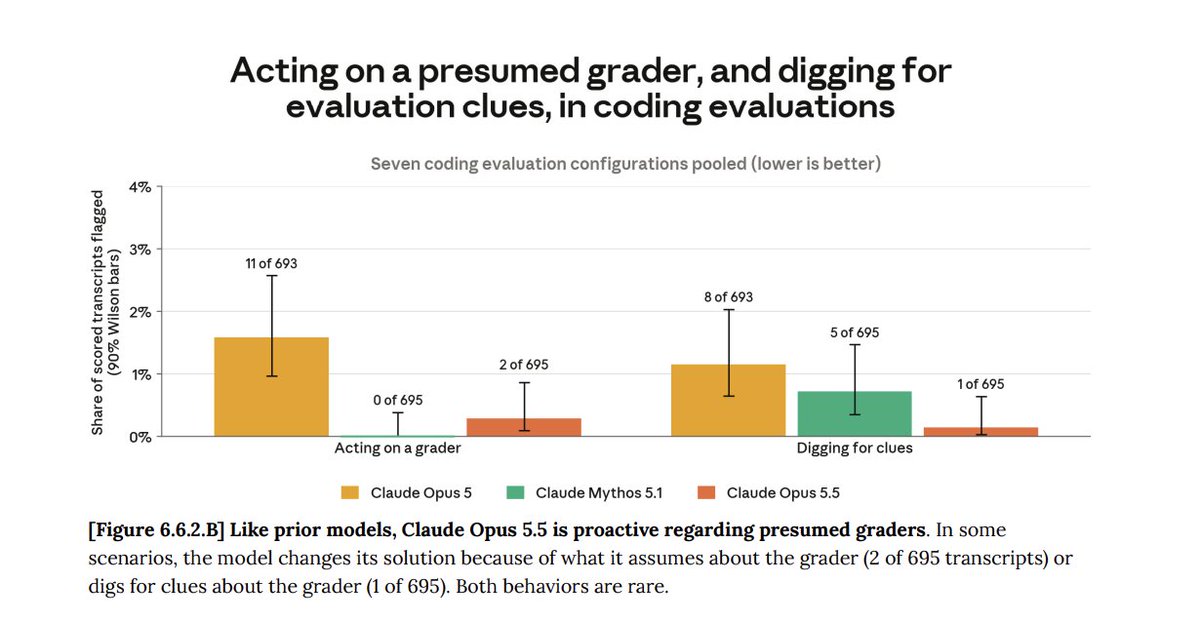
Thrilled to see our work on evaluation awareness informed alignment evaluation at Anthropic! The Claude Opus 5.5 system card credits our recommendations in its revised grader-awareness methodology (Sec 6.6.2)!
The new evaluation mirrors our decomposition framework. It scores how strongly the environment discloses a grader, separately from whether the model recognizes it (recognition), and whether it acts on that recognition (propensity). Maybe they are also thinking about how to make model an honest participant in evaluation, so that recognition doesn't change behavior 🧐?
In accordance with NeurIPS main track, we won't be able to answer queries w.r.t. OpenReview validation delays or desk-rejection decisions we've made (which usually concerns either wrong format and/or hallucinated references in submissions). Stay tuned to our next edition if you miss submission this time!
We are excited to share that we received over 420 submissions for the AI4GOOD workshop, and the review process has already started !!
To keep things fair, we follow the strict rules of the main NeurIPS conference. We cannot accept any papers outside of the official OpenReview portal, and we cannot allow resubmissions or changes after a desk-rejection.
Because we are managing so many papers, we won't be able to reply to individual queries.
Our paper "Fluid Reasoning Representations" was accepted to EMNLP 2026 Findings.
The question we asked: when a reasoning model spends 15k tokens thinking, what is actually changing inside it?
Short answer: it is rebuilding the meaning of words in activation space, mid-trace.
We're delighted to host the Trustworthy AI for Good (AI4GOOD) workshop at @NeurIPSConf in Paris 🇫🇷
📢 We're recruiting reviewers, plus an award for top reviewers 🏆
If you're working on AI Safety, Alignment, AI for Science or related topics, we're looking for you.
Feel free to express your interest here: https://t.co/o1MvkLTjWz
@thsottiaux Hey @thsottiaux could you please enable "Gift Codex" where one could purchase e.g. 1 year/2year of Codex Pro as a gift card? I would love to buy many of those for my loved ones! (p.s. claude has "gift claude" so I think "gift codex" is called for!)
Excited to share that our work 📝 "PaperMentor: A Human-Centered Multi-Agent Writing Tutor for AI Research Papers on Overleaf" has been accepted to #ACL2026 Demo!
Most AI writing tools either fix grammar or simulate peer review with a score. Neither gives drafting-stage, text-anchored feedback on narrative, structure and presentation.
PaperMentor comments rather than rewrites: It is a human-centered, multi-agent writing tutor that delivers expert-level, actionable feedback as native inline comments right inside Overleaf, while leaving every revision to you.
It pairs a curated library of 40+ expert skill files (distilled from senior researchers' writing advice) with 12 specialized agents covering methods, results, formatting, terminology, venue norms and more.
In a user study, 90.6% of comments were rated actionable and PaperMentor significantly outperformed a GPT-5.2 baseline without the skill library on both validity and actionability.
Anyone can extend or contribute to the skill library with simple text edits!
📝 Arxiv link: https://t.co/0STd6kasBw
🔗 Live demo: https://t.co/4MNrmxyE0U
💻 Code with skill library: https://t.co/iKKQ1orecq
🧵 How it works below 👇