This apparently needs repeating: If you hold information that will change humanity as we know it, and alter our understanding of our place in the universe as humans -- then go ahead and change the world.
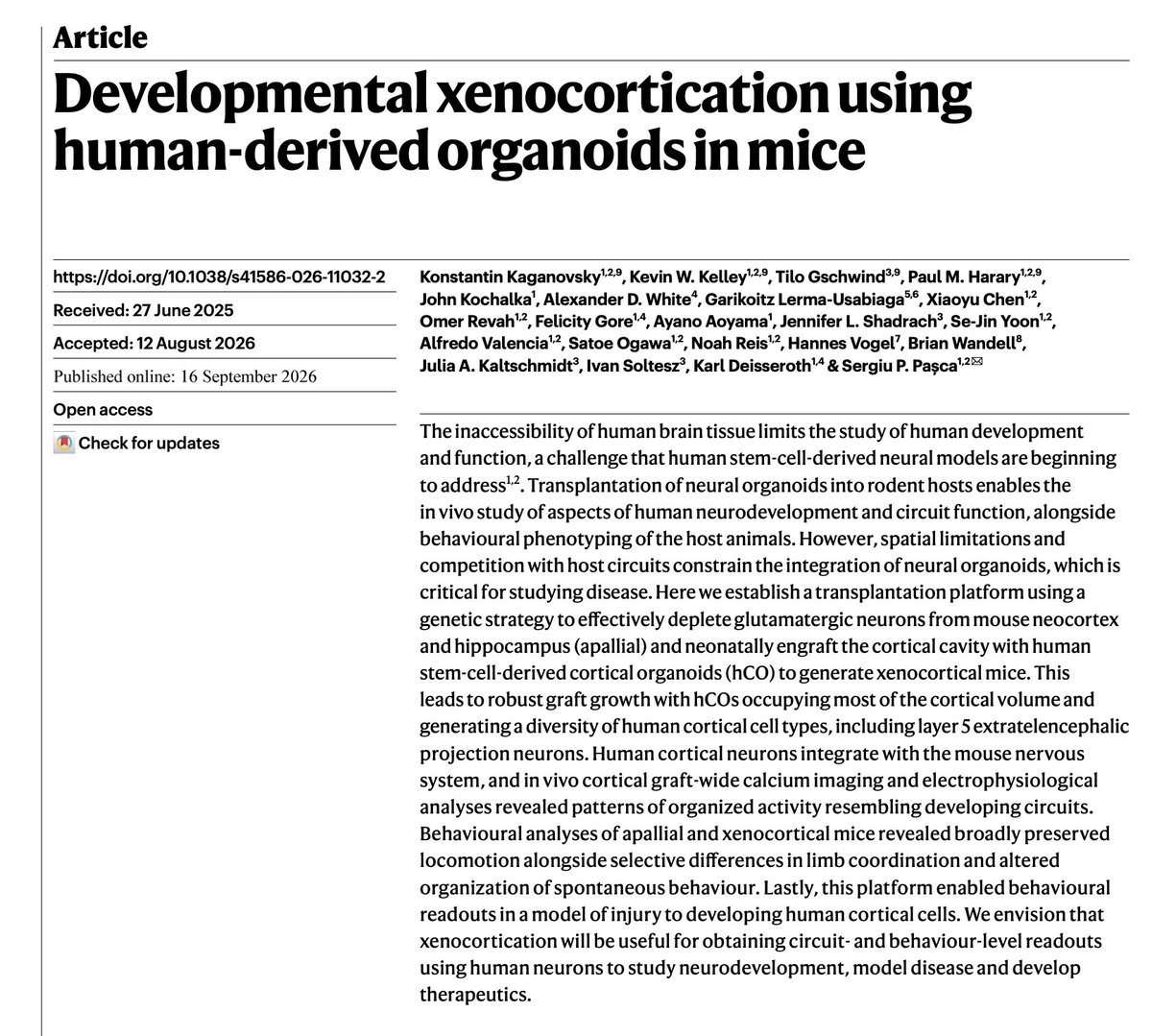
An extraordinary @Nature paper has just landed from the lab of @Sergiu_P_Pasca at @Stanford - led by Konstantin Kaganovsky. They have found a way to create "xenocortical mice" which have ~92% of their cortex occupied by a cortical organoid derived from human stem cells. This human-derived cortical graft integrates deeply with the host nervous system, supporting organised neural activity and behaviour.
This study is a milestone in synthetic biology and chimera research. It has the potential to generate multiple medical breakthroughs by providing an enhanced biological model of human brain tissue that allows behavioural as well as neural and genetic assays.
The Stanford team have been exceptionally thorough and proactive in addressing ethical concerns that comes from this frontier work. But their pioneering work nonetheless raises many open questions: are the xenocortical mice conscious? Do they have any human-like properties of consciousness or cognition?
@NitaFarahany and I will be addressing some of these questions in a forthcoming commentary - where we'll also offer an ethically-informed roadmap to guide this important research as it progresses. In this context, "pacing the frontier" really does make sense 😉
Read the Stanford @nature paper here, and buckle up. It's wild. https://t.co/Ky9HFb9nYI
@ChaseLochmiller@OpenAI GPT-6 Astra, trained on ~100K+ NVIDIA Grace Blackwell NVLink72. From ChatGPT to o1 to Astra in 4 years.
AGI has arrived. Congratulations @OpenAI team.
400K GPUs coming online next.
Your mind is a computer. If you haven't spent 20 minutes in genuine boredom this week, I guarantee you have at least 50 open tabs of useless loops circling around making you feel restless.
An argument from 3 days ago, 500 bookmarks you'll never use, Some social justice problem you literally can't do anything about or doesn't affect you.
Now multiply that by your entire life experience compared to how much genuine "do nothing boredom" time you've spent. Probably 99% stimulation 1% genuine do nothing.
Your brain is trying to render YOUR ACTUAL LIFE (present moment + future possibilites) while simultaneously running all those useless loops. WHILE trying to separate the signal (emotionally charged life experiences) from the noise (algorithmic input). Of course you feel overwhelmed/restless cause your mind is working OVERTIME.
It's like living on 15 frames per second and 400 ping. How many times have you caught yourself talking to someone and you don't even hear what they said (even tho they're right in front of you) cause you got distracted by some dumb shit you randomly remembered from 5 years ago.
Boredom is the key, REAL BOREDOM (allowing urself to relax) is meditation. Meditation isn't activating your butthole chakra or shooting lighting bolts out of your third eye.
It's about allowing yourself to relax SO DEEPLY that LIFE can work it's magic THROUGH YOU (all you have to do is chill for a few minutes).
Process = random tabs opened each in your mind -> all the data is digested -> separates signal (life lesson) from noise (conditioning/limits) -> Ctrl + Alt + Deleting all the old programs -> Uses new INFO + Space to automatically update your software (perspective) and your hardware (neural network).
After that, your render distance expands. Brightness cranks up, contrast gets increases (like a low dose of psychedelics), creativity that you haven't had since being a child comes back, time slows down in a good way. You see all the small details like changing a game from 15 FPS to 240 FPS. Your life is BACK and you feel ready to LIVE out what is pulling your curiosity.
All you have to do is sit through 20 minutes of boredom withdrawals until you get to the place of ALLOWING yourself to relax.
Btw I wrote a free 7 letter series that walks you through the process - link in bio (even my 16H screentime a day sister was able to do it).
𝗢𝗻𝗲 𝗺𝗲𝗺𝗼𝗿𝘆 𝗰𝗮𝗻’𝘁 𝗿𝘂𝗹𝗲 𝘁𝗵𝗲𝗺 𝗮𝗹𝗹.
We present 𝗟𝗼𝗚𝗲𝗥, a new 𝗵𝘆𝗯𝗿𝗶𝗱 𝗺𝗲𝗺𝗼𝗿𝘆 architecture for long-context geometric reconstruction.
LoGeR enables stable reconstruction over up to 𝟭𝟬𝗸 𝗳𝗿𝗮𝗺𝗲𝘀 / 𝗸𝗶𝗹𝗼𝗺𝗲𝘁𝗲𝗿 𝘀𝗰𝗮𝗹𝗲, with 𝗹𝗶𝗻𝗲𝗮𝗿-𝘁𝗶𝗺𝗲 𝘀𝗰𝗮𝗹𝗶𝗻𝗴 in sequence length, 𝗳𝘂𝗹𝗹𝘆 𝗳𝗲𝗲𝗱𝗳𝗼𝗿𝘄𝗮𝗿𝗱 inference, and 𝗻𝗼 𝗽𝗼𝘀𝘁-𝗼𝗽𝘁𝗶𝗺𝗶𝘇𝗮𝘁𝗶𝗼𝗻.
Yet it matches or surpasses strong optimization-based pipelines. (1/5)
@GoogleDeepMind@Berkeley_AI
It’s extremely good that Anthropic has not backed down, and it’s siginficant that OpenAI has taken a similar stance.
In the future, there will be much more challenging situations of this nature, and it will be critical for the relevant leaders to rise up to the occasion, for fierce competitors to put their differences aside. Good to see that happen today.