Artists @HollyHerndon and @matdryhurst have already been pushing the boundaries of human and AI collaboration with their work since 2019.
This duo seems ahead of their time. really.
Holly teamed up with Spawn, an AI she created with her partner, artist Matt Dryhurst. Spawn learned through unique singing sessions where groups of people sang together, teaching the AI to recognize and experiment with new sounds. Instead of using AI to replicate human creativity as we know it, Holly uses it to expand the boundaries of what’s possible, creating something entirely new.
This contrasts with projects like Endel, an AI trained to generate calming background music based on factors like weather, heart rate, and time of day. Endel's music is designed to make people feel relaxed and focused, keeping the environment comfortable and soothing.
Holly's approach in her album PROTO turns this idea upside down. Instead of using AI to maintain the status quo, she uses it to challenge our understanding and explore new creative territories. The video for one of her tracks reflects this, blending the faces of different singers into a single figure that seems to represent Spawn—a fusion of both human and machine input.
For Holly and Matt, technology isn’t something that detracts from being human; rather, it’s an opportunity to forge new connections. As she explains, “There's a pervasive narrative of technology as dehumanizing. We stand in contrast to that. It's not like we want to run away; we’re very much running towards it, but on our terms. Choosing to work with an ensemble of humans is part of our protocol. I don't want to live in a world in which humans are automated off stage. I want an AI to be raised to appreciate and interact with that beauty.”
Stable Diffusion 3 is announced
Stability used @spawning_ Do Not Train registry, which has over 1.5B opt-out requests, to filter their datasets before training
Many more models will be released this year honoring opt-outs. I hope we are getting closer to it being standard!
With the advent of high-quality AI-generated media and the soon-to-be reality of generation on a real-time basis, I'm seeing a version of the same type of questions going around: how will we be able to distinguish real from generated? I think that's the wrong question to ask. It's worth remembering that generated videos have been around for 60+ years. And we are all okay. We actually already have a term for it: computer-generated imagery (CGI). Most movies and shows you watch are partially or entirely generated. Remember those dinosaurs in Jurassic Park? Guess what? They are not real. (yeah, sorry to break that) But sometimes, CGI is harder to find. Look for David Fincher's VFX breakdown of The Social Network, for example. The best CGI is the one you don't notice. And society has been perfectly fine about it.
Under that premise, then, the real concerns do not seem to be how to distinguish what is real from what is not, but what happens when everyone has the tools that a David Fincher movie budget has. What happens when everyone can create anything they can imagine. My long-term position is that what is needed moving forward is a focus on i) digital literacy and ii) social awareness.
i) Digital literacy: you need to adjust your mental models for every new technology. We keep discussing how fast technology changes, but we rarely discuss how fast culture adapts. We tend to underestimate speed of cultural changes and human adaptability. The best way of updating a prior is to have experience and exposure. One of the earliest films ever made was “The Arrival of a Train at La Ciotat Station” by the Lumière brothers in 1895. Legend has it that when the film was first screened, the audience panicked and fled the theater, convinced that the train in the film was going to burst through the screen and run them over. You can cure your fear of trains in films by understanding how movies are made.
ii) Collective awareness: Social verification is key for any malicious type of content. We are already collectively good at sussing out malicious things that are trying to be passed as truth but are not. We get better at collective awareness by exercising more of i). The solution to potential challenges posed by ubiquitous access to high-quality content creation tools is not merely technological but also cultural and educational.
I’ve recorded an interview with brilliant historian of science, Professor Simon Schaffer of Cambridge University about the surprising and little-know history of artificial intelligence and what we can learn from that. Here’s the series trailer! https://t.co/BmYnEgUDZ8
Not true. We said exactly the same thing about photoshop 30 years ago.
When considering technological change, you should also factor in the human and social behavioral changes that come with it.
Very useful paper from DeepMind scientists on " Levels of Artificial General Intelligence": "we propose 'Levels of AGI' based on depth (performance) and breadth (generality) of capabilities, and reflect on how current systems fit into this ontology." https://t.co/9XBL4niLWZ
I just stumbled upon this article about workflows for AI classification in #archive made by the Visual Methodologies collective at @HvA. Very useful study case.
https://t.co/nNg6I8cXdB
I consider Yuval Harari a remarkable figure in today's conversation about society, humans and technology. That's why I want to share this interview where he expresses his point of view of what is happening in the Middle East.
https://t.co/aYj3EkY10K
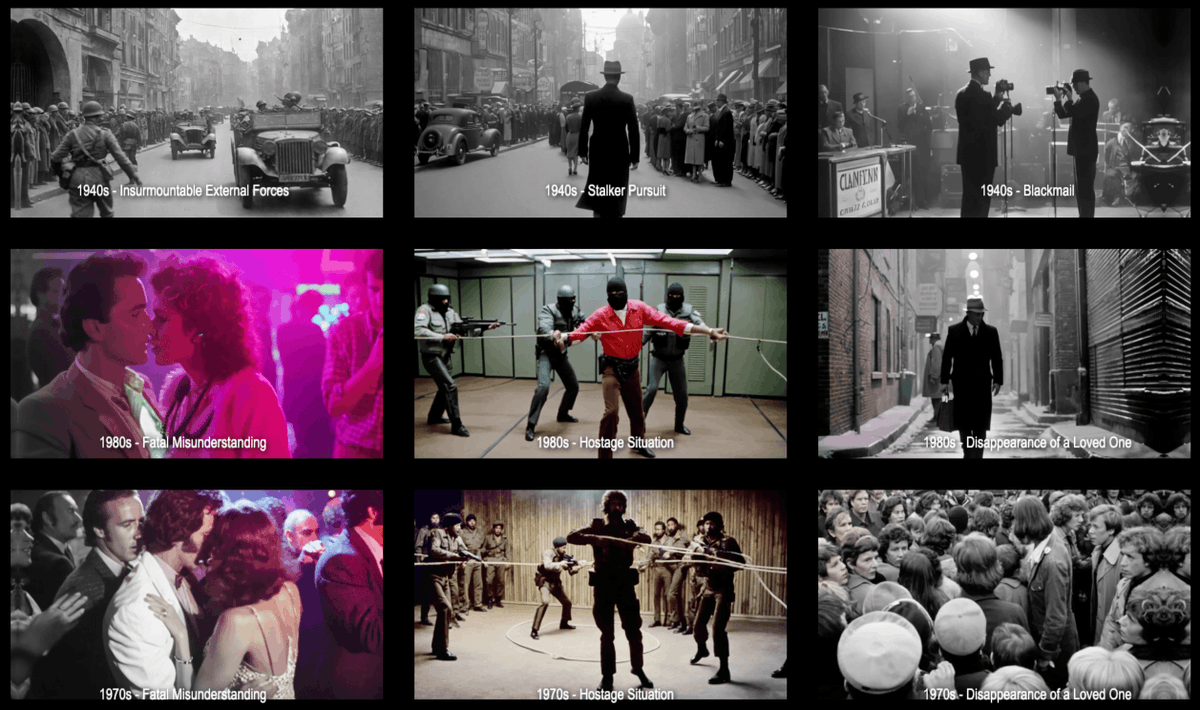
Today at @BeeldenGeluid#RemixFest I'll be giving a lecture and showcasing work I've been doing with #GenerativeAI for its use as a creative tool for researchers and storytellers.
More info at https://t.co/RL6lnhN9Hk