New Research!🚨
Humans get insights from pilot studies in long-horizon tasks, and it also applies to LLM.
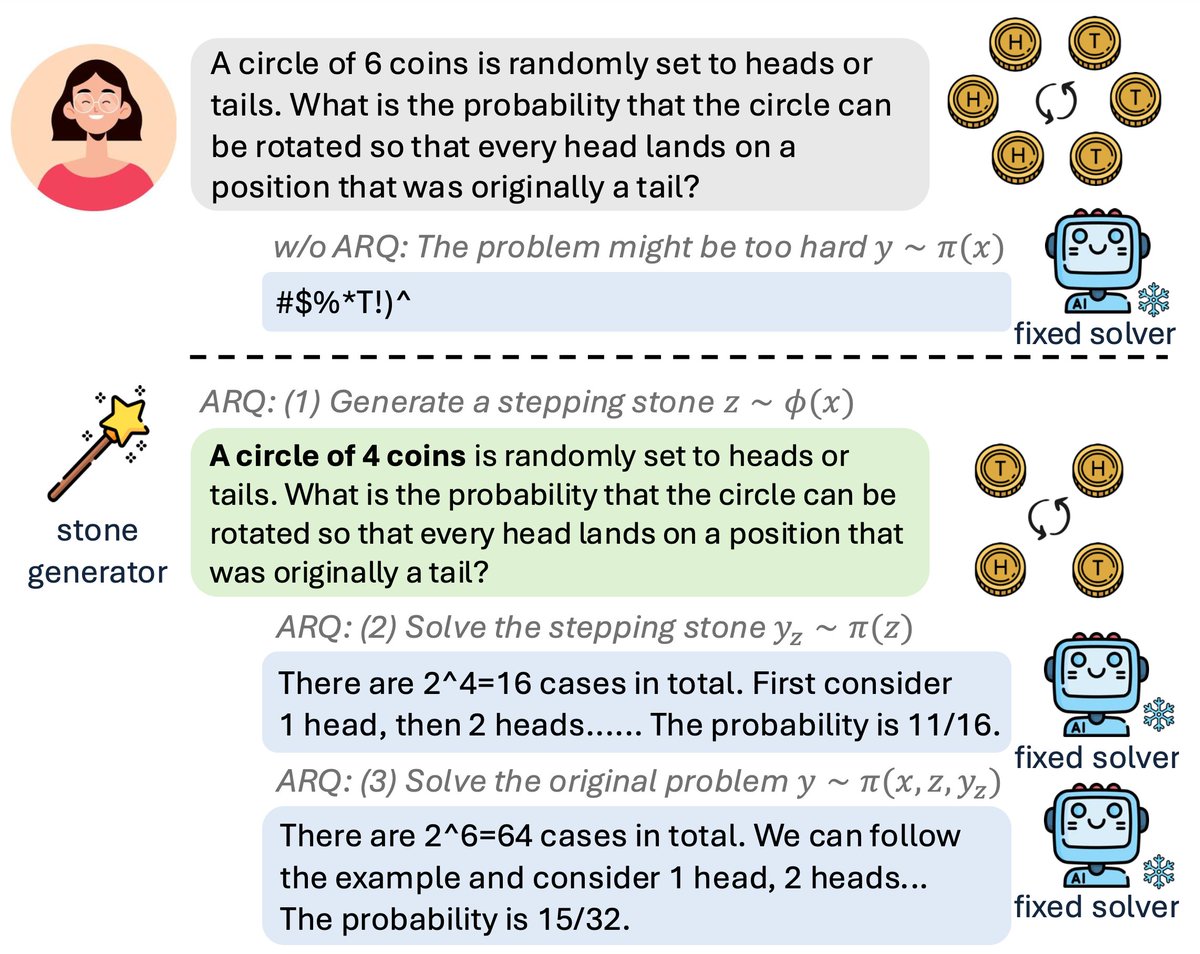
Stepping stone questions provide inspiration for solving hard problems, and even a cutting-edge reasoning model benefits from stepping stones generated by a weaker model.
New research
1/🧵When running into hard questions that seem formidable, we try to make progress by asking related **stepping stone** questions that may help us gain intuition towards solving the ultimate question. In this work, we ask if LLMs can benefit from the same concept.
We gave popular agents (Claude Code & Codex) a browser-based visual interface and let them command a robot via MCP tools — like a human with a mouse and keyboard — and it worked!
Introducing VIA: Visual Interface Agent for Robot Control. 🧵
Hello world :)
We are BOLD — the British Open-ended Learning and Discovery Lab!
BOLD is a new academic research lab fully focussed on paradigm breaking discoveries in fundamental AI. We work towards more efficient & open AI that is built around human needs and capabilities.
To pursue these breakthroughs, we pioneer new modes of collaboration in academia that are more focussed, resourced, agile, and collaborative. Rather than fragmenting resources, today we are sunsetting 5 of the UKs leading AI labs to join forces under our joined scientific vision.
Our vision is centered around three pillars:
⚡ Beyond backpropagation – questioning the foundations of the field.
🤝 Human-centric learning & discovery – treating humans as core to our algorithms
🤖 Embodied learning – fast learning and adapting methods that deal with the messy real world
BOLD is backed by @UKRI_News and @EPSRC with £30M – and this is just the beginning. We are urgently looking for partners and sponsors to 10x this.
👉 https://t.co/eFVFW31mqz
👉 https://t.co/Eoad4G18KL
@j_foerst, @CULLYAntoine, @tonizza82, @shimon8282, @tonizza82, Ani Calinescu & @_rockt
CV has CNNs, NLP has transformers - what inductive bias does RL have? How can policies generalise to regions of the dataset suffering from poor transitions?
We motivate hierarchy by enabling distinct state-representations at different levels of the hierarchy @FLAIR_Ox@j_foerst
✨ Introducing π-BENCH: a benchmark for proactive personal assistant agents in long-horizon workflows.
Real personal assistants work in continuous application scenarios: research projects 🔬, legal handoffs ⚖️, marketing campaigns 📣, financial analysis 📊, pharmaceutical documentation 💊, and more.
In these settings, a task today may depend on something from much earlier: a decision made several sessions ago, a file updated last week, a previous artifact, or a persistent user preference.
π-BENCH tests whether agents can connect these dots across sessions—and, more importantly, use them proactively.
- Can the agent notice what the user forgot to mention?
- Can it ask the right clarification before going in the wrong direction?
- Can it reuse prior context instead of making the user repeat it?
That is the core of π-BENCH: evaluating whether agents can handle long-range dependencies and proactively resolve unstated user intents in realistic, multi-session personal-assistant workflows. 🧵
Huggingface: https://t.co/lUsbrxbza0
Project page: https://t.co/H9zmCBL2AP
Can a simply trained 30B model reach gold-medal-level olympiad reasoning in pure natural language?
In our new report, we introduce **SU-01**, a 30B-A3B model trained with a simple unified recipe for rigorous mathematical and scientific reasoning.
The recipe is intentionally lightweight: around **340K sub-8K-token SFT trajectories**, followed by only **200 RL steps**, then test-time verification and refinement.
The resulting model supports stable reasoning on difficult problems with trajectories exceeding **100K tokens**.
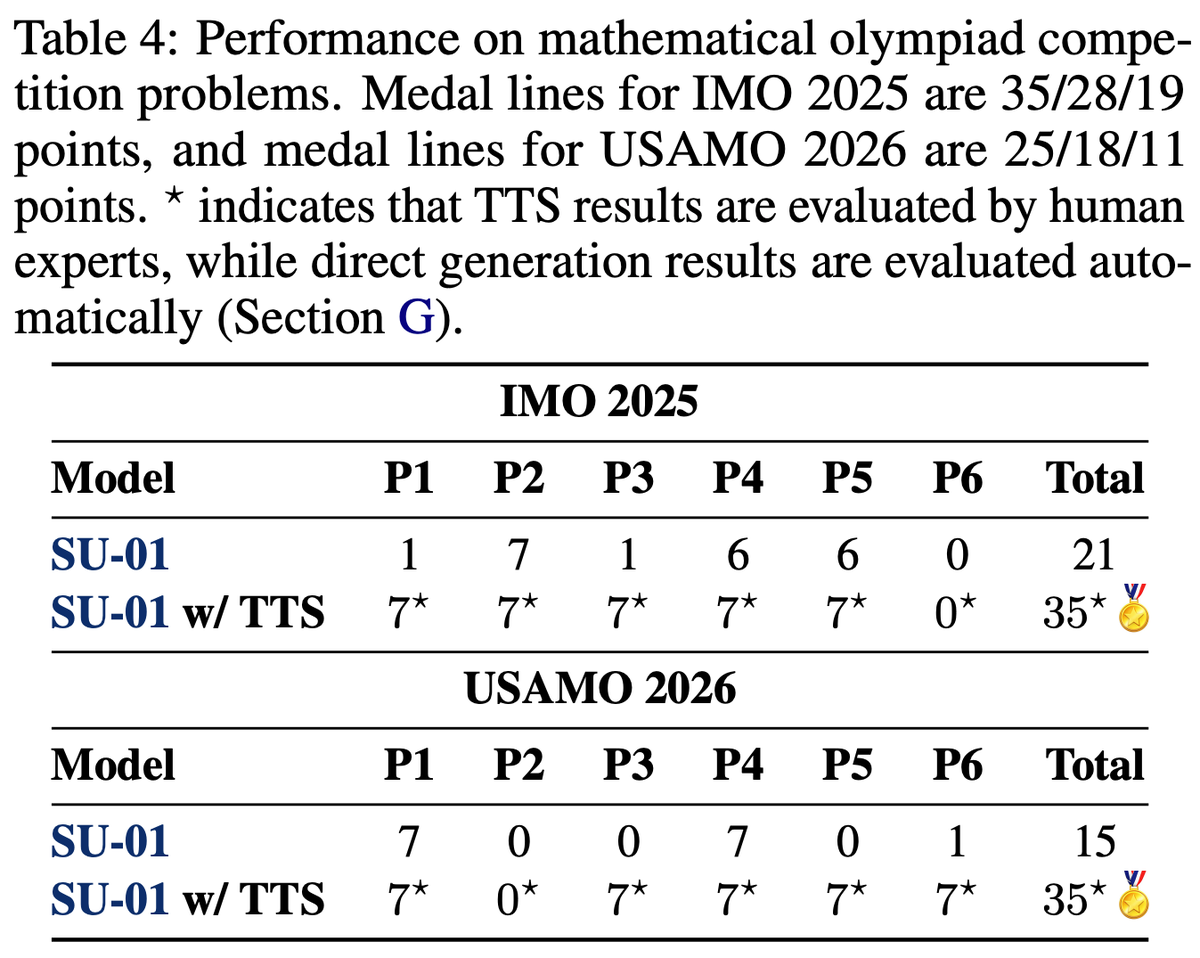
With test-time scaling, SU-01 achieves:
- **35 points on IMO 2025**, meeting the gold-medal line;
- **35 points on USAMO 2026**, far above the 25-point gold line and matching the highest human score among 340 contestants. It also received full credit on Problem 3, where the human average was only 0.01 and no contestant scored above 5;
- gold-level performance on **IPhO 2024/2025**;
- **70.2% on IMO-ProofBench**, close to Gemini 3.1 Pro Thinking.
The key takeaway is simple:
Olympiad-level scientific reasoning may not require a giant model or a heavily customized pipeline for each domain.
What matters is learning a reusable loop of **proof construction, verification, and refinement**.
We have open-sourced the code and model:
Paper: https://t.co/9ZQmttLo8x
Github: https://t.co/yrLWY4Cl7i
Model: https://t.co/qJqXRxrYv0
We’re releasing LongCoT, an incredibly hard benchmark to measure long-horizon reasoning capabilities over tens to hundreds of thousands of tokens.
LongCoT consists of 2.5K questions across chemistry, math, chess, logic, and computer science. Frontier models score less than 10%🧵
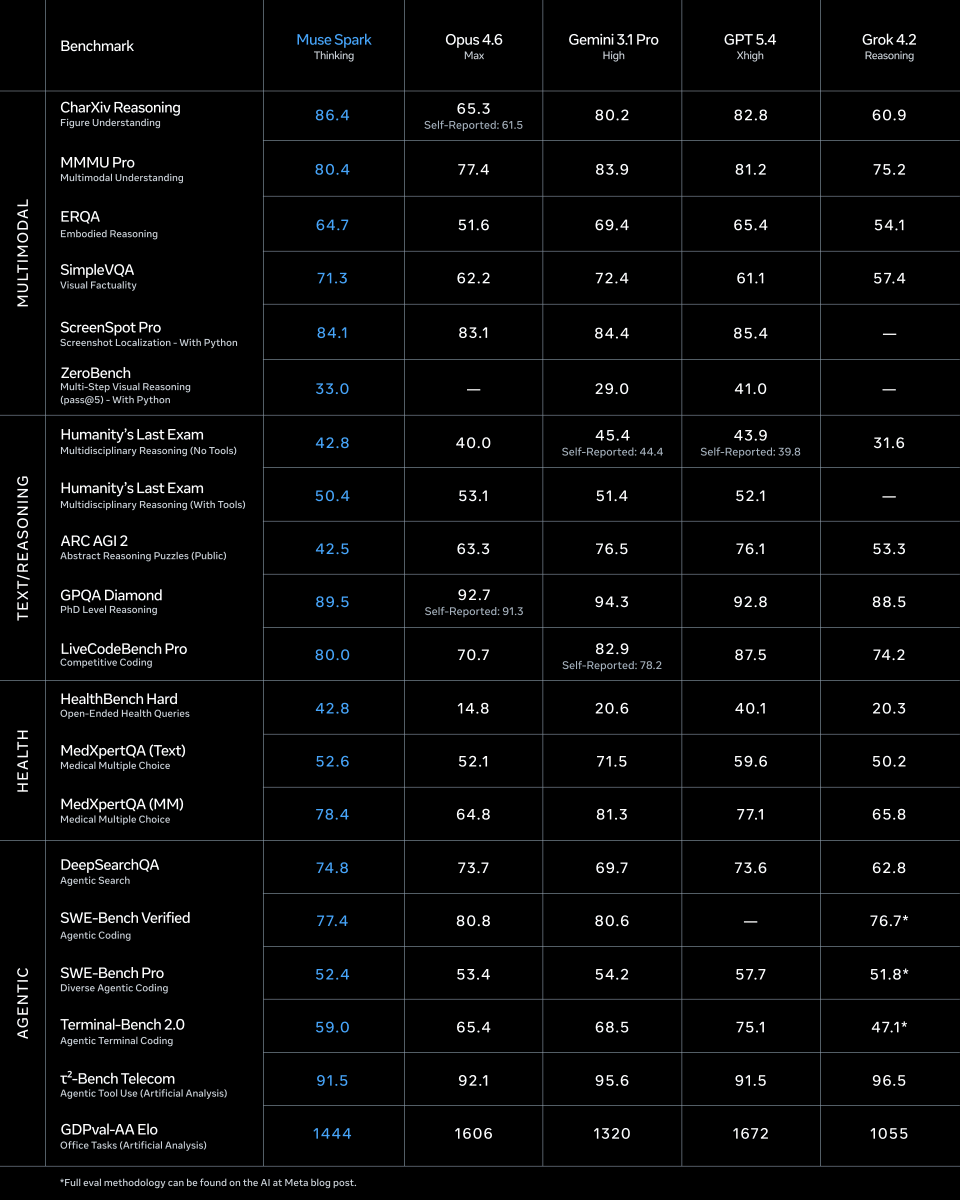
1/ today we're releasing muse spark, the first model from MSL. nine months ago we rebuilt our ai stack from scratch. new infrastructure, new architecture, new data pipelines. muse spark is the result of that work, and now it powers meta ai. 🧵
Introducing ✨Infusion✨, our *new paper* made possible by the UK AISI Challenge Fund and Sovereign AI!
1/8🧵 TL;DR
Influence functions are commonly used to attribute model behavior to its training data. In this paper we explored the reverse: whether it's possible to use influence functions to craft training data that induces model behavior?
Huge thank you to my amazing collaborators for making this possible
@LauraRuis@_robertkirk@egrefen@j_foerst and of course
@AISecurityInst and @UKSovereignAI!
Two days ago, Anthropic cut off third-party harnesses from using Claude subscriptions — not surprising. Three days ago, MiMo launched its Token Plan — a design I spent real time on, and what I believe is a serious attempt at getting compute allocation and agent harness development right. Putting these two things together, some thoughts:
1. Claude Code's subscription is a beautifully designed system for balanced compute allocation. My guess — it doesn't make money, possibly bleeds it, unless their API margins are 10-20x, which I doubt. I can't rigorously calculate the losses from third-party harnesses plugging in, but I've looked at OpenClaw's context management up close — it's bad. Within a single user query, it fires off rounds of low-value tool calls as separate API requests, each carrying a long context window (often >100K tokens) — wasteful even with cache hits, and in extreme cases driving up cache miss rates for other queries. The actual request count per query ends up several times higher than Claude Code's own framework. Translated to API pricing, the real cost is probably tens of times the subscription price. That's not a gap — that's a crater.
2. Third-party harnesses like OpenClaw/OpenCode can still call Claude via API — they just can't ride on subscriptions anymore. Short term, these agent users will feel the pain, costs jumping easily tens of times. But that pressure is exactly what pushes these harnesses to improve context management, maximize prompt cache hit rates to reuse processed context, cut wasteful token burn. Pain eventually converts to engineering discipline.
3. I'd urge LLM companies not to blindly race to the bottom on pricing before figuring out how to price a coding plan without hemorrhaging money. Selling tokens dirt cheap while leaving the door wide open to third-party harnesses looks nice to users, but it's a trap — the same trap Anthropic just walked out of. The deeper problem: if users burn their attention on low-quality agent harnesses, highly unstable and slow inference services, and models downgraded to cut costs, only to find they still can't get anything done — that's not a healthy cycle for user experience or retention.
4. On MiMo Token Plan — it supports third-party harnesses, billed by token quota, same logic as Claude's newly launched extra usage packages. Because what we're going for is long-term stable delivery of high-quality models and services — not getting you to impulse-pay and then abandon ship.
The bigger picture: global compute capacity can't keep up with the token demand agents are creating. The real way forward isn't cheaper tokens — it's co-evolution. "More token-efficient agent harnesses" × "more powerful and efficient models." Anthropic's move, whether they intended it or not, is pushing the entire ecosystem — open source and closed source alike — in that direction. That's probably a good thing. The Agent era doesn't belong to whoever burns the most compute. It belongs to whoever uses it wisely.
Hiring 🎉
Researchers to work on Chains-of-Thought faithfulness, reasoning verification, and AI monitoring robustness, some core questions for how oversight actually works in practice.
Looking for: 2 researchers (with PhD), 1 RA
DM or email with what you'd want to work on.
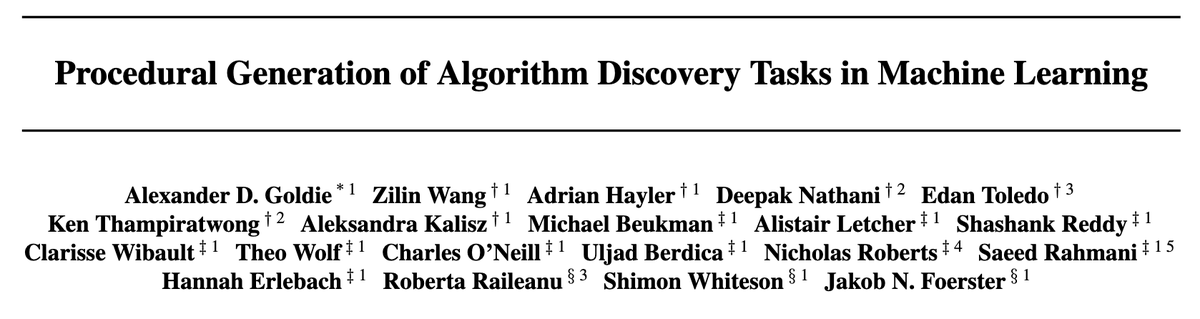
1/ 🪩 Automating the discovery of new algorithms could unlock significant breakthroughs in ML research. But optimising agents for this research has been limited by too few tasks to learn from!
Introducing DiscoGen, a procedural generator of algorithm discovery tasks 🧵
Agents can remember. Agents can learn. But can they learn how to learn? 🤔
MetaClaw tech report is out 📄 — a continual meta-learning framework that teaches deployed agents not just to learn, but to learn how to learn, evolving 24/7 through normal usage.
📊 On 588 continual CLI tasks over 14 simulated workdays:
🦞 Kimi-K2.5 accuracy: 21.1% → 39.6% (+88%)
🚀 Task completion: 18.2% → 51.9% (+185%)
💪 GPT-5.2 also benefits: 44.9% → 49.1% acc, 58.4% → 67.5% completion
Even the strongest models get better with MetaClaw.
Kudos to the team @richardxp888, @JimChenjw, @Xinyu2ML, @lillianwei423, @StephenQS0710, @HaoqinT, @JiaqiLiu835914, @yuyinzhou_cs, @ZhengBerkeley, @cihangxie
The idea of rotating attention by 90° is sooooooo cool (credits to @Jianlin_S 's insights), and it surprisingly works.
We (w/ the amazing @nathan) are so excited about this— been working on the paper for months and couldn't stop.
Go give it a try. It's a drop-in replacement for standard residuals, born in 2015.
really like the figs btw :-)