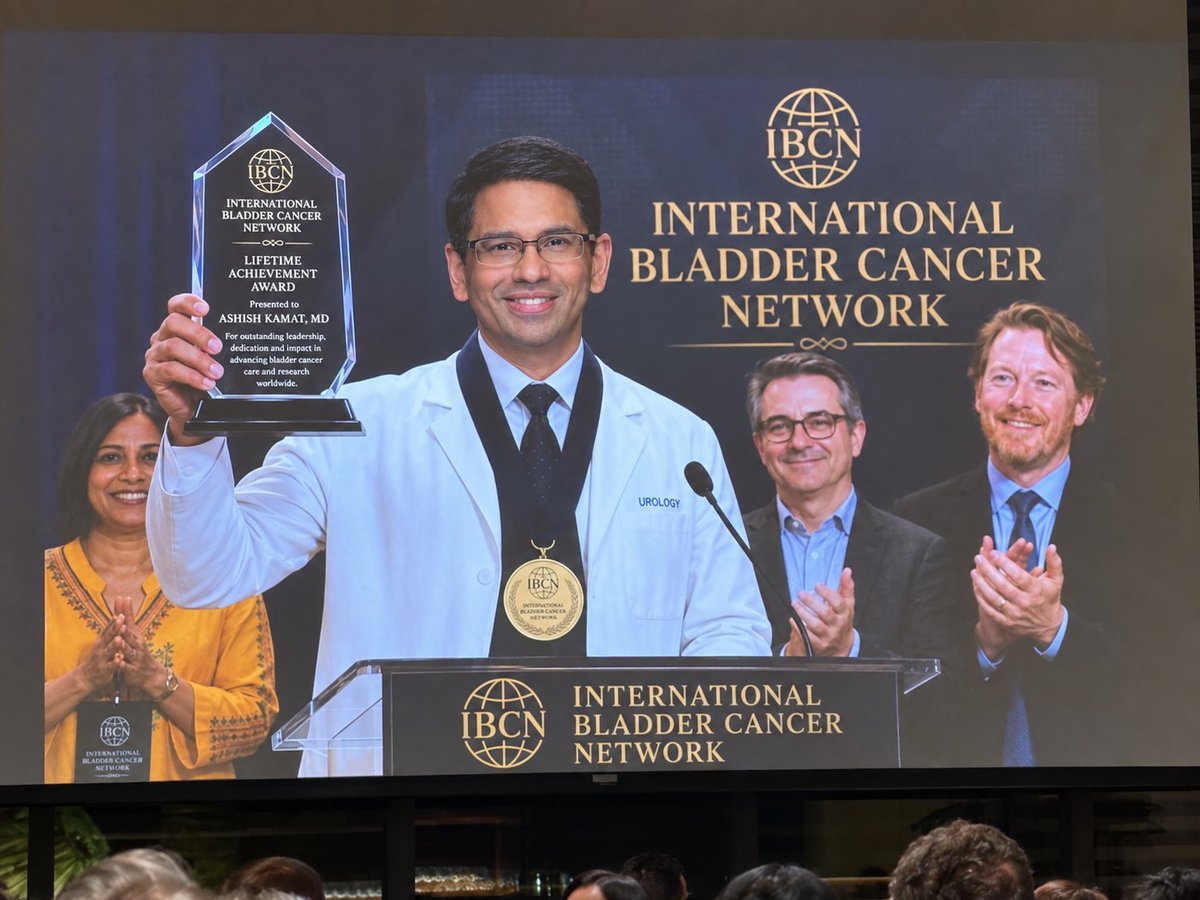
Deeply honored to receive the IBCN Lifetime Achievement Award.
This one is particularly special. IBCN has been a big part of my life for many years, and many colleagues have become close friends along the way.
And receiving it from @pcvblack made it even better. I used to evaluate him. Now apparently he gets to evaluate my lifetime! (His AI skills, however, remain a work in progress).
Thank you to everyone who has been part of the journey. Although, as I said tonight, I certainly hope the “achievement” part isn’t over yet! 😊
#BladderCancer #IBCN @IBCN1997@mouwlab@LDyrskjot@WesKassouf #OncSurgery @IBCG_BladderCA@UTMDAnderson
Practical pathways for delivering new #BladderCancer therapies in community #urology. @HafronJason joins @UroDocAsh explaining how independent urology practices can reliably adopt new intravesical bladder cancer therapies, using gemcitabine intravesical system (TAR-200) that carries a J-code, as the primary example for BCG-refractory disease. #WatchNow > https://t.co/4RMwnsbmgK
Some thoughts on burnout: 🧵
A part of burnout in medicine, especially in academia, is that people are carrying around with them an enormous number of thoughts and frustrations that just sit there and fester in their minds, and they see no safe outlet for expressing them.
(1/)
Spot-on analysis. We assume that NECTIN4 is near ubiquitous, but if we want true precision with ADCs in urothelial cancer, surface availability and target dynamics have to replace broad-brush “positivity”.
Looking forward to the prospective readouts and implications for bladder sparing selection.
@IBCG_BladderCA@PGrivasMDPhD@AndreaNecchi@shilpaonc@UrogerliMD@DrRosenbergMSK
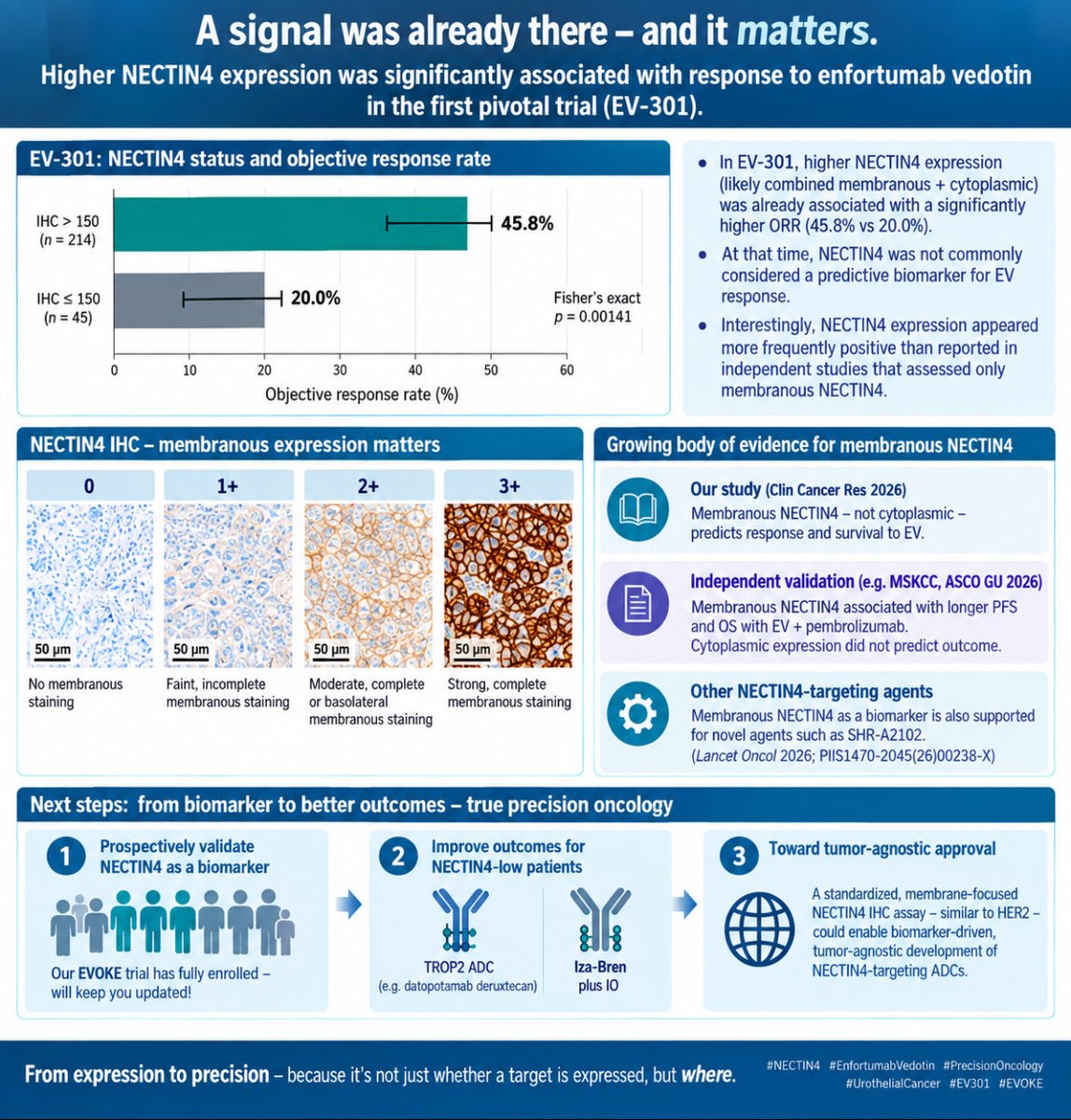
The NECTIN4 biomarker signal was already there.
We were quite surprised when revisiting the pivotal EV-301 data: higher NECTIN4 expression was already significantly associated with response to enfortumab vedotin — ORR 45.8% vs 20.0%.
At the time, this was not the prevailing view: EV was considered effective largely irrespective of NECTIN4 expression.
One possible explanation is how NECTIN4 was measured. The unusually high expression levels in EV-301 suggest that overall/combined staining may have captured both membranous and cytoplasmic NECTIN4, potentially diluting the biologically relevant signal.
Our new data show clearly:
🎯 Membranous NECTIN4 predicts EV response and survival. Cytoplasmic NECTIN4 does not.
This makes sense mechanistically: an ADC needs an accessible cell-surface target to bind and deliver its payload
-> well established eg for HER2 (Tumor agnostic approval in HER2 3+)
Since EV-301, the evidence supporting membranous NECTIN4 as a biomarker has continued to grow — including independent EV+pembrolizumab data and now other NECTIN4-targeting ADCs such as SHR-A2102.
The next step is prospective validation. Our EVOKE trial is fully enrolled — stay tuned.
And perhaps the most important question: Can we improve outcomes for NECTIN4-low tumors by selecting a different target, payload or therapeutic strategy?
This is where ADCs should be heading: from target expression to true precision oncology
@Markuseckstein3@DrRosenbergMSK@Dr_Aggen
#DGU26 @amerseburger@dgukongress@DGUrologie@OncoAlert@weoncologists@urotoday@DrChoueiri@PTarantinoMD@raffcolo@tompowles1@UroDocAsh@Uromigos@imedverse@CCR_AACR@Uroweb@PGrivasMDPhD@montypal@apolo_andrea@AndreaNecchi@DrYukselUrun
Phase II trial of neoadjuvant sasanlimab and SBRT as an in situ vaccine in cisplatin-ineligible #MIBC. @DrRajSat@MethodistHosp joins @UroDocAsh@UTMDAnderson to discuss the RAD VACCINE MIBC phase II trial combining sasanlimab with stereotactic radiation for cisplatin-ineligible muscle-invasive bladder cancer. #WatchNow on UroToday > https://t.co/8fuLYL7mw0
Phase III trial compares BCG strains and priming in #NMIBC. Robert Svatek, MD, MSCI @UTHealthSA sits down with @UroDocAsh@UTMDAnderson to discuss this three-arm trial comparing Tokyo versus TICE BCG strains with priming arm in non-muscle-invasive bladder cancer. Dr. Svatek aims to secure FDA approval for Tokyo strain to address ongoing BCG shortages despite manufacturing challenges. #WatchNow on UroToday > https://t.co/CQHTGHQCM7
Our NECTIN4 scoring system for predicting enfortumab vedotin response in urothelial carcinoma is just published. 🔬
The short version: NECTIN4 is not a failed biomarker. It has been measured in the wrong compartment.
📊 179 EV-treated mUC patients, multicenter, FISH plus IHC, benchmarked against EV-301 EPAR data.
Why the field thought NECTIN4 was ubiquitous 🧠
In EV-301 the median H-score was 250, with 82.6% ≥150. That near-universal expression underpinned the biomarker-unselected label.
In our cohort, membranous H-score alone was 160. Cytoplasmic was 200. Combined, 260, with 78.2% ≥150, almost exactly mirroring EV-301.
So the trial numbers most likely reflect membranous plus cytoplasmic staining. That single methodological choice is why NECTIN4 looked like it was everywhere. 🎯
And it matters, because only one compartment predicts anything:
✅ Membranous 2+/3+ vs 0/1+: ORR 55.1% vs 25.5% (p<0.001), mPFS 7.1 vs 2.9 months (HR 0.45), mOS 12.3 vs 6.9 months (HR 0.57).
❌ Cytoplasmic: ORR 49.6% vs 39.5% (p=0.4). No PFS or OS signal.
❌ Bulk NECTIN4 mRNA, which cannot resolve localisation: no association either.
Adding cytoplasmic staining inflates positivity and dilutes prediction. Negativity rate drops from 12% to 3.4%. More positives, less information. 📉
The scoring system 🔬
Four tiers (0, 1+, 2+, 3+) adapted from the ASCO/CAP HER2 gastric algorithm, chosen deliberately because it accounts for incomplete membranous staining, the same framework that carried T-DXd to tumour-agnostic approval.
Blinded interobserver testing, 44 cases, three raters, two with no prior NECTIN4 experience:
📈 Fleiss' κ 0.749 across all four tiers.
📈 Fleiss' κ 0.874 for the clinically relevant 0/1+ vs 2+/3+ cutoff. Almost perfect agreement.
Reproducible, teachable in a short training session, deployable in routine practice.
Genomics on top 🧬
NECTIN4 amplification in 25.1% (45/179). ORR 76.2% vs 36.6%. mPFS 12.2 vs 3.9 months (HR 0.40). mOS 30.1 vs 8.5 months (HR 0.33). At 24 months, 58.8% of amplified patients were alive versus 19.0%.
And IHC prescreens for it: 80% of amplified tumours are 3+, under 5% of 0/1+ tumours carry an amplification. Restricting FISH to 2+/3+ captures 97.8% of amplified cases while sparing 29.1% of patients any molecular testing. ⚡
The integrated three-tier model:
1️⃣ Amplified: ORR 76.2%, mOS 30.1 mo
2️⃣ Non-amplified, membranous high: ORR 42.9%, mOS 8.8 mo
3️⃣ Non-amplified, membranous low: ORR 26.1%, mOS 6.9 mo
Both remained independent in multivariable models. C-index for OS improves from 0.557 to 0.621 when amplification and membranous expression are combined. Neither marker alone does what the two do together.
Where I think this lands 🎯
I do not (!) read this as an argument for testing every patient . With EV+P as first-line standard and few alternatives, a negative result rarely changes what you do today and shouldn't change it right now given the high EVP efficacy.
But that is an argument about the therapeutic landscape, not about the biology. And the landscape is changing fast: HER2 ADCs, TROP2, HER3/EGFR, NECTIN4 radioligands and T-cell engagers. The moment two viable options compete for the same patient, the question stops being "does the target matter" and becomes "which target first."
Notably, unlike the HER2-low paradigm, EV-301 showed an attenuated treatment effect in NECTIN4-low disease, PFS HR around 0.9 with confidence intervals crossing 1 (check out Figure 1 of the paper).
⚠️Prospective validation is running: EVOKE (DRKS00034745).
Immense thanks to @niklas_kluemper and Jonas Saal, to Thomas Büttner, Sebastian Rauch and Fabienne Lange, and to every centre and biobank that contributed. This was a genuinely collaborative effort within the fantastic GUARDIANS and BRIDGE Consortium. 🙏
🔗 https://t.co/CuQR9LJe6k
@Uroweb@AmerUrological@ASCO@PathSoc@OncoAlert@Histo_Journal@andreanecchi@emanuele_crupi@danieleraggi83@raffcolo@Dr_Aggen@DrRosenbergMSK@h_alahmadie@PGrivasMDPhD@shilpaonc@drenriquegrande@amerseburger@brookmans76@DrYukselUrun@onkowissen@imedverse@UroDocAsh@urotoday@EUplatinum@JCO_ASCO@CCR_AACR@niklas_kluemper@DrRosenbergMSK@Dr_Aggen@Uromigos@tompowles1@shilpaonc@PGrivasMDPhD
#Uropathology #urothelial #BladderCancer #NECTIN4 #pathtwitter