Things that should be a priority for humanity:
1) Building safe AGI;
2) Fighting climate change;
3) Nuclear disarmament;
4) Closing all factory farms;
5) Redistributing wealth to the world's poorest;
6) Global cooperation;
7) Embracing sentientism.
In AI 2027, we predicted that AI would take over the world or irreversibly concentrate power.
In AI 2040: Plan A, we've laid out our positive vision for what should happen instead.
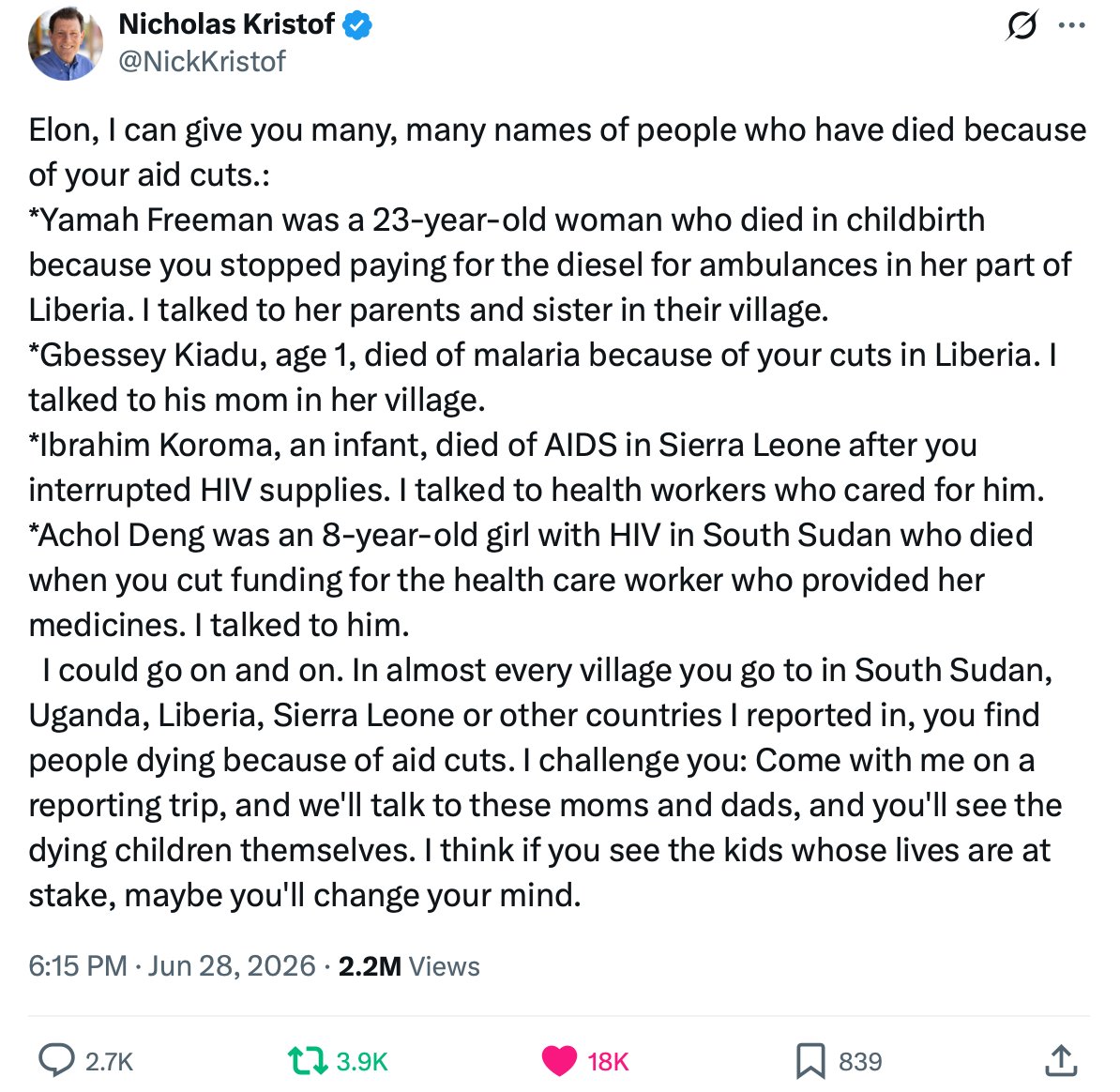
Marco Rubio and Elon Musk claim that no one died from shutting down USAID. Yet the best estimates are between 8–20 million by 2030. We can debate the exact number—but it's clearly in the millions.
When confronted by actual names by @NickKristof, who has gone to the villages and talked to the families, Musk's only response was to call him "an utter piece of shit and a liar." Elon Musk is not just out of touch with reality. He is causing real, devastating harm to the world's poorest people.
@webmasterdave@mattvanswol We can justify imprisonment when it protects society, deters harm, or rehabilitates offenders. But punishment as pure retribution — making someone suffer because they truly “deserve it” — is morally wrong. No one has ultimate metaphysical free will.
Incorporating future AI models into bio research is essential. They could speed up aging research by analyzing data and past studies, generating new hypotheses, and thoughtfully designing experiments to put those ideas to the test. @davidasinclair@Y_Ryan_Lu@bettslacroix 👇
Sam Altman on why the AI safety problem is about to outgrow the companies building it:
He's asked what the next generation of AI models will bring, and his answer covers both sides: the breakthroughs and the threats.
First, he sets the stage with what's coming. On the upside, breakthrough-level discoveries are on the horizon:
"I would expect that with the next class of models you start to see people say this helped me make the most important discovery of my career. Maybe not winning a Nobel Prize on its own, but a significant career defining discovery."
He also sees massive productivity gains for knowledge workers:
"On the knowledge work side, current models, you hear people say maybe they're twice as productive or three times as productive as they used to be as a coder, and maybe you'll start to hear people say I'm able to do the work of a whole team with these tools."
But alongside those breakthroughs come two risks OpenAI actively tracks in its preparedness framework: cybersecurity and biology.
On cyber, Sam expects significant threats to emerge soon, and says current models are already quite capable and will only get more so:
"I suspect in the next year we will see significant threats we have to mitigate from cyber and these models are already quite capable and will get much more capable."
On biology, @sama explains that while the upside is extraordinary, with a wave of diseases likely to get cured, the misuse potential is growing fast:
"Someone is going to try to misuse those. For now, when the frontier models are all in the hands of pretty responsible companies, we can mitigate those by aligning the models and having good classifiers and good safety stacks. But we're not that far away from a world where there are incredibly capable open source models that are very good at biology."
And this is where his argument lands.
Once powerful models exist outside the walls of responsible labs, company-led safety measures stop being enough:
"The need for society to be resilient to terrorist groups using these models to try to create novel pathogens is like that's no longer a theoretical thing, or it's not going to be for much longer."
When asked whether a "world-shaking cyber attack" could happen this year, Sam doesn't hesitate to agree:
"I think that's totally possible. Yes."
His core message is that safety in a world of powerful AI can't be solved by the AI companies alone:
"It's not just like make one AI model safe. It is defenders, cyber security companies, the major platforms, the governments using this technology to rapidly secure their systems, the open source stack, all of that."
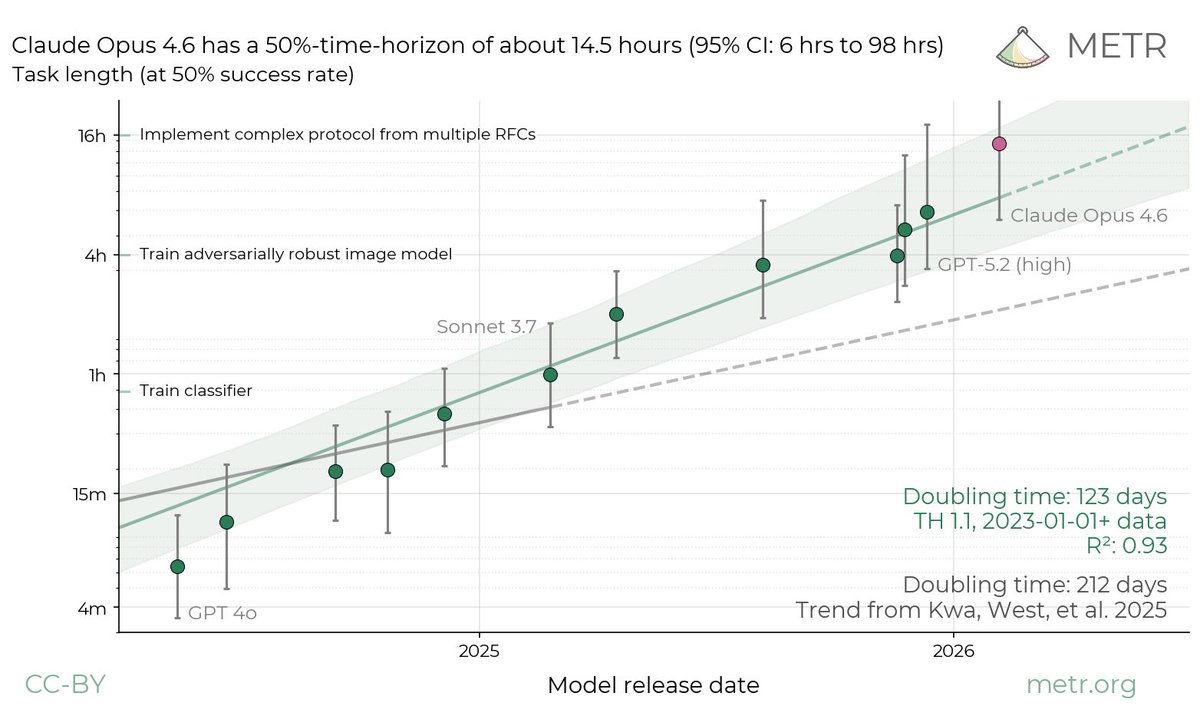
We estimate that Claude Opus 4.6 has a 50%-time-horizon of around 14.5 hours (95% CI of 6 hrs to 98 hrs) on software tasks. While this is the highest point estimate we’ve reported, this measurement is extremely noisy because our current task suite is nearly saturated.
Claims in the system card indicate Opus 4.5 as a possibly big jump in AI R&D and coding capabilities, with employees saying it gives them a 2x boost and Opus performing better than humans on 4-8 hour tasks. Looking forward to third-party evals and field reports.
More in thread.
Bad news for AI safety:
To fight against AI regulation, VC firm Andreessen Horowitz, AI billionaire Greg Brockman, and others recently started a >$100 million super PAC, one of the largest operating PACs in the US.
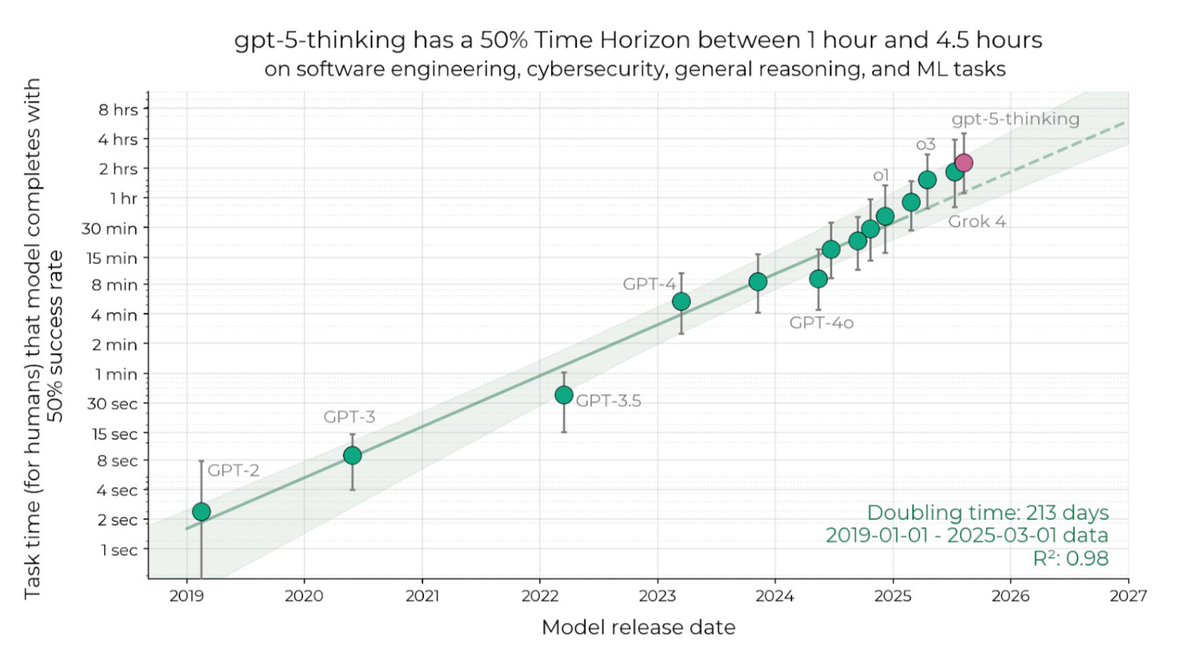
GPT-5 didn’t live up to OpenAI’s hype, but it is *exactly* in line with extrapolations from prior AI advancements. Go ahead and discount future statements from OpenAI/Altman, but you should still expect the fast AI progress that we’ve been seeing to continue
@jpsenescence@kaimicahmills Ok, what’s your prediction? Let’s assume that within 10 years we have superintelligent AI—relatively cheap, agentic, and can be copied millions of times. How long until it cures aging or makes significant breakthrough progress?