This is an excellent analysis. "But what if... the institutions of an open society are no longer necessary for scientific and technological innovation?" I am afraid of this being true. I don't want it to be true. Maybe they are still necessary but not sufficient... would love to learn more about the points raised here.
Last Thursday, I had an interesting dinner with two prominent economists. Soon, the conversation turned to Joel Mokyr’s work and its relationship with @danwwang’s recent book, Breakneck: China’s Quest to Engineer the Future.
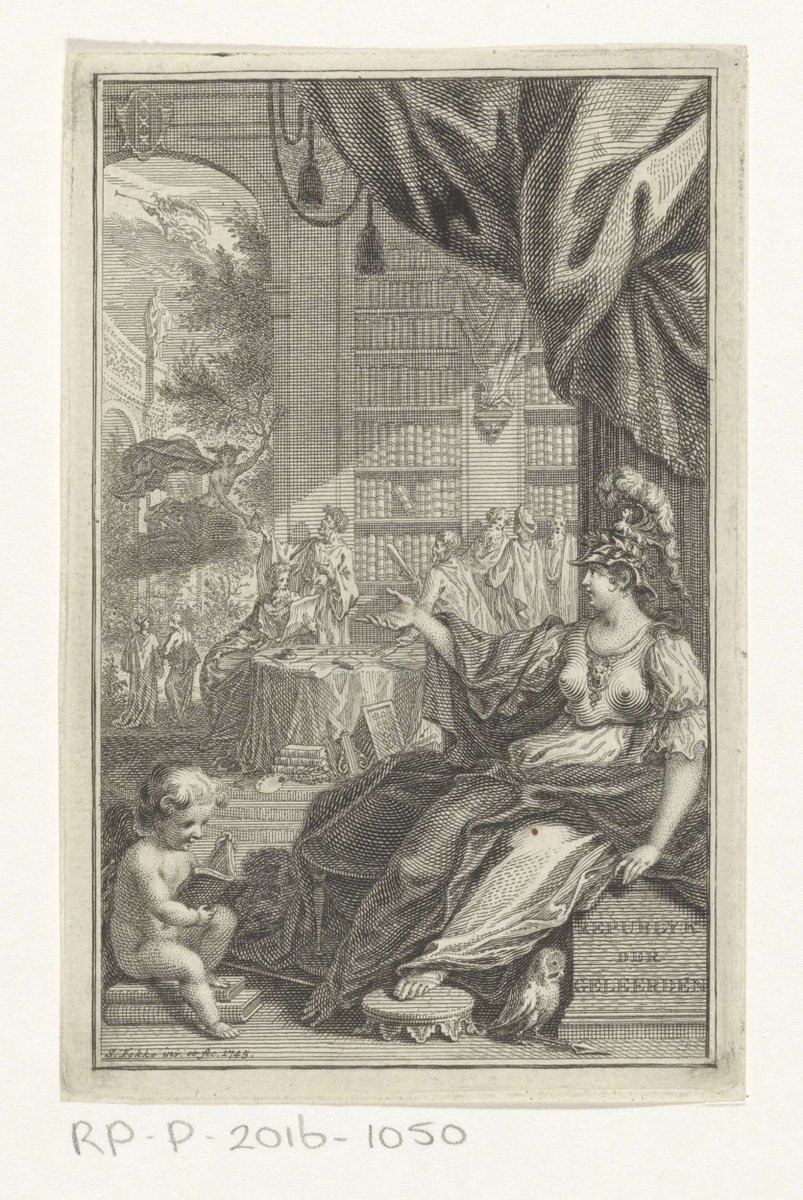
Mokyr has long argued that Europe’s Republic of Letters encouraged broad scientific and technological innovation by providing a setting where new ideas could be evaluated and disseminated. For him, Europe occupied the ideal midpoint between political fragmentation and cultural unity: enough polycentrism to prevent the suppression of ideas by heavy-handed rulers, but enough common ground to sustain serious dialogue and a deep pool of potential patrons and protectors.
But what if, as Wang cautiously suggests, the institutions of an open society are no longer necessary for scientific and technological innovation? (To be fair, Wang does not assert this as fact—he only hints at it).
Elaborating on Wang, one could construct the following argument:
1️⃣ Yes, the Republic of Letters was essential for the flourishing of the scientific method that had emerged in the late Middle Ages and the Renaissance.
2️⃣ Yes, the institutions of an open society were necessary in the 19th and 20th centuries to create today’s framework of universities, academic societies, and scientific journals.
3️⃣ But no, once the scientific method and its institutional architecture are established, an open society might no longer be needed.
4️⃣ Indeed, China possesses institutions such as Peking University and Tsinghua University, and it performs impressively in mathematics, engineering, and computer science—fields central to scientific and technological progress.
5️⃣ Lack of political freedom likely still harms the social sciences (including economics) and the humanities, but those fields may be of secondary importance for technological innovation.
6️⃣ By limiting the rise of anti-scientific movements—such as the “decolonize science” trend on many Western campuses—or by avoiding resource allocation to “useless” humanities, China might even gain a comparative advantage.
7️⃣ The historical episodes of anti-science in totalitarian regimes (e.g., Deutsche Physik in Nazi Germany or Lysenkoism in the USSR) are not inevitable in a modern, technocratic Confucian state such as China’s, which prizes pragmatism.
8️⃣ In fact, pragmatism might help China avoid some of the West’s current problems: the creeping politicization of the natural sciences, rising bureaucratization, and resource allocation driven more by lobbying than by scientific merit.
In short, have science and technology grown so powerful and self-sustaining that they no longer depend on their historical institutional scaffolding?
Let me stress that I am not endorsing points 3), 5), 6), 7), or 8). Points 1), 2), and 4) are hard to deny. My regular readers know that I would never call philosophy or history “useless.”
Moreover, I believe deeply that the institutions of an open society have intrinsic value—an argument far stronger in their favor than any instrumental one.
Still, as a researcher, I must separate what I want to be true (that open societies are better for innovation) from what the evidence actually shows.
So, what kind of empirical evidence could one gather to disprove claims 3), 5), 6), 7), and 8)?
Finally, it’s worth recalling that similar anxieties haunted the West in the 1950s and 1960s, back then focused on the Soviet Union. Would it surpass the West in economic growth and scientific innovation? It did not. Hence, my prior distribution still places a higher probability on China not overtaking the West than on the opposite outcome. Yet China is not the Soviet Union, and overfacile historical analogies are always dangerous.
“The community of interests, the unity that exists between men, stems first and foremost from scientific progress, from discoveries, inventions, and the proliferation of new machines.”
Montessori
For the first time, the world can see the January massacre unfold in sequence, through the lenses of the brave Iranians who took to the streets and documented what happened around them, sometimes in their final moments.
Hours of previously unseen footage, gathered and preserved by @ManotoNews, reveal the scale of the Islamic Republic’s mass killing of protesters. There is no outside narrator. The Iranian people recorded their own courage, the regime’s brutality and the truth it tried to conceal.
https://t.co/NOOTlRYZ19
Read the investigation by @AndyJehring and @NatalieLisbona, and watch the four-part documentary This Is Our Story.
They risked everything to leave this evidence behind. The least the world can do is watch, share and refuse to let their voices be silenced.
Content warning: graphic and deeply distressing footage.
https://t.co/q4C99k9BWE
One minute. That is all it takes to listen to this beautiful voice. One minute to become her voice.
Parastoo Ahmadi, one of Iran's most beloved singers, has reportedly been sentenced to 74 lashes simply for singing. Her musicians and production team face the same punishment. In the 21st century, a woman will be lashed on her body because she dared to sing.
I want to scream. I want to shout in the street and sing loud and tell everyone: this government is killing innocent people, executing them, lashing them. This is not a normal government.
So I am calling on every famous singer, every big name, every artist with a stage and a microphone: be Parastoo's voice. Sing for her until she can sing again.
#ParastooAhmadi
I really hate this genre of tweet because its purpose is to create cynicism about people who actually defend free speech.
And this is a particularly funny example. Did Mehdi actually read the report?
The ACLU/Amnesty report repeatedly cites my organization, @TheFIREorg, and credits us for defending pro-Palestinian students, professors, and protesters. It cites our work involving Tulane, Brandeis, the University of Florida, Texas Tech, Penn, and our First Amendment briefs in major litigation. We were involved with practically all of the incidents in someway.
And FIRE is hardly alone. @CatoInstitute, @EFF, @PENamerica, Knight, @NCAC, the @rcfp, @Rutherford_Inst, the First Amendment Lawyers Association, and others have been fighting these battles too.
So where are the “free speech warriors”? They’re in the report. They’re in the footnotes. They’re writing the letters and filing the briefs.
And on cancel culture, Mehdi has actually acknowledged that people sometimes get wrongly fired and self-censor. Where we disagreed was that he dismissed concern about left-wing cancel culture as largely a “moral panic,” while correctly pointing out that there was also a serious threat from the right.
The left-wing “moral panic” claim was partisan nonsense. The evidence of cancellation from the left was overwhelming. But the threat from the right was real too.
If you actually care about free speech, the answer is not to pick your preferred censor. It is to stand up to both.
We did.
@RIKKISCHLOTT and I wrote an entire book about it, The Canceling of the American Mind. We took on cancel culture from the left AND the right:
https://t.co/5QQbtbAYgV
In light of the progress in mathematics, we at Edison Scientific and FutureHouse have assembled a set of Millennium Problems for Biology. They are chosen to be very hard to solve but very easy to validate in a simple laboratory environment. Any of these, if solved, would mark a major advance in biotechnology, and most of them would contribute materially towards curing disease. These are, in some sense, the “last reasonable eval” for AI in biology. This was work primarily by @MichaelaThinks and myself, with contributions from many others.
Short descriptions below. The full descriptions of the problems with acceptance criteria are at the Bio Millennium Problems website, linked in the next post. Share more if you have ideas. If they meet our criteria, we’ll add them to our list (with attribution and permission).
🧵@amnesty’s new landmark 1000+ page report exposes the chain of command behind the deadly crackdown on the 2022 #WomanLifeFreedom uprising in Iran and identifies 87 officials who should be criminally investigated for crimes against humanity. 1/18 https://t.co/mEyq7WUcNV
This Syrian old man hid his private library in his home in the city of Damascus since the end of 2011 before escaping to Kuwait out of fear of the Assad regime, where the mere presence of a banned book could lead you to Assad's gulag and death under torture.
Today, the uncle returned to his library and completely removed the wall behind which he had hidden it, revealing valuable books that the Assad regime prohibited possessing and circulating.
Every news story follows a predictable decay function- it peaks, then is soon forgotten. That is, every story except one: Israel. I analyzed 14.7 million news articles in 65 languages, cable news airtime, and social media data from X. The results were staggering. 🧵
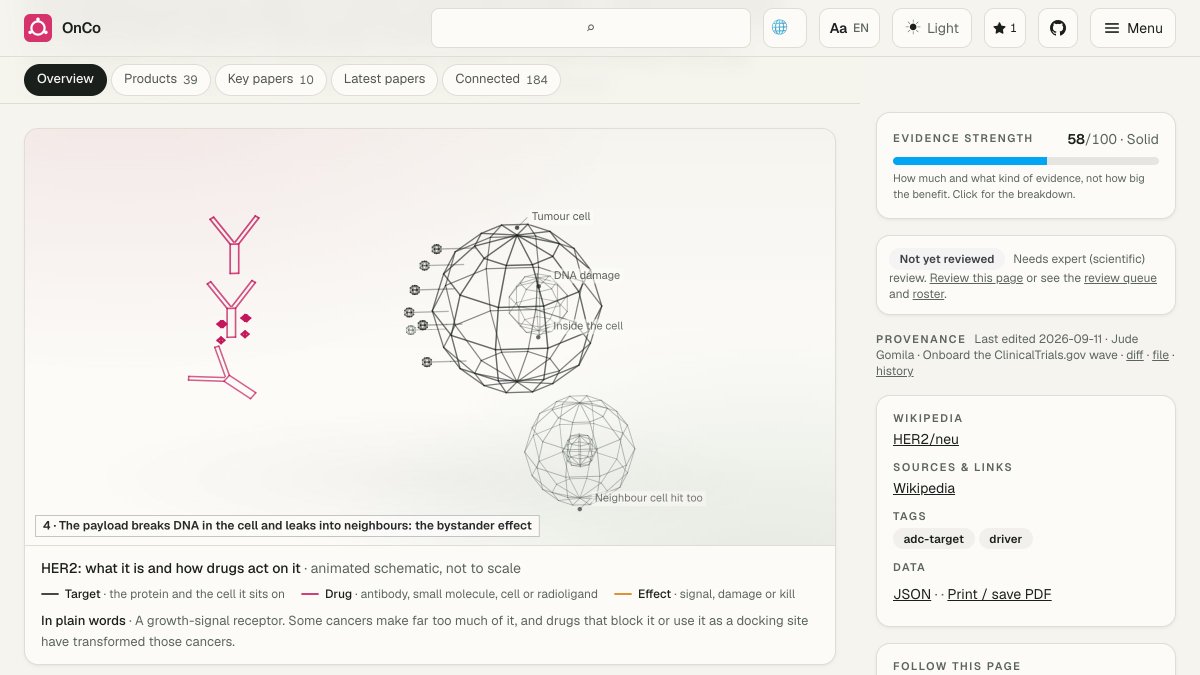
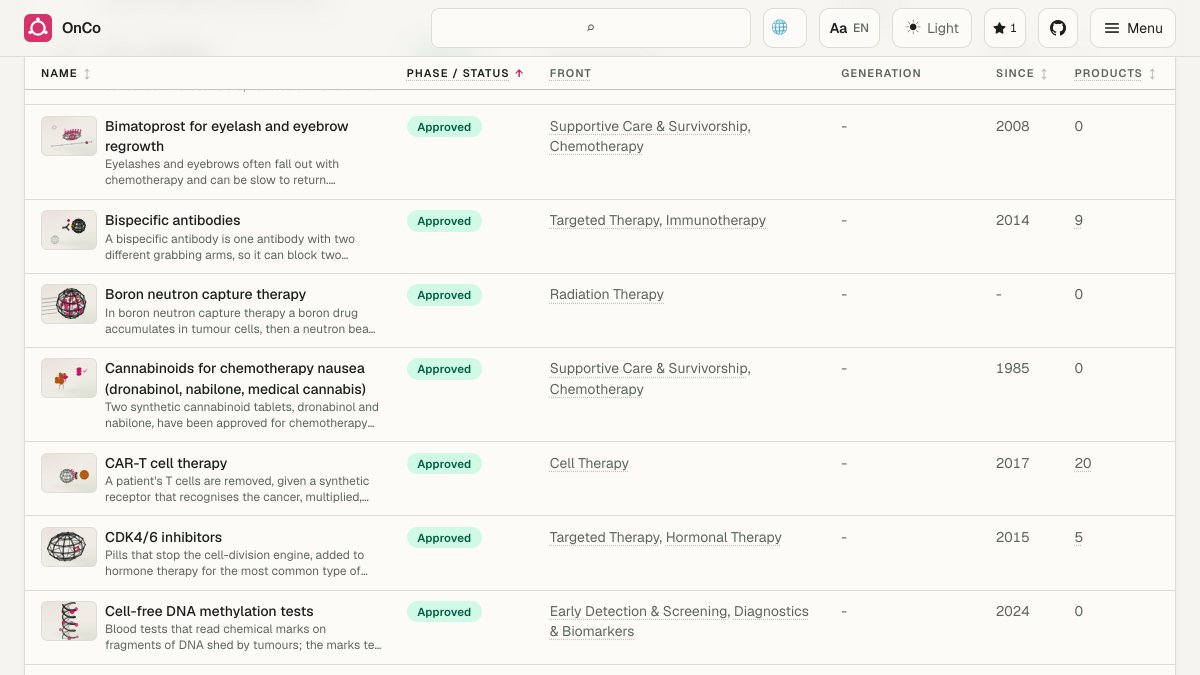
I've attempted to map everything in oncology in a public website and open source repo for all.
The site is trying to get all cancers, products, technologies, bottlenecks, people, startup opportunities with 1000+ ideas for upgrading the field.
If you have a loved one with cancer and you are technical or can engineer, go take a look, file improvement requests or bugs or help with the open repo and make this the best open and free info resource for individuals, researchers and educational use.
This should save people time, aid AI oncology projects and generate positive action. If you are not technical just complain in this thread about broken or annoying or things you want and I'll fix them live.
Some of the interesting pages:
Treatments: https://t.co/EJEOhMppoB
A gallery of the molecules being used https://t.co/EV6ZitrVqm
And targets: https://t.co/CgkjuF8nR2
The technologies in oncology: https://t.co/lNaieWYRKH
1100 ideas for helping oncology: https://t.co/iQA6Z5SvRA
Bottlenecks on oncology: https://t.co/WND44055WD
Open questions (LETS GO RESEARCH PEOPLE) https://t.co/wSbphQ0IBg
Startup requests (LETS GO STARTUP PEOPLE) https://t.co/PphztuLihP
Mechanics of cancer: https://t.co/cMUyVObzZi
Battlefronts: https://t.co/PlSZitVd50
Isotope supply: https://t.co/2Pcl4tTuPv
Key papers: https://t.co/YK0dW1XJj0
Pipeline funnels: https://t.co/xYcbSCSyBg
Cancer by type: https://t.co/d9k8Yyzdk7
Institutional rankings: https://t.co/VepXcKHhaa
The startups: https://t.co/whXKg5dPzb
Heros and heroines : https://t.co/uLDmhRjE36
Key medical people: https://t.co/JWhDZ0rC73
Here is the project roadmap: https://t.co/UtbbuOsdA5
Models and data sets: https://t.co/bim0tjiWOj
There are other views as well, take a browse.
Try making a PR if you have an upgrade to this on the repo here: https://t.co/2Dw0ufEJ3z
If you are biologically/medically minded and something is wrong, file a bug as well or say on the thread and we will get it fixed live.
If this is a useful project star the repo and help get it calibrated.
I've tried to add some other languages but I cannot speak them so tell me if that doesnt work well.
I believe we will crack oncology and having total information dominance is key to the problem.
Let the feedback flow!
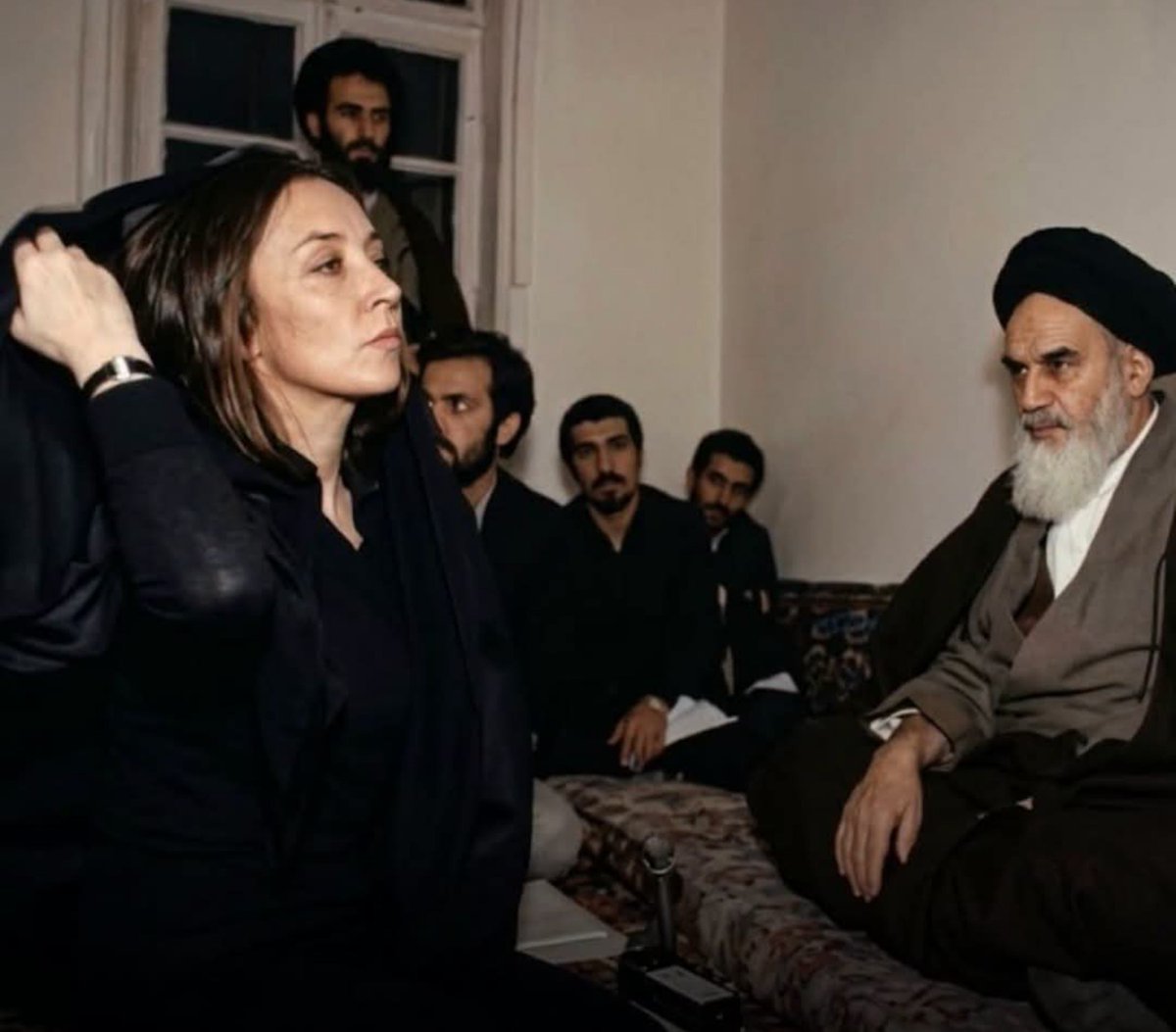
Italian journalist Oriana Fallaci removing her chador during her tense 1979 interview with Ayatollah Ruhollah Khomeini in Qom, Iran...
In October 1979, Italian journalist Oriana Fallaci traveled to Qom, Iran, to interview the Islamic Revolution's supreme leader. To get inside the room, Fallaci was forced to cover herself from head to toe in a heavy black chador, leaving only her face visible.
The conversation inside the room was tense from the very start. Fallaci did not hold back her questions.
She pushed the Ayatollah on political executions, the sudden shutdown of independent newspapers, and the sharp loss of rights for Iranian women under the new regime.
When she asked about the forced wearing of the veil, Khomeini dismissed her concerns and claimed the garment was meant to protect young and respectable women. He then added,
"If you do not like the Islamic dress, you are not obliged to wear it."
Fallaci took his words literally and replied, "Thank you, Mr. Imam. Since you tell me so, I am taking it off right now."
With a quick move, she pulled the chador off her head, leaving her hair completely exposed right in front of the Supreme Leader.
Khomeini was furious.
He stood up without saying another word and walked out of the room. The room fell silent, and the interview was abruptly stopped. However, Fallaci refused to leave Iran until he returned a day later to finish the conversation.
This confrontation became legendary in the history of journalism.
It showed a reporter refusing to bow down to authority, even in one of the most dangerous settings imaginable.
Fallaci proved that real journalism requires standing up to power, asking hard questions, and refusing to be silenced by fear or tradition.
When journalists trade raw courage for easy access and comfortable silence, we lose one of our strongest shields against tyranny.
In an era where true courage in reporting feels rare, her brave stand reminds us that honest journalism still has the power to light up the dark, giving a voice to the voiceless and inspiring future generations to speak truth without fear.
#archaeohistories
Something I wrote about Danny Lewin fifteen years ago:
---
Danny was co-founder and CTO of Akamai Technologies. I met him on a few occasions during an internship I did at Akamai in the summer of 2000. He was smart and confident, and I looked up to him. I still remember how he would frown and say, "Unclear to me", when he wasn't yet sure what he thought of an issue. That made an impression on me, and still stands for me as an illustration of intellectual honesty.
Danny was tall and imposing, built like a linebacker. He was also Israeli, and like many Israelis, he had served in the Israel Defense Forces—in fact, he was in Sayeret Matkal, an elite special-forces unit specializing in counter-terrorism. So when I heard that he had been on one of the planes that was hijacked and flown into the World Trade Center, I had to believe that he had fought them. Danny—strong, confident, a man of action—wouldn't have taken a direct attack sitting down, and wouldn't have been afraid to confront the danger head-on. Re-reading his bio this evening, I found my confirmation. Based on the testimony of a stewardess, who made a phone call from the plane in flight, it is reported that he was stabbed by hijacker Satam al-Suqami as he tried to foil the hijacking—making him the first victim of September 11.
I moved to NYC in June 2001, so I had been there less than three months when the attacks hit. I was only 21, and the events turned my world upside down. I was stunned the entire day, in shock, unable to process everything that was happening. But that evening, when I read the news of Danny's death, everything hit me all at once. For the first time that day, I cried.
Danny, I shed another tear for you today. We remember you and we miss you.
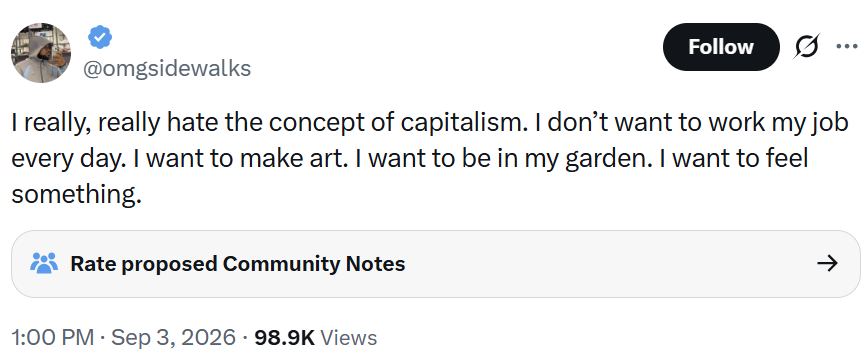
"Capitalism is why people have to work" is very silly thing to say, but it's part of a grand tradition of blaming literally everything, no matter how absurd, on capitalism.
A short thread:
also we are now two issues and 13 pieces into @indevmag; we have almost 4000 subscribers and team of five; we've published on everything from medicine regulation in Africa to ethnography in economics
feeling pretty good about it all, tbh
this is really, really, really, really bad. it's bad that there are no longer institutions that we can trust to at least try, a little, to stay above the fray. it's doubly bad when they are the most prestigious truthseeking institutions in the world. i want a different timeline
Interesting failure of governance at @Nature. Scientists peer review for the scientific journal for free--building up the prestige of the brand--while the Editor-in-Chief & her team get to trash the brand with politicised opinion journalism.
https://t.co/1btvjyJlKe