@luomoalto@__ice9 @farid__jalali @jopo899 2 - These are brilliant biochemists, 1000%. But it is frustrating that the signal is mixed; antioxidants often associated with poor outcomes. Now, we appreciate the critical need to understand the compartment, context, and time-dependent regulation of redox signaling.
@luomoalto@__ice9 @farid__jalali @jopo899 1 - Certainly, Linus Pauling and Joe McCord pioneered the concepts of chronic antioxidant dosing. But now it is clear that the field is moving into more complex and nuanced directions - reductive stress, positive oxidative stress, redox-sensitive reparative signaling etc.
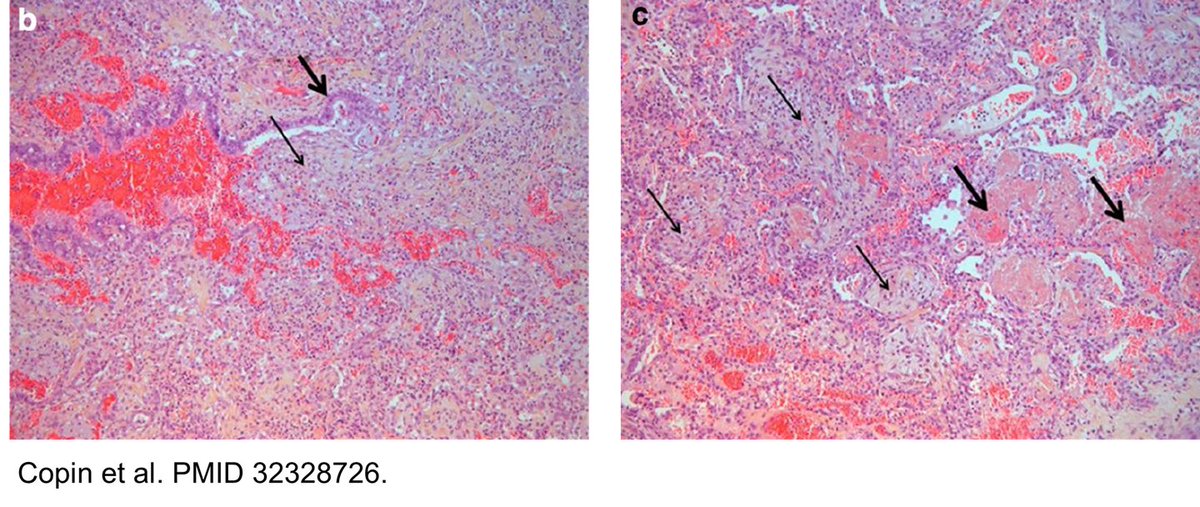
@__ice9@pathdoc3 Thanks🙂 I really enjoyed this discussion when it came out. Initially I was maybe over-enthusiastic about this. Presently, I view DAD/organizing DAD/AFOP on a spectrum reflecting a common final pathway of lung injury and disrepair.
Let's keep a finger on the pulse of this story. Confirmed with authors that AFOP was seen in 11 consecutive postmortem lung specimens from patients succumbing to persistent respiratory failure (> 2 weeks) stemming from COVID19 pneumonia. Significant implications for treatment.
@jopo899 @farid__jalali Holy smokes. I always learn new things after tuning into your posts. Today I learned about the intimate connection between ABO, vWF, and plasma proteases involved in hemoastsis/thrombosis.
@jopo899 @farid__jalali So two possibilities:
1 - Activity-altering variants or SNPs of ADAMTS13 are segregated in disequilibrium with ABO
2 - ABO status of vWF renders it more or less resistant to proteolysis by ADAMTS
Likely the second possibility.
@jopo899 @farid__jalali 🤯Here I am thinking we stumbled on spiffy novel idea, but it looks like this overlap didn't escape the authors of this GWAS.
But I wanted to share what I'm learning in this paper. Shows that ABO group dictates ease with which vWF is proteolyzed
https://t.co/pY0gOpPZ7h
@siwatson@MicrobiomDigest@statsepi@nature@harvardmed Even though it can be a pain and requires stripping/re-probing, it's probably a good habit to always image the uncut membranes. If cutting or cropping can't be avoided, leave at least 5 band-widths to either side of the target band. And when possible, always save the blots.
@siwatson@MicrobiomDigest@statsepi@nature@harvardmed Because the raw data (i.e. the image) is been shown directly and can be further analyzed with forensic graphics software. No way to routinely audit other data types (PCR, etc). Majority of basic science article retractions are first detected through histology or IB images.