New Anthropic research: A global workspace in language models.
Of everything happening in your brain right now, only a tiny fraction is consciously accessible—thoughts you can describe, hold in mind, and reason with.
We found a strikingly similar divide inside Claude.
Bought a new Mac mini to properly tinker with claws over the weekend. The apple store person told me they are selling like hotcakes and everyone is confused :)
I'm definitely a bit sus'd to run OpenClaw specifically - giving my private data/keys to 400K lines of vibe coded monster that is being actively attacked at scale is not very appealing at all. Already seeing reports of exposed instances, RCE vulnerabilities, supply chain poisoning, malicious or compromised skills in the registry, it feels like a complete wild west and a security nightmare. But I do love the concept and I think that just like LLM agents were a new layer on top of LLMs, Claws are now a new layer on top of LLM agents, taking the orchestration, scheduling, context, tool calls and a kind of persistence to a next level.
Looking around, and given that the high level idea is clear, there are a lot of smaller Claws starting to pop out. For example, on a quick skim NanoClaw looks really interesting in that the core engine is ~4000 lines of code (fits into both my head and that of AI agents, so it feels manageable, auditable, flexible, etc.) and runs everything in containers by default. I also love their approach to configurability - it's not done via config files it's done via skills! For example, /add-telegram instructs your AI agent how to modify the actual code to integrate Telegram. I haven't come across this yet and it slightly blew my mind earlier today as a new, AI-enabled approach to preventing config mess and if-then-else monsters. Basically - the implied new meta is to write the most maximally forkable repo and then have skills that fork it into any desired more exotic configuration. Very cool.
Anyway there are many others - e.g. nanobot, zeroclaw, ironclaw, picoclaw (lol @ prefixes). There are also cloud-hosted alternatives but tbh I don't love these because it feels much harder to tinker with. In particular, local setup allows easy connection to home automation gadgets on the local network. And I don't know, there is something aesthetically pleasing about there being a physical device 'possessed' by a little ghost of a personal digital house elf.
Not 100% sure what my setup ends up looking like just yet but Claws are an awesome, exciting new layer of the AI stack.
Personally, I’d rather have someone who executes a mediocre idea brilliantly than someone who talks about a brilliant idea forever.
Execution beats perfection every time.
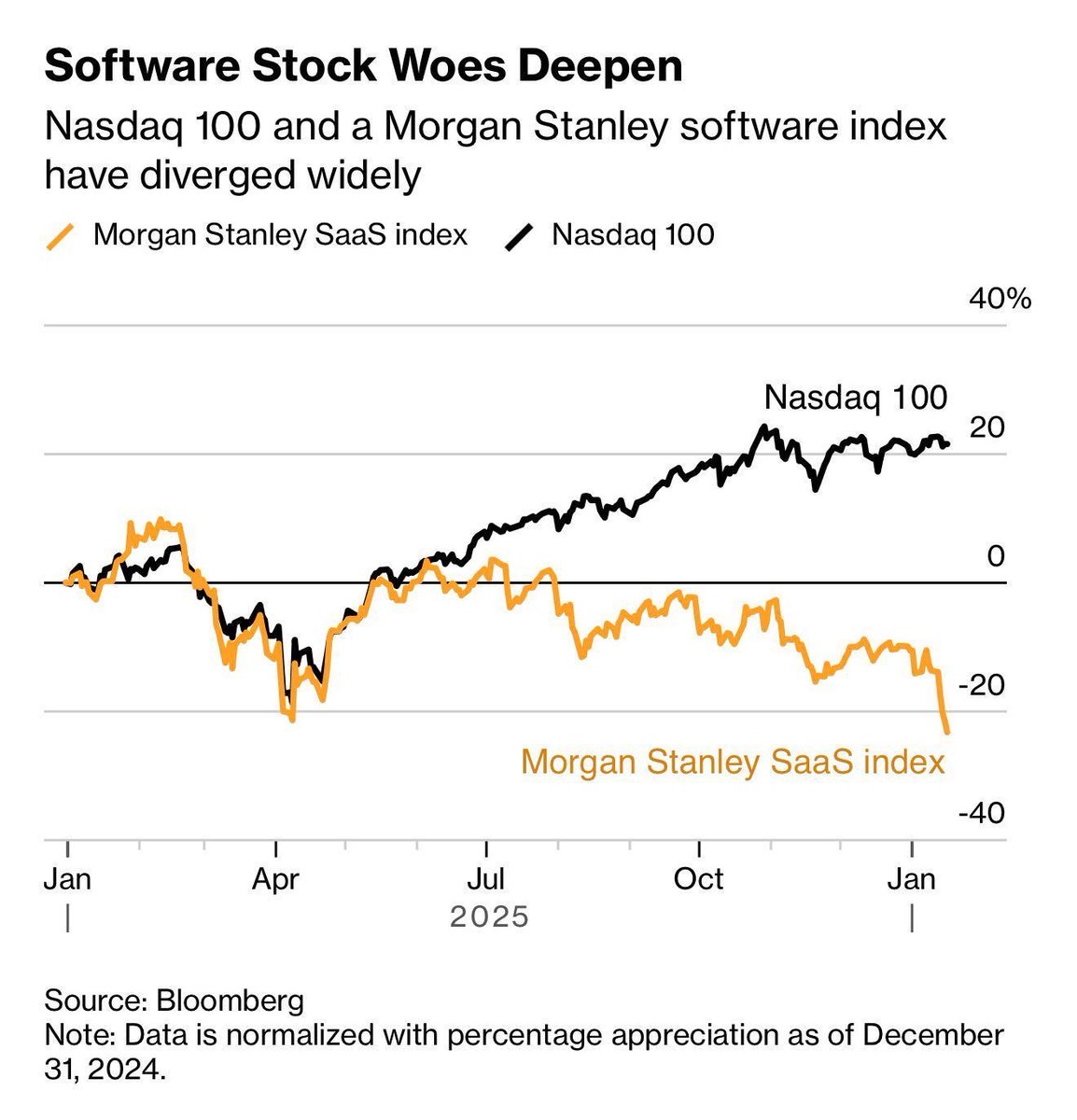
We've talked a lot about this on the Pod, but the Great SaaS Meltdown has started and there's no going back.
What exactly is happening?
In short, hi growth, low/no profitability SaaS is no longer a winning strategy because the big question mark is the durability of that growth in the short term and, because of AI, the lack of profits in the long term. Every SaaS company has sold the dream (to investors and employees) that they will growth quickly now, and harvest lots of cash later. With AI, this assumption may be completely out the window.
Now the threshold question is whether their growth will be overtaken by a much cheaper AI-developed solution?
If you are a venture supported SaaS startup and are a legacy Heuristics+APIs+CRUD product, it is likely that a new AI oriented workflow is coming for you.
Investors in private markets can see this now and think that money to fund short term growth will not be rewarded. Investors in public markets no longer believe long term profitability is possible. They would rather pivot into something they think is more resilient.
This is a change in the risk calculus that has existed for the past 15 years and why the chart below is the chart below.
Good luck to all the players!
We’re launching full-length, on demand practice exams for standardized tests in @GeminiApp, starting with the SAT, available now at no cost.
Practice SATs are grounded in rigorously vetted content in partnership with @ThePrincetonRev, and Gemini will provide immediate feedback highlighting where you excelled and where you might need to study more.
To try it out, tell Gemini, “I want to take a practice SAT test.”
@Roblox you face scanned my 9yo as a 13yo and she’s been put into a completely different age bracket and is at risk of being exposed to content, communications she should have never been exposed to! Train your AI better!
Master these 10 habits in 2026.
Feel amazing, reclaim agency + self-respect.
1. final food 4 hr before bed
2. screens off 30 min before bed
3. avoid blue light 2hr before bed, use red/amber
4. book in hand 10 min before sleep
5. go to bed same time every night
6. light in eyes when waking (sun or 10k lux)
7. walk for 10 min immediately following eating
8. daily exercise (even if for 20 min)
9. eat good stuff, ditch the junk
10. foster friends, family and love
They read as simple. I promise they'll change your life. Make them non-negotiate life habits. Do them every_single_day. Once you establish the habits, it is very easy to maintain. Stick with it for two weeks and start getting the dividends.
One of the most important things I’ve learned as I’ve gotten older is that most things don’t matter.
Whatever you’re trying to accomplish, there are usually just a couple of things on that to-do list that will actually make a difference.
And I’m not saying the rest of the items on your list shouldn’t get done…I’m just saying they probably don’t need to be done well.
There are two big benefits of taking this perspective.
First, it means you can relax. So much of our daily stress comes from the feeling that we’re leaving things undone, or not doing them well, or that we “didn’t put in that extra 10%.”
If you start from the assumption that not much really matters, you can let most things be imperfect.
Second, it allows you to focus a disproportionate amount of time on the one or two things that do matter.
Triage is such an underrated skill.
But if you can correctly determine which one or two things will—if you get them right—make the difference between success and failure, then you can spend your time taking those to a high level of polish rather than wasting your time on everything else.
It’s a power curve.
I've never felt this much behind as a programmer. The profession is being dramatically refactored as the bits contributed by the programmer are increasingly sparse and between. I have a sense that I could be 10X more powerful if I just properly string together what has become available over the last ~year and a failure to claim the boost feels decidedly like skill issue. There's a new programmable layer of abstraction to master (in addition to the usual layers below) involving agents, subagents, their prompts, contexts, memory, modes, permissions, tools, plugins, skills, hooks, MCP, LSP, slash commands, workflows, IDE integrations, and a need to build an all-encompassing mental model for strengths and pitfalls of fundamentally stochastic, fallible, unintelligible and changing entities suddenly intermingled with what used to be good old fashioned engineering. Clearly some powerful alien tool was handed around except it comes with no manual and everyone has to figure out how to hold it and operate it, while the resulting magnitude 9 earthquake is rocking the profession. Roll up your sleeves to not fall behind.
Agency > Intelligence
I had this intuitively wrong for decades, I think due to a pervasive cultural veneration of intelligence, various entertainment/media, obsession with IQ etc. Agency is significantly more powerful and significantly more scarce. Are you hiring for agency? Are we educating for agency? Are you acting as if you had 10X agency?
Grok explanation is ~close:
“Agency, as a personality trait, refers to an individual's capacity to take initiative, make decisions, and exert control over their actions and environment. It’s about being proactive rather than reactive—someone with high agency doesn’t just let life happen to them; they shape it. Think of it as a blend of self-efficacy, determination, and a sense of ownership over one’s path.
People with strong agency tend to set goals and pursue them with confidence, even in the face of obstacles. They’re the type to say, “I’ll figure it out,” and then actually do it. On the flip side, someone low in agency might feel more like a passenger in their own life, waiting for external forces—like luck, other people, or circumstances—to dictate what happens next.
It’s not quite the same as assertiveness or ambition, though it can overlap. Agency is quieter, more internal—it’s the belief that you *can* act, paired with the will to follow through. Psychologists often tie it to concepts like locus of control: high-agency folks lean toward an internal locus, feeling they steer their fate, while low-agency folks might lean external, seeing life as something that happens *to* them.”