Featured in @CellCellPress- Scientists at NYGC have created an atlas of gene regulation across the adult mouse brain, showing new insights into brain cell identity & providing valuable resources for neuroscience and neurological disease research.
https://t.co/DDrPO02rCc
Wish we could show you more #relentlessdiscovery 👀 from the 2026 annual CRI Retreat 🤫 but let's just say... some great science in the works. Take us back to last week! 🗣️ Shoutout to our grad students & #postdocs who presented 👏
#thursdaythrowback #sciencejobs #regeneration #StemCells #CancerBiology #Metabolism #Cancer
We are looking to hire post-doctoral fellows to work on somatic mosaicism, regeneration, and cancer development, please reach out to me if you are interested! @CRI_UTSW
The most important briefings of the day.
Karl Deisseroth, professor of bioengineering and of psychiatry and behavioral sciences, shares the news of his Nobel Prize with his kids.
Extrachromosomal DNA, found in nearly half of all cancers, drives tumor evolution by segregating randomly during cell division. A new study reveals the molecular mechanism governing this, offering new targets to combat therapy resistance.
https://t.co/Pk0aw1t1Kc
🩸🧬 Delighted to share our new @Nature paper! Genetic studies of >28,000 people reveal a BACH2–NRF2 pathway for activating fetal hemoglobin, suggesting new tx avenues for sickle cell disease & β-thalassemia. Led by the amazing @guo_chunjie & co!
https://t.co/1qNunDlsjW
Thrilled to share our latest work! We identified and engineered a miniature, nuclease-dead xCas12m that enables effective epigenome editing. Combined with CRISPRoff, it achieved durable silencing and inhibition of HBV via single-AAV delivery. Huge congrats to the team!👏
Inspired by Gibson cloning, we describe prime assembly, now published, for in cellulo targeted integration of gene-sized DNA fragments using prime editing. https://t.co/XfNDIFkmzs
(1/n) Excited to share close collab w @bloodgenes led by @VarshiniRam23 & @guo_chunjie et al
How to induce expression of key genes while silencing much of the genome during Erythropoiesis?
A: Matchmaker CREs load cohesin near key genes to promote looping
https://t.co/i1Uq0t2yy9
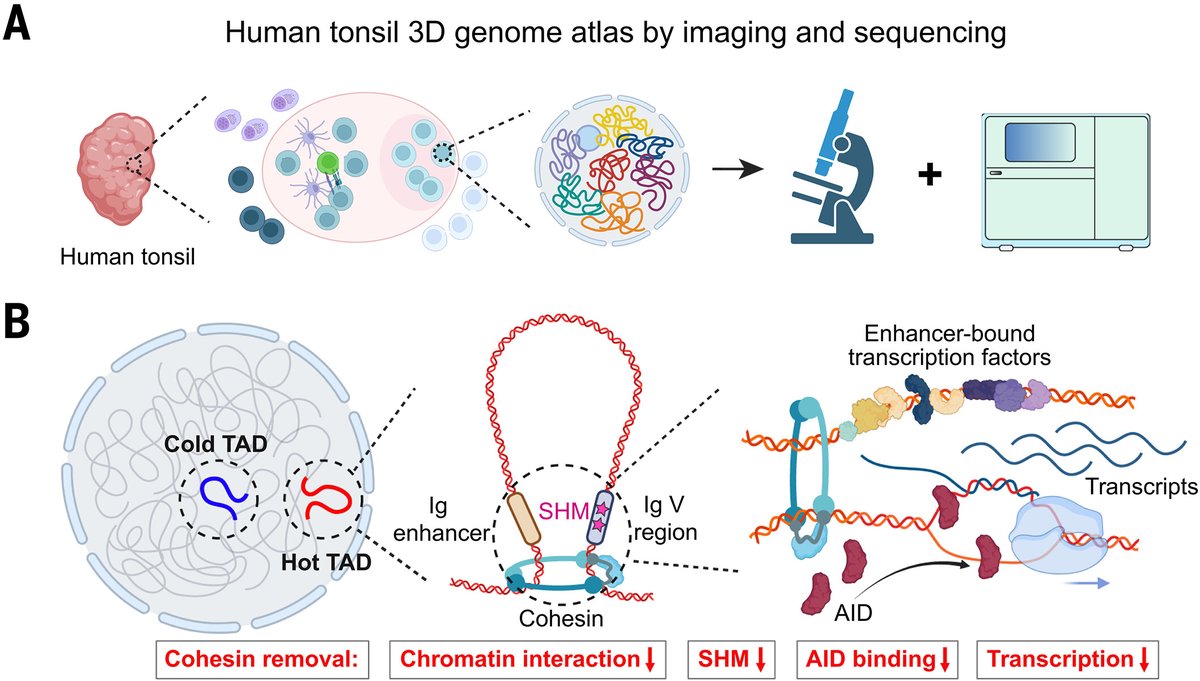
Glad to share our latest publication in Science! This work reports:
🧬 the first single-cell 3D genome atlas of human tonsil and B cell immunity,
🧬 the first image-based 3D genomics dataset of any human tissue,
🧬 a new function for cohesin loop extrusion, and
🧬 a novel chromatin "curl" structure.
Antibody-mediated immunity relies on the generation of point mutations in rearranged immunoglobulin (Ig) loci of activated germinal center (GC) B cells. This process - called somatic hypermutation (SHM) - allows for antibody affinity maturation but also acts at certain non-Ig sites in the genome, thereby contributing to mutations and chromosomal translocations that drive B cell oncogenesis. My collaborator Prof. David Schatz's previous work indicates that SHM susceptibility is controlled by the cooperative action of cis-acting SHM target elements and the architectural properties of topologically associating domains (TADs), but how the genome is spatially organized across multiple length scales as GC B cells develop and activate SHM and how 3D genome architecture influences the targeting of SHM remains unknown.
To test the functional requirement of 3D genome organization for SHM, in this work we developed a 3D genome and spatial transcriptome toolbox optimized for clinical tonsil tissue, and used it to define single cell 3D genome architectures and nuclear organization in GC B cells undergoing SHM in normal human tonsil samples and in malignant GC-derived human B cell lymphoma cell cultures. Our new work generated the following key insights:
🧬 At the large scale, the nuclear positioning of TADs is linked to SHM susceptibility, with the nuclear periphery being more permissive to SHM and the nuclear interior being more protected from SHM.
🧬 At the fine scale, increased intra-TAD looping contacts in gene regions are associated with SHM susceptibility.
🧬 Most importantly, through rapid, targeted degradation of cohesin component RAD21, our new results provide the first direct evidence that the cohesin mediated loop extrusion is essential for SHM. We further showed that the effects of loop extrusion on SHM cannot be solely attributed to transcription activity changes. This represents a brand new function of the famous loop extrusion process.
🧬 In addition, we serendipitously discovered a novel chromatin “curl” structure – a chromatin loop with two long (~25 kb) stem regions aligned in parallel with each other (distinct from e.g., CTCF anchored chromatin loops where two stems are aligned in an anti-parallel fashion). To our best knowledge, this is the first report of such a structure outside of the contexts of DNA recombination/transposition.
I'd like to thank all my co-authors, especially co-corresponding author legendary immunobiologist Prof. David Schatz, and co-first authors Yubao, Jianshu, and Yuan. It has truly been a wonderful experience working with you.
Link to paper:
https://t.co/rmKT7KE9bA