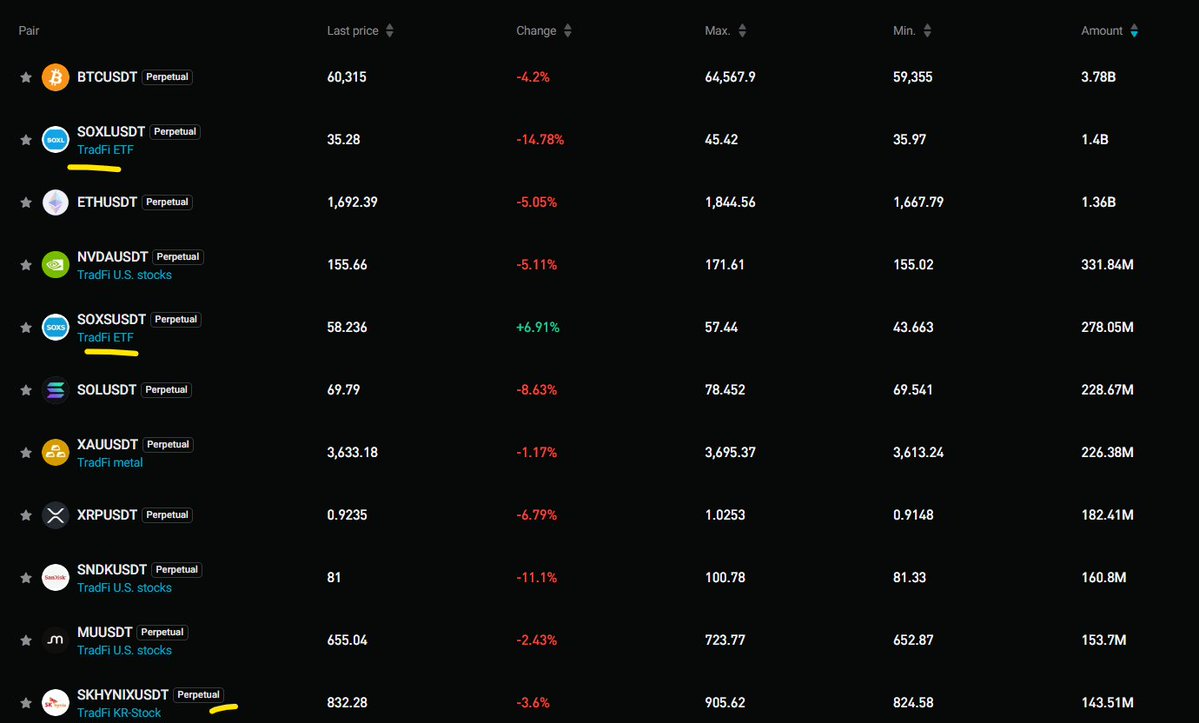
Kalian yang trading futures suka liat ticker ini ga?
- SOXLUSDT
- KORUUSDT
- QQQUSDT
- SNXXUSDT
Kok tau-tau ada di barisan aset-aset crypto yang ditawarkan di exchange yang kalian pake? Apa ini?
Sebenarnya ini adalah salah satu LIFE HACK TRADING CRYPTO KALIAN biar bisa lebih santai dan lebih profitable.
Let me explain
Tapi sebelum lanjut, ingat ya. Disclaimer on!
Ini hanyalah edukasi dan opini pribadi. Bukan ajakan menjual/membeli/mentradingkan. Kalau loss tanggung sendiri, toh kalau cuan gak bagi-bagi
Jadi, ticker-ticker yang tadi itu adalah kontrak futures dari ETF buat sektor tertentu di Traditional Finance, yang diperdagangkan dengan margin/jaminan USDT
Saya akan jelasin sedikit definisinya, lalu keuntungannya dibandingkan asal trading crypto ya. Walaupun trading di exchange yang sama, salah pilih instrumen juga bisa bikin boncos.
ETF TradFi adalah dana yang diperdagangkan di bursa saham biasa (seperti Nasdaq atau NYSE). Versi sangat oversimplifiednya kayak Nasdaq atau IHSG (Walau gak sama persis, tapi buat bikin mudah paham begitu)
Contohnya:
QQQ: 100 saham teknologi terbesar di Amerika Serikat
KORU: ETF leveraged 3x yang mengikuti pasar saham Korea Selatan (MSCI Korea).
SPY: S&P 500.
TQQQ: Versi 3x leveraged dari QQQ.
SOXL: Versi 3x leveraged saham semikonduktor
Kenapa TradFi ETF sangat saya sukai buat Day Trading dibandingkan crypto, apalagi sembarang crypto:
- Karena ini pasar tradisional, jam ramenya NGIKUT pasar tradisional juga.
Ada Daily Open/Asian Session jam 7.00 WIB, sampai NY session di malam hari. Walaupun pasar tetap buka 24 jam 7 hari (karena kontraknya pakai crypto), namun jam-jam trading tadi memaksa trader buat DISIPLIN buat hanya masuk di sekitaran jam-jam tadi.
Beda dengan crypto yang pure 24/7. Pump atau dump bisa terjadi kapan saja. Bisa tengah malem, dini hari, habis magrib, pokoknya bikin alert 24 jam...walaupun banyaknya pasar diem-diem aja
- Lebih mudah analisa "fundamental"nya
KORU = liat aja pasar saham Korea (KOSPI)
QQQ = sama kayak nasdaq. yang udah kebiasa di forex aman banget sih
SOXL = indeks semi konduktor. Tinggal lihat pasar AI dan teknologi lainnya
TIPS BUAT YANG MAU JADI FULL TIME TRADER
(bukan nasihat finansial ya. Disclaimer on)
- Kalau mau trading futures, cukup "mainan" ETF ini dengan jam trading daily open/asian session, london session, dan NY session aja. Jadi "cuma" butuh 30 menit - 1 jam sehari 3 kali. Jadi dapet freedom gak terikat sama layar chart
Cobain analisa, bandingin sama "asal pilih" altcoin
Mana yang lebih enak?
If you understand stocks, crypto becomes much easier.
Here’s the simplest comparison 👇
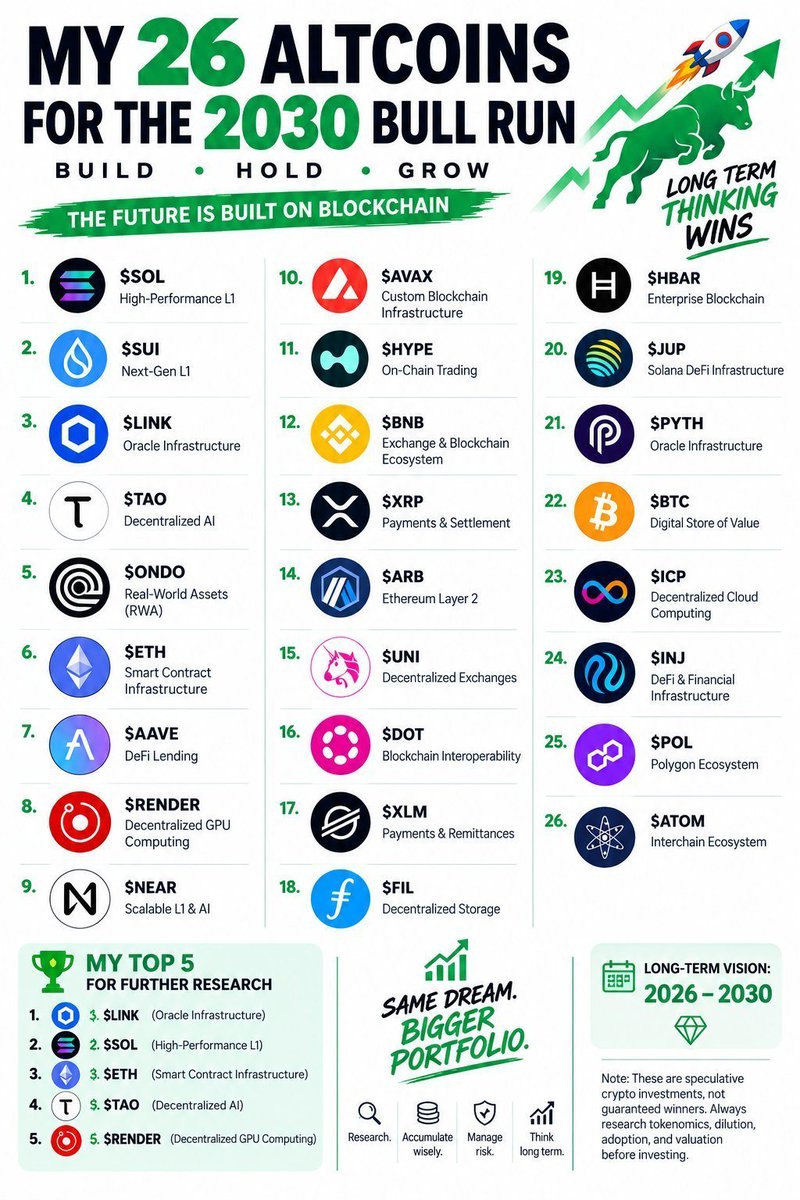
$ONDO : BLACKROCK
$SOL : NVIDIA
$XRP : VISA
$TAO : OPENAI
$AAVE : JPMORGAN
$BTC : GOLD
$HYPE : CME GROUP
$LINK : BLOOMBERG
$SUI : TESLA
$JUP : ROBINHOOD
$ETH : MICROSOFT
$RENDER : NVIDIA CLOUD
$BNB : BERKSHIRE HATHAWAY
$PYTH : REUTERS
$MORPHO : LENDINGCLUB
$UNI : NASDAQ
$AKT : AWS
$XLM : WESTERN UNION
$IMX : STEAM
$PENDLE : BOND TRADING DESK
$ENA : DIGITAL BANK
$HNT : T-MOBILE
$FIL : DROPBOX
$PENGU : DISNEY
$HBAR : IBM
$DOGE : GAMESTOP
$CHZ : FANATICS
$GRT : GOOGLE FOR BLOCKCHAIN DATA
$WLD : DIGITAL ID COMPANY
$GRASS : AI DATA COMPANY
$AVAX : CLOUD INFRASTRUCTURE
$FET : AI SOFTWARE COMPANY
$STX : BITCOIN APP STORE
$ZRO : GLOBAL MESSAGING NETWORK
$TIA : CLOUD DATA LAYER
$LDO : ASSET MANAGER
$ETHFI : STAKING FINTECH
$NEAR : CLOUD PLATFORM
$RUNE : CROSS-BORDER EXCHANGE
$QNT : ENTERPRISE SOFTWARE
Not exact comparisons.
Just a simple way to understand crypto through businesses and assets you already know.
Save this list.
Which comparison is PERFECT?
Which one is completely WRONG?
Drop ONE below. 👇
NEW: Chainlink builds a blockchain solution with @UBS to bring the $2+ trillion global structured notes market onchain.
Powered by Chainlink Runtime Environment (CRE), the solution automates issuance, lifecycle management, and settlement workflows for tokenized structured notes by connecting smart contracts, market data, and settlement into a single production workflow that is interoperable with UBS’s existing systems.
UBS gains real-time visibility into token balances, coupon entitlements, barrier proximity, and product status, along with a scalable foundation for bringing additional structured products onchain.
A major production milestone for tokenized capital markets.
CRAZY things happened on Solana today 👇
> @solana dropped “beta” and moved to Solana 1.0, with 150ms finality via Alpenglow and Firedancer live on mainnet
> @solflare integrated @MoneyGram Ramps for USDC cash-outs in 170+ countries and territories
> @Zelle is launching its ZLUSD stablecoin on Solana and demoed a $1.25M confidential transfer live
> @WesternUnion brought USDPT on Solana to 180 countries, 130 currencies and 400K cash pickup points
> @Bitso Mexican peso stablecoin MXNB is coming to Solana
> @Ledger launched Clear Signing for Solana DeFi, cutting a Jupiter swap from 13 steps to 3
> @The_DTCC will connect its tokenization service to Solana, with assets live in H2 2027
> @ICE_Markets said the NYSE ATS is ready for Solana-minted tokens and is considering running a validator
> Allfunds named 22 asset managers, including Apollo Global, Fidelity, Schroders, Wellington and Franklin Templeton, for tokenized funds on Solana
> @Cordaxyz launched EPIC on Solana, its first institutional yield vault
> @Backpack secured a CFTC-regulated clearinghouse in the US, the first built from scratch by a crypto-native exchange
> @JupiterExchange unveiled Global Passport, Liquidity Services and an equities lending market with @Bullish
> @sunrise launched an API bringing tokenized stocks to Jupiter, OKX, Titan, 1inch and 0xProject
> @kamino launched a rebuilt app with 100+ RWAs, the Kamino ONE swap engine, and Kamino Omni for institutional portfolios
> @getclocked launched Onchain Option Spreads
> @formation_so is launching the first tokenized securities venue on Solana under the SEC’s innovation exemption
> @Solmate is launching GPU-as-a-Service for AI, payable in dollars or stablecoins on Solana
And it's only day 1...
Which tokens are actually worth holding through a full cycle?
I’m becoming more selective about what deserves a long-term position.
For me, durable token demand comes down to two things:
→ How strong is the belief behind the asset?
→ How credibly does economic value reach the tokenholder?
Some tokens have one. Very few have both.
Yet the good news is that in this cycle, protocols build strong revenue model + product first and connect real business with their token.
[1] Conviction assets
BTC is the clearest example.
Its demand depends on people continuing to accept its scarcity, monetary properties and role as a store of value.
Gold has a monetary premium too, but I need to distinguish durable belief from attention that disappears when prices fall.
I look for a few things:
→ A clear reason to hold that people can explain simply.
→ A community that stays engaged through prolonged losses.
→ Continued adoption after a major failure or crisis.
→ An identity that extends beyond the next incentive campaign.
$BTC, $ZEC, $ETH, $BNB and $SOL offer different examples of how conviction can persist through severe setbacks.
A recognizable founder, strong memes and wealthy early holders don’t prove that the next token will become a durable asset.
Those traits are easy to identify after something succeeds.
The harder question is whether new buyers will still have a reason to hold after the original narrative loses attention.
[2] Cashflow assets
This is where I can apply a more conventional financial framework.
I usually as what I am economically entitled to by owning this token?
A successful product doesn’t automatically create a valuable token.
The company can grow while profits go to equity holders. Protocol revenue can rise while tokenholders receive nothing.
Buybacks can happen while unlocks increase the circulating supply faster.
So I want to understand:
→ Profitability: What remains after operating costs and incentives?
→ Verification: Can I independently check the revenue and distributions?
→ Ownership: Does value reach the token, the company, or both?
→ Distribution: Are buybacks systematic or dependent on team decisions?
→ Dilution: How much supply is entering circulation?
→ Valuation: What am I paying for the value holders actually receive?
A strong business can still be an expensive investment.
I also don’t expect every growing protocol to distribute all its earnings immediately.
Reinvestment can create more value.
But without enforceable holder rights, I’m underwriting both the business and the team’s willingness to share its future success.
That deserves a higher required return.
Why HYPE stands out in this framework
HYPE combines an identifiable source of economic demand through fee-funded purchases with a community developing strong conviction around the product.
That combination deserves attention.
But I still need to assess trading activity, competition, operating risks, supply changes and valuation. Strong token mechanics don’t remove those risks.
For $HYPE, $SKY, $UNI, $NEAR, $PENDLE, $AERO and other cashflow candidates, I’d apply the same discipline: examine what reaches holders and whether it can persist.
My view this cycle
Macro conditions affect how much investors will pay for both future cashflows and collective belief.
When liquidity expands, weak token economics can be easy to overlook. I want a holding thesis that remains credible when conditions tighten.
I’m willing to own belief where I can explain its durability.
I’m willing to own cashflow where I can verify the economics and the token’s share.
I’m most interested when both exist and the price still offers a reasonable return.
The internet is a decentralized technology
Owned by no one and everyone at once
But we’ve trapped ourselves in centralized platforms
Blockchain lets the internet’s inherent decentralization be retained all the way up the stack
Blockchain will change how we use the internet
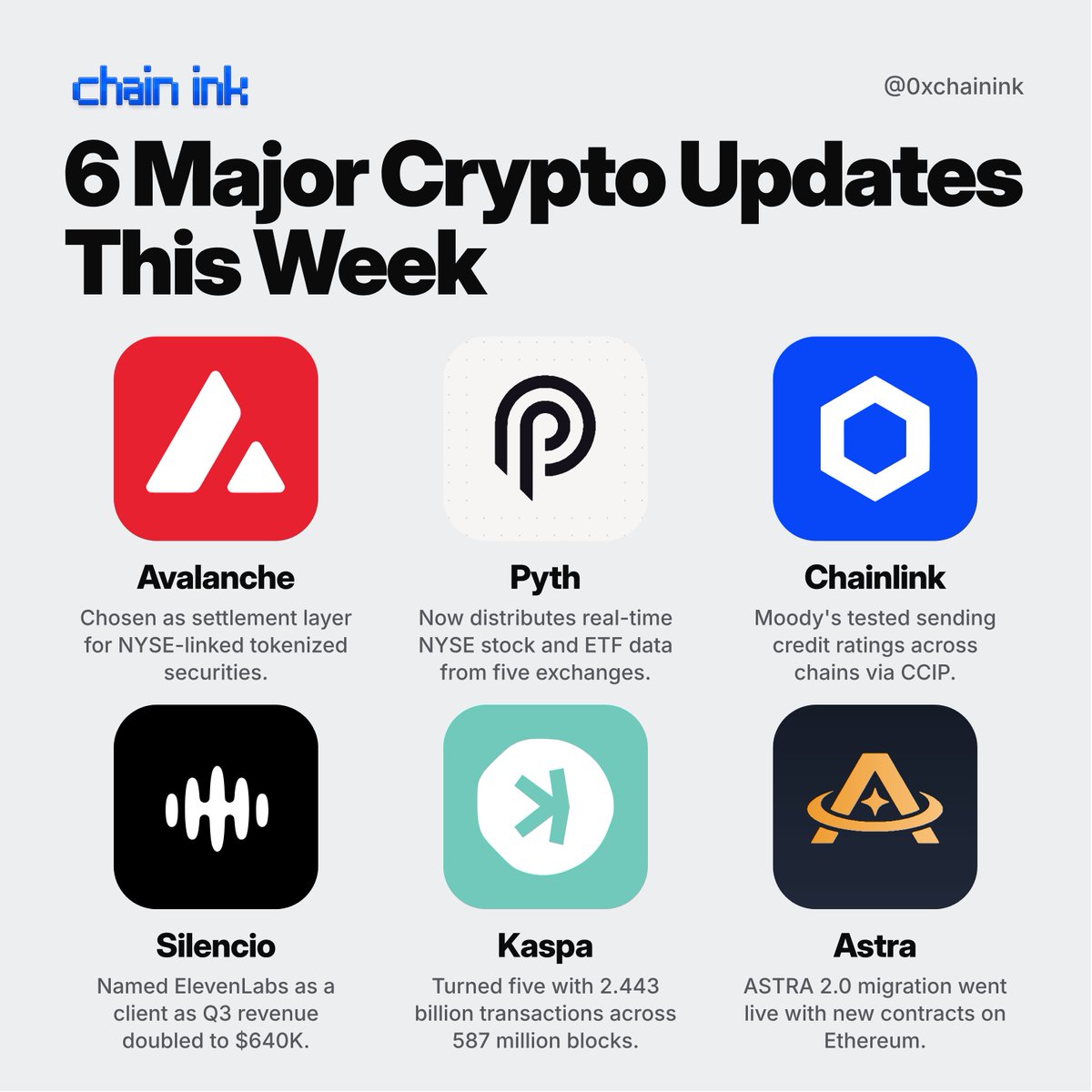
Big Week Onchain 📛
6 Updates Worth Tracking ↓
1️⃣ $AVAX | @avax
- NYSE picked Avalanche
- Ledger for its clearing firm
- 24/7 settlement, approval pending
2️⃣ $PYTH | @PythNetwork
- NYSE stock data live
- All five NYSE Group exchanges
- Nasdaq came first, in September
3️⃣ $LINK | @chainlink
- Moody's ratings pilot
- Cross-chain via CCIP
- Testnet only for now
4️⃣ $SLC | @silencioNetwork
- ElevenLabs named as a client
- Q3 revenue $300K to $640K
- Buybacks start Q4
5️⃣ $KAS | @kaspaunchained
- Five years, 2.443B transactions
- KCC-20 tokens finalized
- Kaspa Dollar planned for 2027
6️⃣ $ASTRA | @AstraLabs_Inc
- ASTRA 2.0 live on Ethereum
- Trading back since Nov 10
- Claim window closes Dec 10
TradFi made half the list this week.
NYSE twice, Moody’s once.
Wall Street is onchain.
Weekly Recap:
1) Nvidia CEO Jensen Huang resigns after having 3 reported affairs.
2) Billionaire shareholder Leo KoGuan says he will not invest more money in Nvidia without Jensen Huang.
3) Elon Musk says it would "be an honor" to hire Jensen Huang.
4) Elon Musk, CZ, Nvidia employees & shareholders petition to bring back Jensen Huang as CEO with over 150k signatures.
5) Two Nvidia investors holding over $2 billion in shares call for board to reinstate Jensen Huang as CEO.
6) Jensen Huang discusses returning as Nvidia CEO.
7) Crypto market crashes with $5.9 billion in liquidations.
8) Bitcoin falls to as low as $62k
9) 🇺🇸 FAA issues nationwide ground stop for all flights, halting all flight departures for the longest time since 9/11.
10) Elon Musk's SpaceX $SPCX successfully catches Starship rocket at launch tower for the first time in history.
11) 🇺🇸 US credit card debt reaches new all-time high of $1.29 trillion.
12) 🇺🇸 Senate Democrats prepare to impose 10% cap on credit card interest rates.
13) 🇺🇸 Coinbase officially receives full US federal approval to operate as a national trust bank.
14) 🇺🇸 Bank of America removes Nvidia and Micron $MU from its list of top stock picks.
15) 🇺🇸 Federal Reserve report identifies artificial intelligence as a major risk to the US financial system.
16) 🇩🇪 Germany's largest bank Deutsche Bank officially rolls out crypto custody services.
17) $15 trillion BlackRock expects billions of dollars in crypto to move into ETFs over security concerns.
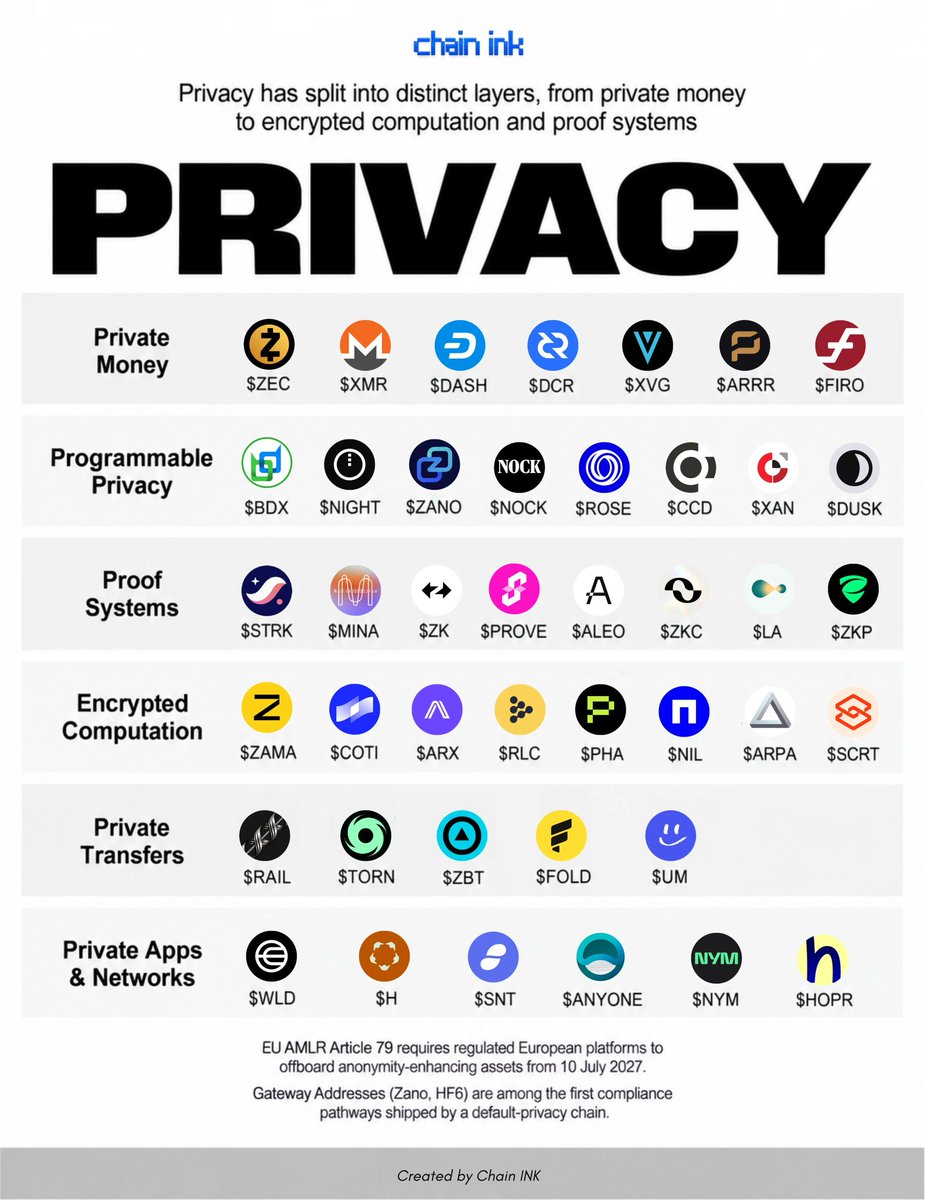
$ANYONE is down 37% in a month.
It's also nearly 97% below its ATH.
Yet development hasn't stopped.
Paid privacy circuits, VPN upgrades and AI-agent integrations are still in progress.
Can this privacy DePIN make a comeback? 🧵👇
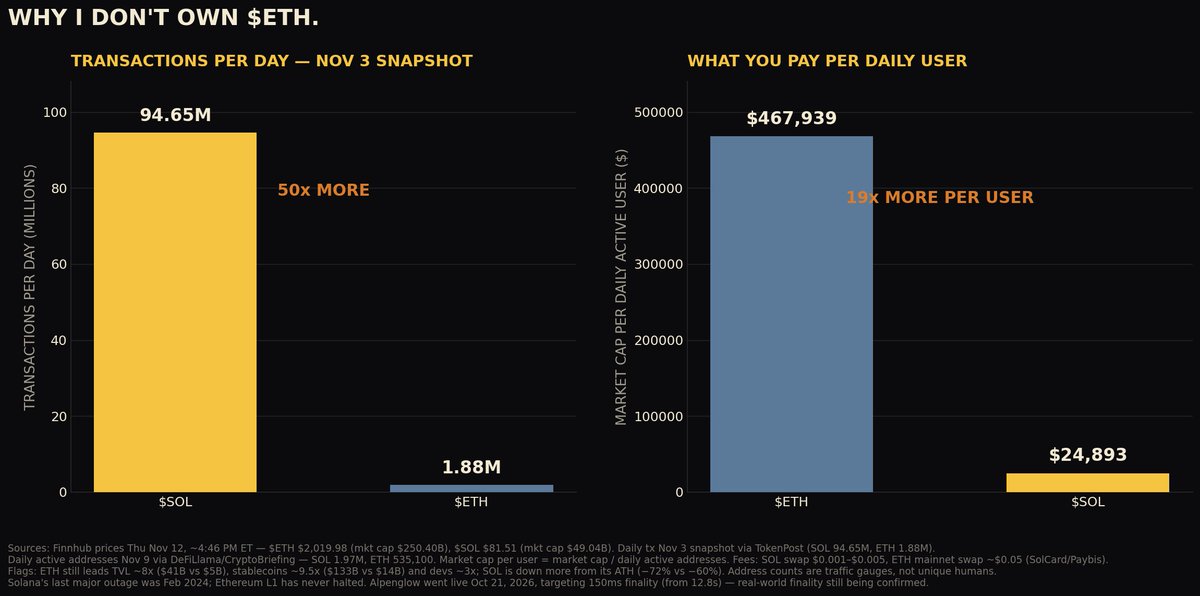
Why I don't own $ETH so here is the data, not the vibes...
$ETH is $2,020 with a $250 billion market cap.. $SOL is $81 with a $49 billion market cap.. now look at who actually uses the chains...
$SOL does about 95 million transactions a day.. $ETH does 1.9 million.. that's 50x more activity on Solana.. 1.97 million wallets a day on $SOL vs 535,000 on $ETH the users already voted, the price just hasn't caught up yet...
A swap on $SOL costs a fraction of a cent and settles in 0.3 seconds.. I paid with USDC on Solana myself, it settled before I could close my phone.. the same swap on $ETH costs 50x more and takes 12 seconds a block, minutes to be final.. you cannot build on chain finance on a chain where every click costs money and takes forever...
And here is the killer number.. market cap per daily user.. $ETH is $468,000 per user.. $SOL is $25,000 per user.. you are paying 19 times more for every user on Ethereum than on Solana.. for a chain with less activity...
$ETH is built like the old system.. sequential, one transaction at a time, then they bolted on 70 different L2 to fix it and split all the liquidity across them.. $SOL was built different.. parallel, everything runs at once, one chain, one state, everything settles together.. and Alpenglow just went live Oct 21, finality heading from 12.8 seconds toward 150 milliseconds.. that's how code is supposed to work...
And then there is the security.. $ETH is where the hackers go shopping.. the 2nd biggest theft in crypto history was $1.46 BILLION in $ETH, stolen from Bybit in Feb 2025.. not by breaking the chain, by poisoning the Safe wallet screen the signers trusted.. and $ETH lost $1.7 BILLION across 310 incidents in 2025 alone, more than any chain.. why.. because $ETH is a maze of bridges, L2 and unaudited contracts.. every bridge is a new door, Ronin $625M, Poly $611M, and the hackers know it...
And the future threat.. quantum.. a big enough quantum computer breaks the signatures $ETH and $SOL both use today.. the difference is $SOL already shipped the fix.. the Winternitz Vault, live since Jan 2025.. hash based signatures, no elliptic curves for Shor's algorithm to break, works on mainnet today, no protocol change, no waiting.. $ETH has a plan.. a team formed Jan 2026, a roadmap from Vitalik, core infrastructure targeted 2029.. a plan is not a product.. when the quantum day comes, $SOL holders can already lock their coins behind math a quantum computer cannot break, $ETH holders are still waiting on a fork...
$ETH is where the big money parks.. $41 Billion in TVL, $133 billion in stablecoins, it is the deposit ledger.. but finance is not about where money parks, it's about where money MOVES.. and the movement is on Solana.. more DEX volume every week, more fees paid every day, more users every day...
$ETH is legacy.. it had its run, it built the category, respect for that.. but the future of on chain finance needs speed, sub cent fees and one chain that everything runs on.. that's Solana.. that's why I own $SOL and not $ETH!
Kalabalık hikâye kovalarken ben paranın nereye aktığına baktım.
Gelir üreten projeleri tek tek ayıkladım. Her biri için fiyatı ne yaptığı son 30 günde ürettiği ücret ve benim yorumum.
Solana: 86.9 dolar
Hızlı ve ucuz işlem odaklı ana ağ.
30 günlük ücret: 14.8 milyon dolar.
Konuşmaya gerek yok. FTX çöküşünden sonra ayağa kalkması bile ne kadar büyük olduğunu gösteriyor.
Chainlink: 10.6 dolar
Zincir dışı veriyi akıllı sözleşmelere taşıyan altyapı.
30 günlük ücret: 4.5 milyon dolar.
Rakam küçük görünür ama DeFi'nin önemli bir kısmı onun üzerinde çalışıyor.
Uniswap: 6.9 dolar
Ethereum'un en büyük merkeziyetsiz borsası.
30 günlük ücret: 89 milyon dolar.
Listenin ücret şampiyonu artık bu gelirle kendi tokenını yakıyor.
Aave: 132.9 dolar
Kriptonun en büyük borç verme platformu.
30 günlük ücret: 40.5 milyon dolar.
Kategorinin lideri. Yıllardır ayakta kalması başlı başına bir sinyal.
Ondo: 0.358 dolar
ABD tahvillerini ve hisselerini zincire taşıyan platform.
30 günlük ücret: 7.6 milyon dolar.
RWA tarafında bu döngünün en ciddi hikâyelerinden biri.
Aster: 0.64 dolar
Merkeziyetsiz vadeli işlem borsası.
30 günlük ücret: 4.2 milyon dolar.
CZ faktörünün burada etkili olacağını düşünüyorum.
Morpho: 2.07 dolar
Borç verme işlemlerinin altyapısını sunan protokol.
30 günlük ücret: 25 milyon dolar.
Kullanım çok güçlü ama protokol henüz kendine pay almıyor. O gün geldiğinde çok konuşulur.
Pumpfun: 0.00366 dolar
Memecoin çıkarma ve alım satım platformu.
30 günlük ücret: 75 milyon dolar.
Kriptonun en çok kazanan uygulamalarından biri. Gelirinin bir kısmıyla düzenli olarak kendi tokenını geri alıyor.
Curve: 0.265 dolar
Stablecoin takası için merkeziyetsiz borsa.
30 günlük ücret: 1.8 milyon dolar.
Küçük ama gelirinin neredeyse tamamı veCRV sahiplerine gidiyor.
Etherfi: 0.62 dolar
ETH restaking ve kripto kart hizmeti.
30 günlük ücret: 15.5 milyon dolar.
Gelir var asıl soru bu gelirin kalıcı olup olmadığı.
Ldo: 0.33 dolar
ETH'yi stake edip karşılığında likit token veren platform.
30 günlük ücret: 49 milyon dolar.
Ethereum büyüdükçe en doğal kazananlardan biri.
Pendle: 1.61 dolar
Faiz getirisini alınıp satılabilir hale getiren protokol.
30 günlük ücret: 0.9 milyon dolar.
DeFi'nin en özgün ürünlerinden biri. Ücret şu an düşük toparlanmasını izliyorum.
Hyperliquid ve Tron'u bilerek almadım. Gelirleri güçlü ama fiyatları şu an düşündüğüm seviyelerin çok üstünde.
Radarımdaki diğerleri: Bittensor, OKB, Fetchai ve Alchemy Pay.
Listedekiler sürekli trade ettiğim ve boğa döneminde öne çıkacağını düşündüğüm coinler. Benim odağım bu tarafta.
HİKÂYE BİTER, GELİR KALIR.
Most people in crypto are still asleep.
They're waiting for the old crypto market to come back.
The same altcoin seasons. The same easy money. The same cycle where everything pumps.
Wake up. That era is over.
The next chapter of crypto will look nothing like the last one.
Capital will become increasingly concentrated in a handful of strong projects, while the rest slowly fade into irrelevance.
And I genuinely believe only a select few will know how to navigate what's coming.
The chosen few.
Right now, some of you hate this account because I'm telling you what you don't want to hear.
But in a few weeks/months, I believe this same account will become one of the voices you wish you'd listened to earlier.
You don't have to like me. You just have to understand what's happening.
Hope you understand.