🧬 Great to see Jonathan @DrRosenbergMSK discussing NECTIN4 biomarkers and ADC sequencing in urothelial cancer at @GuardConsortium#guardsymposium2026
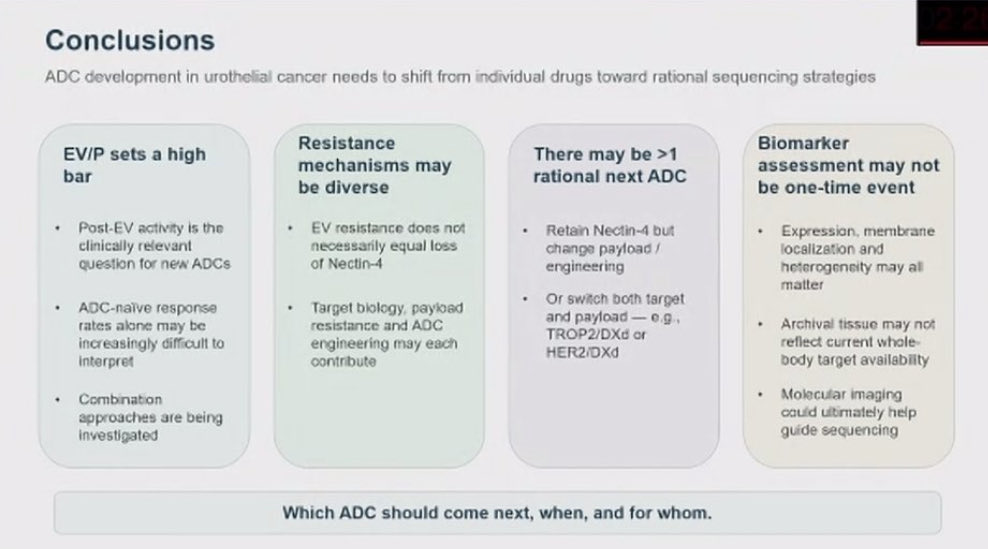
Our previous data — and independent data from Jonathan’s group at MSKCC — demonstrate that membranous NECTIN4 matters for response and outcome with EV(P). Importantly, cytoplasmic expression does not show the same biomarker signal.
But a single biopsy is only a snapshot. Spatial heterogeneity, metastatic evolution and treatment pressure can make archival tissue increasingly disconnected from current target availability.
This is why molecular imaging of NECTIN4 is such an exciting avenue: potentially mapping target expression across the whole body and longitudinally during treatment, while avoiding some of the spatial and temporal bias of single biopsies.
At progression: Is NECTIN4 still there? Is it homogeneous? Should we retain the target and switch payload—or switch the ADC target altogether?
Moving from empiric ADC sequencing toward dynamic, biomarker-guided precision oncology. 🎯
@OncoAlert@weoncologists@UroDocAsh@urotoday@drenriquegrande@g_develasco@cdanicas@DrChoueiri@tompowles1@Markuseckstein3@Dr_Aggen
Hoy he entregado otra revisión por pares. Sin cobrar, como casi todos y sacándolo del tiempo personal.
Mañana hacen huelga, por primera vez en 200 años, quienes editan The Lancet
Algo está cambiando.
Unos y otros sostenemos la calidad de lo que se publica. Merecemos que se reconozca.
https://t.co/uns7Rqo29k
😳 Disappointing results of T-DXd in large randomized phase III Destiny-Lung04 first line in HER2mut NSCLC vs SoC chemo-pembro. Although control arm outperformed, the lack of translation into OS benefit and the concerning safety issues of this agent warrants a lot of discussion, specially in the upcoming data from selective HER2 TKIs, with are associated with better tolerance and safety profile. #WCLC26 @iasclc #lcsm
📌 Long-term KEYNOTE-564 results
Adjuvant pembrolizumab in ccRCC shows sustained benefit:
• 5-y OS: 87.7% vs 82.3% (HR 0.66)
• 5-y DFS: 60.9% vs 52.2% (HR 0.71)
Results were consistent across key subgroups.
Reassuring long-term data years after treatment @OncoAlert
🚨IMPACT trial 5y results
3063 participants in 20 countries. Median age 54y
2 cohorts: BRCA1/2+ vs age-matched BRCA1/2-
Annual PSA. Biopsy if >3 ng/ml
⬆️ csPC (GG>=2) in BRCA2+
⬆️ % of cancers NCCN unfav/high if BRCA2+ or BRCA1+
@OncoAlert@urotoday@PCF_Science
🧬 Should TP53 co-mutation push us toward upfront chemotherapy in EGFR-mutant NSCLC?
A randomized phase III trial suggests YES: in EGFR + TP53 co-mutated advanced NSCLC, adding chemotherapy to osimertinib more than doubled median PFS.
📌 Study
294 treatment-naïve patients with stage IV/recurrent nonsquamous NSCLC, EGFR Ex19del/L858R + concurrent TP53 mutation.
🔹 Osimertinib + carboplatin/pemetrexed ×4 → osimertinib + pemetrexed maintenance
vs
🔹 Osimertinib alone
📊 Key results
🔥 mPFS: 34.0 vs 15.6 months
HR 0.44 (95% CI 0.32–0.60), P<.001
🎯 ORR: 82.9% vs 71.6%
⏳ Duration of response: 32.7 vs 15.3 months
👀 Interim OS:
48.4 vs 36.5 months
HR 0.57 (95% CI 0.38–0.88)
But OS remains immature at only 30.6% maturity.
⚠️ The price: toxicity
Grade ≥3 TRAEs: 62.4% vs 14.9%
1 treatment-related death occurred with combination therapy.
💡 Why it matters
This is prospective randomized evidence that TP53 may help identify the high-risk EGFR-mutant population most likely to justify upfront treatment intensification, rather than giving chemotherapy to every patient with EGFR-mutant disease.
⚠️ Limitations
Single-region Chinese study, open-label design, immature OS and additional genomic/resistance analyses still pending.
✅ Clinical verdict: PROMISING & potentially practice-informing
EGFR alone tells us what to target.
TP53 may increasingly tell us how aggressively to target it.
@ASCO@oncoalert
#LungCancer #NSCLC #EGFR #Oncology
La Sociedad Mexicana de Oncología expresa su solidaridad con Colombia ante las afectaciones ocasionadas por el reciente terremoto.
Nuestro acompañamiento a las personas y comunidades afectadas, así como a nuestros colegas de la Asociación Colombiana de Hematología y Oncología (ACHO) y a toda la comunidad médica y oncológica colombiana.
Desde México, nos unimos con respeto, empatía y solidaridad. 🇲🇽🇨🇴
#SMeO #Oncología #Colombia #Solidaridad
Hot off the press Editorial in @JAMA_current
« Is there still room for monotherapy in EGFR-mutated NSCLC? »
With FLAURA2, MARIPOSA and now compelling data in EGFR/TP53 co-mutated disease, treatment intensification is increasingly becoming the standard. Key question remains: who can safely be spared intensification?
Our take: TP53 is clinically relevant, but its absence alone is not enough to justify de-escalation. Prospective de-escalation strategies are now needed.
Great collaboration with @Maxime_Borgeaud & Pr Shun Lu.
#LungCancer #NSCLC #EGFR https://t.co/67BIKLlnkx
Early EV rash may be associated with response
📈 EV-attributed skin toxicity: OS HR 0.46, PFS HR 0.60 at the 30-day landmark
🎯 Onset by day 15 carried the signal. Late rash did not.
⚠️ High-grade rash did not predict worse survival
Retrospective, and the rash group started healthier, ECOG 0 in 57% vs 33%.
Hope we continue to learn more as we understand dose intensity and response how we can best manage what can be severe skin toxicity. Topical and oral steroids, dose hold, and dose reductions.
👉 https://t.co/AsDeCWtAAs
#BladderCancer #UrothelialCA #GUonc #ADC
🚨 177Lu-PSMA-617 to ADT + ARPI improves rPFS (PSMAddition) 🚨
@TheLancet
👥 1144 pts w/ PSMA+ metastatic APMN/S #ProstateCancer (50% de novo, 68% high-volume)
📊 Phase 3 RCT, 1:1, open-label, 169 sites, crossover allowed at progression
💊 177Lu-PSMA-617 (7.4 GBq q6w x6) + ADT/ARPI vs ADT/ARPI
⏱️ Median f/u 19.6 mo for rPFS
✅ rPFS HR 0.72 (95% CI 0.58-0.90), p=0.0021; median not reached in either arm
BUT👇
⚠️ G3+ AEs 51% vs 43%; dry mouth 46% vs 4% (all G1-2); more cytopenias and GI events
⚠️ QoL trended worse w/ RLT: time to FACT-P worsening 11.3 vs 17.1 mo (HR 1.14, CI crosses 1); gap seen mainly during treatment cycles, similar arms after week 36
🎯 RLT moves into earlier stage PCa. But we need to keep an eye on QoL
@AmerUrological@UroOnc@SUO_YUO@PCFnews@urotoday@UrologyTimes@PCF_Science
🔗https://t.co/gP8mbU4ojm
📢 FDA approves Pluvicto for PSMA+ mHSPC bringing radioligand therapy earlier in the prostate cancer journey.
Based on PSMAddition:
– 33% reduction in risk of progression/death (HR 0.67)
- OS still immature but encouraging (HR 0.80)
BREAKING: The most controversial article of the year, claiming that early morning immunotherapy works better than in the afternoon, is now retracted.
After reading the responses provided by the authors to the inconsistencies raised in the web, the @NatureMedicine editors no longer have confidence in the integrity of the results. The only prospective evidence that time-of-day matters for immunotherapy is now gone.
https://t.co/aXUY6aekhl
To me, this means (at least) two things.
First, it confirms that prudence on this topic was and remains critical. For as inexpensive it may be to give a drug earlier or later in the day, it carries a much more relevant cost: the one of scientific integrity. We owe our patients to make decisions based on solid data. We should not give up this practice too easily, particularly in the presence of several concerning red flags.
Second, this retraction should also prompt a broader reflection on the current state of peer review, in which unpaid reviewers struggle to keep up with a steady rise in submitted papers. Journals need to improve the process by implementing a formal, consistent, in-depth review of each paper by paid professionals. A practice that, in this case, may have avoided a retraction arriving after 22 citations and after inclusion of this study in at least one meta-analysis. And possibly, after some physicians had already changed their practice in IO administration.
For a thoughtful recap of this story, I recommend this well-written new piece in @ScienceMagazine by Laura Agudelo. I’m grateful to Laura for including my perspective in the article.
https://t.co/qHM5fMjwQ3
The new Enhertu? Presented at #ASCO26, the FIH phase 1/2 trial of SYS6043 (n=627) shows impressive activity across a wide variety of tumor types. Mostly hematologic and GI tox, though ILD was observed, despite Fc engineering. No relationship of efficacy with B7H3 expression.