I'm very excited to share that I joined @AtlantaFed as a Research Economist and Assistant Advisor! Grateful for my incredible colleagues at @federalreserve and looking forward to this next chapter in Atlanta!
Taking place tomorrow at @UTAustinEcon: first edition of the CMT Expectations conference, organized by @BachmannRudi, @YGorodnichenko and Oli Coibion.
We are looking forward to a great program and a fantastic keynote speech by @S_Stantcheva
The St. Louis Fed is looking to recruit research economists with experience in monetary and fiscal policy modeling. Please apply if you work on these topics, or share with your network if you know of someone who does. Must be authorized to work in the US.
https://t.co/l7VKDS8SY1
Super excited to be giving this lecture at @vox_dev!
With @SposiMichael, I'll be discussing about industrial development, export-led growth, and industrial policy.
Many thanks to @vox_dev for this opportunity.
This suggests the effectiveness of monetary policy isn't constant—it hinges on the shifting landscape of public attention. I hope you'll find it an interesting read! Comments and feedback are very welcome!
#EconTwitter#MonetaryPolicy#Inflation#Economics#FEDS
Happy to share our new paper, "Attention-Dependent Monetary Transmission to Household Beliefs," co-authored with Jaemin and Eunseong.
Why does the same policy action from the Fed sometimes have different effects? Our paper shows that it depends on who is paying attention.
Household attention acts as a crucial gatekeeper for monetary policy's effect on expectations. New #FEDSPaper shows this channel is most potent when people are already paying attention during recessions and among those with high financial stakes. https://t.co/y4fw2aCESm
We develop a model and use survey data to show MP only affects inflation expectations of those who are actively paying attention, and this expectations channel is most powerful during uncertain times and among people with higher financial stakes, like stockholders and homeowners.
Household attention acts as a crucial gatekeeper for monetary policy's effect on expectations. New #FEDSPaper shows this channel is most potent when people are already paying attention during recessions and among those with high financial stakes. https://t.co/y4fw2aCESm
Looking forward to @SEDmeeting in Copenhagen from tomorrow!
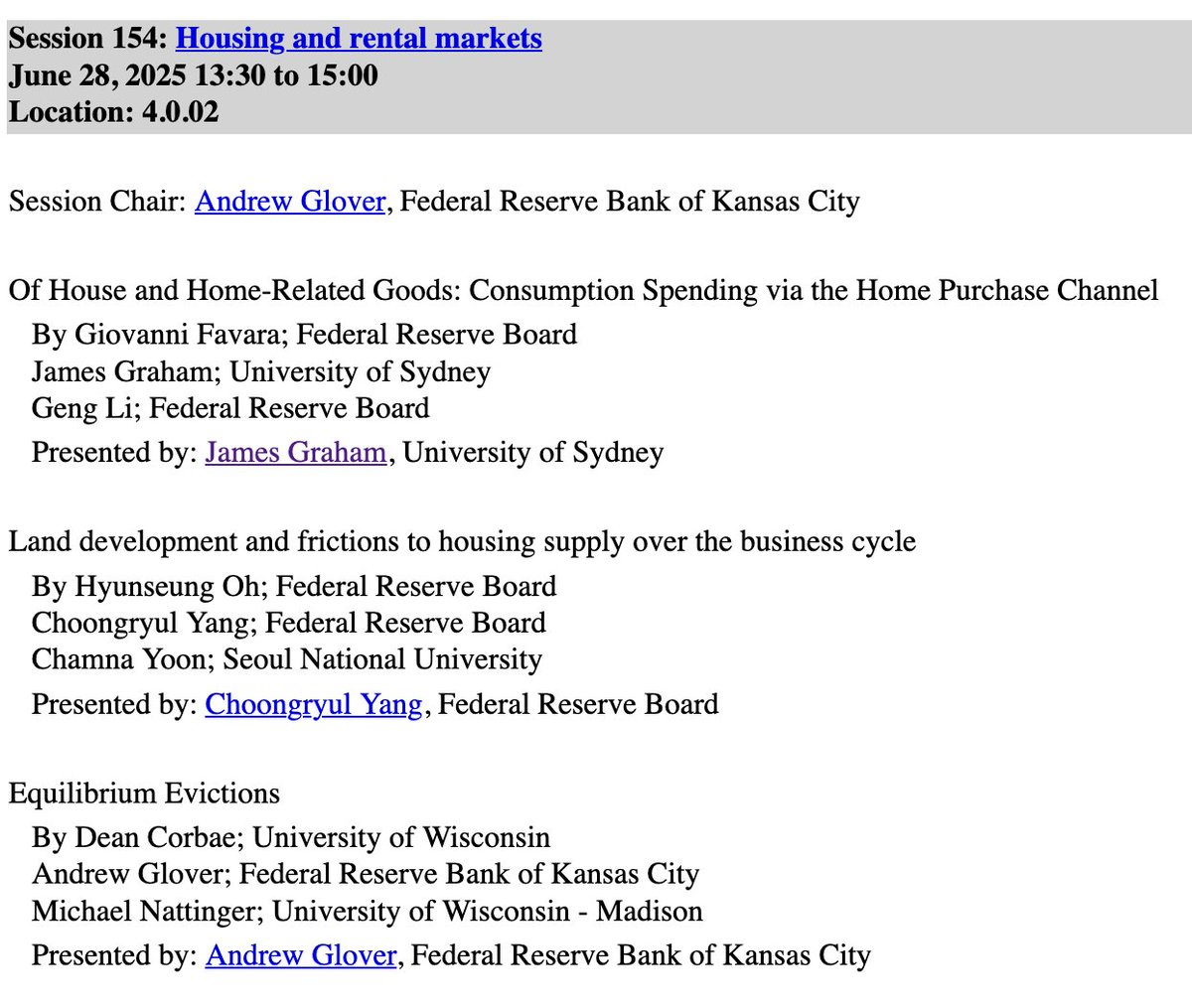
Come and check out our session on Housing and Rental Markets on Saturday, with @andyecon and @_ChoongYang. I'll be presenting my recent paper on the "Home Purchase Channel of Expenditure".
I’m excited to present our paper “What can measured beliefs tell us monetary non-neutrality?” with @hafrouzi and @joel_flynn at this great conference at the ECB on Tuesday morning! Looking forward to interacting with many leading scholars in this field!
Our joint conference with the Bank of Canada and the Federal Reserve Bank of New York on Expectations Surveys, Central Banks and the Economy kicks off on Tuesday. Follow live from 9:00 CET
https://t.co/WraNx8TC7U
Our joint conference with the Bank of Canada and the Federal Reserve Bank of New York on Expectations Surveys, Central Banks and the Economy kicks off on Tuesday. Follow live from 9:00 CET
https://t.co/WraNx8TC7U
How can measured beliefs elucidate the real effects of monetary shocks? The authors highlight the interaction between firms’ beliefs & price-setting behaviors, revealing the crucial role of cross-sectional data on uncertainty & pricing durations. https://t.co/XTQQtRA7eN
I'm excited that our new paper will be presented today in the Impulse and Propagation Mechanism session of the NBER SI, which will be live-streamed at 11:15 ET via YouTube. Watch it here 😀: https://t.co/WtvskD4ua9
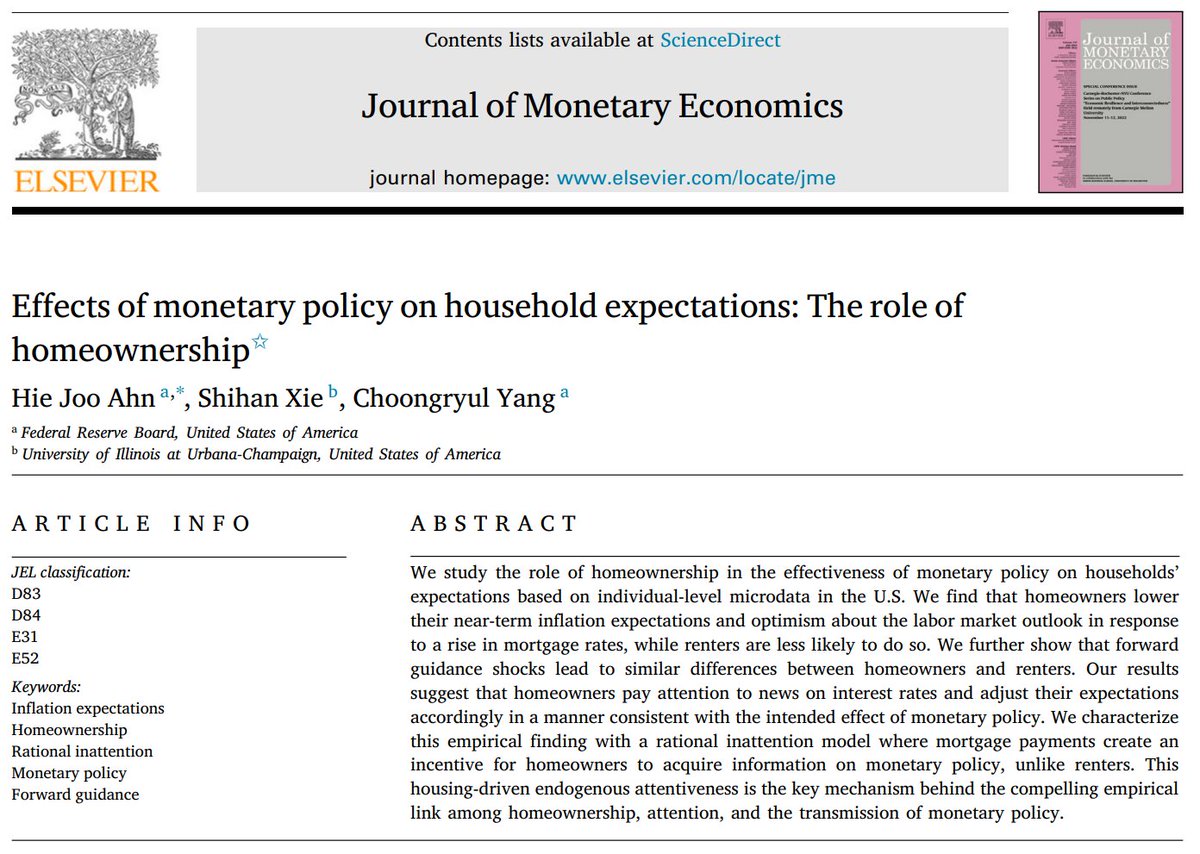
Very excited to see our paper "Effects of monetary policy on household expectations: The role of homeownership" (with Hie Joo Ahn and
@ShihanXie ) is now available online in the Journal of Monetary Economics! 👇1/4 https://t.co/ecBxMJRSQr