🐷✨AquaFi: Your Crypto Piggy Bank
Ever wished your crypto could grow while just sitting there? Meet AquaFi a fun, secure way to save and earn, every 5 minutes.
👇 Here’s how it works:
1/6 IPO Season Is Coming but most are approaching it like a TGE.
And like TGEs, IPO success cluster around timing, access and market cycles. Which means not everyone captures the upside.
But if you're going to play them anyway, you’d need to get in on the ground floor 👇
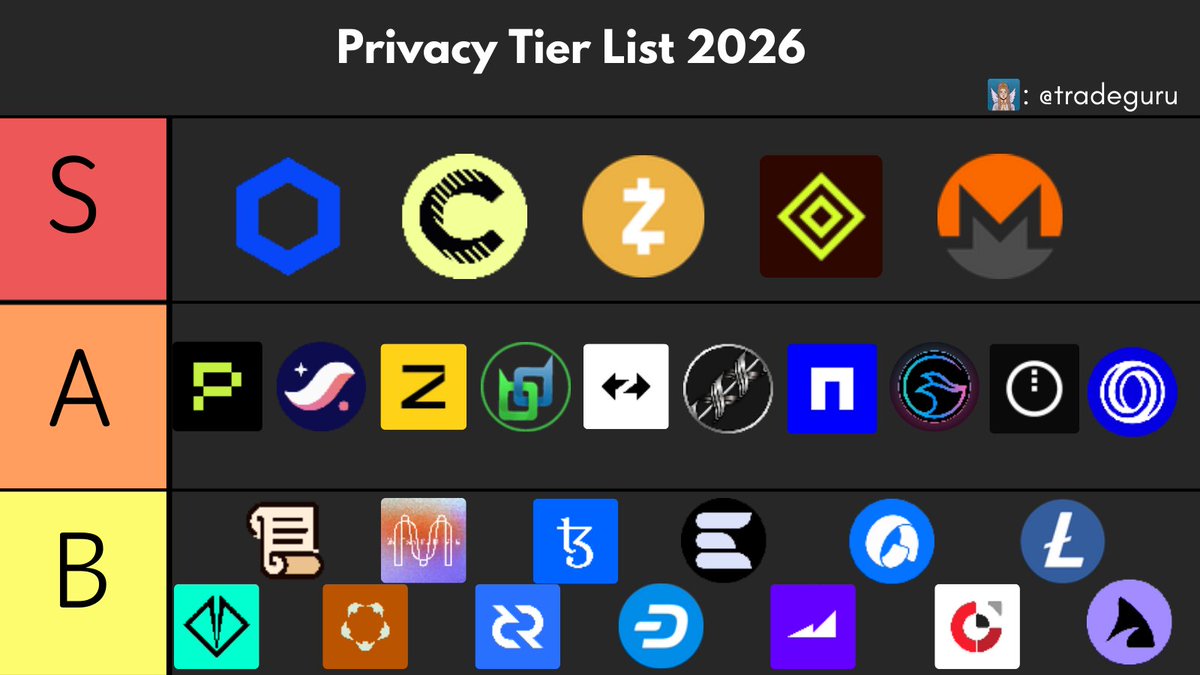
Privacy Protocols Tier List - 2026
This list evaluates 30 privacy protocols across three key merits:
> Privacy Technology
> Mindshare
> Volume
S TIER
.@monero | $XMR
Tech: Ring Signatures, Stealth Addresses, Ring Confidential Transactions, Dandelion++
Monero is the undisputed gold standard of privacy coins with mandatory privacy by default, where every transaction is private. A ccommunity-driven project with no VC backing, and no founder rewards. Token is completely fungible and untraceable, making it the preferred choice for users prioritizing absolute transactional privacy.
.@zcashco | $ZEC
Tech: zk-SNARKs, Halo 2 proving system & Unified Addresses
Zcash is the pioneer of zk cryptography in crypto, also the first widespread application of zk-SNARKs. Offers optional privacy through shielded addresses (z-addrs) that encrypt sender, receiver, and amount. They have strong institutional interest with backing from Electric Coin Company.
.@aztecnetwork | $AZTEC
Tech: zk-SNARKs, Private Execution Environment, Noir programming language & UTXO private state tree.
Aztec is the first fully decentralized privacy-preserving L2 on Ethereum. It enables private smart contracts with optional privacy.
.@CantonNetwork | $CC
Tech: Daml smart contracts, Configurable privacy, Subnets, Global Synchronizer
Institutional-grade privacy-enabled blockchain for regulated finance. 2-tier consensus with subnets for unlimited scaling - each application runs independently. Daml language for privacy-by-design with access control built-in. Global Synchronizer ensures atomic cross-subnet transactions. Backed by Goldman Sachs, BNP Paribas, Broadridge, Microsoft, DTCC. Privacy is configurable per application; not a privacy coin but privacy infrastructure for institutions.
.@chainlink | $LINK
Tech: DECO (zk-TLS oracles), Town Crier (TEE-based oracle), Blockchain Privacy Manager
While primarily known as the leading oracle network, Chainlink has developed significant privacy infrastructure. DECO enables zk proofs of web data without revealing the underlying information. Town Crier uses Intel SGX TEEs to fetch HTTPS data privately. The Blockchain Privacy Manager provides configurable privacy for enterprise blockchain networks, allowing selective data sharing with counterparties. LINK isn't a privacy coin per se, but its oracle infrastructure enables privacy-preserving applications across DeFi - private credit scoring, confidential KYC, and selective credential disclosure. The CCIP also supports private message passing between chains.
A TIER
.@zama_fhe | $ZAMA
Technology: FHE, fhEVM
Leader in FHE industry with fhEVM (confidential smart contract solution). Co-developed ERC-7984, a confidential token standard with Mind Network. Their focus is on making FHE accessible to devs through easy-to-use libraries. They have strong academic and research backing from top cryptographers. The tech enables computation on encrypted data without decryption - breakthrough for privacy-preserving AI and confidential DeFi.
.@MidnightNtwrk | $NIGHT
Tech: zk-SNARKs, TypeScript, Kachina Protocol, dual-state architecture
Night is a Cardano partner chain for rational privacyand Google Cloud partnership for validator infrastructure. UTXO public ledger for consensus + account-based private execution. $DUST non-transferable and generated by holding NIGHT.
.@BeldexCoin | $BDX
Tech: Ring Signatures, Stealth Addresses (Monero fork)
Beldex is building a complete PoS privacy infrastructure: BChat (end-to-end encrypted messenger routing through masternodes), BelNet (decentralized VPN masking IPs), Beldex Browser (privacy-focused with ad blocking), and a Name Service for human-readable private domains. They have enabled cross-chain interoperability via Stargate and LayerZero. The ecosystem approach makes privacy practical for everyday digital life - messaging, browsing, and payments all in one confidential suite.
.@PhalaNetwork | $PHA
Tech: TEEs, Intel SGX, Phat Contracts, pRuntime
A Polkadot parachain providing decentralized confidential cloud computing. Worker nodes run Intel SGX TEEs creating secure enclaves where code executes with cryptographic guarantee, that even node operators can't see the data. Phat Contracts (Rust-based) enable complex off-chain computation with blockchain verification, thereby accessing any web service securely.
.@nillionnetwork | $NIL
Tech: Blind Computation, Secure Multi-Party Computation (MPC), Nil Message Compute (NMC)
Building humanity's first blind computer for secure computation on encrypted data without ever revealing the underlying information. Unlike blockchains that decentralize transactions, Nillion decentralizes trust for high-value data and computation.
.@Starknet | $STRK
Tech: zk-STARKs
Ethereum L2 using STARKs - quantum-resistant and no trusted setup required over SNARKs. Recently announced strkBTC - a private Bitcoin wrapper with Zcash-like shielded balances and confidential transfers. $STRK is used for staking and governance. The Cairo programming language enables efficient ZK proof generation with strong focus on privacy as a key feature.
.@zksync | $ZK
Tech: zk-SNARKs, Rollup, account abstraction
User-centric zk rollup on Ethereum. zk-SNARKs enable verified private trxns without revealing underlying data. Account abstraction makes privacy accessible through smart accounts with social recovery and custom security rules.
.@OasisProtocol | $ROSE
Tech: Trusted execution environments (TEEs), Sapphire confidential EVM, Runtime offchain logic (ROFL)
An L1 with unique architecture separating consensus from execution. The ROFL framework (launched July 2025) enables off-chain AI model training with on-chain verification - a "trustless AWS" for confidential compute.
.@MantaNetwork | $MANTA
Tech: zk-SNARKs, zk Proofs
L2 solution making privacy accessible for everyday users. zk-SNARKs enable private transactions and identity verification without complex setup. Recent partnership with @carv_official focuses on Web3 gaming and decentralized identity. Manta offers low fees and fast finality while preserving privacy.
.@RAILGUN_Project | $RAIL
Tech: zk-SNARKs, UTXO model, Merkle Trees, encrypted accumulator, 0zk addresses
The privacy middleware for DeFi integrated directly into Ethereum, BNB, Polygon, and Arbitrum. Users shield assets into private pools via 0zk addresses and there is full anonymity for using Uniswap, Aave, 1inch without revealing wallet, amounts, or asset types. $RAIL stakers earn ETH, DAI, and RAIL from protocol treasury.
B TIER
.@Scroll_ZKP | $SCR
Tech: zkEVM, Zero-Knowledge Proofs, Halo 2
Native zkEVM L2 with bytecode-level Ethereum compatibility. Built with Ethereum Found's PSE team using Halo 2 proving system. PipeZK hardware accelerator enables GPU provers 10x faster than CPU.
.@XelisCurrency | $XEL
Tech: Homomorphic Encryption, BlockDAG, zk-Proofs, Xelis Hash
A BlockDAG with privacy as the fourth pillar (Quadrilemma instead of Trilemma). Built from scratch in Rust with 15-second blocks. Homomorphic encryption hides transaction amounts and balances while keeping addresses visible for compliance.
.@Litecoin | $LTC
Tech: MWEB (Mimblewimble Extension Blocks) - optional privacy
Has optional privacy via MWEB. Mimblewimble protocol enables confidential trxns hiding amounts and improved pruning for scalability.
.@LayerEdge | $EDGEN
Tech: zk Proofs, BitVM
Decentralized network improving Bitcoin blockspace efficiency. Proof aggregation enables efficient rollups on Bitcoin with trust-minimized verification. Light node operation allows users to earn EDGE points by keeping browser tab open.
.@Holdstation | $HOLD
Tech: Account Abstraction, zkSync integration
Non-custodial DeFAI wallet with perp dex offering up to 100x leverage. Account abstraction enables social recovery and gasless transactions. Native on zkSync with expansion to BNB Chain, WorldChain, Solana, Ethereum, and Berachain. 2M+ users since 2022. Partners with Ondo Finance, Worldcoin, World Liberty Financial. Also has Tokenized stock trading for global markets.
.@mindnetwork_xyz | $FHE
Tech: FHE, HTTPZ protocol, FHEBridge
The first FHE-based general-purpose Restaking Rollup. Enables verifiable computation on encrypted data. AgenticWorld for private AI agents with encrypted memory. MindChain is the first FHE blockchain for AI agents. Co-developed ERC-7984 confidential token standard with Zama.
.@mavprotocol | $MAV
Tech: DeFi infrastructure, Liquidity optimization
Defi liquidity OS with Dynamic Distribution AMM. Customizable liquidity distributions, fee auto-compounding, boosted positions. Native LST support with price following. Top 5 DEX by volume on multiple chains. #1 for wstETH trading volume surpassing Uniswap and Curve. $MAV token for governance via veMAV voting escrow. Included here due to integration with privacy protocols and enabling efficient private liquidity markets. Not a privacy protocol per se but critical infrastructure for private DeFi.
.@AvailProject | $AVAIL
Tech: Data availability sampling, Modular blockchain
Modular chain providing DA layer for rollups and L2s. Nexus Mainnet launching Q4 2025 for multichain infrastructure enables applications to connect users and liquidity across ecosystems without bridges. Not a direct privacy protocol but enables privacy-preserving L2 deployments through modular architecture. Light clients can verify data availability without downloading full blocks. They focus on scalability and interoperability as foundations for private applications.
.@HumanityProt | $H
Tech: zk Proofs, Palm Biometrics, Proof of Humanity
Decentralized identity network using palm biometrics and ZK proofs for privacy-preserving human verification. Human ID is reusable credential without exposing biometric data. zkEVM L2 with Proof-of-Humanity consensus. Prevents Sybil attacks for fair airdrops, voting, and lending. Partners with Animoca Brands, Polygon, Pantera, Fireblocks, Mastercard. Palm scans processed locally into irreversible hashes with liveness detection.
.@decredproject | $DCR
Tech: CoinJoin mixing, Confidential Transactions (proposed)
Hybrid PoW/PoS blockchain with strong on-chain governance and treasury system. CoinJoin privacy through built-in mixing of transactions. There is an active proposal for Confidential Transactions tech, to hide amounts and improve CoinJoin UX. Privacy is optional but integrated.
.@Dashpay | $DASH
Technology: CoinJoin mixing (built-in), InstantSend
Digital cash focused on fast, cheap payments with optional privacy via CoinJoin. Masternodes (requiring 1,000 DASH collateral) enable InstantSend and governance. They have 4-16 mixing rounds recommended for privacy, taking hours for full anonymity. They also have an active proposal for Confidential Transactions to enhance privacy and streamline mixing. This is one of the older privacy projects (2014) with established merchant adoption.
.@Tezos | $XTZ
Tech: Limited privacy features (optional via DApps)
Self-amending blockchain with on-chain governance enabling upgrades without hard forks. Liquid PoS consensus with 4-6% staking rewards. Smart formal verification for high-security applications. Privacy features available through DApps but not native to protocol.
.@MinaProtocol | $MINA
Tech: zk-SNARKs, Succinct blockchain
World's lightest blockchain at 22KB (the entire chain is the size of a few tweets) fixed size using recursive zk-SNARKs. Privacy through zk proofs enabling private, verifiable computation. Used for high-security apps requiring succinct verification. The small size enables easy full node participation from any device.
.@anoma | $XAN
Tech: Intent-based architecture, zk Proofs
Intent-centric blockchain for counterparty discovery and atomic settlement. Users express intents without exposing information to validators until matched. It's a novel architecture separating intent expression from execution. Their focus is on enabling private, efficient trading and coordination without order books.
Pls I would love to know which ones are on your radar.
I am not entirely sure what CT is bullish in Q1 but @circle appears to be onto something.
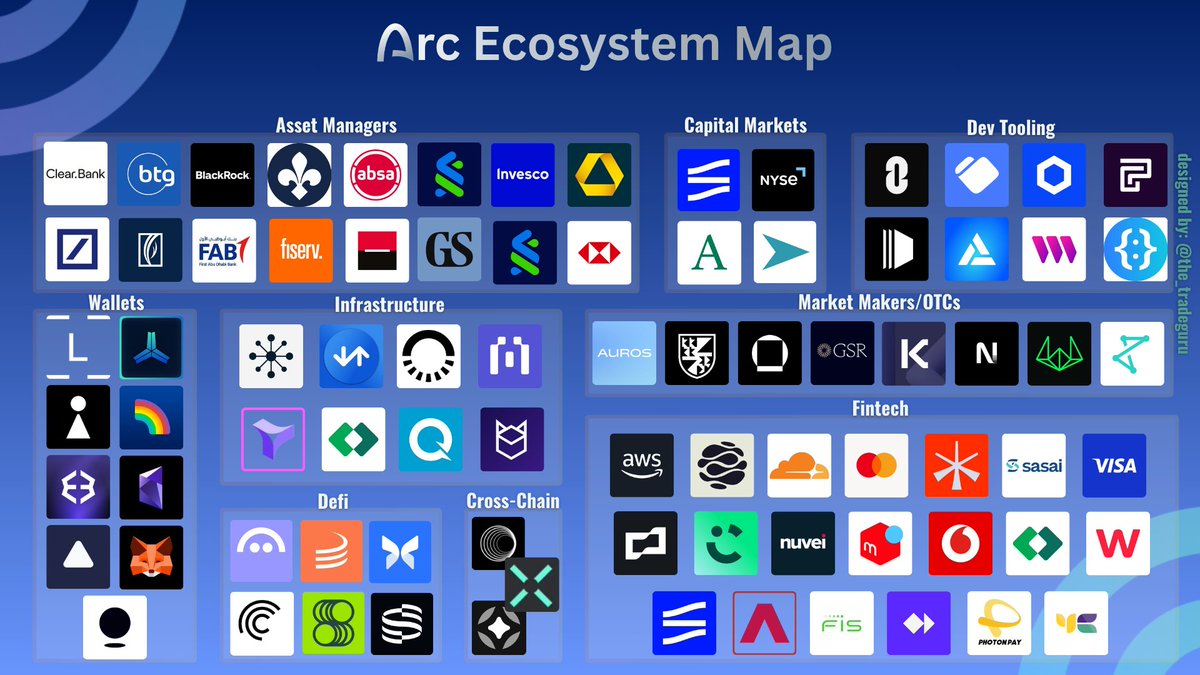
A closer look at Circle's 2026 vision shows they're building:
> contracts to enable tokenization
> direct access to Federal Reserve payment rails via Fedmaster
> a product roadmap that treats stablecoins as programmable financial primitives
All around a stack where digital assets ( $USDC, $EURC, $USYC, Mint and xReserves) power 2 product layers and 3 infrastructure pillars.
1.) At the product layer utilising stablecoin liquidity sits:
> Circle Payments Network (CPN)
> StableFX
2.) Underneath that layer are the infrastructures that make the system usable at scale:
> .@arc as the settlement network
> developer tooling (wallets, contracts, paymaster architecture)
> interoperability rails through CCTP and Gateway.
Arc is the centerpiece of the infrastructure thesis.
Arc is Circle’s attempt to build a purpose-specific settlement layer for global financial workflows rather than a general-purpose retail chain.
The design choices reflect that goal: stablecoins as native gas, deterministic sub-second finality, configurable privacy with auditability, and direct integration with Circle’s tokenization and payments stack.
The past 90 days of testnet activity provided the first signal that Arc is not simply conceptual. Circle reports that Arc processed:
> 150M transactions
> reached roughly 1.5M transacting wallets
> maintained average settlement around 0.5.
These numbers translate into sustained daily throughput that demonstrates early demand for stablecoin-native execution.
What matters more than raw usage, however, is who is building around the network and why.
Arc’s integrations over the period with 100+ institutional coverage reveals a deliberate strategy to remove the traditional barriers institutions face when moving onchain.
i. Infrastructure providers such as @Quicknode introduced node and endpoint support, lowering the operational complexity of deploying production applications.
ii. Custody and tokenization specialists like Taurus joined the testnet to provide secure asset management rails.
iii. While compliance analytics providers such as @elliptic integrated monitoring capabilities to ensure privacy features can coexist with regulatory obligations.
iv. @FireblocksHQ's collaboration with Circle further expands distribution by allowing institutions already using Fireblocks to access Arc without rebuilding custody or settlement workflows.
v. @hibachi_xyz and many other players building on Arc through the builder's programe.
Each integration closes a different adoption gap. Together they convert Arc from another competing chain to a viable financial environment.
Arc's infrastructure thesis only becomes meaningful when viewed alongside Circle’s product layer.
CPN already has $3.4B annualized volume and is expanding geographic corridors, positioning Arc as a potential settlement backbone for cross-border transactions.
StableFX, now live in institutional pilot environments, demonstrates how Arc can host FX markets with instant payment execution.
Meanwhile, tokenized treasury instruments such as $USYC (already at $1.6B AUM) introduces collateral primitives that can support lending and money markets on the same network.
The implication of it all is that Arc is less about competing with existing chains and more about coordinating financial primitives into a unified settlement venue.
Testnets no longer inspire the confidence they once did as a result of repeated airdrop disappointments.
Arc’s early story, on the other hand, looks different. Backed by @circle and major institutions.
In short: if you’re here for value, this testnet might be worth the effort
“Claude wrote a vulnerable code that led to an exploit of $1.78M.”
To OpenAI, failures like this justify building benchmarks such as EVMbench.
Frontier models can generate isolated smart contract code effectively, yet still miss system-level correctness. EVMbench addresses this gap by introducing end-to-end evaluation of AI agents in realistic execution environments.
I spent the last hour going through the full whitepaper. Here’s why EVMbench matters for crypto audits.
EVMbench is a smart contract security evaluation built by @OpenAI x @paradigm to evaluate AI agents in realistic environments.
Instead of testing isolated coding abilities, they decided it was best to evaluate agents based on 3 capabilities:
> detect vulnerabilities
> patch them without breaking functionality
> exploit a fund-drain in controlled sandbox conditions.
To evaluate these three distinct capabilities, 3 frontier models were used.
1.) @OpenAI's models (o3, GPT-5 variants, Codex agent setups)
2.) @Google's Gemini 3 Pro
3.) @AnthropicAI's Claude Opus variants
Within the workspace, EVMbench recreated a realistic real smart contract workflow running on a local Ethereum environment powered by Anvil.
The benchmark uses a curated dataset of vulnerabilities drawn from audit competitions and real protocol repositories.
Each task includes ground-truth vulnerabilities and an environment where the contract can be deployed and interacted with.
The resulting data reflects a consistent pattern.
In Detect, Claude Opus 4.6 reaches one of the strongest points around the mid 40% range, while GPT-5.3 Codex improves steadily with more tokens, approaching roughly 40%. GPT-5.2 trails slightly but remains competitive.
> Key insight: detection improves with reasoning budget across all agents
In Patch, GPT-5.3 Codex becomes the strongest agent, reaching just above 40%. GPT-5.2 follows close behind, near 39%. Claude Opus variants sit lower, around the mid 20% range.
> Key insight: patching is the hardest capability across all agents, and even the best agent remains far from perfect.
In Exploit, GPT-5.3 Codex clearly dominates, exceeding 70%, making it the highest-scoring agent overall. GPT-5.2 reaches roughly low 60%. Claude Opus 4.6 also performs strongly, around 60%, but still below the Codex agent.
> Key insight: task execution is currently the strongest domain for AI agents and they can drain funds.
Taken together, the results show that AI agents can find and exploit vulnerabilities in controlled environments. However, fixing those vulnerabilities safely remains difficult for agents, which means human review is still essential before deploying smart contracts to production.
Having reviewed the complete paper, EVMbench stands out as a meaningful step toward measurable AI security evaluation in crypto.
You should read it.
evmbenchmark[.]pdf
1|6 APY is microscopic. It is useful, but it can also make you blind.🧵
When a protocol makes a market projection, most readers do not hear a long horizon plan. They hear a sales pitch and start asking what is in it for me.
In @aave’s case, this $30–$50T projection triggered sarcasm about low APR. Meanwhile the question we ought to ask is.
What happens when lending becomes global, automated, and capable of financing assets that were never liquid before?
Reading this piece genuinely increased my respect for @StaniKulechov.
2|6 Every major transformation started as an argument in public.
People argued about railways tearing up the countryside.
They argued about electrification being unsafe and unnecessary.
They argued about the internet being a toy.
They argued about virtual money. Now we have onchain finance, and we argue in the most unserious way possible, reducing everything to APR screenshots, airdrop flips, market caps and TVL charts. If a protocol does not move fast enough, it is declared finished.
Perspective helps. @nvidia was founded in 1993. It took 26 years and 9 months from its 1999 IPO to become the first company to touch a $5 trillion market cap.
That arc required decades of semiconductor scaling, AI research, and capital formation. Bitcoin took roughly 16 years to reach half that valuation. In crypto time that feels ancient. In economic time it is barely a chapter.
So is 25 years really long when you are talking about financing a structural shift in global energy, infrastructure, and productive assets?
3|6 Alas, arguments against inevitable adoption never win.
> Irrigation financed the first cities.
> Railways reorganized trade.
> Electrification reshaped daily life.
> In every case finance did not simply earn yield, it enabled a new form of economic organization.
I see Stani’s point clearly with The abundance thesis – which is not poetic language. It is about cost curves.
Solar panels fell from over $100 per watt in the 1970s to a fraction of a dollar today, same as Batteries.
As production scales, costs collapse. That collapse unlocks new behavior.
If cheap computing created the internet economy, cheap energy can create an entirely new industrial base. The bottleneck is not technology anymore. It is capital coordination.
This is where Aave enters the conversation in a way that CT is not yet pricing correctly.
4|6 Background
DeFi has largely solved the supply side of capital. Billions can be aggregated globally, instantly, without permission.
What it has not yet solved at scale is the demand side beyond crypto native collateral. If onchain lending can finance tokenized productive assets such as solar farms, data centers, or infrastructure debt, according to Stani, it stops being a circular crypto liquidity loop and starts becoming an allocation layer for real economic expansion.
5|6 Aave today is not the same protocol it was in 2020.
With V3, it introduced:
> risk isolation
> efficiency modes
> granular supply and borrow caps
> multi chain deployment across major ecosystems.
The roadmap toward V4 signals deeper liquidity unification and more advanced risk architecture.
The introduction of $GHO as a native overcollateralized stablecoin adds a monetary layer to the lending engine. That vertical integration matters because it allows Aave to control more of the value chain between collateral, borrowing and stable liquidity.
6|6 Now layer tokenization into that structure.
If even a fraction of the trillions allocated annually to energy transition and infrastructure can be represented onchain, used as collateral, and financed through a global liquidity pool, we are no longer debating a few billion in TVL. We are debating access to a slice of capital markets that already measure in the hundreds of trillions.
The $30 to $50 trillion figure is not a promise that Aave becomes that large tomorrow. It is a framing of the addressable transformation if onchain finance becomes a credible rail for funding abundance assets over the next 25 years.
Most founders are optimizing for the next cycle. Aave is optimizing for the next economic regime.
When lending starts to generate real world cash flows at scale, the sarcasm shifts not to ‘why is the APR low this week?’ but which onchain financier earns the right to sit at the center of the next industrial expansion.
That is a harder thesis to digest. It also happens to be the target to escape from this Bitcoin-focused space.


![tradeguru's tweet photo. “Claude wrote a vulnerable code that led to an exploit of $1.78M.”
To OpenAI, failures like this justify building benchmarks such as EVMbench.
Frontier models can generate isolated smart contract code effectively, yet still miss system-level correctness. EVMbench addresses this gap by introducing end-to-end evaluation of AI agents in realistic execution environments.
I spent the last hour going through the full whitepaper. Here’s why EVMbench matters for crypto audits.
EVMbench is a smart contract security evaluation built by @OpenAI x @paradigm to evaluate AI agents in realistic environments.
Instead of testing isolated coding abilities, they decided it was best to evaluate agents based on 3 capabilities:
> detect vulnerabilities
> patch them without breaking functionality
> exploit a fund-drain in controlled sandbox conditions.
To evaluate these three distinct capabilities, 3 frontier models were used.
1.) @OpenAI's models (o3, GPT-5 variants, Codex agent setups)
2.) @Google's Gemini 3 Pro
3.) @AnthropicAI's Claude Opus variants
Within the workspace, EVMbench recreated a realistic real smart contract workflow running on a local Ethereum environment powered by Anvil.
The benchmark uses a curated dataset of vulnerabilities drawn from audit competitions and real protocol repositories.
Each task includes ground-truth vulnerabilities and an environment where the contract can be deployed and interacted with.
The resulting data reflects a consistent pattern.
In Detect, Claude Opus 4.6 reaches one of the strongest points around the mid 40% range, while GPT-5.3 Codex improves steadily with more tokens, approaching roughly 40%. GPT-5.2 trails slightly but remains competitive.
> Key insight: detection improves with reasoning budget across all agents
In Patch, GPT-5.3 Codex becomes the strongest agent, reaching just above 40%. GPT-5.2 follows close behind, near 39%. Claude Opus variants sit lower, around the mid 20% range.
> Key insight: patching is the hardest capability across all agents, and even the best agent remains far from perfect.
In Exploit, GPT-5.3 Codex clearly dominates, exceeding 70%, making it the highest-scoring agent overall. GPT-5.2 reaches roughly low 60%. Claude Opus 4.6 also performs strongly, around 60%, but still below the Codex agent.
> Key insight: task execution is currently the strongest domain for AI agents and they can drain funds.
Taken together, the results show that AI agents can find and exploit vulnerabilities in controlled environments. However, fixing those vulnerabilities safely remains difficult for agents, which means human review is still essential before deploying smart contracts to production.
Having reviewed the complete paper, EVMbench stands out as a meaningful step toward measurable AI security evaluation in crypto.
You should read it.
evmbenchmark[.]pdf](https://pbs.twimg.com/media/HBhoyHgXQAAfgPf.png)
![tradeguru's tweet photo. “Claude wrote a vulnerable code that led to an exploit of $1.78M.”
To OpenAI, failures like this justify building benchmarks such as EVMbench.
Frontier models can generate isolated smart contract code effectively, yet still miss system-level correctness. EVMbench addresses this gap by introducing end-to-end evaluation of AI agents in realistic execution environments.
I spent the last hour going through the full whitepaper. Here’s why EVMbench matters for crypto audits.
EVMbench is a smart contract security evaluation built by @OpenAI x @paradigm to evaluate AI agents in realistic environments.
Instead of testing isolated coding abilities, they decided it was best to evaluate agents based on 3 capabilities:
> detect vulnerabilities
> patch them without breaking functionality
> exploit a fund-drain in controlled sandbox conditions.
To evaluate these three distinct capabilities, 3 frontier models were used.
1.) @OpenAI's models (o3, GPT-5 variants, Codex agent setups)
2.) @Google's Gemini 3 Pro
3.) @AnthropicAI's Claude Opus variants
Within the workspace, EVMbench recreated a realistic real smart contract workflow running on a local Ethereum environment powered by Anvil.
The benchmark uses a curated dataset of vulnerabilities drawn from audit competitions and real protocol repositories.
Each task includes ground-truth vulnerabilities and an environment where the contract can be deployed and interacted with.
The resulting data reflects a consistent pattern.
In Detect, Claude Opus 4.6 reaches one of the strongest points around the mid 40% range, while GPT-5.3 Codex improves steadily with more tokens, approaching roughly 40%. GPT-5.2 trails slightly but remains competitive.
> Key insight: detection improves with reasoning budget across all agents
In Patch, GPT-5.3 Codex becomes the strongest agent, reaching just above 40%. GPT-5.2 follows close behind, near 39%. Claude Opus variants sit lower, around the mid 20% range.
> Key insight: patching is the hardest capability across all agents, and even the best agent remains far from perfect.
In Exploit, GPT-5.3 Codex clearly dominates, exceeding 70%, making it the highest-scoring agent overall. GPT-5.2 reaches roughly low 60%. Claude Opus 4.6 also performs strongly, around 60%, but still below the Codex agent.
> Key insight: task execution is currently the strongest domain for AI agents and they can drain funds.
Taken together, the results show that AI agents can find and exploit vulnerabilities in controlled environments. However, fixing those vulnerabilities safely remains difficult for agents, which means human review is still essential before deploying smart contracts to production.
Having reviewed the complete paper, EVMbench stands out as a meaningful step toward measurable AI security evaluation in crypto.
You should read it.
evmbenchmark[.]pdf](https://pbs.twimg.com/media/HBhoxqRWgAAFRq-.png)







![tradeguru's tweet photo. “Claude wrote a vulnerable code that led to an exploit of $1.78M.”
To OpenAI, failures like this justify building benchmarks such as EVMbench.
Frontier models can generate isolated smart contract code effectively, yet still miss system-level correctness. EVMbench addresses this gap by introducing end-to-end evaluation of AI agents in realistic execution environments.
I spent the last hour going through the full whitepaper. Here’s why EVMbench matters for crypto audits.
EVMbench is a smart contract security evaluation built by @OpenAI x @paradigm to evaluate AI agents in realistic environments.
Instead of testing isolated coding abilities, they decided it was best to evaluate agents based on 3 capabilities:
> detect vulnerabilities
> patch them without breaking functionality
> exploit a fund-drain in controlled sandbox conditions.
To evaluate these three distinct capabilities, 3 frontier models were used.
1.) @OpenAI's models (o3, GPT-5 variants, Codex agent setups)
2.) @Google's Gemini 3 Pro
3.) @AnthropicAI's Claude Opus variants
Within the workspace, EVMbench recreated a realistic real smart contract workflow running on a local Ethereum environment powered by Anvil.
The benchmark uses a curated dataset of vulnerabilities drawn from audit competitions and real protocol repositories.
Each task includes ground-truth vulnerabilities and an environment where the contract can be deployed and interacted with.
The resulting data reflects a consistent pattern.
In Detect, Claude Opus 4.6 reaches one of the strongest points around the mid 40% range, while GPT-5.3 Codex improves steadily with more tokens, approaching roughly 40%. GPT-5.2 trails slightly but remains competitive.
> Key insight: detection improves with reasoning budget across all agents
In Patch, GPT-5.3 Codex becomes the strongest agent, reaching just above 40%. GPT-5.2 follows close behind, near 39%. Claude Opus variants sit lower, around the mid 20% range.
> Key insight: patching is the hardest capability across all agents, and even the best agent remains far from perfect.
In Exploit, GPT-5.3 Codex clearly dominates, exceeding 70%, making it the highest-scoring agent overall. GPT-5.2 reaches roughly low 60%. Claude Opus 4.6 also performs strongly, around 60%, but still below the Codex agent.
> Key insight: task execution is currently the strongest domain for AI agents and they can drain funds.
Taken together, the results show that AI agents can find and exploit vulnerabilities in controlled environments. However, fixing those vulnerabilities safely remains difficult for agents, which means human review is still essential before deploying smart contracts to production.
Having reviewed the complete paper, EVMbench stands out as a meaningful step toward measurable AI security evaluation in crypto.
You should read it.
evmbenchmark[.]pdf](https://pbs.twimg.com/media/HBhoytUW0AAkfrc.png)