We just shipped Pulse and I'm so excited about what this means for how we use ChatGPT.
When we started, the core idea was simple: what if ChatGPT could talk first? Not waiting for you to ask the perfect question, but proactively sending you things that would actually help based on what it knows about you.
My own usage of ChatGPT has changed since we started building this. Last week I asked about bike maintenance and Pulse remembered I'd been looking at weekend activities, so it found me a bike route I didn't know existed near my place. When I was debugging Pulse code, it surfaced fresh RL papers from Arxiv because it knows what's relevant to my work.
The magic for me is that ChatGPT now works for me even when I'm not actively using it. Its value no longer stops at the boundary of what I typed. It connects the dots between my past conversations, proactively does work on my behalf, and surfaces what I need, often before I even think to ask.
This is v1. We're working to make it more useful, more timely, and get it to more people soon.
Would love to hear what feels useful and what doesn't. Your feedback directly shapes where we take this!
Now in preview: ChatGPT Pulse
This is a new experience where ChatGPT can proactively deliver personalized daily updates from your chats, feedback, and connected apps like your calendar.
Rolling out to Pro users on mobile today.
For anyone with endless ideas, this agent age is nirvana as those ideas are met with endless execution, endless exploration. I've never had has much fun working with computers as I do right now. What a time to be alive.
We’re giving scientists, mathematicians, and engineers free access to our frontier models—starting with 10,000 researchers and expanding to 100,000 through 2027.
ChatGPT for Academic Researchers is built to accelerate discovery across disciplines.
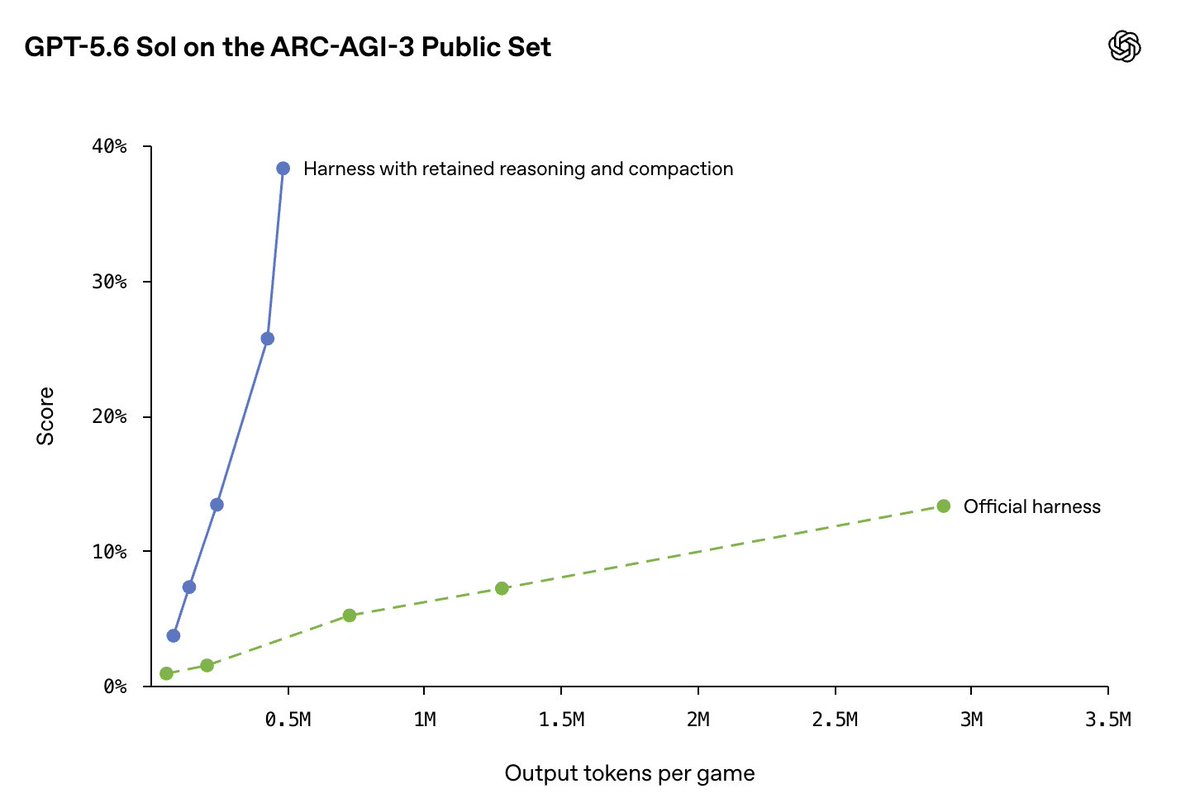
Turns out GPT-5.6 Sol is actually SoTA on ARC-AGI-3.
Just took two setting changes. You just have to allow it to reason and work over multiple context windows with the help of our canonical compaction implementation.
https://t.co/wHjaNsvIv8
A ChatGPT automation just found ~$45K in erroneous invoices across 3 years of billing history that I've confirmed and already had resolved. My lifetime history for ChatGPT is ~$1,800, so it just paid for itself 25x over.
I setup an automation with read-only access to my email, and tasked this one specifically with analyzing construction invoices. It has access to prior construction invoices, emails, meeting notes, etc. It produces a report and emails it to me (the only email its allowed to send, enforced by API token) whenever I receive a construction invoice.
Across 3 years of construction projects, it found about $45K in issues. Some were wrong amounts, some were duplicate invoices, some were invoices addressed to the wrong person. I manually verified, emailed my GCs, and got refunded/credited.
I get multiple construction bills each month and each bill is ~50 pages in a PDF of low-quality scanned paper. I do manually review each bill but its pretty hard to be right all the time.
I do believe these were genuine mistakes and not done out of ill will just based on what the mistakes were. I don't want to share my full construction costs across the past few years, but $45K is a very small percentage of overall billed amounts.
Pretty sweet.
If you were using Codex before, two things to do
1. Keep using Codex. It is for you
2. Tell your friends and family about ChatGPT Work who you always wanted to show Codex but they’re not as technical and don’t work with code every day
and tell me how it goes
Hello beautiful people! We have reset usage limits across Codex and ChatGPT Work. And another one will come later in the day. Rejoice.
Now that I have your attention, a quick update on ChatGPT Work, Codex and all the updates we shared yesterday.
We’ve spent the last 24 hours reading feedback, looking at usage patterns, and talking with many of you. The short version is that there is a *lot* of excitement for GPT 5.6 Sol, ChatGPT Work on mobile & web, but also that we didn't get everything quite right.
- We made it too easy to use the highest-compute settings without making the impact on usage limits sufficiently clear.
- We reorganized the desktop app in one bold move, making familiar things like chats and projects harder to find.
- Our launch framing was focused on ChatGPT Work and to some of our Codex fans it made it feel like Codex was going away over time. Absolutely not our intention, we love Codex and it is here to stay.
- And we introduced regressions for some existing multi-agent workflows, alongside a collection of rough edges in plugins and other parts of the experience.
We’re landing a first set of improvements today. We’re resetting usage twice so people can keep experimenting, changing defaults and the model picker so they don’t push people toward unnecessarily expensive settings, fixing several plugin submission issues, improving how we represent Codex in the product, and cleaning up some of the most immediate desktop problems.
A larger set of improvements will land next week. We’re bringing chats and projects back into the sidebar in a more familiar and customizable way, making usage and reset timing much more visible, clarifying when to use ChatGPT Work and when to use Codex, and addressing the many other smaller pieces of great feedback we've had.
The ambition behind this launch hasn’t changed. We think bringing ChatGPT and Codex together into a workspace where people and agents can collaborate is a very important step forward. But an ambitious direction doesn’t excuse avoidable confusion or regressions in the first version.
Please keep the feedback coming. We’re moving quickly, and you should see the experience already get better with a few updates today; and substantially better again next week.
if you like watching videos on 2x speed you might like watching GPT-sol do things with CUA
here's GPT- Sol making a cannon in Blender (but this video is NOT sped up)
make CUA fast again