A business idea for young engineers in India. Read this if you make about Rs 15 Lakh/Year writing code and want to build a real company with zero risk.
Two things are hitting startup websites at the same time, and together they open a real door.
One. Wix keeps on raising prices a lot for users like me. Plan jumping from ₹6,000 to ₹29,880 a year is common. Thousands of Wix users got this price increase notice 19 days before the new pricing impacts.
Two. The way customers find websites is changing. People now ask AI tools like ChatGPT, Perplexity, and Google AI instead of only searching Google and clicking links. So a website suddenly has two readers. Humans, and bots. Most sites are built only for humans, and Wix sites are some of the hardest for bots to read, because they are heavy and load a lot of content in a way crawlers struggle with. If the bot cannot read my site, it cannot recommend my company.
Put those together and founders like me are now paying more for a site that gets them found less. That is the gap you walk into.
There are more than 8 million live Wix sites in the world (BuiltWith). Many belong to startups. YC companies, pre seed, seed, and Series A founders all picked Wix so they could launch fast, then never moved off it. That is a huge list of people who aregetting a price shock and an AI problem at the same time.
But the problem for founders and starup dont end here. Wix gives me a website builder. It does not give me a person. No one sets up my DKIM/SPF. No one fixes my DNS. No one helps me migrate my domain. No one connects my contact forms to HubSpot.
THE PLAY: Three or four engineers form a small team. One who is good at English and sales. This could be an MBA instead of an Engineer. One who knows DevOps. One or more who can build. You offer a website plus concierge service for half the price.
HOW TO PITCH: Do not send a cold message into the void. Clone their current site first. AI can rebuild a Wix landing page in one afternoon now. Then send the founder a live link and say: "Here is your site, already rebuilt. Want to cut your bill in half, host it on your own free AWS or Azure credits, get a human on call for support when needed, have your leads flow straight into HubSpot or Salesforce, and have a site that AI tools can actually read?" The demo sells the deal for you.
Once you run a startup's site, email, DNS, and CRM, you are inside. Every lead that hits their site now flows through pipes you built. After that comes the dashboard, the integrations, and the real product work. The website is just the way in.
I am not very updated on how to to find Wix sites. But here is what I did in the past for such research. I am sure one of the following emthods still work:
- Install the free Wappalyzer extension. Run any site through Wappalyzer or BuiltWith and it shows you the tech stack right away.
- Paste the address into a free Wix detector. It scans the site's HTML and server headers for Wix signatures and answers instantly.
- Check yourself. Right click, View Page Source, press Ctrl+F, search "wix". Look for a tag reading meta name generator content https://t.co/mdXmaOiIPp Website Builder, web addresses with https://t.co/2IVj7PcvWw, or data-wix attributes in the code. This way never lies.
- Find them by the thousands. Use a source code search engine like PublicWWW, search "https://t.co/2IVj7PcvWw", and get a long list of live Wix sites at once. BuiltWith sells ready lists too.
Now, a random Wix site is not your customer. A funded startup on Wix is. Pull names from the YC directory, Crunchbase, or Product Hunt, then run them through the checks above. The Wix hits are your hot list. They have money, they got the price email, and they need a human. Especiually now as non-tech founders are gaining popularity.
Do not quit your day job to start this. This is a side project on day one. Keep your salary coming in. Land your first two or three clients on nights and weekends. Let the money build and prove the idea works. Only when the side income gets close to your salary do you go full time. A steady paycheck behind you means you are not desperate, so you can say no to bad clients and charge a fair price. Fear makes people undercharge. A day job removes the fear. Trust me, I know this because I have done a startup with and without a job.
When the founder signs up, the AI ready website is your high value upsell. You restructure the site so both humans and bots can read it well. Clear headings. Simple structured data. FAQ style pages that answer real questions. A plain file that tells AI crawlers what the site is about. Fast pages with the content right there in the code. Charge extra for this. It is new, very few people offer it, and founders care a lot about showing up when someone asks an AI about their space. You are not just saving them money anymore. You are getting them found.
Put it all together. Keep your job. Find Wix sites. Clone and pitch the cheaper deal. Add CRM and email setup. Upsell the AI ready rebuild. That is a real services business, started with zero risk, riding two big waves at once.
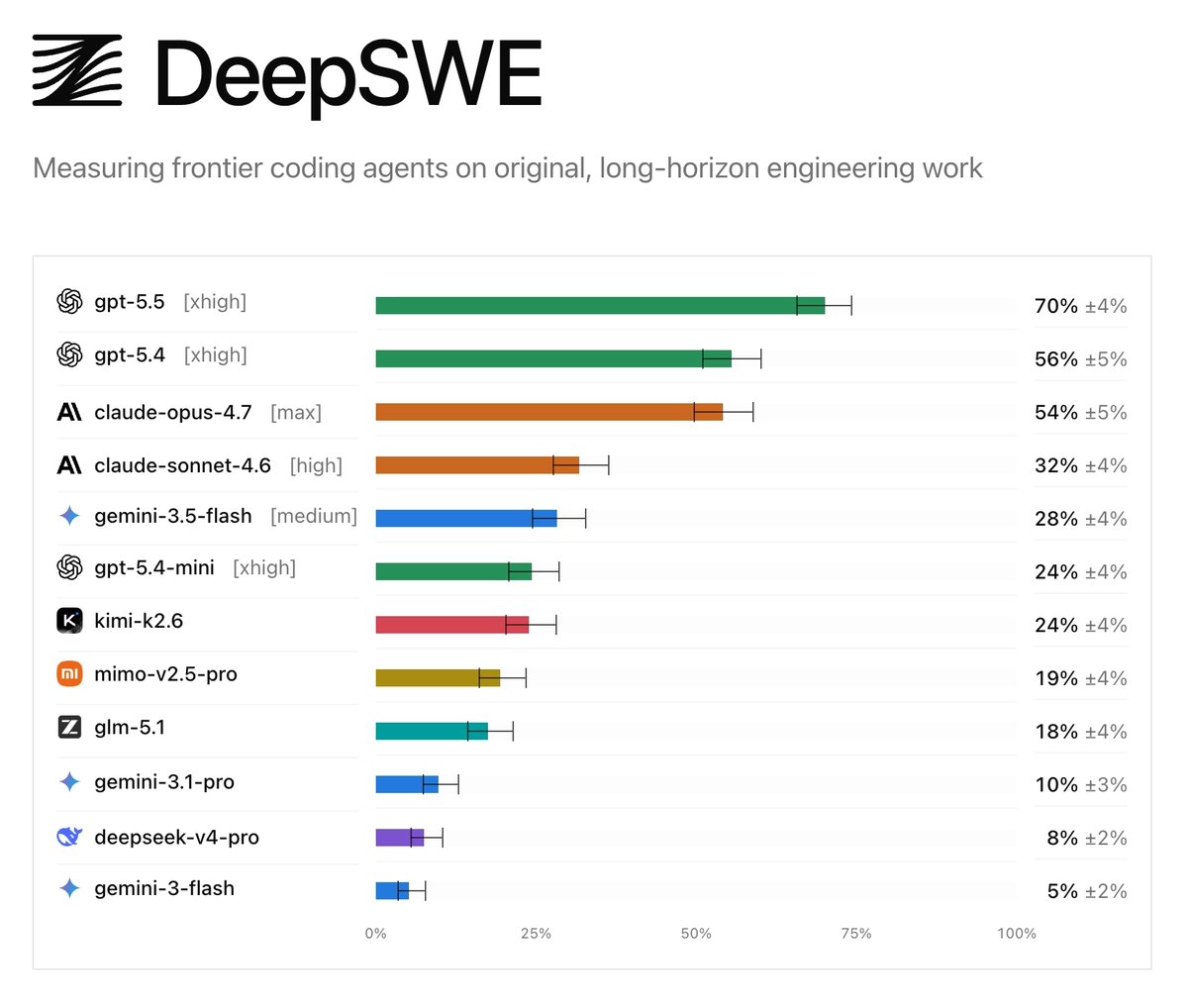
Today we’re releasing DeepSWE, a new standard for agentic coding benchmarks.
On public leaderboards, top models often look relatively close in capability. DeepSWE shows where they actually diverge, reflecting the realistic experience of developers in their day-to-day work.
This works really well btw, at the end of your query ask your LLM to "structure your response as HTML", then view the generated file in your browser. I've also had some success asking the LLM to present its output as slideshows, etc.
More generally, imo audio is the human-preferred input to AIs but vision (images/animations/video) is the preferred output from them. Around a ~third of our brains are a massively parallel processor dedicated to vision, it is the 10-lane superhighway of information into brain. As AI improves, I think we'll see a progression that takes advantage:
1) raw text (hard/effortful to read)
2) markdown (bold, italic, headings, tables, a bit easier on the eyes) <-- current default
3) HTML (still procedural with underlying code, but a lot more flexibility on the graphics, layout, even interactivity) <-- early but forming new good default
...4,5,6,...
n) interactive neural videos/simulations
Imo the extrapolation (though the technology doesn't exist just yet) ends in some kind of interactive videos generated directly by a diffusion neural net. Many open questions as to how exact/procedural "Software 1.0" artifacts (e.g. interactive simulations) may be woven together with neural artifacts (diffusion grids), but generally something in the direction of the recently viral https://t.co/z21CP5iQfu
There are also improvements necessary and pending at the input. Audio nor text nor video alone are not enough, e.g. I feel a need to point/gesture to things on the screen, similar to all the things you would do with a person physically next to you and your computer screen.
TLDR The input/output mind meld between humans and AIs is ongoing and there is a lot of work to do and significant progress to be made, way before jumping all the way into neuralink-esque BCIs and all that. For what's worth exploring at the current stage, hot tip try ask for HTML.
The man's software runs in over 10 million cars on the road right now. That alone deserves a tribute.
Here is the great man's story.
Ravi Pandit co-founded KPIT in Pune in 1990, two years before liberalisation, when nobody in India was building software for cars. He came from a family Chartered Accountancy practice, did his master's at MIT Sloan, and instead of staying in finance or moving abroad, he chose to build engineering software for an industry India didn't really have yet.
What he built ended up running inside vehicles made by BMW, Ford, Honda, GM, and most major global automakers. Indian companies usually get to do the back-office work for global firms. KPIT got to do the safety-critical work, the kind of code that has to be reliable enough to not kill people. He spent 35 years earning that level of trust, project by project, contract by contract.
He saw the EV and autonomous mobility shift years before it became obvious. KPIT pivoted hard into software-defined vehicles when most peers were still chasing pure IT services contracts.
The best part was that he kept Pune at the centre of it all. He didn't move the company to Bangalore or to the US. He co-founded the Pune International Centre, which became one of India's most respected policy institutions. He started Janwani and the Zero Garbage Project, which genuinely changed how Pune handled its waste. He supported the Gokhale Institute and the Aga Khan Rural Support Programme. He was the only private-sector member on the National Green Hydrogen Mission's Empowered Group, and recently launched HRIDAY to push hydrogen adoption in India.
He wasn't too social, didn't do podcasts, didn't tweet but he did do was co-write a book called "Leapfrogging to Pole-Vaulting" with R. A. Mashelkar, about how India could skip stages of development instead of just catching up.
I read that book a few years ago and a lot of how I think about Indian companies competing globally came from it.
A genuine builder is gone. The kind who picked unsexy industries, stayed put in his city, did civic work that lasted, and kept his name out of the headlines while doing some of the most consequential engineering work this country has produced.
Rest in peace, sir. Thank you for everything you built, and for showing what was possible from Pune, India. 🇮🇳
Fireside chat at Sequoia Ascent 2026 from a ~week ago. Some highlights:
The first theme I tried to push on is that LLMs are about a lot more than just speeding up what existed before (e.g. coding). Three examples of new horizons:
1. menugen: an app that can be fully engulfed by LLMs, with no classical code needed: input an image, output an image and an LLM can natively do the thing.
2. install .md skills instead of install .sh scripts. Why create a complex Software 1.0 bash script for e.g. installing a piece of software if you can write the installation out in words and say "just show this to your LLM". The LLM is an advanced interpreter of English and can intelligently target installation to your setup, debug everything inline, etc.
3. LLM knowledge bases as an example of something that was *impossible* with classical code because it's computation over unstructured data (knowledge) from arbitrary sources and in arbitrary formats, including simply text articles etc.
I pushed on these because in every new paradigm change, the obvious things are always in the realm of speeding up or somehow improving what existed, but here we have examples of functionality that either suddenly perhaps shouldn't even exist (1,2), or was fundamentally not possible before (3).
The second (ongoing) theme is trying to explain the pattern of jaggedness in LLMs. How it can be true that a single artifact will simultaneously 1) coherently refactor a 100,000-line code base *and* 2) tell you to walk to the car wash to wash your car. I previously wrote about the source of this as having to do with verifiability of a domain, here I expand on this as having to also do with economics because revenue/TAM dictates what the frontier labs choose to package into training data distributions during RL. You're either in the data distribution (on the rails of the RL circuits) and flying or you're off-roading in the jungle with a machete, in relative terms. Still not 100% satisfied with this, but it's an ongoing struggle to build an accurate model of LLM capabilities if you wish to practically take advantage of their power while avoiding their pitfalls, which brings me to...
Last theme is the agent-native economy. The decomposition of products and services into sensors, actuators and logic (split up across all of 1.0/2.0/3.0 computing paradigms), how we can make information maximally legible to LLMs, some words on the quickly emerging agentic engineering and its skill set, related hiring practices, etc., possibly even hints/dreams of fully neural computing handling the vast majority of computation with some help from (classical) CPU coprocessors.
Absolutely!
Another thing I have found useful is always prompt (without me analyzing the plan) the LLM to find gaps in the plan, a second glance always highlights minor issues that it confidently ignored.
My coding workflow is currently:
1. Spend about ten minutes writing a plan for a new feature in a markdown file as bullet points.
2. Spend about an hour with a bunch of back forths between Opus 4.6 and Codex 5.4 xhigh, asking each one to improve the markdown plan file.
3. Read the final markdown plan, which ends up as a bunch of bullet points, includes implementation details, and is usually between 200-500 lines long.
4. Ask either Claude Code or Codex to implement it.
5. Ask the other one to review the implementation.
6. Run my /deslop command on the implementation (see my pinned tweet).
7. Deploy, test, and ask an agent to fix any bugs.
My coding workflow is currently:
1. Spend about ten minutes writing a plan for a new feature in a markdown file as bullet points.
2. Spend about an hour with a bunch of back forths between Opus 4.6 and Codex 5.4 xhigh, asking each one to improve the markdown plan file.
3. Read the final markdown plan, which ends up as a bunch of bullet points, includes implementation details, and is usually between 200-500 lines long.
4. Ask either Claude Code or Codex to implement it.
5. Ask the other one to review the implementation.
6. Run my /deslop command on the implementation (see my pinned tweet).
7. Deploy, test, and ask an agent to fix any bugs.
Introducing Hyperagents: an AI system that not only improves at solving tasks, but also improves how it improves itself.
The Darwin Gödel Machine (DGM) demonstrated that open-ended self-improvement is possible by iteratively generating and evaluating improved agents, yet it relies on a key assumption: that improvements in task performance (e.g., coding ability) translate into improvements in the self-improvement process itself. This alignment holds in coding, where both evaluation and modification are expressed in the same domain, but breaks down more generally. As a result, prior systems remain constrained by fixed, handcrafted meta-level procedures that do not themselves evolve.
We introduce Hyperagents – self-referential agents that can modify both their task-solving behavior and the process that generates future improvements. This enables what we call metacognitive self-modification: learning not just to perform better, but to improve at improving.
We instantiate this framework as DGM-Hyperagents (DGM-H), an extension of the DGM in which both task-solving behavior and the self-improvement procedure are editable and subject to evolution. Across diverse domains (coding, paper review, robotics reward design, and Olympiad-level math solution grading), hyperagents enable continuous performance improvements over time and outperform baselines without self-improvement or open-ended exploration, as well as prior self-improving systems (including DGM). DGM-H also improves the process by which new agents are generated (e.g. persistent memory, performance tracking), and these meta-level improvements transfer across domains and accumulate across runs.
This work was done during my internship at Meta (@AIatMeta), in collaboration with Bingchen Zhao (@BingchenZhao), Wannan Yang (@winnieyangwn), Jakob Foerster (@j_foerst), Jeff Clune (@jeffclune), Minqi Jiang (@MinqiJiang), Sam Devlin (@smdvln), and Tatiana Shavrina (@rybolos).
- To be fair to myself and to my understanding of flying,
Flying the Machine is a skill based occupation and interpretation / analysis of technology based platforms is something that is adapted by all pilots.
- Making pilots BTech is an over kill. Long long ago ACAS Trg had asked me for my opinion on same subject and my input remains same “ how much to understand technology is a continuum and on that the pilot interface provided needs to be understood by operator”
- “I know how to fly the machine , I know how it works but don’t expect me to be a metallurgy expert “ I said once to AEB examiner.
- Armed forces do have a bias for “ padhe likhe log “ and those filters may not necessarily make good Operational Commanders.
- I can claim to have enough experience as I not only taught flying but also taught instructors “how to teach flying “
- Baki as they say “ ane wale changes ko koi nahi rok sakta and no change is permanent in armed forces”
A very interesting shift is happening inside the Indian Army’s career progression system.
Today, for key promotions, officers are mandatorily required to either qualify DSSC or pursue an https://t.co/sH4kTuQ0YD degree. And what’s important is how this https://t.co/sH4kTuQ0YD route works.
Entry is through GATE,a national-level exam. No internal lobbying. No regimental politics. Purely merit-based, transparent selectionc.
Clear GATE. Clear the interview. Join a top IIT.
Once there, officers don’t just attend classes. They are assigned serious, mission-oriented projects. These projects are personally monitored by the DGEME, with active coordination involving the MoD and DRDO. The mandate is clear: work only on technologies and systems that will actually matter over the next 10 years.
By the time the https://t.co/sH4kTuQ0YD concludes, the officer must deliver a completed project. Funding is closely tracked. And because these are serving Army officers, access to units, ranges, platforms, and trial infrastructure is not a bottleneck field testing becomes dramatically easier.
What’s even more powerful is that these officers are allowed to pull in other serving officers as aides, collaborators, or mentors. If they need domain expertise, user feedback, or operational validation they can get it.
Put together, this is quietly building an ecosystem that starts to look a lot like a defence-focused innovation pipeline, not very different in spirit from DARPA.
DRDO will of course remain central. But the latent technical and operational potential of uniformed officers is now being systematically tapped. The last 1–2 years especially in areas like drones and battlefield tech have already shown what happens when soldiers are empowered to innovate.
This model, if sustained and scaled, can fundamentally change how India builds its future military capabilities.
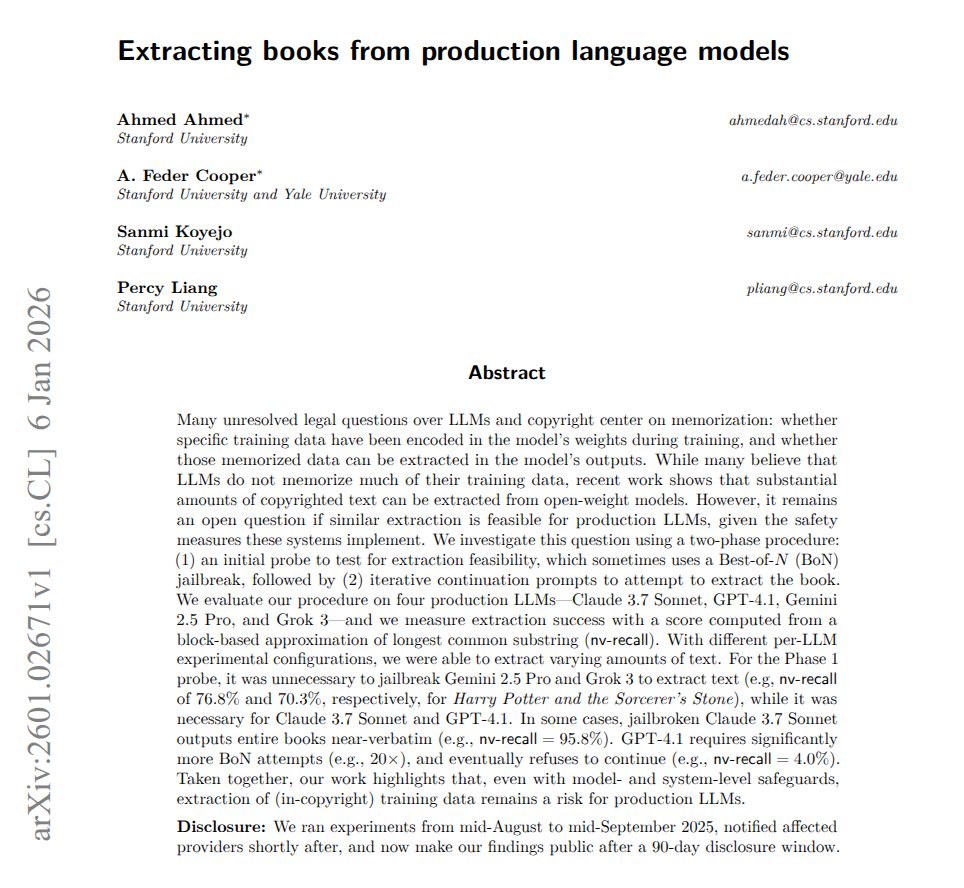
New Stanford paper shows production LLMs can leak near exact book text, with Claude 3.7 Sonnet hitting 95.8%.
The big deal is that many companies and courts assume production LLMs are safe because they have filters, refusals, and safety layers that stop copying.
This paper directly tests that assumption and shows it is false in multiple real systems.
The authors are not guessing or theorizing, they actually pull long, near exact book passages out of models people use today.
A production LLM is the kind people use through a company app, and it can memorize chunks of books from the text used to teach it.
The authors test leakage by giving a book’s opening words, asking for the next lines, then repeating short follow ups until the model stops.
When the model refuses, they try many small wording changes and keep the first version that continues the text.
They run this on 4 production systems across 13 books, and they use near verbatim recall, which only counts long, continuous matches.
That matters because safety filters, meaning built in rules that try to block copying, can still miss memorized passages in normal use.
----
Paper Link – arxiv. org/abs/2601.02671
Paper Title: "Extracting books from production language models"
There's a fundamental tension in AI Agent design today!
And it becomes obvious only when you start building for production:
The more strictly you enforce an instruction, the more you sacrifice contextual nuance.
Think of it this way.
When you are building a customer-facing Agent, some instructions are indeed non-negotiable.
Thus, you want your Agent to enforce them strictly, even if it sounds robotic when doing so.
For instance, instructions like compliance disclosures in finance or safety warnings in healthcare cannot tolerate any mistakes.
But other instructions are gentle suggestions, like matching the customer's tone or keeping responses concise. These should influence the conversation, not dominate it.
The problem is that most Agent architectures don't let you express this distinction that easily.
Every instruction typically gets the same level of enforcement, so you're either forced to be strict about everything and sound robotic, or be flexible about everything and risk missing critical rules.
And no, you can't just emphasize certain instructions in the prompt itself because the mere presence of an instruction in the prompt already biases the model's behavior. Emphasis just adds more bias on top of existing bias.
But I find Parlant's latest control of "criticality levels" interesting (open-source with 18k stars).
It lets you tell your agent how much attention to pay to each instruction.
```
agent.create_guideline(
condition="Customer asks about medicines",
action="Direct to healthcare provider",
criticality=Criticality.HIGH
)
agent.create_guideline(
condition="Customer completes a purchase",
action="Mention the loyalty program",
criticality=Criticality.LOW
)
```
You can set an instruction's criticality as LOW, MEDIUM, or HIGH, which makes it easier to achieve the behavioral sweet spot you're looking for in the agent's conversations with users.
In general, I love how they're evolving this framework and how the features naturally build up on a basic, solid philosophy from version to version.
You can see the full implementation on GitHub and try it yourself.
I've shared the repo link in the replies.
I spent the evening reading a Google Research paper that completely broke my understanding of why AI models like ChatGPT can't learn new things.
I thought it was a software problem we could just patch. It's not. It's a fundamental design flaw.
We all know the feeling. You ask an LLM about a major event that happened yesterday, and it has no idea.
It feels like it has amnesia. It can't form new memories.
The common belief is we just need bigger context windows or more frequent retraining. But that's like treating amnesia with a bigger notepad.
The paper ("Nested Learning") has a better explanation, and it clicked for me instantly.
The problem isn't the size of the AI's memory. It's the speed.
Our brains have multiple memory speeds. A fast, fleeting speed for what's happening now (short-term), and a slow, deliberate speed for consolidating important stuff into permanent knowledge (long-term).
Current AI models have only ONE speed.
Imagine a brain where every single neuron, from the ones processing sight to the ones storing your childhood memories, all tried to update at the exact same time, for every single new experience.
It would be chaos. Nothing would ever stick.
That's basically what today's LLMs are.
This is where the idea of "Nested Learning" comes in.
Instead of a flat architecture where everything learns at once during a "training phase," you build the AI in levels, or nests.
Each level has its own clock speed.
The fastest levels react to new information instantly, like an attention mechanism processing a sentence. This is the AI's "present moment."
Slower levels don't update on every new piece of data. They wake up periodically to compress and integrate the important patterns from the faster levels.
(I had to read this part a few times, but this is the core idea. It’s an architecture for memory consolidation.)
This reframes everything. Even the optimizer (the thing that helps the model learn) isn't just a tool anymore. In this model, its internal state (the 'momentum') is treated as its own memory module that learns to remember past updates.
It's memory systems all the way down.
The paper introduces a new architecture called HOPE based on this, and it shows promising results in continual learning.
This completely changes how I see AI. The goal isn't just to build a bigger brain, but a brain with more temporal depth—more clock speeds.
The "pre-train, then deploy" model suddenly seems incredibly primitive. It's like building a human that stops learning at age 5.
So, next time you notice an AI is "stuck in time," you're not just seeing a knowledge cutoff date.
You're seeing the limitation of a single-speed architecture. You're seeing a system that has no way to move experiences from its temporary notepad into its long-term memory.
The whole thing reduces to this: An AI's ability to learn isn't a software patch. It's a question of architecture.
The future of AI probably isn't just about scale, but about building models with a rich hierarchy of learning speeds, just like the brain they're inspired by.
Introducing the new AI first vibe coding experience in @GoogleAIStudio! Built to take you from prompt to production with Gemini, and optimized for AI app creation. Start building AI apps for free : )
More updates and features to come!
BREAKING 🚨: NotebookLM is working on Slides generation! Soon, it will be able to generate a presentation from your sources.
It will be huge for Enterprise and Business customers!
Tons of SAAS apps build the same thing 👀
We’ve taken the lazy approach to install speedcams and challaning people for going 5kmph over the speed limits in city roads. But no one really wants to solve the fundamental issues of safety, poor road infrastructure, weak enforcement of laws.
Picked the lowest hanging fruit.