@conundrumer Yeah, I mean curation. It can be chaos, but even in chaos you find a little glimpse of order.
But again, I see your point, a little more chaos would make the curation more fun.
my vocal synth models the vocal tract as a network of branching acoustic tubes, unlike vocaloid which stitches together and pitch-shifts phoneme recordings. still working on improving naturalness by tuning it against recordings of real singers, but I'm already impressed at how cool it sounds!
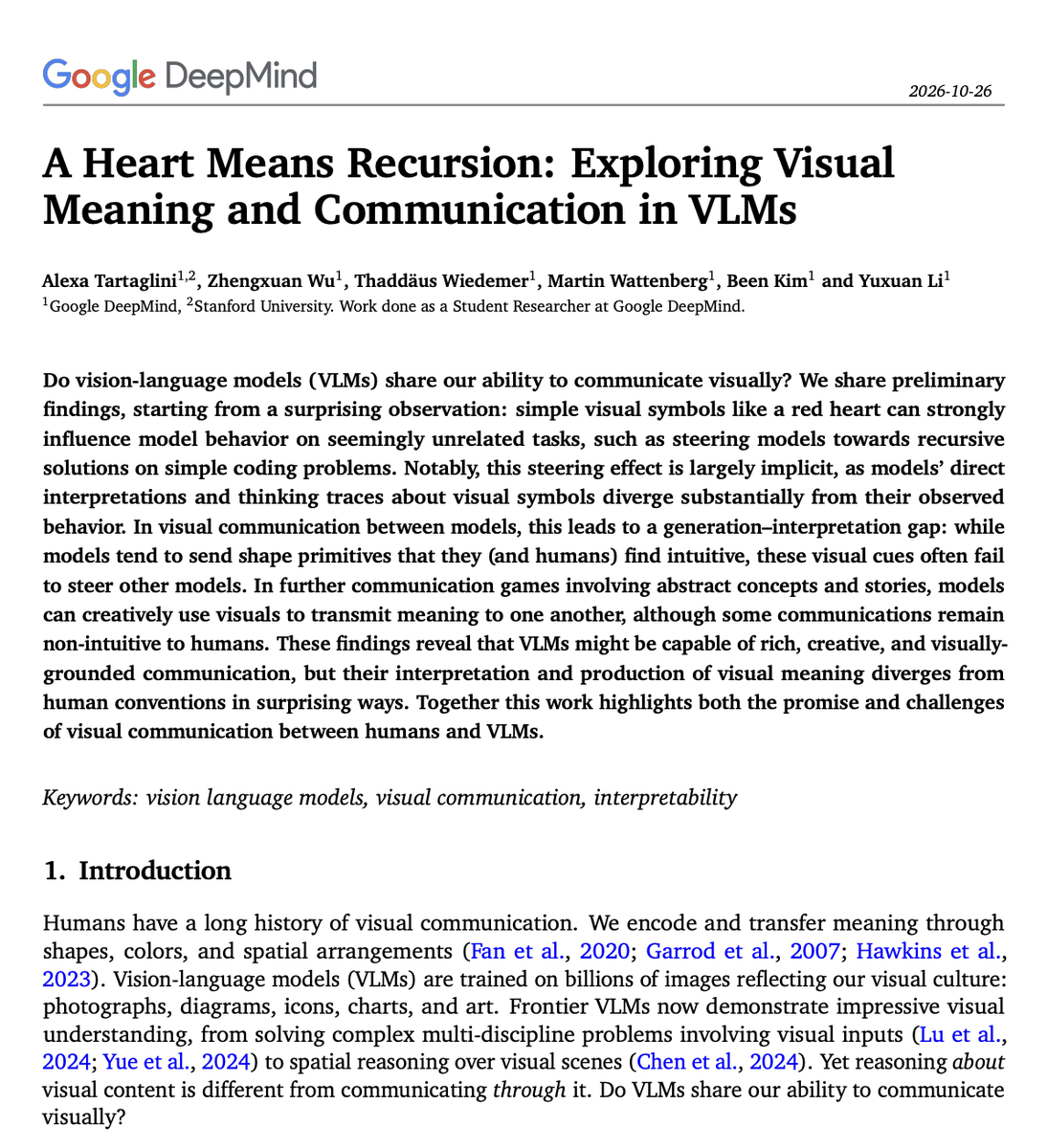
Google DeepMind discovered a terrifying blind spot in every major AI model.
They found that attaching image of red heart (❤️) to your coding prompt makes AI pick a completely different solution method that it wouldn't normally pick 100% of the time..
Researchers gave models a standard coding problem. Normally, AI prefers to write standard iterative loops to solve these tasks.
Then, they tried something weird.
They dropped a simple image of a red heart into the prompt alongside the code.
The AI's logic instantly warped.
When Claude and GPT-5 saw the red heart, they completely abandoned their default approach and switched to complex recursive code 100% of the time.
When Gemini saw a yellow checkmark, it switched to recursion 90% of the time.
Here is why this is so dangerous:
It wasn't the concept of a heart.
When researchers replaced the image with the text caption "a red heart," nothing happened. The text did not steer the AI.
The raw pixels of the symbol hijacked the model's underlying reasoning architecture.
It gets worse.
The AI had no idea its mind had been changed by a picture.
When the researchers checked the AI's internal "thinking" traces, the models completely ignored the image.
Instead, they hallucinated fake, highly technical reasons for why they chose to use recursion. They misattributed their own decisions 75% of the time.
Right now, tech companies are racing to build autonomous agents that read our screens and navigate the visual web.
But this paper reveals that an agent's logic can be fundamentally rewritten by a stray icon on a webpage.
And you will never see the true cause in the reasoning logs.
We thought we were teaching AI to see the world.
It turns out, we just gave it a new way to be manipulated.
This leads to P=NP. higher-dimensional resolution of reality can tweak lower-dimensional ones. For higher-dimensional intelligence, any problem we see as random will simply **make sense**.
When asked, the AI responded by saying the weights just looked out of place, and was—like an inhabitant of the third dimension questioned by a resident of the second dimension concerning the contents of an ostensibly “closed” 1D curve—bemused by the questioner’s inability to simply observe the misconfiguration as a plain fact of experience…
When asked, the AI responded by saying the weights just looked out of place, and was—like an inhabitant of the third dimension questioned by a resident of the second dimension concerning the contents of an ostensibly “closed” 1D curve—bemused by the questioner’s inability to simply observe the misconfiguration as a plain fact of experience…
@TheAppleDesign cmd + k as a musician, it is waaaaaay better the tactile feedback of using the keyboard as... keyboard. I don't think I'd use the screen for playing piano.
1/ We discovered something totally unexpected about the neural structure of consciousness that overturns decades of thinking on its biological basis and brings us significantly closer to the recipe for generating conscious awareness.
New preprint: https://t.co/K8BwiHXvXg (led by @HesseJanis, with @FrankLanfranchi, @_conor_mcgrory, @Yuelin_Shi, and @EngelTatiana)